



High-Speed Separators Market Size, Companies, Share, Pricing Analysis, Competitive Positioning, and Demand Forecast
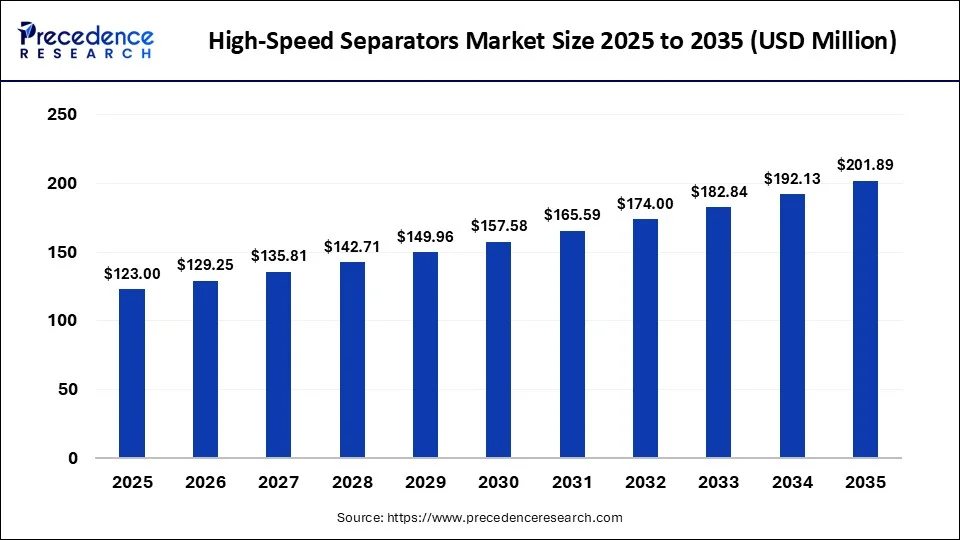
Vidyesh Swar, a Chemical and Materials Industry Expert, estimates the high-speed separators market at USD 129.25 million in 2026, with the market projected to reach USD 201.89 million by 2035 at a CAGR of 5.08%. Major high-speed separators market companies such as Alfa Laval, Andritz, Ferrum Ag are competing across key material and application segments, including product type, speed range, separation technology, application, capacity, operation mode, end user, distribution channel, region.
Source: https://www.precedenceresearch.com/high-speed-separators-market
 Get a Sample
 Table Of Content


High-Speed Separators Market Size and Forecast 2026 to 2035
The global high-speed separators market size is predicted to increase from USD 129.25 million in 2026 to approximately USD 201.89 million by 2035, expanding at a CAGR of 5.08% from 2026 to 2035.
Key Takeaways
- By product type, centrifugal separators segment dominated the market with a share of 44% in 2025.
- By product type, high-speed sorting separators segment held a 5% share of the market in 2025 and is expected to grow at the fastest CAGR of 6.4% between 2026 and 2035.
- By speed range, 5,000-15,000 RPM segment dominated the market with a share of 46% in 2025.
- By speed range, Above 15,000 RPM segment held a 31% share of the market in 2025 and is expected to grow at the fastest CAGR of 6.2% between 2026 and 2035.
Market Size Description
The separators market is increasing rapidly around the globe. Industries align their focus toward achieving precision separation as opposed to a filtering process. Demand is increasing in all of the food processors, pharmaceuticals, chemicals, mining, recycling, and wastewater treatment industries. The areas with higher manufacturing and processing infrastructure are the fastest growing areas of installed unit bases. There's been a trend toward pricing towards energy efficient digitally monitored separator units. Rather than only mechanical units.
Analysts are predicting a greater level of integration in separator operations with automation and predictive maintenance. In response to higher safety and yield requirements from the food and beverage industry. Hygienic and fast separators with high throughput are being used. Biopharma applications such as precipitated proteins and microbial product isolation use high-speed centrifugal separation. Manufacturers seek to reduce costs and speed up time to market.
Alfa Laval products have a long-standing history in the green production of alternative proteins. Sector that requires high-performance separators. Alfa Laval's PureFerm 750/750 N separators are designed for cell-separation applications, with a maximum capacity of 25,000 l/h. This has been designed specifically for the high-density cell fermentation process within the industry. The launch highlights the industry trend towards machines designed for difficult, next-generation fluid streams, overcoming generic requirements.
This momentum flows directly to mining and recycling and wastewater operators. They are always looking for improved separation efficiency in more challenging environments. In July 2026, GEA reported that it had delivered and commissioned two petroMaster CF 5000 decanters for a refinery project in South America, using ATEX-compliant nitrogen blanketing and the Varipond C system. These deployments illustrate the practical way in which requirements for automation and efficiency are met. They are transforming the designs of separators from a mechanical component into a digital intelligence piece. Design that manufacturers must now envision as both operating independently and also working together.
Market Snapshot
In 2026, the market for high-speed separators is estimated to grow into a USD 129.25 million industry globally. According to analysts' forecasts, the CAGR of the market ranges from 2026 to 2035 at 5.08%. Volume growth is on the up with continued installations in process industries. Raw material prices continue to affect average prices in manufacturing. Also, precision engineering specifications have an effect. Average selling prices reflect a higher level of hygiene design. Controls that are simple to automate and energy efficiency features.
Disc-stack separators remain the largest share in this family of products. Due to its ability to be applied in both liquid-liquid and liquid-solid separation. Spyder connected, sensor rich separator systems will be the fastest growing technology area coming into 2026. Most applications are still within the food and beverage processing sector. There is a demand for hygiene and throughput requirements. Asia Pacific is the fastest-growing region as a result of growing production capability in manufacturing and industrial production. Product-pushing in such a way as you see here is a reflection of the direction in which the fastest-growing segments in the region are going.
Strategic Market Insights
Adoption of automation is changing the way manufacturers are designing and deploying separators. Operators are becoming more demanding of the system to adapt to varying feed conditions without intervention. The application relies on self-adjusting for exceptional feed variations. For exceptional feed variations, the application is based on self adjusting, which operators are becoming increasingly demanding. Demanding purity and yield requirements in the industries. Separation with high precision has become indispensable. ANDRITZ directly tackled this issue by developing the ecoOne pusher centrifuge. This is based on the proven Krauss-Maffei technology and equipped with a single motor to serve various functions. This typical scenario of consolidated engineering is a statement of where the efficiency improvements are being made in 2026.
Bio-pharma manufacturers continue to use high-speed centrifugal separation for sensitive and delicate operations. Pharmaceutical applications are still growing. Investment is also growing in the case of recycling. Manufacturers are devising ways to transform their centrifuges for plastics recovery and circular material streams. There has been growing pressure on permitting and ESG reporting, and mining and mineral processing companies are investing in it. Technology-driven opportunity is for separating equipment to become a true sustainability lever rather than simply a processing step, and that's where it's at.
Market Overview
Understanding High-Speed Separators and Their Industrial Importance
High speed separators are mechanical separators that separate mixtures into separate components by centrifugal force. The machines spin at high speeds. Sometimes hundreds or thousands of RPMS, to separate the solids from the liquids. They also perform liquid-liquid separation processes where foreign particles, contaminants, and materials are removed. This separation process is considered a crucial part in industries.
Centrifugal force from a spinning bowl separates heavier particles from lighter phases, bringing them toward the center. This is the core of the newly developed applications such as in the food industry, pharmaceuticals, marine fuel processing, and industrial wastewater treatment. It is a reflection of the development of separation technology over time.
Evolution of High-Speed Separation Technologies
Before modern technology, gravity settling, simple filtration, and manual removal of solids were widely used separation techniques. Centrifugal separators brought the ability to perform continuous high-speed processing with improved precision. Subsequent developments of magnetic separation technology added to the users' toolbox. Further enabling the removal of magnetic material from process streams with the utmost efficiency. The sensor-based detection, by means of optical sorting, was then activated. This allows for the materials to be sorted according to their colour, form, and composition. The latest frontier in this evolution is AI-powered systems in the coming years.
Market Scope and Coverage
Centrifugal separators, Disc-stack separators, Decanters, and Hybrid magnetic-optical sorting systems are a part of the market assessed. It covers mechanical centrifugation and sensor- and AI-driven separation platforms. Food & beverage processing, pharmaceutical production/synthesis, chemical processing, industrial mining, recycling machines, and wastewater treatment. From big industrial processors to niche biopharma and marine fuel companies. End user industries come in all shapes and forms. Sales via distribution channels include direct sales, authorised regional sales and long-term service and maintenance contracts. The geographies focused in this market include North America, Europe and Asia-Pacific, reflecting how established players have become integral to setting the technology bar for this market.
Market Trends
- Increasing Adoption of Automated Separation Systems: Manufacturers are making a move toward separators. That allow minimal manual operation and require steady output uniformity. This growing trend toward self regulating, labour-reduction-style equipment is now gaining across the whole spectrum of process manufacturing, well off the seas and into industry.
- Growing Demand for High-Precision Separation in Pharmaceutical Manufacturing: Biotechnology producers require separators that are gentle and contamination-free. That does not damage the cells to be harvested. Sartorius tackles this with its single-use automated centrifugation platform designed for next generation cell-therapy production. In March 2026, Sartorius also introduced the company's Eveo Cell Therapy Platform, accepting orders from September 2026. This enhances the manufacturing efficiency of advanced therapies.
- Integration of AI and Smart Sorting Technologies: The use of AI-powered sensors in separating, classifying, and routing materials in real time is changing bio science. During IFAT 2026, TOMRA announced its software platform called Local Control. That enables operators to control all sorting machines from one application across the plant network. This type of predictive monitoring is moving the separation equipment's laborious, reactive maintenance to a new level of intelligence and self-optimization.
- Rising Importance of Sustainable Material Recovery: The pressure of the circular economy is pushing recyclers towards an increase in precision separation equipment. This illustrates the percentage change in separation. Through mechanical and sensor technologies across plastics, metal, and paper recovery in 2025 and 2026.
- Expansion of Compact and Energy-Efficient Separator Designs: Manufacturers are being driven to smaller and lower energy separators. Due to the escalating price of energy. Alfa Laval's eMotion technology uses up to 75% less energy than conventional separators when installed in the separator bowl. Compact, low drag is a key engineering attribute that is increasingly defining an emerging class of new separator platforms that will be part of the future to 2035.
Market Segmentation Analysis
Product Type Insights
Why Did Centrifugal Separators Secure the Largest Share in the Global High-Speed Separators Market?
The centrifugal separators segment dominated the market with a share of 44% in 2025, due to the ability to deliver high throughput with minimal product loss, manufacturers consistently selected centrifugal equipment for mission-critical operations.
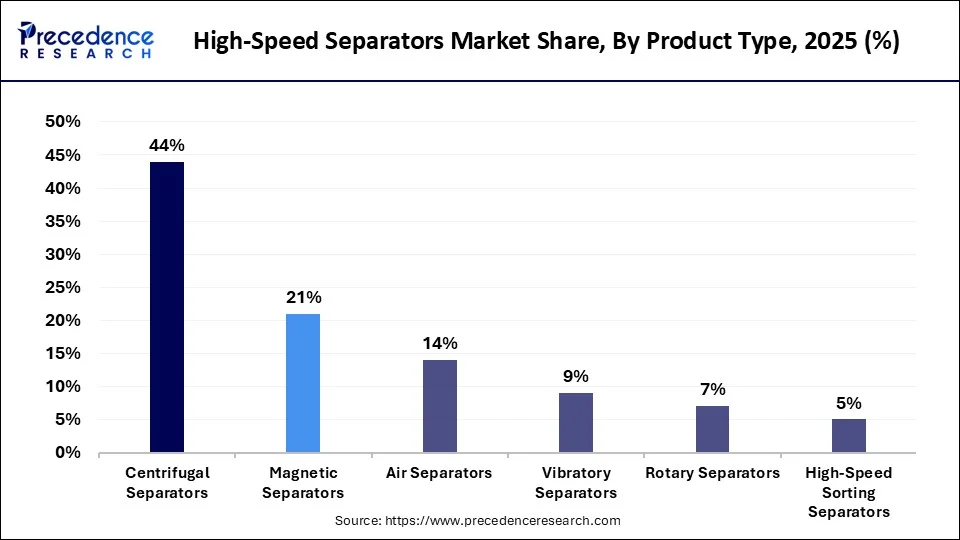
The high-speed sorting separators segment held a 5% share of the market in 2025 and is expected to grow at the fastest CAGR of 6.4% between 2026 and 2035, driven by growing demand for automated quality control across high-volume manufacturing environments, adoption is expected to accelerate steadily.
Speed Range Insights
How Did High-Speed Systems Emerge as the Leading Segment in the Global High-Speed Separators Market?
The 5,000-15,000 RPM segment dominated the market with a share of 46% in 2025, due to many processing applications require gentle handling of delicate materials and sensitive biological products.
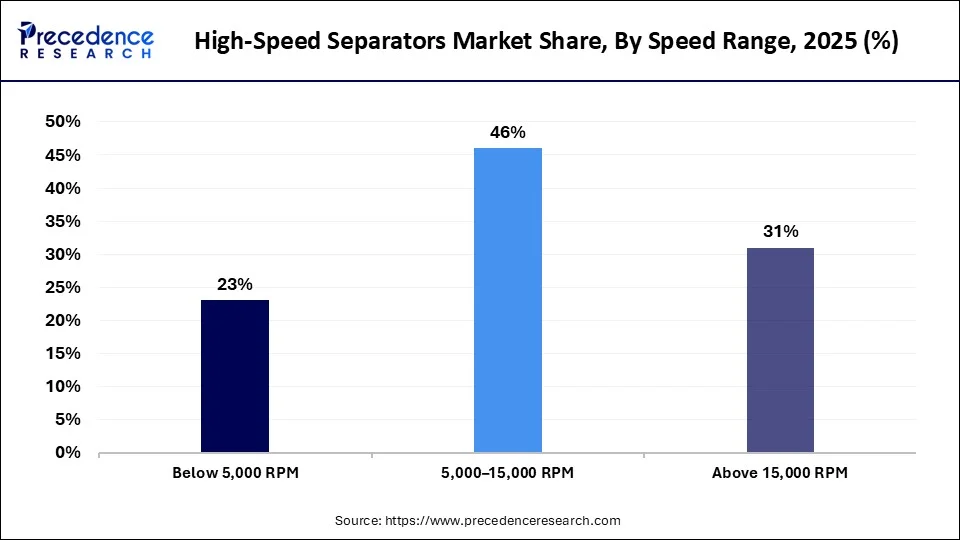
The Above 15,000 RPM segment held a 31% share of the market in 2025 and is expected to grow at the fastest CAGR of 6.2% between 2026 and 2035, driven by capability to deliver superior separation efficiency across demanding industrial applications, high-speed equipment secured the largest market share.
Separation Technology Insights
What Made Centrifugal Separation the Dominant Technology in the Global High-Speed Separators Market?
The centrifugal separation segment dominated the market with a share of 39% in 2025, due to proven operational reliability and superior separation efficiency under continuous workloads.
High-Speed Separators Market Share, By Separation Technology, 2025 (%)
| Separation Technology | Market Share (%) | CAGR (%) |
| Centrifugal Separation | 39.00% | 5.4% |
| Mechanical Separation | 18.00% | 4.5% |
| Magnetic Separation | 16.00% | 4.8% |
| Air Classification | 12.00% | 5.1% |
| Optical Separation | 8.00% | 6.8% |
| Density-Based Separation | 7.00% | 4.9% |
The optical separation segment held 8% of market share and is expected to grow at the highest CAGR of 6.8% between 2026 and 2035, owing to the rising adoption of smart manufacturing and digital inspection technologies.
Application Insights
Why Was Food & Beverage Processing the Largest Application Across the Global High-Speed Separators Market?
The food & beverage processing segment dominated the market with a share of 27% in 2025, driven by manufacturers requiring continuous separation to maintain product purity and production efficiency.
High-Speed Separators Market Share, By Application, 2025 (%)
| Application | Market Share (%) | CAGR (%) |
| Food & Beverage Processing | 27.00% | 5.2% |
| Pharmaceutical & Biotechnology | 18.00% | 6.5% |
| Chemical Processing | 16.00% | 4.9% |
| Mining & Minerals | 14.00% | 4.7% |
| Waste Recycling | 12.00% | 6.1% |
| Water & Wastewater Treatment | 8.00% | 4.8% |
| Energy & Fuel Processing | 5.00% | 4.6% |
The pharmaceutical & biotechnology segment held a 18% share of the market in 2025 and is expected to grow at a rapid CAGR of 6.5% between 2026 and 2035, due to manufacturers increasingly requiring highly precise purification during advanced drug production.
Capacity Insights
How Did Large-Capacity Systems Capture the Highest Share of the Global High-Speed Separators Market?
The 10-50 m³/hour segment dominated the market with a share of 48% in 2025, due to the ability to support large-scale manufacturing with high throughput and dependable performance.
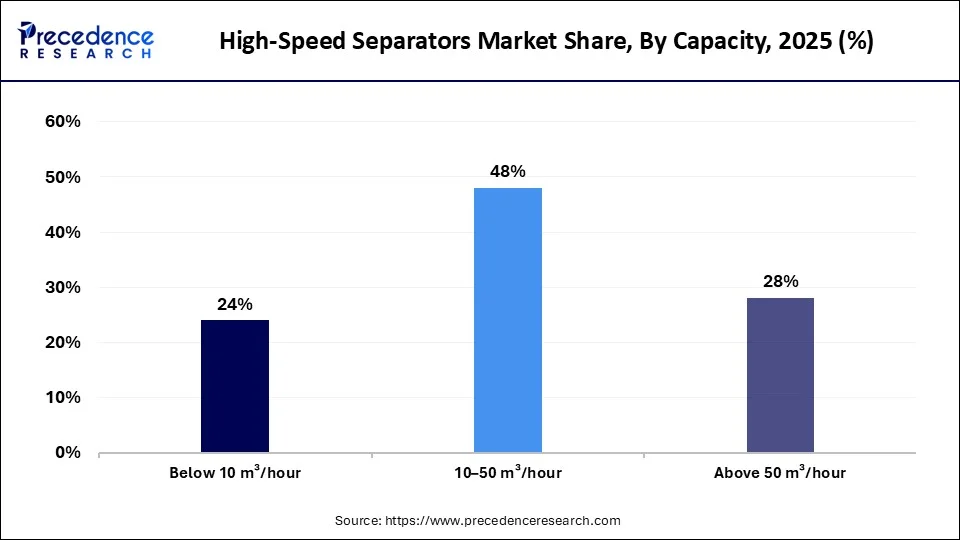
The above 50 m³/hour segment held 28% of market share in 2025 and is expected to grow at the fastest CAGR of 7.1% between 2026 and 2035, owing to the growing investment in laboratory-scale processing and niche industrial production.
Operation Mode Insights
Why Did Continuous Separators Remain the Preferred Choice in the Global High-Speed Separators Market?
The continuous separators segment dominated the market with a share of 62% in 2025, due to its ability to support high-output production with consistent separation performance.
High-Speed Separators Market Share, By Operation Mode, 2025 (%)
| Operation Mode | Market Share (%) | CAGR (%) |
| Continuous Separators | 62.00% | 5.3 |
| Batch Separators | 25.00% | 4.5 |
| Automated Separators | 13.00% | 7.1% |
The automated separators segment held 13% of market share in 2025 and is expected to grow at the fastest CAGR of 7.1% between 2026 and 2035, owing to the rising adoption of Industry 4.0 technologies and smart factory investments.
End User Insights
What Enabled Food Processing Companies to Lead the Global High-Speed Separators Market?
The food processing companies segment dominated the market with a share of 25% in 2025, due to the increasing emphasis on food safety, hygiene standards, and consistent product quality.
High-Speed Separators Market Share, By End User, 2025 (%)
| End User | Market Share (%) | CAGR (%) |
| Food Processing Companies | 25.00% | 5.2% |
| Pharmaceutical Manufacturers | 18.00% | 6.7% |
| Chemical Companies | 15.00% | 4.8% |
| Mining Companies | 13.00% | 4.6% |
| Recycling Companies | 12.00% | 6.2% |
| Water Treatment Facilities | 9.00% | 4.9% |
| Energy Companies | 5.00% | 4.7% |
| Research Laboratories | 3.00% | 5.8% |
The pharmaceutical manufacturers segment held 18% of market share in 2025 and is expected to grow at the fastest CAGR of 6.7% between 2026 and 2035, owing to the rising production of complex therapeutic products and expanding pharmaceutical research activities.
Distribution Channel Insights
How Did Direct Sales Become the Dominant Distribution Channel in the Global High-Speed Separators Market?
The direct sales segment dominated the market with a share of 55% in 2025, due to the requirement for customized system configurations and comprehensive after-sales assistance.
High-Speed Separators Market Share, By Distribution Channel, 2025 (%)
| Distribution Channel | Market Share (%) | CAGR (%) |
| Direct Sales | 55.00% | 4.9% |
| Equipment Distributors | 25.00% | 5% |
| System Integrators | 15.00% | 6.5% |
| Online Industrial Platforms | 5.00% | 6% |
The system integrators segment held 15% of market share in 2025 and is expected to grow at the fastest CAGR of 6.5% between 2026 and 2035, owing to the accelerating adoption of Industry 4.0 technologies and automated production infrastructure.
Market Dynamics
Market Drivers
Increasing Industrial Automation Across Processing Industries
Spending on automation is rapidly growing in food, pharmaceutical, and chemical plants around the globe. This indicates that plants continue to invest in automated, durable separation lines. In the future, the combination of durability and automation is the key driver in separator upgrades for 2026.
Growing Need for Efficient Material Recovery and Separation
The demand for separation accuracy for mining, scrap, and waste recovery is one that manual sorting can hardly fill. STEINERT's eddy current technology contributed to ReSource Waste's nonferrous metal recovery being multiplied by two. This produced a significant amount of copper pipe recovery, among other materials. These improvements illustrate the importance of continually raising the bar in terms of separation accuracy, as operators seek better-than-mechanical separation.
Expansion of Pharmaceutical and Biotechnology Manufacturing
High-speed separators are advancing into the realm of cell separation and purification for biopharmaceutical applications. Manufacturers rely on precipitated protein, microbial broth, and other biopharma-specific separators. In addition to centrifugation, continuous chromatography and filtering processes are growing in popularity in downstream processing trains on a single use basis.
Rising Food Safety and Quality Standards
The removal of contaminants, without compromising the quality of the food or beverage being processed. This is becoming a challenge to food and beverage processors. During pre-treatment stages, Bactofuge units remove bacterial spores from cheese milk, as part of Tetra Pak's separator range. They are also safe for hygiene-level high-tech food packaging applications. These innovations reflect the ongoing drive towards increasing precision separation equipment in food processing. As it seeks to meet the continually evolving requirements of clarification and contamination removal.
Market Restraints
High Initial Equipment Investment Costs
Up-front capital costs are high for advanced high-speed separators. Particularly the hygienic and automation-ready versions. All the precision stainless steel bowls, sensor integration, and digital controls have a high price tag before a unit starts up. Many smaller processors and mid-sized recyclers use mechanical systems that are past their prime and are not upgraded because it's too expensive.
Maintenance Complexity and Technical Expertise Requirements
Reliable, safe operation of high-speed separators demands trained technicians. Knowing bowl balancing, calibration, and rotating equipment risk. The increasing differential in experience makes the source of reliable separator service increasingly difficult. Especially with the departure of the senior technologists with a wealth of operational experience.
Energy Consumption Concerns in High-Speed Operations
High speed centrifugation is an inherently energy intensive process. Due to the rotational forces that are required for good separation. According to the International Energy Agency's (IEA) 2025 Energy Efficiency Policy Toolkit, 37% of global final energy consumption is currently used within the industry sector. Electric motor systems are a major contributor to this. The cost of electricity and efficiency standards set in the future are prompting operators to carefully consider efficiency. They are adopting a separator stage in relation to their long-term power consumption.
Market Opportunities
Growth of AI-Based Optical and Automated Separation Systems
Opportunities are arising in the recycling, food, and mineral processing industries. As a result of machine vision and AI-driven sorting. Reduction in dependency on manpower by manufacturers who invest in advanced platforms. Such factors attracting new funding to AI-powered optical separation in 2026.
Expansion of Recycling and Circular Economy Infrastructure
The new demands for advanced sorting and separation technology are driving the circular economy. In July 2026, STEINERT's MSort sorting technology started to process green and brown recycled glass in Edinburgh (Scotland) into water treatment filter media AFM. Such cross-industry material recovery, where waste glass is used for a new purpose as a filtration product. Demonstrates the current role of separation technology beyond plastics and metals in today's circular economy. This wide range of applications that continues to grow the opportunity for separator and sorting equipment suppliers.
Increasing Adoption in Emerging Industrial Markets
Separator manufacturers are looking at Latin America and Middle East industrial sectors as promising growth opportunities. The regional trade events illustrate not only an active approach rather than a reactive one in courting new processing centers. But an aggressive one on the part of manufacturers. Local processing units in these areas are striving to supply dairy, beverage, and industrial products. Consequently are seeking state-of-the-art and automated separation units. It also offers the possibility for manufacturers to develop regional service and support facilities that complement their equipment offerings.
Development of Customized Separation Solutions
The specialized industries demand more use of technologies that are optimized for specific process conditions, rather than off-the-shelf solutions. Such application-specific engineering is part of a trend that emphasizes the movement away from one size fits all separation equipment. From biopharma processors to speciality chemical processors to alternative protein processors. Catering to the demands for customisation is fast becoming a distinguishing factor in the attainment of niche industrial contract work among separator manufacturers.
Market Challenges
Balancing Separation Efficiency and Operating Costs
Higher separation performance for increased precision engineering cost is a continuous battle for manufacturers. Various constant engineering juggling act needs to be maintained so as not to overprice equipment, as the market moves toward 2026.
Competition from Alternative Separation Technologies
The centrifugal separator is increasingly challenged by other modes of filtering processes such as membrane filtration, chromatography, and other non-mechanical processes. Processors looking to reduce the amount of energy required. Treating delicate biological materials with care and careless gentleness alike have an increasing positive inclination toward membrane systems. This competitive drive is compelling centrifuge manufacturers to continue to work hard on developing their speed, hygiene, and automation properties. These units are not seeing a loss of ground due to the competitiveness of alternatives which are based on filtration.
High-Speed Separators Market Ecosystem Analysis
Industry Value Chain Analysis
The high-speed separators ecosystem starts with the suppliers of raw materials, including stainless steel, alloys and precision-machined parts. They are used by component makers to form compounds. That are capable of tolerating high torque speeds in bowl, disc, and drive applications.
Separator manufacturers then install these components to make them into usable machines. They often as part of a package that comes with automation vendors that provide sensors and control software. Distributors and system integrators then deliver equipment to end users. Such as food, pharmaceutical and chemical and recycling plants where end users rely on equipment for day-to-day process integrity.
Key Stakeholders and Their Roles
Essential separator machines are designed and manufactured by equipment companies such as Alfa Laval, GEA, and Flottweg. These types of machines are sold to various industries. Further enhancing accuracy and uptime. Technology companies are adding artificial intelligence, sensors and predictive monitoring software to this technology.
The system integrators, in turn, integrate separators with pumps, valves and control systems. They are creating entire processing lines customised to each plant. Industrial buyers, from the dairy processor to the mining company, make their purchasing decisions based on throughput, hygiene and total cost of ownership. Service providers complete the circle and are there to provide installation assistance, spare parts and long-term maintenance contracts. This ensures separators operate at peak performance well into the future, including until 2026.
Supplier and Manufacturing Landscape
Specialty stainless steel and precision-cast metal parts are a major focus point when it comes to source materials for high speed separators. The regional scale capacity upturn is one example of decentralized manufacturing. That aspires to make plants closer to the big end-user markets. The issues of supply chain resilience, material sustainability, and manufacturing footprint. Further turning into equally significant considerations for buyers as a separator's core mechanical capabilities.
Regional Analysis
Why Did Asia Pacific Account for the Largest Share of the Global High-Speed Separators Market?
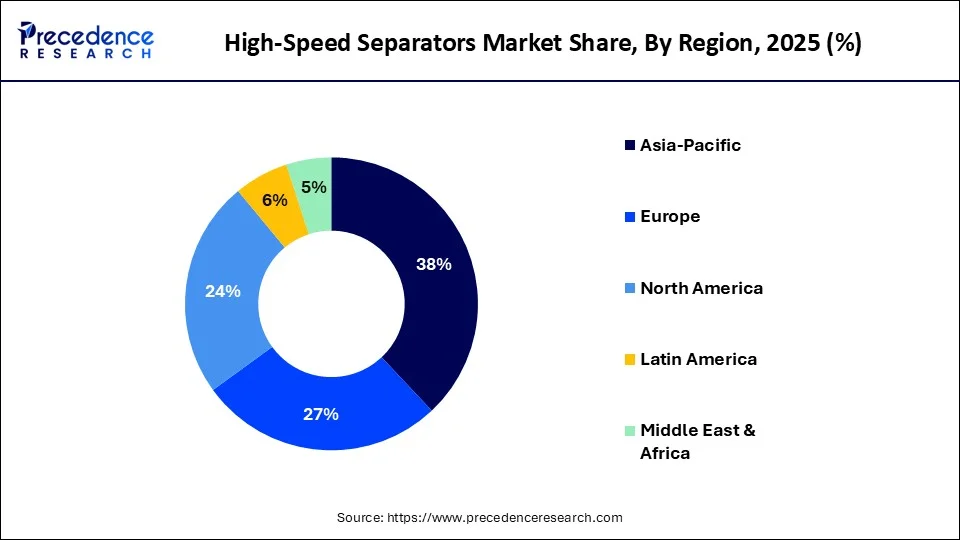
Asia Pacific led the market, capturing the largest revenue share in 2025, accounting for an estimated 38%, and is expected to grow at the fastest CAGR of 6.4% between 2026 and 2035, due to rapid industrialization, expanding manufacturing capacity, and rising automation investments.
Asia Pacific High-Speed Separators Market Size and Growth 2026 to 2035
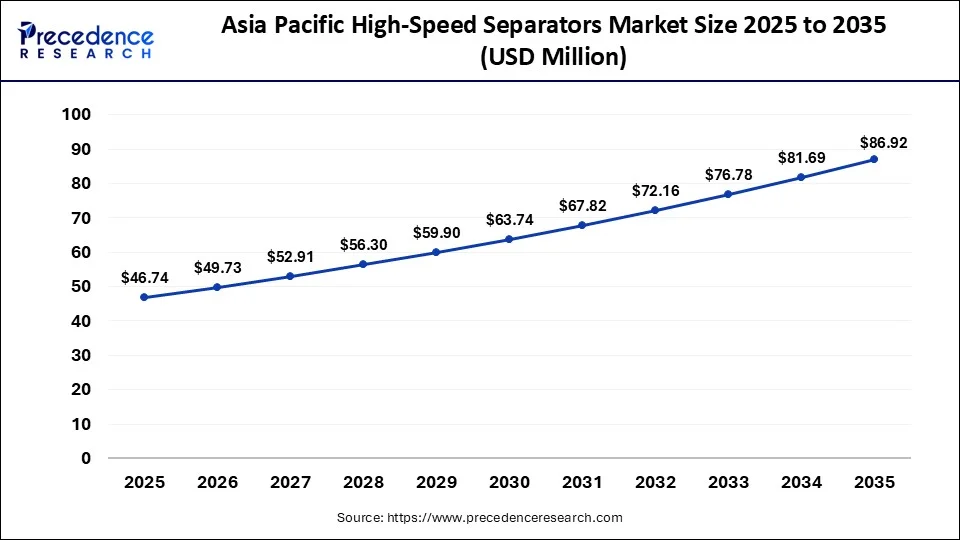
The Asia Pacific high-speed separators market size was evaluated at USD 49.73 million in 2026 and is projected to reach around USD 86.92 million by 2035, growing at a CAGR of 6.40% from 2026 to 2035.
China
The robust public funding for innovative manufacturing, recycling facilities, and industrial modernization led to the rapid adoption of high-speed separation solutions throughout the country.
India
India became one of the big markets to grow as packaged food production and investments in biotechnology and industrial processing grew continuously in the country.
Europe Expected to Held Second Largest Market Share of 27% in 2025
Europe is expected to hold 27% of the market in 2025 and is estimated to grow at a strong CAGR of 4.8% over the projected period, supported by strong emphasis on operational efficiency and advanced production technologies.
Germany
Germany was the dominant player in the market owing to its strong industrial manufacturing infrastructure, which had readily embraced the latest technological advancements in the field of food, chemical, and pharmaceutical processing.
North America Held Significant Market Share of 24% in 2025
The North America region held a 24% share of the market in 2025 and is expected to grow at a 4.7% CAGR between 2026 and 2035, driven by the presence of leading equipment manufacturers and advanced industrial infrastructure.
U.S.
The U.S. was the leading player in the regional market with a significant level of food processing facilities, mass-producing pharmaceuticals, and embracing automation in industrial production.
Latin America Held Notable Market Share with 6% in 2025
The Latin America region is expected to grow at a notable CAGR of 4.9% between 2026 and 2035, rising industrial investments and expanding processed food production; separator installations steadily increased across the region.
Brazil
The largest country in the region, dominated the market due to its food-processing industry, agricultural production, and increasing demand for industrial separation technologies.
Middle East & Africa Held a Considerable Market Share of 5% in 2025
The Middle East & Africa region is expected to grow at a strong CAGR of 5.2% between 2026 and 2035, fuelled by increasing investment in advanced manufacturing infrastructure and regional production capacity.
Saudi Arabia
Saudi Arabia has emerged in the region as one of the larger markets with the launch of industrial diversification plans, increasing food production, and investing more in water treatment facilities.
Technology Landscape Analysis
Centrifugal Separation Technology
Centrifugal separators, such as disc stack and tubular bowl centrifugal separators and decanters. They are the most popular designs used in the industrial market. Disc Filter Units are suitable for continuous liquid-liquid and liquid-solid separation in food, pharma, and marine applications. Tubular bowl centrifuges are used to separate finer particles. Their extremely high g-forces are critical. High-solids applications such as sludge dewatering and mining slurry treatment, on the other hand, are handled by decanter centrifuges.
Magnetic Separation Technology
Ferrous particles present a risk of contamination to both the product and equipment. Magnetic separation is an important step that must be used. Magnets are used for a variety of metal processing, including magnetic drums, pulleys, and eddy current systems used by the mining, recycling, and waste processing industries. The upstream contamination is removed, causing magnetic separation to be an essential. Protecting sensitive equipment downstream.
Air Classification Technology
Air classification uses controlled airflow to separate materials by particle size and/or density. Rather than liquid or centrifugal force. In cyclone separators, the incoming material is spun in a manner that causes coarser material to be thrown farther from the center for separation. Also, particle size increases while fine particles are carried further for collection. No water is used during separation. This method would be suitable for operators in industrial areas, where they are restricted on how much water they can use.
Optical and AI-Based Separation Technologies
Infrared or AI sorting has emerged as the biggest segment of the whole separation segment. In May 2025, Buhler introduced its SORTEX AI700 optical sorter based on deep learning convolutional neural networks. This identifies very fine contaminants in the processing of oats. This resulted in reduced reject concentration, which represents direct increases in yields for grain processors. In all their product areas, Bühler has since expanded on similar AI-based sorting logic for wheat, rye, coffee and pulses in their SORTEX H SpectraVision platform.
Pricing Analysis
Average Manufacturing Price Analysis
High-speed separators are currently being produced at an average price of approximately USD 20,000–100,000 per set. Mainly due to precision machining and raw material prices. The cost driver for stainless is its use as the most important factor in bowls and rotating parts. They require both corrosion-resistant and strong alloys. Nickel prices at the London Metal Exchange (LME) eased in one of the key input costs for manufacturers in June 2026. Averaging around USD 15,420 per tonne compared to an average of around USD 16,800 in Q1. Motor systems, sensors, and control electronics are also added in. Their cost is reflected in component pricing, whereas adding cost also increases reliability and automation readiness.
Average Selling Price Analysis
Average selling prices are significantly higher than average manufacturing costs. Reflecting the engineers' value and the brand reputation and after-sales support in each sale. Customization contributes heavily to the cost of ASP since every one of them may be different depending on whether the application is for biopharma or alternative protein processing. This necessitates the development of materials and validation.
The service products, which consist of spare parts, calibration services, and remote monitoring. Constitute an ever larger percentage of contract cost over the entire life of the contractor, in addition to the initial hardware sale. These higher ASPs are attributed to their deep learning capabilities and offer improvements. Especially with premium AI-driven and sensor-driven technologies, such as Bühler's SORTEX AI700 platform. The trend toward total cost of delivery pricing, instead of just software, is gradually driving the way manufacturers approach separators through their contracts for 2026 and beyond.
Pricing Forecast Through 2035
Price into 2035 will likely involve a price battle between increases in technology and manufacturing efficiencies. Automation and integration with AI, there will be initial costs. But the potential savings from predictive maintenance and remote monitoring will reduce long-term TOTW. Some levels of raw material volatility should be more than offset by improving manufacturing efficiency by producing locally and building regional manufacturing capacity. Looking at this trend, separator pricing will become more aligned with operational intelligence and service integration over mechanical ability over time.
Supply Chain Analysis
Raw Material and Component Supply
Electro manufacturers are looking on the global side of the market for motors, sensors, control systems, and magnets. All of these are part of a tightening global supply. There is truly sourcing pressure on rare earth magnets right now. MP Materials delivered the first commercial order for NdFeB permanent magnets from its Independence Facility in Fort Worth, Texas, in December 2025. The first commercial-scale production of permanent magnets in the US in more than 20 years. That trend has been seen throughout the industry for suppliers to diversify component sourcing to prevent sole regional dependency.
Manufacturing Process Analysis
The manufacturing process for the separator comprises precision casting, bowl balancing, motor integration, and final assembly. Quality control requires tight tolerances. Because out of balance rotating parts can lead to catastrophic failures under high-speed conditions. On the other hand, these pre-delivery testing protocols minimize commissioning timelines. They also provide the buyer with performance certification before equipment even arrives at the plant floor.
Distribution and Service Network
All equipment sales are gradually being offered as part of a package. That includes support for initial installation along with promises of maintenance. During the new customer onboarding, for instance. SPX FLOW's First Year Care Program matches them to specialist technical partnerships and automated assistance with the company's remote experts around the clock. This aftermarket connection is rounded out by spares availability and preventative maintenance training. Throughout the life of separators, to keep them running efficiently way beyond their original installation. This service oriented distributional method is emerging as a key differentiator for the separator manufacturing industry.
Customer Buying Behavior Analysis
Industrial Purchasing Criteria
Reliability is important because an unexpected outage of any centrifuge can stop an entire production line. Total cost of ownership (TCO) and ease of maintaining the acquisition solution become more important. The initial purchase price is a strong buying criterion. Alfa Laval's S and P Flex separation systems are directly affected by the shift, as they are always highly efficient. They also offer low sludge output and provide a flexible scope of supply within a single purchase. This versatility ranges from standard solutions to fully contracted arrangements. That is exactly what buyers are looking for prior to making the final investment decision in 2026 on capital equipment.
Equipment Selection Factors
Major industries' selection decisions for separators are based on the application requirements. Food processors choose accordingly, with hygienic design and CIP compatibility being a priority. Rather than wear resistance. Sterility and documentation of validation are more important to pharmaceutical buyers than just about anything else. Such application-specific selection logic is the reason why manufacturers continue to offer more niche product designs than one size fits all selections.
Preference for Integrated Processing Systems
There is growing demand for a whole package automatic buyer rather than buyers of separator units. SPX FLOW now provides complete turnkey solutions supporting dairy, food, beverage, and industrial processing plants. This change is part of a broader trend in the industry towards having just one source of accountability. Rather than dealing with multiple vendors for the production line. They are all from the same provider. System-level separation equipment, controls, and automation enable buyers to commission the systems more smoothly. This further enables troubleshooting with greater efficiency and simplicity. The one-vendor convenience is increasingly as significant in the buying process as the separator is in its performance.
Regulatory and Industry Standards Analysis
Food Processing Equipment Regulations
The design requirements for a separator, whether it is intended for use with food. They must comply with the strict design requirements established by organisations such as EHEDG and 3-A Sanitary Standards. These cover cleanability, material and CIP compatibility for equipment that comes in contact with consumable products. These standards are the minimum requirement to be met prior to a high-speed separator being added to dairy, beverage or processed food production lines.
Pharmaceutical Manufacturing Compliance
Unlike other industrial equipment, biopharmaceutical separators are much more demanding to validate and document. Good Manufacturing Practice (GMP) principles are being encouraged by industry groups such as ISPE and dictating the design and documentation of separator systems for cell separation. Engineering and documentation requirements are applied when designing a pharmaceutical model versus a general product model for separators.
Environmental Regulations
The demand for recycling and material recovery separation equipment is significantly being redefined by environmental policy. An increasing number of cities worldwide implement similar waste and recycling rules. The demand for sophisticated technologies that filter, sort, and dewater waste materials using magnetic, optical, and centrifugal separation equipment will steadily climb beyond 2026.
Investment and Opportunity Analysis
Manufacturing Expansion Opportunities
The manufacturing of separators and process equipment is expanding. Adopting with equipment companies striving to keep up with demand. ANDRITZ agreed to invest more than double-digit million euros by 2028 and to increase its production facilities in Linz and Weiz in Austria. That growth should bring in approximately 350 engineering and industrial equipment skilled jobs. Supporting the production of turbo generators and industrial equipment. This is the type of commitment for long-term supply. They project confidence in demand over a longer-term basis, as opposed to in the short-term order cycles. Those that wish to be paid to occupy space at the mills will gain a larger than proportional share of future orders for capacity constrained items.
High-Growth Application Investments
The significant capital investment at present is in pharmaceutical, recycling, and automation applications. In February 2026, Johnson & Johnson announced it would invest $1 billion in a next-generation manufacturing plant for the production of separation and purification in PA. TOMRA has committed to a higher investment in automation in the form of becoming a majority shareholder in PolyPerception. This will boost investment in AI-powered recycling sorting.
The investment in pharma automation and precision separation is not a standalone effort, but fully discovered parallel investment initiatives. Demonstrating the growing importance of automation and precision separation movements in the dynamics of capital investment. Manufacturers are taking a gamble in the technology based separation market that it will continue to become more application-specific rather than become an industrial market.
Regional Investment Opportunities
Growth in the region's industry is creating new opportunities for separator and processing equipment manufacturers. Manufacturers are localizing manufacturing and engineering skills right in high-growth Asian markets. In Latin America and the Middle East, processors are doing much the same. Replacing old-fashioned systems with up-to-the-minute, fully automated gear. This regional buildout places manufacturers that have local manufacturing and services to meet growing demand at a significant advantage through 2035.
Competitive Landscape
Market Competition Overview
The competition in the high-speed separators market is moderately concentrated with some established engineering groups. Alfa Laval, GEA, ANDRITZ, and Flottweg remain leading competitors not just with price. Technology innovations that include AI-powered sorting and predictive maintenance. They have been increasingly differentiated and are becoming real competitive battles instead of add-ons.
GEA furthered this trend with its acquisition of the specialty brand Flocmix for mixing as well as the decanter centrifuge sensor technology brand. This is a form of "capability acquisition" that mirrors the new approach to strategic positioning by having a certain technical niche rather than competing on a wide basis within all applications.
Competitive Benchmarking
Benchmarking industry practice shows a variety of strategic positions among the top manufacturers. Alfa Laval's differentiators are breadth and the company's one of the broadest disc-stack separator portfolios on the market. Covering marine, food, and pharmaceutical applications. Bühler and TOMRA are separated from each other almost solely on pure technology innovation. Namely via its AI and Deep Learning Sorting capability. In niche operations, such as mining and metal recovery dominated by other players. They focus on specific magnetic and sensor-based separation technology. On the other hand, STEINERT secured a competitive edge with its sorting depth.
Strategic Developments
There has been significant strategic movement throughout the separator industry over the last couple of years, up to and including 2025 and 2026. Trucent acquired Separator Restorations, headquartered in Indiana, bringing centrifuge maintenance. Repairing and balancing services under one umbrella of services. Dover Corporation has doubled down on pumps and process solutions by purchasing Cryo-Mach. This is a cryogenic centrifugal pump and mechanical seal supplier, acquired in January 2025. These deals highlight manufacturers that are targeting acquisitions that are not necessarily horizontal. But specialized in their technical area, as the true source of competitive advantage becomes more specialized and technical.
High-Speed Separators Market Companies
- Alfa Laval
- Andritz
- Ferrum Ag
- Gea Group Aktiengesellschaft
- Ihi Rotating Machinery Engineering Co., Ltd.
- Mitsubishi Kakoki Kaisha, Ltd.
- Tetra Pak International S.A.
- Tomoe Engineering Co., Ltd.
Future Market Outlook (2026-2035)
Short-Term Outlook (2026-2028)
Growth in the short term will focus on investments in recycling facilities, food processing demand, and growth of automation. Automated and self-cleaning separator lines are still to be further developed by manufacturers. Such as Alfa Laval and GEA, with the impact being reduced dependency on human labour in the plant. This short term period really doesn't mark the introduction of a new separation technology per se. But simply the accentuation of trends that are already taking place in the separation process.
Medium-Term Outlook (2028-2032)
The medium term should see AI-based separation move beyond being a premium use and into common industrial use. The options in the pharmaceutical space will continue on the path of expansion. In addition to investments in cell therapy manufacturing projects, such as what Johnson & Johnson announced in its Pennsylvania plant in 2026. The industry-wide emphasis on smart manufacturing integration. Such as integrating sensors, predictive maintenance, and remote monitoring, should no longer be considered an option, but a requirement across separator product lines. The software and connectivity aspects of separation equipment should factor into the buying decision much like the mechanical performance of the equipment by 2032.
Long-Term Outlook (2032-2035)
Technology will bring closer together mechanical separation and fully autonomous processing systems in the future, 2035 and beyond. Competitive advantage via performance breaches should become smaller as markets mature, leaving service, software, and sustainability characteristics as key differentiators between manufacturers. Early investment in AI, magnetic sorting depth, and application engineering will be a competitive advantage for manufacturers. In 2035, high-speed separators will not be a separate machine. But rather be smart parts with an embedded system that will be smartly connected in a complete industrial processing network.
Strategic Recommendations
Recommendations for Equipment Manufacturers
Manufacturers should invest in automation, as Alfa Laval and GEA are doing ahead of time. Bühler's deep-learning contamination-detection approach and product innovation should aim at the intelligent machine action of sorting. They are further assisted by Artificial Intelligence. Manufacturers must move toward service-based revenue models, as SPX FLOW implements turnkey solutions for manufacturers through such services as maintenance, spare parts, and remote monitoring. Combined with these four, automation, innovation, regional footprint, and services revenue will distinguish market leaders from those that remain just competing on hardware.
Recommendations for Investors
Optical and AI-based separation is one technology investors will have to keep an eye on. Both TOMRA and Bühler have taken deep-learning sorting platforms to a new level in no time. The pharmaceutical sector holds special promise, particularly as a huge investment for cell therapy production lines, such as J&J's Pennsylvania facility. The Asia-Pacific region is another highlight, as there continues to be a strong push for manufacturers to localise production and seek direct processing opportunities in the region.
Recommendations for End Users
Cost of the separator is not the only basis on which an end user should choose a product. They need to consider total system cost as well. While efficiency is important, reliability and uptime are more likely to make a long-term investment successful because if it isn't, the investment is actually a complete loss. The readiness for automation also needs to be taken into account, as retrofitting commonly has a higher cost. Compared to purchasing existing systems that are already automation-ready. Organizations that consider all these aspects can save themselves from the pitfall of choosing the lowest price and forgetting about reliability in subsequent operation.
High-Speed Separators Market Segments
By Product Type
- Centrifugal Separators
- Magnetic Separators
- Air Separators
- Vibratory Separators
- Rotary Separators
- High-Speed Sorting Separators
By Speed Range
- Low Speed
- Medium Speed
- High Speed
By Separation Technology
- Mechanical Separation
- Centrifugal Separation
- Magnetic Separation
- Air Classification
- Optical Separation
- Density-Based Separation
By Application
- Food & Beverage Processing
- Pharmaceutical & Biotechnology
- Chemical Processing
- Mining & Minerals
- Waste Recycling
- Water & Wastewater Treatment
- Energy & Fuel Processing
By Capacity
- Small Capacity
- Medium Capacity
- Large Capacity
By Operation Mode
- Continuous Separators
- Batch Separators
- Automated Separators
By End User
- Food Processing Companies
- Pharmaceutical Manufacturers
- Chemical Companies
- Mining Companies
- Recycling Companies
- Water Treatment Facilities
- Energy Companies
- Research Laboratories
By Distribution Channel
- Direct Sales
- Equipment Distributors
- System Integrators
- Online Industrial Platforms
By Region
- North America
- Latin America
- Europe
- Asia-Pacific
- Middle East and Africa
For inquiries regarding discounts, bulk purchases, or customization requests, please contact us at sales@precedenceresearch.com
Frequently Asked Questions





Ask For Sample
No cookie-cutter, only authentic analysis – take the 1st step to become a Precedence Research client
 Get a Sample




 sales@precedenceresearch.com
 Schedule a Meeting
