



Tau Protein Targeting Therapeutics Market Revenue to Attain USD 6,534.16 Mn by 2035
Published: 21 May 2026
Author: Precedence Research



Tau Protein Targeting Therapeutics Market Revenue and Trends 2026 to 2035
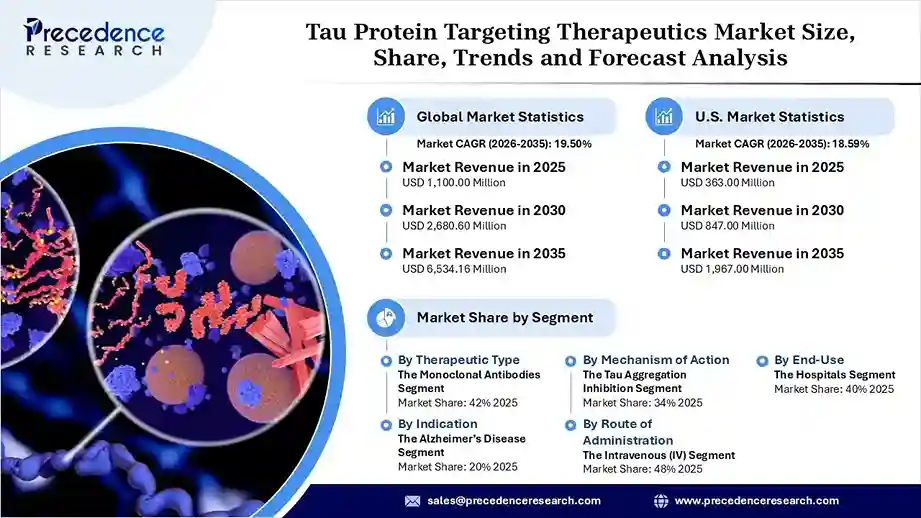
The global tau protein targeting therapeutics market revenue surpassed USD 1,100.00 million in 2025 and is predicted to attain around USD 6,534.16 million by 2035, growing at a CAGR of 19.50%. The market is gaining traction as drugmakers race to tackle Alzheimer’s and related brain disorders at their biological root, fueled by rising dementia cases, a deeper understanding of tau pathology, and the urgent need for treatments that do more than temporarily ease symptoms.
Market at a Glance
The tau protein targeting therapeutics market refers to the segment of the biopharmaceutical industry focused on developing treatments that address abnormal tau proteins linked to Alzheimer’s disease and other neurodegenerative disorders. These therapies aim to slow, stop, or reverse the accumulation, misfolding, or spread of tau in the brain by targeting tau aggregators or their reverse. Therapeutics include monoclonal antibodies, vaccines, antisense oligonucleotides, and small molecules at multiple stages, including research labs, clinical trials, regulatory pathways, and potential commercial applications, as well as studies through pipelines and through trials and possible in-market sales or therapies.
The market scope can encompass both Alzheimer’s (AD) and frontotemporal dementia (FTD), progressive supranuclear palsy (PSP), and many other tau-mediated diseases. It consists of process and clinical research development of a drug, as well as biomarker diagnostics work, through licensing agreements and commercial product introduction. Furthermore, the field offers potential for expansion via synergistic therapeutic strategies tailored to individual patient needs, with development for aging populations worldwide.
Market Forecast for the Tau Protein Targeting Therapeutics Market
- Combination Therapy Era Could Redefine Alzheimer’s Treatment: The market is moving toward multi-pathway treatment models where tau-targeting drugs may be paired with amyloid therapies. Reuters reported that Alzheimer’s drug development is increasingly borrowing the cancer-treatment playbook, focusing on multiple biological targets rather than a single pathway. This opens commercial room for tau therapies as add-on or co-administered products.
- Diagnostics Growth Supports Therapeutics Adoption: Roche announced CE Mark approval for its Elecsys pTau217 blood test in 2026. Earlier diagnosis means more patients can be identified in mild or preclinical stages-exactly where disease-modifying tau drugs are expected to work best. Diagnostics often become the front door for therapeutic demand.
Tau Assets Gain Commercial Attention
- South Korea-based ADEL entered a partnership with Sanofi valued at up to USD 1.04 billion to develop and commercialize a tau-focused Alzheimer’s therapy, signaling that tau protein assets are attracting heavyweight capital.
- The contract entails an upfront amount of USD 80 million as early-stage treatments of tau are starting to have significant immediate valuations now, since they are not exclusively based on milestone achievements.
- Later payouts linked to milestones will be dependent on clinical advancement and market performance, so future revenue opportunities are likely if developmental goals are met.
- ADEL-Y01 targets the acetylation of tau, representing a unique pathway in tau biology, demonstrating how novel therapeutics are moving beyond traditional anti-tau approaches.
- The drug is already in early-stage human trials in the United States, confirming that clinical pipelines for tau therapeutics are active and globally expanding.
- Large pharma participation from Sanofi suggests rising confidence that tau-targeting drugs could become a commercial pillar in future neurodegenerative disease treatment markets.
Market Segmentation Overview
- By therapeutic type, the monoclonal antibodies segment held a major revenue share of 42% in the tau protein targeting therapeutics market in 2025, as pharmaceutical companies had intensified development of anti-tau antibody therapies. Strong investment flows into antibody platforms, improving trial outcomes in passive immunotherapy, and rising demand for disease-modifying treatments have strengthened their commercial lead.
- By therapeutic type, the gene therapies segment is expected to grow at the fastest CAGR of 28% in the market between 2026 and 2035, due to rapid progress in antisense oligonucleotide technologies and broader confidence in RNA-based therapeutics. Increasing preference for precision medicine, coupled with targeted genetic intervention strategies, is likely to accelerate adoption across neurodegenerative pipelines.
- By indication, the Alzheimer’s disease segment dominated the market with a 58% market share in 2025 and is expected to maintain its leading position with a CAGR of 20% in the coming years, due to its high global prevalence for Alzheimer’s disease. Growing clinical focus on reducing tau pathology, rising patient volumes, and sustained investment into disease-modifying drug pipelines have kept this indication at the forefront of market demand.
- By mechanism of action, the tau aggregation inhibition segment accounted for a considerable revenue share of 34% in the market in 2025, as developers had concentrated on preventing tau protein accumulation, one of the hallmark drivers of neuronal decline. Increased creation of aggregation-blocking compounds and active clinical testing in Alzheimer’s therapeutics had supported the segment’s established position.
- By mechanism of action, the tau clearance enhancement segment is expected to expand rapidly in the tau protein targeting therapeutics market with a CAGR of 24% in the coming years, due to the rising adoption of immunotherapy-based tau clearance strategies. Rising development of antibody-mediated therapies and growing preference for disease-modifying treatment approaches are projected to fuel expansion.
- By route of administration, the intravenous (IV) segment held a major revenue share of 48% in the market in 2025, because monoclonal antibody therapies had largely relied on infusion-based delivery. Strong hospital adoption, clinician familiarity with IV biologics, and the continued expansion of biologics-based treatment pipelines had reinforced this route’s market leadership.
- By route of administration, the intrathecal segment is steadily growing with a CAGR of 23% in the market between 2026 and 2035, due to increasing use of RNA and gene-based neurological therapies requiring direct CNS access. Demand for precise brain-targeted drug delivery and advances in neurology treatment protocols are likely to propel uptake.
- By end-use, the hospitals segment accounted for a considerable revenue share of 40% in the market in 2025, due to the growing availability of specialty neurology departments and increasing use of biologics and infusion-based therapies. Strong patient inflow for neurodegenerative disease treatment, along with wider access to specialty departments, has anchored their leading share.
- By end-use, the pharmaceutical and biotechnology companies segment is expected to grow at the fastest CAGR of 25% in the market between 2026 and 2035, as investment in neurodegenerative drug pipelines continues to rise. Expanding clinical programs, aggressive R&D spending, and a surge in licensing and strategic partnerships are likely to drive momentum.
Regional Insights
North America held a major revenue share of 44% in the tau protein targeting therapeutics market in 2025, as it had built a strong neurodegenerative disease research ecosystem supported by leading universities, NIH-backed programs, and deep biotech funding pools. The region had also witnessed rising clinical trials for tau-directed therapies and significant Alzheimer’s drug investments. The United States led due to the presence of major pharmaceutical innovators and advanced trial infrastructure, while Canada had strengthened the market through neuroscience research grants, collaborative healthcare networks, and growing dementia-focused innovation programs.
Asia-Pacific held a market share of 17% in 2025 and is expected to grow at the fastest CAGR of 24.0% in the market during the forecast period, as the region faces a rapidly aging population increasingly vulnerable to tauopathies. Governments are also expanding neurological research spending, while Alzheimer’s clinical trial activity continues to rise. China is expected to benefit from large patient pools, biotech expansion, and faster translational research capacity, whereas Japan is likely to remain a key growth engine through advanced dementia R&D, pharmaceutical expertise, and active tau-focused drug development programs.
Tau Protein Targeting Therapeutics Market Coverage
| Report Attribute | Key Statistics |
| Market Revenue in 2025 | USD 1,100.00 Million |
| Market Revenue by 2035 | USD 6,534.16 Million |
| CAGR from 2026 to 2035 | 19.50% |
| Quantitative Units | Revenue in USD million/billion, Volume in units |
| Largest Market | North America |
| Base Year | 2025 |
| Regions Covered | North America, Europe, Asia-Pacific, Latin America, and the Middle East & Africa |
Top Companies in the Tau Protein Targeting Therapeutics Market
Biogen Inc., F. Hoffmann-La Roche Ltd., and Eli Lilly and Company have led the way in creating therapeutics that target tau proteins and using advanced neuroscience techniques alongside substantial research and development budgets to create therapies that can modify the progression of Alzheimer’s disease and associated tauopathies. Biogen is getting noticed with its BIIB080 antisense program; Roche does a great job of combining its strengths in diagnostics with creating new neurodegenerative drugs; Lilly is expanding their focus away from just amyloid-targeted drugs to brain health. Moreover, AbbVie Inc., Johnson & Johnson, and Novartis AG have taken decisive steps with their business as biologics experts backed by global clinical trial networks and strategic alliances within the field of neurology.
Segments Covered in the Report
By Therapeutic Type
- Monoclonal Antibodies
- Anti-tau Antibodies
- Passive Immunotherapies
- Small Molecule Inhibitors
- Tau Aggregation Inhibitors
- Kinase Inhibitors
- Vaccines
- Active Immunotherapies
- Peptide-based Vaccines
- Gene Therapies
- Antisense Oligonucleotides (ASOs)
- RNA-based Therapies
By Indication
- Alzheimer's Disease
- Frontotemporal Dementia (FTD)
- Progressive Supranuclear Palsy (PSP)
- Corticobasal Degeneration (CBD)
- Chronic Traumatic Encephalopathy (CTE)
- Other Tauopathies
By Mechanism of Action
- Tau Aggregation Inhibition
- Tau Phosphorylation Inhibition
- Microtubule Stabilization
- Tau Clearance Enhancement
- Neuroinflammation Modulation
By Route of Administration
- Intravenous
- Oral
- Intrathecal
- Subcutaneous
By End-Use
- Hospitals
- Specialty Neurology Clinics
- Academic & Research Institutes
- Pharmaceutical & Biotechnology Companies
By Region
- North America
- Latin America
- Europe
- Asia-pacific
- Middle and East Africa
Get this report to explore global market size, share, CAGR, and trends, featuring detailed segmental analysis and an insightful competitive landscape overview @ https://www.precedenceresearch.com/sample/8423
You can place an order or ask any questions. Please feel free to contact us at sales@precedenceresearch.com |+1 804 441 9344