



Viral and Non-Viral Vectors Market Revenue to Attain USD 48.37 Bn by 2035
Published: 06 May 2026
Author: Precedence Research



Viral and Non-Viral Vectors Market Revenue and Trends 2026 to 2035
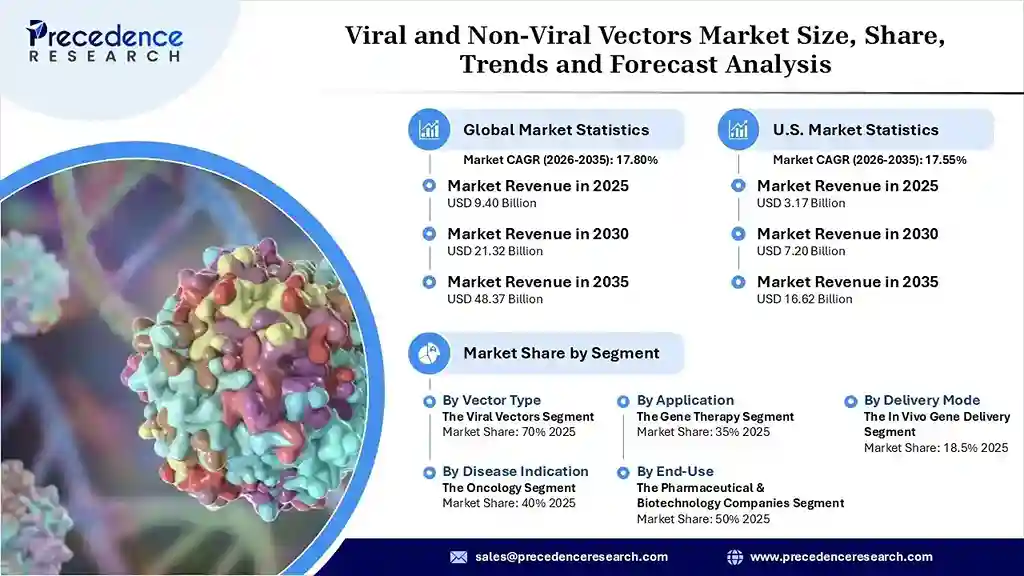
The global viral and non-viral vectors market revenue reached USD 9.40 billion in 2025 and is predicted to attain around USD 48.37 billion by 2035 with a CAGR of 17.80%. The market is gaining momentum due to the rising demand for gene therapies, mRNA platforms, and precision medicines.
Market at a Glance
The viral and non-viral vectors market focuses on technologies used to deliver genetic material (DNA or RNA) and therapeutic agents into target cells for clinical and research applications. Viral vectors such as adeno-associated virus (AAV), lentivirus, and adenovirus are widely utilized for efficient gene transfer, while non-viral methods, including lipid nanoparticles, polymers, and electroporation, offer scalable and safer alternatives.
The market spans applications across gene therapy, vaccine development, oncology, regenerative medicine, and genome editing. It also includes research tools, clinical manufacturing systems, and commercial-scale production services, with growing emphasis on rare disease treatment, expanding oncology pipelines, and next-generation RNA-based delivery platforms.
What Drives the Viral and Non-Viral Vectors Market?
- Rising FDA Approvals: The increasing number of approved cell and gene therapies is directly boosting demand for both viral and non-viral delivery systems. The U.S. Food and Drug Administration has approved several therapies, such as Zolgensma, Luxturna, Hemgenix, Casgevy, Kymriah, Yescarta, and Carvykti, each increasing the need for scalable vector manufacturing platforms such as AAV, lentiviral, and retroviral systems.
- Growing Demand from Cell Therapy Applications: The rapid expansion of CAR-T and engineered cell therapies is sustaining strong demand for viral vectors, particularly lentiviral and retroviral systems used in cell modification. Approved therapies such as Kymriah, Breyanzi, Tecartus, Abecma, Carvykti, and Yescarta continue to create consistent baseline demand for high-quality vector production capacity.
Market Segmentation Overview
- By vector type, the viral vectors segment held the largest share of 70% in the viral and non-viral vectors market in 2025, due to their remarkable transfection efficiency, which makes them the preferred option for intricate gene delivery. Their widespread use in approved gene therapies, cell engineering programs, and advanced clinical pipelines has reinforced their strong commercial position.
- By vector type, the non-viral vectors segment is expected to grow at the fastest CAGR of 22.5% in the market between 2026 and 2035 because of their enhanced safety and scalability. Lower immunogenicity, repeat dosing capability, and flexible manufacturing are accelerating their adoption in mRNA, CRISPR, and next-generation precision therapies.
- By application, the gene therapy segment held a major revenue share of 35% in the viral and non-viral vectors market in 2025, driven by increasing regulatory approvals and expanding clinical pipelines. The commercialization of treatments for rare and inherited diseases has further strengthened demand for both viral and non-viral delivery systems.
- By application, the cell therapy segment is expected to expand at a CAGR of 20% in the market between 2026 and 2035, supported by the rapid expansion of CAR-T programs and regenerative medicine. Rising investments in personalized immune therapies are increasing the need for efficient vector-based manufacturing processes.
- By disease indication, the oncology segment dominated the viral and non-viral vectors market with a 40% share in 2025 and is expected to maintain its leading position in the coming years, driven by the growing adoption of CAR-T therapies and targeted gene therapies. Strong funding activity, expanding pipelines, and increasing commercial demand have positioned cancer-focused applications as the largest contributor to market revenue.
- By end-use, the pharmaceutical & biotechnology companies segment accounted for a major share of 50% in the market in 2025, as commercialization of gene and cell therapies requires significant R&D capabilities, regulatory expertise, and capital-intensive manufacturing infrastructure. Their control over late-stage pipelines places them at the center of revenue generation.
- By end-use, the contract research and manufacturing organizations segment is expected to expand rapidly in the market with a CAGR of 20.5% in the coming years, driven by increasing outsourcing trends. Biotech companies are relying on specialized partners to manage complex vector production and accelerate time-to-market.
- By delivery mode, the in-vivo gene delivery segment dominated the viral and non-viral vectors market with a 55% share in 2025 and is expected to maintain its leading position with a CAGR of 18.5% in the coming years. This growth is driven by the rising number of approved therapies administered directly to patients, along with simpler treatment workflows and broader applicability across liver, ocular, and neuromuscular diseases.
- By manufacturing type, the in-house manufacturing segment accounted for a significant revenue share of 55% in 2025, as companies prioritized control over intellectual property, quality assurance, and complex production processes. Internal facilities also enabled better scheduling, consistency, and oversight for high-value therapies advancing through late-stage clinical development and commercialization.
- By manufacturing type, the contract manufacturing segment is expected to grow at the fastest CAGR of 20.5% between 2026 and 2035, driven by increasing scalability needs and outsourcing trends. Developers are increasingly partnering with CDMOs to reduce capital expenditure while gaining faster access to specialized manufacturing capabilities and advanced infrastructure.
Regional Analysis
North America dominated the global viral and non-viral vectors market with a share of 45% in 2025, supported by a strong gene therapy pipeline, high investment levels, and the presence of major biotechnology companies. The U.S. dominates the region due to proactive regulatory support from the U.S. Food and Drug Administration, advanced manufacturing capabilities, and consistent venture capital inflows. Moreover, Canada contributes through strong academic-industry collaborations and research infrastructure.
Asia Pacific held a market share of 18% in 2025 and is expected to grow at the fastest CAGR of 22.5% during the forecast period. This growth is driven by increasing clinical trial activity, expanding manufacturing capabilities, and supportive government initiatives. China leads the region with significant investments in bioprocessing and a rapidly growing domestic gene therapy sector, while Japan benefits from advancements in regenerative medicine and accelerated approval pathways.
Viral and Non-Viral Vectors Market Coverage
| Report Attribute | Key Statistics |
| Market Revenue in 2025 | USD 9.40 Billion |
| Market Revenue by 2035 | USD 48.37 Billion |
| CAGR from 2026 to 2035 | 17.80% |
| Quantitative Units | Revenue in USD million/billion, Volume in units |
| Largest Market | North America |
| Base Year | 2025 |
| Regions Covered | North America, Europe, Asia-Pacific, Latin America, and the Middle East & Africa |
Top Companies in the Viral and Non-Viral Vectors Market
Key players in the market include Thermo Fisher Scientific, Lonza, and Catalent, which offer comprehensive capabilities in viral vector manufacturing and cell and gene therapy services. Other prominent companies such as WuXi AppTec, Oxford Biomedica, and FUJIFILM Diosynth Biotechnologies are expanding their presence through advanced technologies and scalable production platforms, catering to growing demand from emerging biotech firms.
Segments Covered in the Report
By Vector Type
- Viral Vectors (AAV, Lentivirus, Retrovirus, Adenovirus)
- Non-Viral Vectors (Lipid-based, Polymer-based, Electroporation, Nanoparticles)
By Application
- Gene Therapy
- Cell Therapy (CAR-T, TCR-T, Stem Cells)
- Vaccines (DNA, mRNA, Viral Vector Vaccines)
- Genetic Research & Functional Genomics
By Disease Indication
- Oncology
- Rare Genetic Disorders
- Infectious Diseases
- Cardiovascular Diseases
- Neurological Disorders
By End-Use
- Pharmaceutical & Biotechnology Companies
- Academic & Research Institutes
- Contract Research & Manufacturing Organizations (CROs/CDMOs)
By Delivery Mode
- In Vivo Gene Delivery
- Ex Vivo Gene Delivery
By Manufacturing Type
- In-house Manufacturing
- Contract Manufacturing (CDMO-based)
By Region
- North America
- Latin America
- Europe
- Asia-pacific
- Middle and East Africa
Get this report to explore global market size, share, CAGR, and trends, featuring detailed segmental analysis and an insightful competitive landscape overview @ https://www.precedenceresearch.com/sample/8373
You can place an order or ask any questions, please feel free to contact us at sales@precedenceresearch.com |+1 804 441 9344