



Solid-State Transformers Market Trends, Companies, Revenue / Sales Performance, Manufacturing Yield, Fab Capacity, Export & Import Dynamics, Supply Chain Analysis, Competitive Landscape, and Growth Forecast
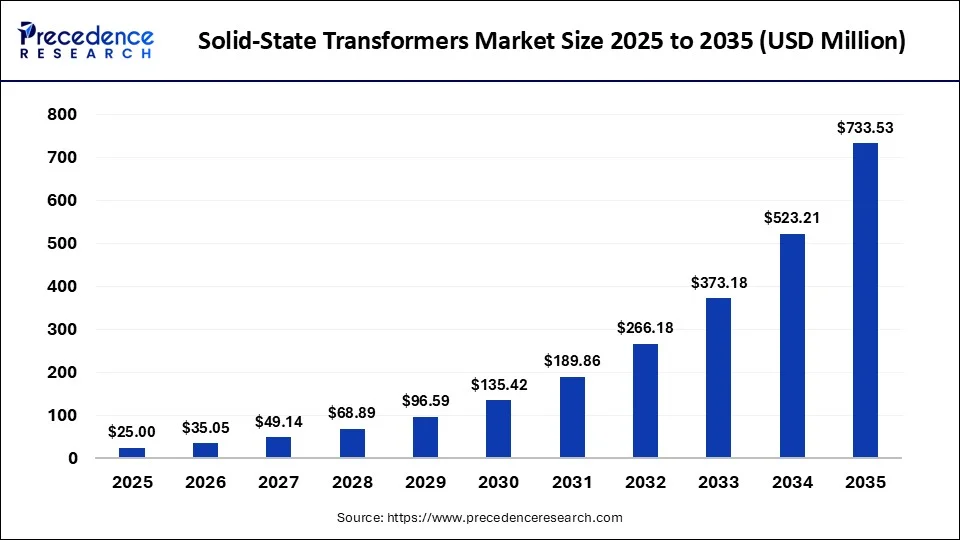
According to semiconductor and electronics specialist Laxmi Narayan, the solid-state transformers market is valued at USD 35.05 billion in 2026 and is forecast to reach USD 733.53 billion by 2035, reflecting a CAGR of 40.20%. Leading solid-state transformers market companies, including ABB Ltd., Eaton Corporation, are strengthening their presence across key segments such as component type, technology type, power rating, voltage level, application, end user, installation type, distribution channel.
Source: https://www.precedenceresearch.com/solid-state-transformers-market
 Get a Sample
 Table Of Content


Solid-State Transformers Market Size and Forecast 2026 to 2035
The global solid-state transformers market size accounted for USD 35.05 million in 2026 and is predicted to increase from USD 35.05 billion in 2026 to approximately USD 733.53 million by 2035, expanding at a CAGR of 40.20% from 2026 to 2035.
Key Takeaways
- By technology, the medium voltage solid-state transformers segment held 45% of market share in 2025.
- By technology, the distribution solid-state transformers segment held 25% of market share and is expected to grow at the highest CAGR of 43.2% between 2026 and 2035.
- By application, the smart grid applications segment held a major market share of 30% in 2025.
- By application, the renewable energy integration segment held 25% of market share in 2025 and is expected to register the fastest growth of 44.2% CAGR during 2026 and 2035.
- The DOE's DIRECT project is beginning to scale modular SSTs for field tests, marking this power-conversion field's progress toward real grid readiness.
- The Eaton purchase of Resilient Power Systems brought solid-state technology into one of this equipment's biggest firms.
- But NVIDIA's move to 800VDC architecture for Rubin Ultra GPUs is changing demands throughout the SST space.
- This transformer technology area directly consumes semiconductors, and its gap is being threatened by the suspension of the exports of its primary material, gallium, from China that runs until November 2026.
- This is a significant commercialization step for this sector, with Delta Electronics signing an MOU with X LABS for gigawatt-level deployments.
Market Size Description
SSRs are being deployed in the real grid with pilot deployments. As of November 2025, the U.S. Department of Energy has confirmed the DIRECT project. This work pre-shrinks single-stage solid-state transformers to become cascaded multi-module systems. With field deployment, it actively targets a load-serving circuit instead. The Energy Department's Office of Electricity also granted about USD 20 million separately via its Flexible Innovative Transformer Technologies program. A one-MVA three-winding solid-state transformer (SST) was funded by GE Vernova for a public utilities substation. It wasn't just a solo powerhouse.
This confidence translates right through into company activity this year. In November 2025, Infineon and SolarEdge joined forces on solid-state transformer technology. The target is direct medium-voltage power conversion for challenging application areas. These firms are complementing them with an equal amount of serious capital investment from startups. In February 2026, heroin Power raised USD 140 M from Andreessen Horowitz and Breakthrough Energy Ventures. DG Matrix was also funded for USD 60 million by a group. That, in addition to ABB, included Mitsubishi Heavy Industries.
Current demand is spurring important innovation forward with the need for artificial intelligence infrastructure. AI workloads simply outpace the speed that traditional transformers can achieve. GPU clusters can quickly ramp up from idle to full capacity within seconds. NVIDIA is working with more than 20 DC infrastructure partners, such as CoreWeave and Oracle Cloud Infrastructure, to bring 800-volt DC designs to life. The architecture is ideal for NVIDIA's upcoming Rubin Ultra GPU platform in 2027. This runs on racks that can accommodate up to 600 kilowatts of power. Enphase Energy and SolarEdge are launching products that are focused directly at data centers. There is now a single technology that enables grid modernization, EV charging, and renewable integration.
Market Snapshot
By 2026, solid-state transformers are moving beyond pilot programs to become part of the mainstream discussion on the grid. This year, the distribution segment has the largest share of deployments. Due to the need for voltage management at the feeder level in that segment. Medium-voltage becomes a leader in applications and is also the most rapidly commercialized, in data centres, EV charging hubs, and renewable interconnection.
Asia Pacific is spearheading the region with initiatives on grid modernization. Also high concentration of power electronics manufacturing in the region. Prices are higher than traditional units, but the prices of semiconductors are improving steadily. On the other hand, the end users that are prominent are utilities, hyperscale data center operators, and EV charging networks.
This demand momentum helps power fresh 2026 announcements from those utilities and hyperscalers. At APEC 2026, Navitas Semiconductor and École Polytechnique Federale de Lausanne demoed a 250kW SST platform. CEO of DG Matrix Haroon Inam says that his company is the only solid-state transformer company to sell a commercial product today. Heron Power won investment to construct a converter line 40Gcapacity manufacturing plant in the USA. Today's unit volume is modest and is expected to escalate sharply by 2027 and 2028.
Strategic Insights
Electrification opportunities are expanding beyond the scope of traditional utilities. DG Matrix has been hired to build an AC / DC power routing solution for renewable energy provider Exowatt for its modular AI data centre systems. The integration offers a way to overcome interconnection bottlenecks for dispatchable power delivery traditionally found in the marketplace, said Exowatt's CEO.
In September 2025, Canada also took action individually to invest in the Innisfil facility expansion project at Northern Transformer. Bolstering domestic grid supply chain. Data center operators, EV Fleet Charging networks, and renewable developers share a common underlying technology need. A common tendency throughout all sectors is that solid-state transformers are seen as a major infrastructure investment for 2027.
Market Overview
Introduction to Solid-State Transformer Technology
The function of a solid-state transformer is to perform electronic voltage conversion. But not through magnetic induction. Power semiconductors switch very quickly, without having to use large copper and iron cores. The SST WattEV from WattEV is engineered to operate directly and completely. Replacing the step-down transformer, switchgear, and low voltage rectifiers in a single unit. This design provides bi-directional power flow and control capabilities, real-time control, and a dramatically decreased physical space.
Evolution of Transformer Technology
For more than a century, the grid network infrastructure was largely based on electromagnetic transformers without any digitization. Now the grid network infrastructure is largely built around the electromagnetic transformer. This has very little digital intelligence. The Department of Energy has placed more emphasis on the development and deployment of advanced solid-state transformers. In its FY26 budget request, the Department of its Grid Modernization Initiative. Smart modern SSTs include sensing, communication, and adaptive control, which were not found in legacy hardware.
Importance of Solid-State Transformers in Future Energy Systems
Efficient equipment to handle bidirectional, variable power flows is critical to efficient renewable integration. The partnership agreement between DG Matrix and PowerSecure was signed in December 2025. Beyond that, multi-port SST platforms are being deployed in microgrid and distributed energy type projects. The deployments demonstrate that solid-state transformers are playing a key role in microgrids, EV charging corridors, and distributed energy resources management.
Market Scope and Coverage
The investigation includes analyses and discussion of key SST elements. Such as power modules, semiconductor switches, and control electronics. There is coverage from distribution, medium-voltage, and high-voltage up to various installation types. Application focus on extreme fast EV charging stations, connecting with medium voltage grid. End users range from utilities to data center operators, industrial plants, and defense infrastructure throughout the large regions of the world.
Market Trends
Increasing Adoption of Smart Grid Infrastructure
Intelligent sensors, automated controls, and bi-directional power flow are empowering utilities with an advanced network of the future. AEMO has announced plans for Australia to grow the transmission network. By 6,000 kilometres for smarter grid coordination in 2026. The enhancements expand the energy management functions of these devices and enable broader use of solid-state transformers (SSTs).
Growing Integration of Renewable Energy Sources
Advanced voltage conversion and reliable grid synchronisation are essential for solar, wind, and battery projects. Last year, the energy being generated through non-fossil sources accounted for 54.18% of the cumulative installed capacity in India, as reported by the Ministry of NRE (New and Renewable Energy). This growing share of renewables drives SSTs to address the nature of variable generation and keep grids stable.
Rising Demand for Electric Vehicle Charging Infrastructure
Efficient power conversion and enhanced interaction with local electric power systems are needed for a fast charging network. There was 19.1% annual growth in public charging infrastructure. That stood at 1.22 million charge points across Europe in 2025. SSTs can enable high-power charging. They simultaneously optimize voltage regulation, load balancing, and responsiveness to the grid.
Advancement of Silicon Carbide and Gallium Nitride Semiconductor Technologies
Silicon carbide devices and gallium nitride devices enhance switching characteristics, efficiency, reliability, and power density. In 2025, semiconductor provider Infineon and others were still technology innovators. They were deploying WBG solutions in energy and mobility. Infineon and others were still semiconductor technology innovators in 2025 with regard to energy and mobility applications. These advancements allow designs of smaller SSTs that have less energy loss and better thermal efficiency.
Increasing Deployment of Digital Energy Management Systems
The adoption of digital energy management systems is on the rise. Digital controllers help SSTs respond to changes in the grid quickly and monitor operating conditions. AI optimisation, digital twins, predictive maintenance, and autonomous grid monitoring were pointed out in a 2026 study. Intelligent SST deployment continues to grow. Reaching more established and distributed energy networks through these capabilities.
Market Report Coverage and Key Metrics
| Report Coverage | Details |
| Market Size in 2025 | USD 25.00 Million |
| Market Size in 2026 | USD 35.05 Million |
| Market Size by 2035 | USD 733.53 Million |
| Market Growth Rate from 2026 to 2035 | CAGR of 40.20% |
| Dominating Region | North America |
| Fastest Growing Region | Asia Paicfic |
| Base Year | 2025 |
| Forecast Period | 2026 to 2035 |
| Segments Covered | Component Type, Technology Type, Power Rating, Voltage Level, Application, End User, Installation Type, Distribution Channel, and Region |
| Regions Covered | North America, Europe, Asia-Pacific, Latin America, and Middle East & Africa |
Market Segmentation Analysis
Component Type Insights
Why Did Power Electronic Converters Dominate the Solid-State Transformers Market?
The power electronic converters segment dominated the market with a share of 32% in 2025, due to their central role in multi-stage voltage conversion and precise bidirectional power regulation.
Solid-State Transformers Market Share, By Component Type, 2025 (%)
| Component Type | Market Share (%) | CAGR (%) |
| Power Electronic Converters | 32.00% | 40.8% |
| Semiconductor Devices | 28.00% | 44.5% |
| High-Frequency Transformers | 20.00% | 39.2% |
| Control Systems | 10.00% | 41.5% |
| Cooling Systems | 6.00% | 37.8% |
| Protection & Monitoring Systems | 4.00% | 38.5% |
The semiconductor devices segment held 28% of the market share in 2025 and is expected to grow at the fastest CAGR of 44.5% between 2026 and 2035, driven by rapid advances in silicon carbide and gallium nitride technologies for high-power switching applications.
Technology Type Insights
How Did Medium Voltage Solid-State Transformers Secure Leadership in the Solid-State Transformers Market?
The medium voltage solid-state transformers segment dominated the market with a share of 45% in 2025, due to their superior benefits, such as fewer conversion stages, a smaller physical footprint, and native support for high-voltage DC architectures. They enable direct conversion, eliminating bulky copper-and-iron components.
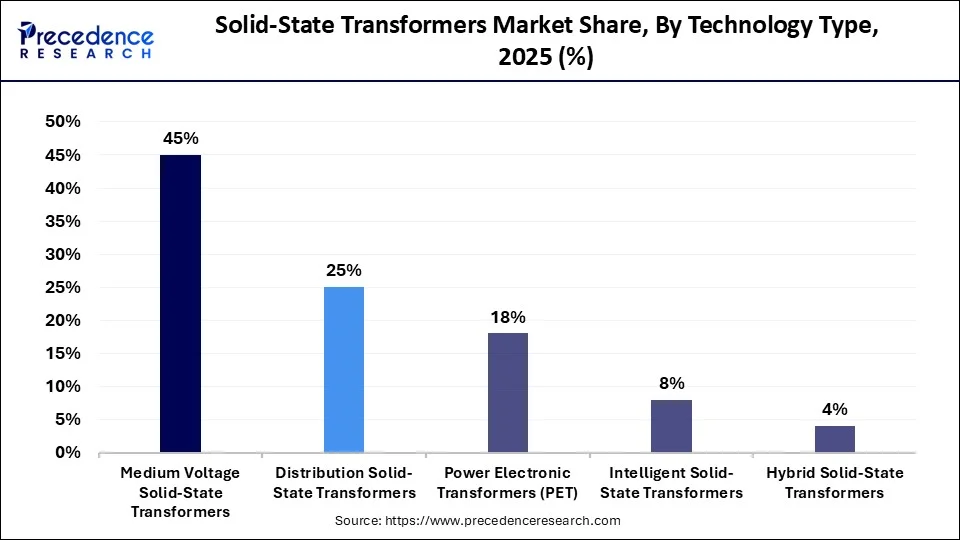
The distribution solid-state transformers segment held a 25% share of the market in 2025 and is expected to grow at the fastest CAGR of 43.2% between 2026 and 2035, driven by their widespread application to manage bi-directional power flow, regulate voltage, and integrate renewable energy. They enable electrification and increase grid reliability and resilience.
Power Rating Insights
What Made 1-10 MVA Lead the Solid-State Transformers Market?
The 1-10 MVA segment dominated the market with a share of 58% in 2025, due to its suitability for utility distribution networks, renewable energy integration, and industrial power systems.
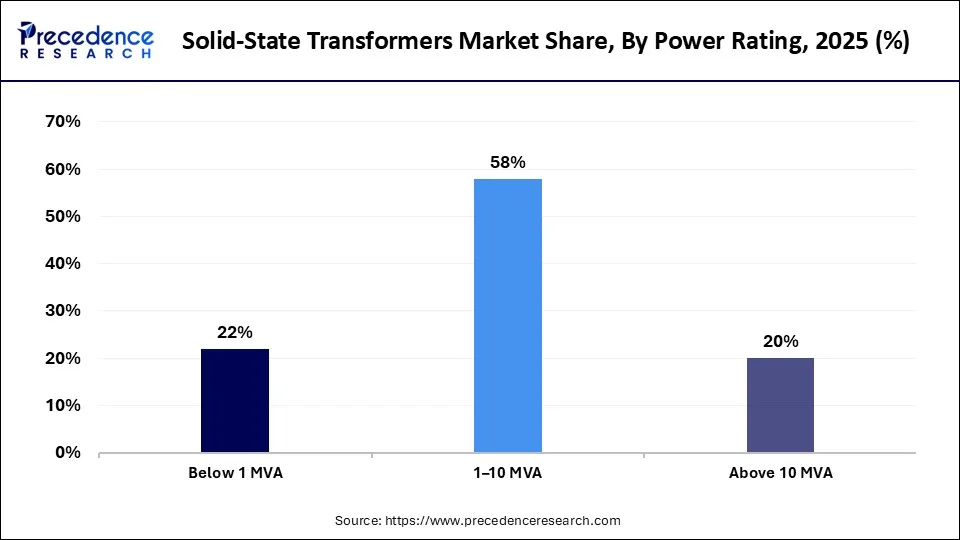
The above 10 MVA segment held 20% of market share and is expected to grow at the highest CAGR of 42.8% between 2026 and 2035, owing to the accelerating grid decentralization and rising deployment of distributed renewable energy systems.
Voltage Level Insights
Why Did Medium Voltage (MV) Systems Remain the Leading Voltage Level in the Solid-State Transformers Market?
The medium voltage (1 kV-35 kV) segment dominated the market with a share of 62% in 2025, due to its broad suitability for distribution grids, commercial facilities, renewable energy plants, and industrial operations.
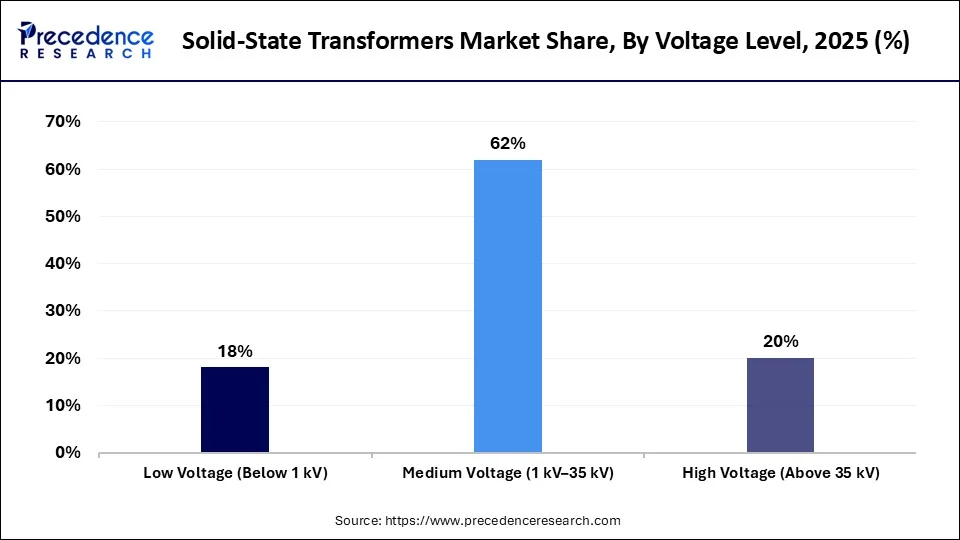
The high voltage (Above 35 kV) segment held a 20% share of the market in 2025 and is expected to grow at the fastest CAGR of 43.5% between 2026 and 2035, driven by rising investments in utility-scale transmission, offshore wind projects, and high-capacity industrial electrification.
Application Insights
How Did Smart Grid Applications Become the Leading Segment in the Market?
The smart grid applications segment dominated the market with a share of 30% in 2025, owing to the rising investments in digital electricity networks requiring intelligent voltage regulation and real-time power management.
Solid-State Transformers Market Share, By Application, 2025 (%)
| Application | Market Share (%) | CAGR (%) |
| Smart Grid Applications | 30.00% | 40.6% |
| Renewable Energy Integration | 25.00% | 44.2% |
| Electric Vehicle Infrastructure | 18.00% | 45% |
| Industrial Applications | 15.00% | 38.8% |
| Transportation Systems | 7.00% | 39.5% |
| Residential & Commercial Distribution | 5.00% | 37.9% |
The renewable energy integration segment held a 25% share of the market in 2025 and is expected to grow at the fastest CAGR of 44.2% between 2026 and 2035, driven by the accelerating utility-scale solar, offshore wind, and battery energy storage deployments worldwide.
End User Insights
Why Did Utilities & Grid Operators Emerge as the Largest End Users in the Solid-State Transformers Market?
The utilities & grid operators segment dominated the market with a share of 38% in 2025, due to continued investment in digital electricity networks, which is expected to preserve leadership for utility and grid operator applications.
Solid-State Transformers Market Share, By End User, 2025 (%)
| End User | Market Share (%) | CAGR (%) |
| Utilities & Grid Operators | 38.00% | 40.1% |
| Renewable Energy Developers | 22.00% | 45.1% |
| Electric Vehicle Charging Providers | 16.00% | 46% |
| Industrial Companies | 12.00% | 39.5% |
| Commercial Infrastructure Owners | 6.00% | 38.7% |
| Transportation Operators | 4.00% | 39.8% |
| Government Energy Agencies | 2.00% | 41.2% |
The renewable energy developers segment held a 22% share of the market in 2025 and is expected to grow at the fastest CAGR of 45.1% between 2026 and 2035, driven by expanding solar, wind, hybrid renewable, and battery storage projects requiring advanced grid integration technologies.
Installation Type Insights
What Drove New Installations to Lead the Solid-State Transformers Market?
The new installations segment dominated the market with a share of 72% in 2025, due to the rising investment in modern electricity infrastructure, which is expected to sustain demand for new installation projects.
Solid-State Transformers Market Share, By Installation Type, 2025 (%)
| Installation Type | Market Share (%) | CAGR (%) |
| New Installations | 72.00% | 41.2 |
| Retrofit Installations | 28.00% | 42.6% |
The retrofit installations segment held 28% of market share in 2025 and is expected to grow at the fastest CAGR of 42.6% between 2026 and 2035, driven by the continued refurbishment of legacy electricity networks, which is anticipated to drive strong adoption of retrofit solid-state transformer installations.
Distribution Channel Insights
How Did Direct Sales Become the Preferred Distribution Channel in the Solid-State Transformers Market?
The direct sales segment dominated the market with a share of 55% in 2025, due to the highly customised nature of solid-state transformer projects across utility, industrial, and infrastructure applications.
Solid-State Transformers Market Share, By Distribution Channel, 2025 (%)
| Distribution Channel | Market Share (%) | CAGR (%) |
| Direct Sales | 55.00% | 39.8% |
| System Integrators | 25.00% | 44.0% |
| Electrical Equipment Distributors | 12.00% | 39.5% |
| Energy Solution Providers | 8.00% | 42.1% |
The system integrators segment held 25% of market share in 2025 and is expected to grow at the fastest CAGR of 44% between 2026 and 2035, supported by Continued adoption of integrated energy systems, which is anticipated to accelerate demand for system integration services.
Market Dynamics
Market Drivers
Global Grid Modernization Initiatives
The world is exchanging old power equipment for digitally controlled systems. That utilities are transplanting them around the world. Hitachi Energy began construction in June 2026 for the country's largest facility to manufacture large power transformers in South Boston, Virginia. The expansion was announced as part of Hitachi's U.S. manufacturing plan to meet a growing demand for grid equipment. This modernization process will be further underpinned by various initiatives undertaken by the DOE. Such as the Solid State Power Substation roadmap until 2026 and beyond.
Expansion of Renewable Energy Capacity
Wind and solar projects produce energy on a daily basis, and it is constantly changing. IEEE research has proved that the pair of solid-state transformer and back-to-back converters indeed plays a greater role. Than low-frequency units in terms of weight and cost without compromising efficiency. This makes them ideal for wind forecasting for volatile offshore connections and solar forecasting for distributed wind. Ampere and Singapore-based proved that with their existing bidirectional charging model. They can reduce the bidirectional charging demand for port operator PSA to reduce its cost.
Rapid Growth of Electric Vehicle Charging Networks
SST adoption has been boosted by heavy-duty freight electrification. WattEV currently has five truck charging depots and fifteen others still in development in California. The solid-state transformer, which was recently announced in October 2025, will be directly installed on the medium-voltage lines of the utility. As megawatt charging progresses throughout the country. Salim Youssefzadeh, CEO, pointed out that fleets are increasingly beset by equipment stacking and supply chain challenges.
Industrial Electrification and Automation
Steady trend towards increased automation and electrification of factories, mining culture, and semiconductor manufacturing. From PCIM's industry coverage, these facilities require better clean power, quick protection, and local generation and storage ease. This transformation is enabled by the solid-state transformers' flexibility in the AC/DC interfaces and ability to grow modularly. On the other hand, engineers still consider thermal performance, insulation coordination, and serviceability. Before deciding to go to full-scale rollouts with the industrial market.
Market Restraints
High Initial Cost Compared with Conventional Transformers
The traditional copper-iron cores are used in the old iron based transformers. The new and reliable solid-state transformers use power semiconductors. This complexity does not yet make the cost of manufacturing these kinds of electromagnetic units as low as it would be with traditional electromagnetic units.
Technology Maturity and Commercialization Challenges
Validation is a real challenge still to be overcome before the rollout of a large-scale system by utilities. NVIDIA itself noted that while 800-volt direct current adds new challenges to the safety, standards, and workforce training field. It would also give electrical safety a significant lift. It is intended to implement it in stages, beginning with sidecar racks in 2026, in keeping with the industry's slow pace of adoption for wider commercialization.
Limited Manufacturing Ecosystem
Today it's just a handful of established players who have a comfortable share of the component supply market. Some major companies, such as ABB, Eaton, Delta, Hitachi Energy, and Siemens, have a hole in the market for system integration. This which is a factor that is encouraging Chinese companies. Especially Huawei and Sungrow, to catch up. If more SSTs were to be used, it would add to the current widespread and limited availability of wide-bandgap semiconductor supply chains in the industry.
Market Opportunities
Renewable Energy Microgrid Expansion
DG is changing the power management paradigm in cities and factories. Solid-state transformers (SST) for industrial DC microgrids integrate distributed energy resources (DER). This provides real-time monitoring of dynamic loads, Infineon says. Loss of performance is no longer an incidental with AI-powered demand, said Delta Electronics' William Mao in March 2026. The same flexible, bidirectional architecture will be the primary architectural principle. That will drive decentralized microgrids in the coming years.
Growth of EV Charging Infrastructure
Commercial fleet and charging network operators actively seek out SST suppliers for scale. DG Matrix raised USD 20M in a fully subscribed seed investment by Clean Energy Ventures for in-field pilot deployments in microgrids and EV fleets. Due to the unprecedented demand for electrification, the grid is under strain. Thus, everyone is in need of standardised and cost-effective solutions. As smart charging hubs grow, they are increasingly becoming energy nodes equipped with batteries, solar, and vehicle-to-grid features.
Replacement of Aging Transformer Infrastructure
Across the developed grids, utilities are facing gear decades old. With increased network complexity, solid-state transformers have become a key research target for end users' power supply applications. Digital control installations, which are smaller and more compact. They are becoming the choice for retrofit applications over traditional big units. This evolution provides a long-term, lucrative marketing prospect for replacement programs into the late 2020s.
Development of Intelligent Energy Networks
The ability to sense, communicate, and make independent decisions is becoming part and parcel of power infrastructure. Infineon and LS Electric have announced an agreement. Help advance Industry 4.0 high-efficiency DC power solutions for AI Data Centers in July 2026. These trends will lead to self-healing energy networks with artificial intelligence (AI) coordinated commercially within the coming decade.
Market Challenges
Integration Complexity with Existing Power Infrastructure
The cost of replacing the traditional transformers involves a large number of network redesigns with existing substations and compatibility testing. In legacy grids, the existing equipment may be old and constrict the ability to perform seamless SST and complicate engineering. The challenge of integration makes projects longer than they would otherwise be, and naturally the project demands more specialized engineering skills.
Need for Advanced Power Electronics Expertise
Engineers capable of power electronics, wide bandgap semiconductor technologies, and embedded software are needed to deploy the solid-state transformer. There remains a shortage of skilled professionals who can design and commission the next generation of SST platforms in this industry.
Solid-State Transformers Market Ecosystem Analysis
Industry Value Chain Analysis
The raw semiconductor and materials suppliers are the first in the SST ecosystem. The power semiconductors, high frequency magnetics, DC bus capacitors, and silicon carbide substrates form this layer, where most unit cost comes from. This materials-to-device pipeline is being realized with a medium-voltage grid transformer under ARPA-E funding at Georgia Tech Research Corporation. The downstream portion of the chain comprises power electronics manufacturers, system integrators, utilities, and end users.
Key Stakeholders Across the Market
It involves both research institutions and well-developed manufacturers as well as agile start-ups. The NSF-funded NS State Commercialization Partnership for foundational research on superconductive solid-state transformers is continuing to advance research at NC State University, led by Professor Alex Huang. An ERMCO company, GridBridge has risen as one of the significant players in the field of medium-voltage SST technology for utility distribution networks. These academic and federal research anchors now face competition from already-established companies, semiconductor companies, and startups backed by various sources of venture capital.
Partnership and Collaboration Landscape
Industry-wide, days are getting closer to commercialization as a result of cross-sector collaboration. In March 2025, ABB was joined by a strategic minority investment in DG Matrix, supporting their 20M USD seed round for multi-port SST platforms. The FREEDM Center at NC State also reached out independently to ABB and NYPA, with funding support from the DOE, to develop fast chargers. Partnerships between utilities, technology vendors, and universities are still playing a part in expediting the rollout of solid-state transformers to commercial scale.
Technology Landscape Analysis
Semiconductor Technology Assessment
Silicon Carbide (SiC) Devices
In high-power SST applications, silicon carbide devices offer higher efficiency, quicker switching, lower thermal losses, and lower losses. Mitsubishi Electric unveiled next-generation SiC power modules in 2025. As a new power module technology for the enhancement of the grid infrastructure and renewable energy equipment. Such enhancements not only boost the power density. But they also lower cooling demands, paving the way for more powerful semiconductor technology at higher frequencies.
Gallium Nitride (GaN) Devices
Gallium nitride devices can help achieve ultra-fast switching, small converter designs, and superior operating efficiency on modern SST platforms. In 2025, Infineon Technologies added to its family of GaN power products for industrial and energy infrastructure markets. Shorting lead, size of passive components, and switching frequencies can all be tuned to a higher level directly with the technology. This brings the semiconductor alternatives in a more advanced form.
Silicon-Based Semiconductor Devices
The silicon semiconductors are widely used because they are proven to be reliable and available to make power conversion products. Despite the rising widespread penetration of the SiC and GaN materials in energy systems. onsemi persevered in its silicon IGBT and power MOSFET solutions for industrial energy systems in 2025. Silicon devices are limited by switching speeds and thermal requirements. Driving the industry towards advanced SST power conversion architectures.
Power Conversion Architecture Analysis
AC-DC Converter Technology
AC-DC power supplies convert grid power to regulated DC power. This can provide energy management and voltage regulation. Hitachi Energy is rolling out advanced converter technology for digital substations and grid modernisation solutions in 2026. These systems generate stable DC connections. Helping transfer energy efficiently to the next step of power conversion.
DC-DC Converter Technology
Very few losses during the regulation of voltage between storage systems. Renewable generation and high power EV charging infrastructure by using DC-DC converters. ABB built on power conversion solutions. This enables battery energy storage and fast-charging installations in 2025. The highly accurate voltage control flexes the system and adapts the electricity to the grid even with inverter stages.
DC-AC Converter Technology
A DC-AC converter integrates renewable energy with the electric grid. Also enables distributed energy resources and micro-grids. These features complete the power conversion process of SST and allow smarter, resilient, and digitally connected electrical grids.
Component Analysis
Power Electronic Converters
The most prominent application of power electronic computing for the SST system. They regulate the supplied voltage, power quality, and backward energy transfer. They play a vital role in enabling all downstream SST functions, and drive up demand for high-end semiconductor components.
Semiconductor Devices
The semiconductor devices are the fastest growing component segment, with switching speeds and losses being significantly improved by SiC and GaN technology. ROHM Semiconductor enhanced its SiC Power Device portfolio for energy infrastructure and industrial applications in 2026. They enhance efficiency and enable more compact transformer architecture while also offering effective overload protection.
High-Frequency Transformers
High-frequency transformers are designed to minimize equipment sizes. Further enhancing conversion efficiency and electrical isolation over the SST platforms. TDK Corporation broadened its advanced magnetic component solutions for industrial power conversion applications in 2025. They are compact, which aids ease of installation and opens the door to more intelligent digital control systems.
Control Systems
Digital controllers manage switching, embedded software, and real-time energy management operations within SST installations. In 2026, Schneider Electric's artificial intelligence (AI) based grid automation platforms for intelligent power distribution were improved. The capabilities add to operational accuracy and require more advanced cooling technology.
Cooling Systems
Cooling systems keep the operating temperatures steady and maintain a safe condition of high power SST components when operating continuously. Good thermal management also prolongs the lifetime of the equipment and can enhance the reliability of advanced protection platforms.
Protection & Monitoring Systems
Modern grids are protected and monitored to detect faults, enhance safety of operation, and aid predictive maintenance. These plans provide another boost to network resilience and further the transition to full 100% digital solid-state transformer infrastructure.
Pricing Analysis
Manufacturing Cost Structure
The major cost component of any solid-state transformer still consists of semiconductor devices. On top of the cost of the component, there are power electronics, cooling systems, and digital control electronics. Wolfspeed's commercial 200mm silicon carbide (SiC) wafer product boosts the yield of MOFETS. Further accelerates new device manufacturers into the market. This larger substrate size has been steadily reducing semiconductor costs throughout the manufacturing stack.
Average Manufacturing Price Analysis
Lack of supply of components held up per-unit manufacturing costs through 2025. At the same time, with 200mm production lines still being built by device manufacturers in 2025 and 2026. There were new opportunities for supporting materials at the 200mm substrates that are available. As this capacity comes to maturity, and yields improve, manufacturing prices should gradually decrease. Early 2026 is not a full-fledged cost period.
Average Selling Price Analysis
There is a clear premium in selling prices due to reliability, control software, and certification activities. Sellers bid on capabilities like tasks that the buyer can't acquire otherwise. TDK's applications engineers showcased at APEC 2026 various component-level technology enhancements. These facilitate not only space savings but also power density requirements as well. That kind of engineering progress lets vendors justify current margins while incremental cost improvements continue underneath.
Pricing Forecast Through 2035
A gradual price decline should be expected as the size and scale of the manufacturing industry grows. In early 2026, Wolfspeed has finished the 150mm wafer fab shutdown, moving 150mm production to its 200mm customers. INFINIENON, STMicroelectronics, and ON Semiconductor each have two parallel ramps going to 200mm. Then on through 2026 and beyond. With their capacity growth rounds beginning to come to maturity, and as semiconductor yields improve and technologies develop. The cost of solid-state transformers should approach that of conventional transformers by the mid-2030s.
Supply Chain Analysis
Raw Material and Component Supply Chain
The basic components include semiconductors, magnetics, capacitors, and thermal components. With production scheduled to take place in the following Q4 2025. STMicroelectronics is investing in building a fully integrated 200mm silicon carbide campus in Catania. The final groups of components that influence a unit's final reliability are cooling systems and control boards. Transformer manufacturers will be relying on the arrival of all these inputs. Delivering to the standard and time they had hoped for.
Manufacturing Landscape
Production is being clustered around a few specialised semiconductor campuses. Wolfspeed's Mohawk Valley silicon carbide devices manufacturing plant in Marcy, New York. This is the world's first silicon carbide device fabrication plant. It will provide 200mm wafers only and will aim to run at capacity for silicon carbide devices by 2026.
The groundbreaking of the world's largest power semiconductor and analog fab took place in Dresden, Germany, on 3rd July 2026. Ushering the beginning of a new era in semiconductor manufacturing. The regional hubs are becoming one of the crucial landmarks for determining which technology providers will be able to scale SST production fastest.
Distribution and Deployment Network
System integrators exist between component manufacturers and the end users, the comfortables, and the utilities. Midstream players accept semiconductor devices, magnetics, and control boards and transform them into certified and deployable SST systems that can be put into place in the field. Distributors or partner energy solution providers serve smaller commercial and industrial customers. They are typically connected to large utility contracts via direct sales relationships. This stacked network determines the rate at which new SST designs enter real connected sites.
Supply Chain Risks
Geopolitical conflict persists over semiconductors' materials coming into SST manufacturing. A bilateral trade pact put the restrictions on China's gallium export on hold for a year beginning November 2025, and will terminate on November 27, 2026. If new restrictions are imposed, gallium nitride and silicon carbide availability will be crimped as demand grows. Manufacturers are keen on this deadline, and are trying to spread their orders among different suppliers to overcome over-reliance on any single country.
Investment and Funding Analysis
Investment Trends in SST Technology
Investment activity is a trend that's also gaining momentum amongst utilities, semiconductor companies, and niche start-up groups. In 2026, OSU was selected for ARPA-E's support for its DC-GRIDS project that pairs with NREL, EPRI, Virginia Tech, and Raytheon Technologies. They secured USD 2.9 million for partnering to focus on achieving the smallest space and lowest cost converter topologies for multi-terminal HVDC systems.
Eaton also received ARPA-E funding to develop a unique, ultra-high-efficiency medium-voltage hybrid circuit breaker. This combination of electro-mechanical and solid-state devices. The parallel efforts indicate a common central technology for these new efforts and bring together established power firms and research teams.
Government Support and Energy Transition Funding
Federal agencies are still considering grid modernization to be a national priority and will continue to do so until 2026. The Department of Energy SPARK funding opportunity takes a long view of supporting projects. That advances the capabilities of the transmission grid, including reconductoring and other advanced transmission improvements to increase grid resilience. As the AI boom grows, transformer and breaker supply is listed as one of the highest mission priority areas in an internal ARPA-E document from January 2026. That policy support ensures that public investment continues to support solid-state grid technology in the face of volatility in private investment in the market.
Strategic Investment Opportunities
Silicon carbide devices, EV charging, and smart grid hardware are some of the technology parts driving concentrations of activity at the highest level of growth. The Illinois Institute of Technology is working to create a series of autonomously operated solid-state circuit breakers in gallium-nitride composites. That will shield a microgrid from a faulty grid.
They are engineered to hit the shortest response time of 1 microsecond, much quicker than current mechanical breakers. There is a great deal of interest by investors in what rate these microgrid protection technologies are synchronizing with SST platforms coming to commercial pilots. The most obvious near-term future use case ahead for both of these technologies is smart grid applications.
Patent and Innovation Analysis
Patent Activity in Solid-State Transformer Technology
Encouraging innovations occur at a fast pace in converter design and integration in semiconductors. Looking at patent activity in the years 2016-2026. It can be seen that roughly 70 percent of all patents filed in the world come from China, which is led by a substantial group from Huawei Digital Power. The latest wave of new filings moving into examination is geared towards intelligent control systems and multi-output charging architecture.
Emerging SST Innovations
Vendors are going modular and hot-swappable in attempts to redefine high-voltage applications. Enphase's IQ Solid-State Transformer creates a supercluster consisting of 342 hot-swappable 350-watt power modules and replaces a few large blocks in 2026. The platform's gallium nitride switching and custom Kestrel control ASIC take the platform to 98.5 percent peak efficiency. AI-based predictive control, compact high-frequency magnetics, and module-level redundancy are becoming the defining features separating next-generation SST platforms from earlier prototypes.
Market Regional Analysis: North America, Europe, Asia-Pacific
Why Did Asia Pacific Dominate the Solid-State Transformers Market?
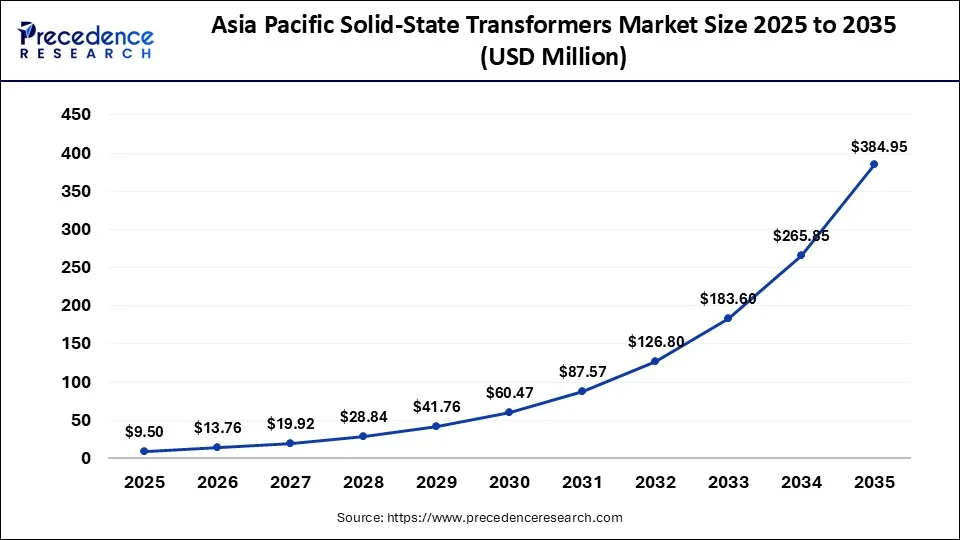
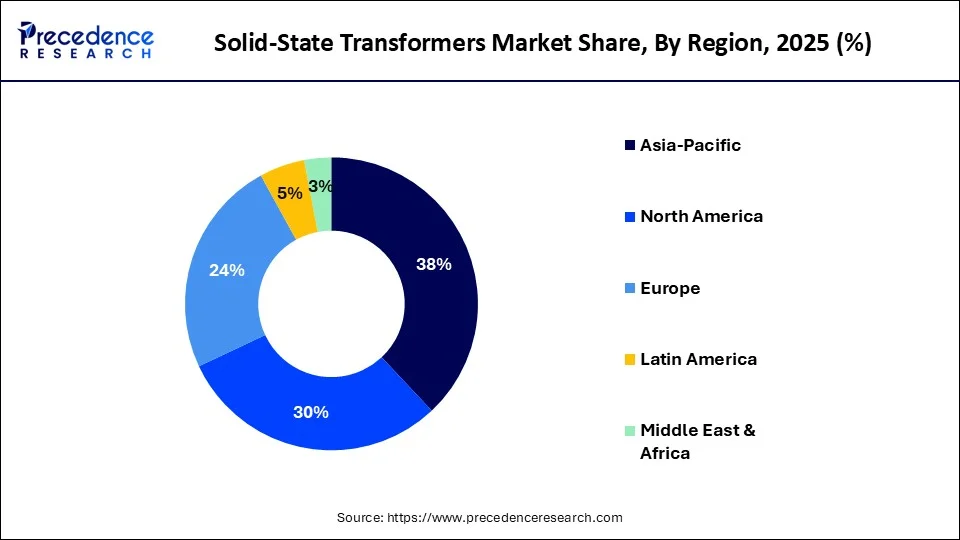
Asia Pacific led the market, capturing the largest revenue share in 2025, accounting for an estimated 38%, and is estimated to grow at a strong CAGR of 44.8% over the projected period, due to ongoing power infrastructure investments that are expected to accelerate long-term market expansion.
Asia Pacific Solid-State Transformers Market Size and Growth 2026 to 2035
The Asia Pacific solid-state transformers market size was evaluated at USD 9.50 billion in 2025 and is projected to reach around USD 384.95 billion by 2035, growing at a CAGR of 44.80% from 2026 to 2035.
China
Domestic manufacturers strengthen production of advanced semiconductor devices and grid equipment. Rapid renewable energy deployment further accelerates solid-state transformer adoption.
North America Region Held Significant Market Share of 30% in 2025
North America held a 30% share of the market in 2025 and is expected to grow at a 39.7% CAGR between 2026 and 2035, driven by extensive grid modernisation programmes and rapid deployment of advanced power electronics across utility networks.
United States
The U.S. demand is largely led by huge investments in smart grids, upgrades in transmission, and nationwide electrification projects. There are ongoing federal initiatives that promote advanced transformer adoption in all parts of the energy world, particularly in utility-scale energy projects.
Europe Expected to Held Market Share of 24%
Europe is expected to hold 24% of the market in 2025 and is estimated to grow at a considerable CAGR of 40.5% over the projected period, supported by ambitious decarbonisation policies and continuous investment in intelligent electricity infrastructure.
Germany
Domestic adoption is further strengthened by, of course, the engineering skills developed and ongoing investment in smart grid technologies. This technology is promoted for industrial application by the need for efficient power conversion.
Latin America Held Notable Market Share with 5% in 2025
The Latin America region is expected to grow at a notable CAGR of 38.9% between 2026 and 2035, due to increasing grid digitalisation, which is anticipated to create additional opportunities across the region.
Middle East & Africa Held a Considerable Market Share of 3% in 2025
The Middle East & Africa region is expected to grow at a strong CAGR of 39.4% between 2026 and 2035, driven by rising investments in smart cities, renewable energy, and advanced transmission infrastructure.
Competitive Landscape
Market Competition Overview
The competition is becoming more intense with the emergence of more sophisticated vendors in the emerging commercial-scale market. In July 2026, Sungrow officially rolled out a 3 MW solid-state transformer. EnerNeo inked cooperation agreements with HEC Technology, a Chinese firm, and ZDATA, a South Korean enterprise.
ON the other hand, on 14th July 2026, Delta Electronics signed an MOU for the deployment of 100 MW of SST and is looking to scale up to gigawatts. Commercialization schemes are increasingly based on framework agreements and staged rollout programs, as opposed to isolated pilot projects.
Competitive Benchmarking
Portfolios now range from traditional grid players to China's swiftly moving players. Between 2027 and 2030, Sungrow will further expand its SST technology into the field of charging infrastructure, energy storage, solar power, wind power, hydrogen power, and grid applications. Meanwhile, Eaton is cutting its path through Southeast Asia, running pilot SST programs in various countries.
Such as Singapore, Malaysia, Thailand, the Philippines, Vietnam, and China, including a pilot project in a containerized medium-voltage testbed with a Singapore University. The geographic separation of leaders is growing. Chinese suppliers increase manufacturing in China, and Western companies make use of partnerships and acquisitions.
Strategic Developments
Series of new cross-continental and new application collaborations marked the past few months. Delta signed an MOU with X LABS that focuses on energy-as-a-service delivery to AI data center projects in July 2026. These developments illustrate the success of strategic partnerships rather than only acquisitions, as the main route to commercial scale.
Solid-State Transformers Market Companies
- ABB Ltd.
- Eaton Corporation
- General Electric
- Hitachi Ltd
- Mitsubishi Electric Corporation
- Schneider Electric
- Siemens AG
- Toshiba Corporation
Future Market Outlook (2025-2035)
Short-Term Outlook (2025-2028)
In this initial stage, pilot projects are predominant, with vendors proving reliability in real grid conditions. Heron Power's roadmap reveals a full systems demonstration through the end of 2026. Also, customer shipments will begin in 2027 and ramp up to volume at the end of that year. The expanded South Boston, VA transformer site will be powered up by 2028, complementing the broader grid capacity. Adoption so far on an early commercial rollout is still limited to four key areas, such as AI data centers, port electrification, and heavy-duty EV charging depots.
Medium-Term Outlook (2028-2032)
Early pilots should generate reliability data to expand the meaning of utility adoption. There are existing coverage policies for industry to expect UL 1741 and IEC 62109 certifications. That will mature for broader commercial use. It's expected that this certified hardware will also be used to integrate variable solar and wind generation in large quantities. Thus, a key component of renewable integration projects. It's a point in time when EV infrastructure providers need to move from the megawatt pilots to an organized rollout of networks across multiple sites.
Long-Term Outlook (2032-2035)
They are looking to reach full commercialization when manufacturing scales up to meet demand. There is an increasing need to replace conventional electromagnetic transformers. They are being used in high density urban and industrial substations. In June 2026, academic research already set solid-state transformers as an important research direction for the future development of distribution networks. At this point, smart energy networks with SST nodes should be more of a must have than an experimental feature for today's grid infrastructure.
Strategic Recommendations
Recommendations for Technology Manufacturers
In the world of semiconductor manufacturing, the new partners are crucial. Semiconductor manufacturers should make sure to partner with those that offer increased wafer economics in an efficient time frame. Cost cutting should remain linked to concrete steps in the qualification process and not just announced. Those companies that want to level up their product for scalability must go for modular designs. That allows the same platform to be effective for data centres, EV charging and grid applications without redesigning the product.
Recommendations for Utilities
Pilot data from 2026 should not be used for marketing purposes only. But instead form the basis for utility procurement. By 2030, the IEA estimates that grid digitalisation will reduce curtailment of renewables by over 25 percent. If renewables are being considered for inclusion, utilities will do well to consider. That curtailment reduction is strong when the case is internally made for SST investment.
Recommendations for Investors
Investors need to keep an eye on semiconductor mergers and acquisitions. These mergers can lead to commercial scale-up across the board. In various deals, the components are typically a warning shot about where application-layer investment opportunity will focus. As the countries surveyed are currently engaged in building out usable manufacturing capacity from 2017 to 2027 and beyond. Geographically, investors should monitor both of those known SST hubs and the potential markets that present the greatest upside opportunity moving forward.
Complete Market Segmentation
By Component Type
- Power Electronic Converters
- AC-DC Converter
- DC-DC Converters
- DC-AC Converters
- High-Frequency Transformers
- Semiconductor Devices
- Silicon Carbide (SiC) Devices
- Gallium Nitride (GaN) Devices
- Silicon-Based Devices
- Control Systems
- Digital Controllers
- Embedded Control Systems
- Cooling Systems
- Air Cooling
- Liquid Cooling
- Protection & Monitoring Systems
By Technology Type
- Medium Voltage Solid-State Transformers
- MV-LV Solid-State Transformers
- MV-MV Solid-State Transformers
- Distribution Solid-State Transformers
- Power Electronic Transformer (PET)
- Intelligent Solid-State Transformers
- Hybrid Solid-State Transformers
By Power Rating
- Low Power
- Below 1 MVA
- Medium Power
- 1–10 MVA
- High Power
- Above 10 MVA
By Voltage Level
- Low Voltage (LV)
- Below 1 kV
- Medium Voltage (MV)
- 1 kV–35 kV
- High Voltage (HV)
- Above 35 kV
By Application
- Renewable Energy Integration
- Solar Power System
- Wind Energy System
- Battery Energy Storage Systems
- Electric Vehicle Infrastructure
- EV Charging Stations
- Fast Charging Networks
- Smart Grid Applications
- Grid Modernization
- Distributed Energy Resources Management
- Industrial Applications
- Manufacturing Facilities
- Data Centers
- Industrial Automation
- Transportation Systems
- Rail Electrification
- Marine Electrification
- Residential & Commercial Power Distribution
By End User
- Utilities & Grid Operators
- Renewable Energy Developers
- Electric Vehicle Charging Providers
- Industrial Companies
- Commercial Infrastructure Owners
- Transportation Operators
- Government Energy Agencies
- Research Institutions
By Installation Type
- New Installations
- Retrofit Installations
By Distribution Channel
- Direct Sales
- System Integrators
- Electrical Equipment Distributors
- Energy Solution Providers
By Region
- North America
- Latin America
- Europe
- Asia-pacific
- Middle and East Africa
For inquiries regarding discounts, bulk purchases, or customization requests, please contact us at sales@precedenceresearch.com
Frequently Asked Questions





Ask For Sample
No cookie-cutter, only authentic analysis – take the 1st step to become a Precedence Research client
 Get a Sample




 sales@precedenceresearch.com
 Schedule a Meeting
