



Utility Markers Market Size, Companies, Share, Production Capacity, Raw Material Pricing, Export & Import Analysis, Manufacturing Cost, Competitive Positioning, and Demand Forecast
Utility Markers Market (By Product Type: Ball Markers, Marker Posts, Marker Tapes, Flag Markers, Electronic/RFID Utility Markers; By Material: Plastic/Polymer, Metal, Composite/Fiberglass; By Application: Underground Utility Identification, Utility Mapping & Surveying, Construction & Excavation Safety, Maintenance & Repair Activities; By End User: Utility Service Providers, Construction & Engineering Companies, Municipal & Government Authorities, Oil & Gas Companies) - Global Industry Analysis, Size, Trends, Leading Companies, Regional Outlook, and Forecast 2026 to 2035
Source: https://www.precedenceresearch.com/utility-markers-market
 Get a Sample
 Table Of Content


What is the Utility Markers Market Size?
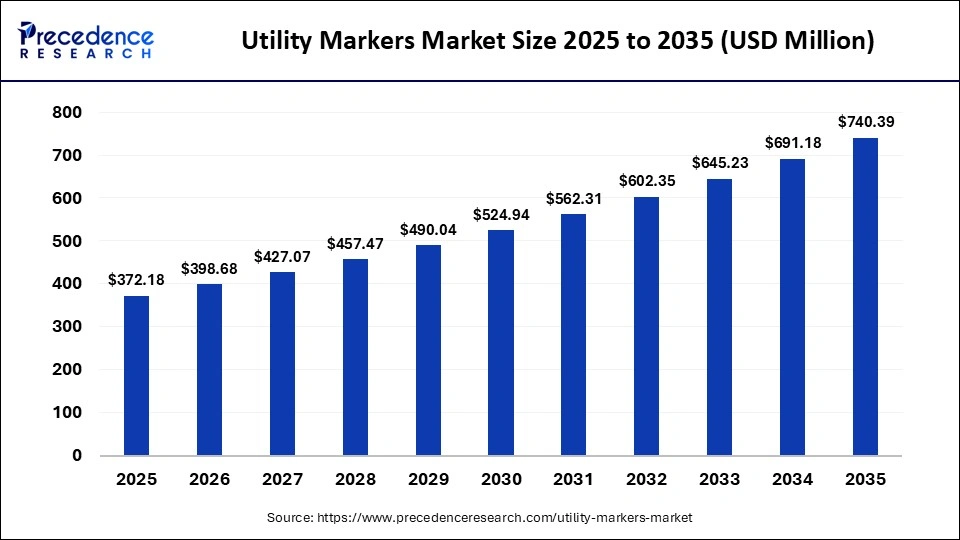
The global utility markers market size accounted for USD 372.18 million in 2025 and is predicted to increase from USD 398.68 million in 2026 to approximately USD 740.39 million by 2035, expanding at a CAGR of 7.12% from 2026 to 2035. The utility markers sector is witnessing unprecedented growth, driven by rapid urbanization, stringent environmental regulations, and rising investment in infrastructure modernization.
Market Highlights
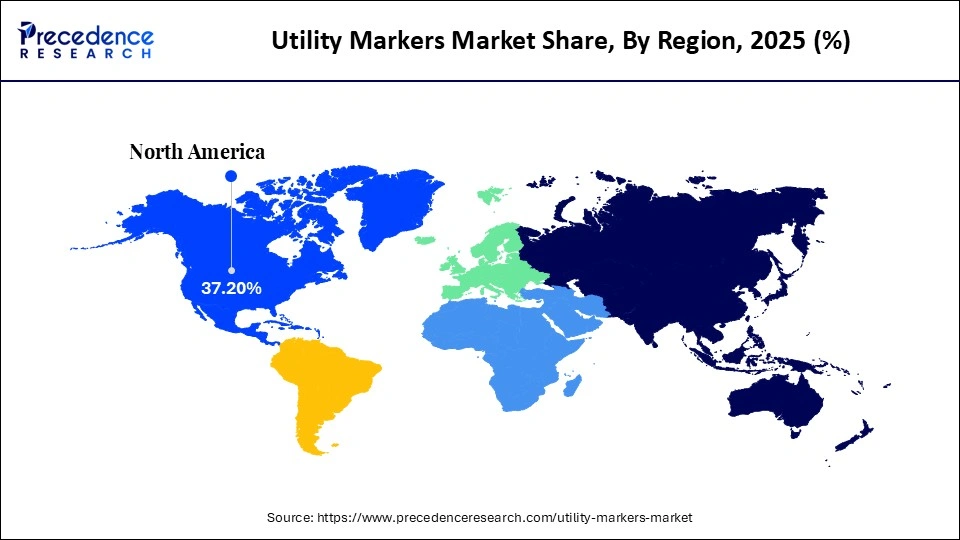
- North America dominated the market, holding the largest market share of 37.20% in 2025.
- The Asia Pacific is expected to grow at the fastest CAGR of 8.70% between 2026 and 2035.
- By product type, the ball markers segment contributed the biggest market share of 34% in 2025.
- By product type, the electronic/RFID utility markers segment is growing at a significant CAGR of 9.60% between 2026 and 2035.
- By material, the plastic/polymer segment held the major market share of 56.20% in 2025.
- By material, the composite/fiberglass segment is expanding at a strong CAGR of 7.90% between 2026 and 2035.
- By application, the underground utility identification segment captured the highest market share of 41.30% in 2025.
- By application, the utility mapping & surveying segment is set to grow at a notable CAGR of 8.50% between 2026 and 2035.
- By end user, the utility service providers segment accounted for the highest market share of 46.10% in 2025.
- By end user, the construction & engineering companies segment is growing at a solid CAGR of 7.20% between 2026 and 2035.
Defining the Utility Markers Market: Marking Technologies for Power, Water, Gas, and Telecom Assets
Utility markers are permanent identification markings or color-coded coatings used to indicate the location of underground utility lines before excavation, helping prevent accidental damage and safety incidents. They are typically applied as durable paints and coatings that are resistant to UV exposure, abrasion, moisture, and harsh environmental conditions, ensuring long-term visibility even in demanding outdoor settings.
These markers are used by construction firms and utility location contractors to permanently identify underground services such as gas, water, electricity, and telecommunications in areas where physical signage or surface markers are impractical. By clearly indicating buried infrastructure, utility markers improve site safety, reduce service disruptions, and support compliance with regulatory frameworks such as the Construction (Design and Management) Regulations, protecting contractors, workers, and surrounding assets during excavation activities.
AI in Utilities: Transforming Asset Management, Fault Detection, and Network Optimization
As the energy landscape shifts rapidly, the integration of Artificial Intelligence (AI) is significantly accelerating the growth of the utility sector. AI is uniquely positioned to address various challenges, such as aging infrastructure, demand volatility, regulatory pressure, data overload, cybersecurity threats, and evolving customer expectations. Aging grid infrastructure struggles to meet ongoing modern energy demands. AI allows utilities to modernize by using intelligent automation and predictive analytics to reduce maintenance costs, extend asset life, and optimize grid performance. AI-powered systems efficiently analyze real-time data from smart meters and sensors to balance loads, predict demand patterns, and prevent overloads. Major utility providers are increasingly leveraging AI agents and machine learning (ML) to manage aging infrastructure and meet rising electricity demands. By analyzing real-time sensor data, AI predicts potential equipment failures in advance, which reduces maintenance downtime.
Utility Markers Market Outlook
- Industry Growth Overview: Between 2025 and 2030, the industry is expected to experience accelerated growth. The growth of the market is driven by increasing regulatory focus on underground utility safety and risk mitigation, a surge in smart city projects, growing popularity of GPS-tracked, RFID-enabled, and IoT-enabled smart utility markers, and significant investment in upgrading aging infrastructure, such as energy, water, and wastewater.
- Global Expansion: Several leading players in the utility markers market are actively expanding their global footprint through various strategic initiatives, including collaborations, acquisitions, and new product launches. Companies are increasingly focusing on broadening their reach to cater to the global demand. For instance, in May 2025, Radiodetection, a leading provider of utility location solutions, launched its RF Marker ball (MRX) range; the MRX, MRX G, and MRX SG, a line of three innovative locators designed to improve the efficiency and accuracy of utility location. All RF marker locators integrate marker ball detection and utility locating functionality in one device.
- Major Investors: Prominent private equity firms, government bodies, and industry players are actively engaged in the utility markers market. Market players such as 3M Company, Radiodetection Ltd., and Hexagon AB are investing heavily in advanced technologies like RFID and GPS-enabled marking solutions, research and development (R&D), strategic acquisitions, and massive infrastructure funding to strengthen their market presence.
Market Scope
| Report Coverage | Details |
| Market Size in 2025 | USD 372.18 Million |
| Market Size in 2026 | USD 398.68 Million |
| Market Size by 2035 | USD 740.39 Million |
| Market Growth Rate from 2026 to 2035 | CAGR of 7.12% |
| Dominating Region | North America |
| Fastest Growing Region | Asia Pacific |
| Base Year | 2025 |
| Forecast Period | 2026 to 2035 |
| Segments Covered | Product Type, Material, Application, End User, and Region |
| Regions Covered | North America, Europe, Asia-Pacific, Latin America, and Middle East & Africa |
Segmental Insights
Product type Insights
What Causes the Markers Post Segment to Dominate the Utility Markers Market?
Marker Posts: The segment held the largest market share of 34% in 2025, as marker posts find application across various industries such as gas, power, telecommunications, wastewater, and water applications, owing to their durability, longevity, high visibility, ease of location, and versatility. Their spherical shape and various colors make them easily spotted. Industry players are increasingly focusing on offering programmable ball markers, as they can store critical information on the markers for reading later.
Electronic/RFID Utility Markers: This segment is expected to grow at a remarkable CAGR of 9.6% between 2026 and 2035, with growth driven by the growing need for accuracy and safety, government initiatives and regulations, and integration with advanced technology. Electronic and RFID markers provide valuable information on utility locations, significantly minimizing the risk of damage and accidents during construction or maintenance activities. Moreover, the rising integration of RFID systems with IoT and smart manufacturing technologies provides real-time data for better management.
Material Insights
Which Segment Is Dominated by the Material in the Utility Markers Market?
Plastic/Polymer: This segment is dominating the utility markers market by holding a majority share of 56.2%, with growth driven by the material's durability, versatility, and cost-effectiveness. Plastic materials are most extensively utilized for utility markers such as flags, tapes, and poles as they are strongly resistant to chemicals, extreme weather conditions, and moisture. Plastics allow for easy color coding and customization to meet utility identification standards across different regions and applications. Their lightweight nature also simplifies transportation, installation, and replacement during large-scale excavation and infrastructure projects.
Composite/Fiberglass: This segment is the fastest-growing in the utility markers market and is expected to grow at a remarkable CAGR of 7.90% between 2026 and 2035, owing to its high strength-to-weight ratio, durability, longevity, and resistance to corrosion and chemicals. Several manufacturers are increasingly incorporating innovative technologies, such as RFID chips and GPS integration, into composite markers for improving asset tracking and management. Moreover, the rising global investment in infrastructure development and government mandates for accurate utility location are anticipated to boost the demand for composite/fiberglass.
Application Insights
What Has Led the Underground Utility Identification Segment to Dominate the Utility Markers Market?
Underground Utility Identification: The segment dominated the utility markers market with a 41.3% share owing to the rapid urbanization, expansion of smart cities, renewable energy grids, and rollout of 5G telecommunications networks. Utility markers assist in preventing accidental damage during excavation, which can often lead to power outages, hazardous leaks, and high repair costs.
Utility Mapping & Surveying: On the other hand, this segment is a significant and rapidly growing application segment for the utility markers market. The growth of the segment is primarily driven by the increasing need for locating and mapping underground utilities like sewer, water, gas, electricity, and fiber optics before construction or excavation to prevent the risk of dangerous hits. The adoption of Ground Penetrating Radar (GPR), Electromagnetic (EM) locators, drones, and RFID for identifying underground pipes to prevent damage and improve safety in infrastructure projects of smart cities.
End-user Insights
What Causes the Utility Service Providers Segment to Dominate the Utility Markers Industry?
Utility Service Providers: The segment dominated the utility markers industry, with a 46.1% share as they manage extensive networks buried underground, requiring marking for continuous maintenance and new projects. Additionally, the telecom sector's rapid 5G deployment and increased high-speed internet have significantly increased the usage of utility markers. Frequent network upgrades, fiber rollouts, and repair activities require clear and durable identification of underground assets to avoid service disruptions. Utility markers also support faster fault location and safer excavation during telecom infrastructure expansion projects.
Construction & Engineering Companies: On the other hand, this segment is set to be the fastest-growing one with a remarkable growth rate of 7.20% between 2026 and 2035. Utility markers are crucial to prevent damage to buried infrastructure during excavation and construction activities. Moreover, the rise in global infrastructure development projects and supportive government regulations mandates the accurate marking of underground utilities, driving the growth of the segment during the forecast period.
Regional Insights
How Big is the North America Utility Markers Market Size?
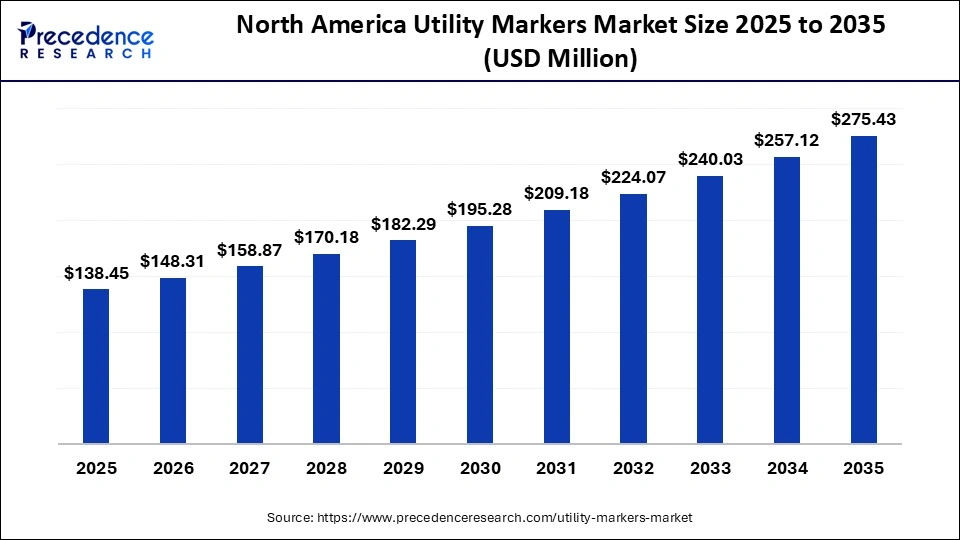
The North America utility markers market size is estimated at USD 138.45 million in 2025 and is projected to reach approximately USD 275.43 billion by 2035, with a 7.12% CAGR from 2026 to 2035.
What Has Led the North America Region to Dominate the Utility Markers Sector?
North America dominated the utility markers market in 2025, accounting for a majority revenue share of 37.20%. Growth in the region is driven by stringent safety and excavation regulations enforced by authorized bodies, alongside rising infrastructure development activity and substantial investment in power grid modernization and telecommunications expansion. These factors are increasing the need for accurate and durable identification of underground utilities across urban and industrial projects.
Regional growth is further supported by increasing adoption of smart utility marking technologies, including RFID- and GPS-enabled markers, which improve location accuracy, asset tracking, and maintenance efficiency. Utilities and contractors are using these advanced markers to reduce excavation errors, enhance compliance, and support long-term utility management across increasingly complex underground networks.
What is the Size of the U.S. Utility Markers Market?
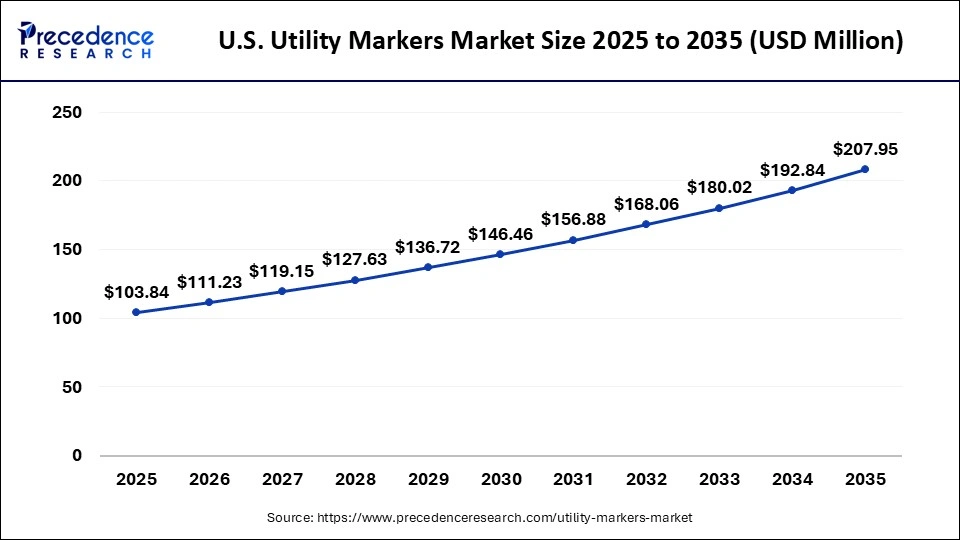
The U.S. utility markers market size is calculated at USD 103.84 billion in 2025 and is expected to reach nearly USD 207.95 billion in 2035, accelerating at a strong CAGR of 7.19% between 2026 and 2035.
United States' Utility Markers Industry Analysis
The United States leads the utility markers industry. The United States is a major contributor to the market in the North American region. The country is increasingly focusing on the development and infrastructure upgrades, stringent regulatory compliance, and increasing investments in various utilities like telecommunications, oil and gas, water & wastewater, and other utilities. The country also benefits from early adoption of sophisticated technologies like GPS-enabled and RFID markers, accelerating the growth of the country in the coming years.
How Is the Asia-Pacific Region the Fastest-Growing in the Utility Markers Market?
Asia-Pacific is projected to grow at the fastest CAGR of 8.70% in the utility markers market between 2026 and 2035. Regional growth is supported by rapid urban development, expanding industrial activity, and sustained infrastructure investment across countries such as China, India, Japan, South Korea, and Singapore. Large-scale projects involving transportation networks, power distribution, and telecommunications are increasing the need for accurate identification of underground utilities.
Growth is further reinforced by strict government regulations that mandate proper marking of buried infrastructure to improve excavation safety and reduce service disruptions. Utilities and contractors in the region are increasingly prioritizing durable and reliable utility markers to improve operational efficiency and comply with safety standards. Together, these factors are expected to drive strong demand for utility markers across Asia-Pacific during the forecast period.
How Is India Transforming the Utility Markers Sector?
India is experiencing significant growth with the utility markers sector's growth supported by the increasing infrastructure development, stringent government regulations for safety, and rapid adoption of smart technologies. The country's push for smart cities initiative, the expansion of 5G networks, and the Jal Jeevan Mission to provide household tap connections is expected to boost the market's expansion in the coming years. Moreover, the country's growth is largely driven by the rising investments in power grids and telecom projects, such as the deployment of 5G networks.
Is the European Region Responsible for Growth in the Utility Markers Market?
Europe's utility markers market is experiencing strong growth, supported by the region's focus on infrastructure modernization across telecommunications, power transmission, water, and gas networks. Ongoing upgrades to aging infrastructure are increasing demand for durable, high-visibility, and environmentally responsible utility marking solutions that can support long-term asset identification.
Growth is further driven by stringent safety regulations that require accurate utility location and mapping prior to excavation to prevent accidents, service disruptions, and infrastructure damage. Governments and regulatory bodies across Europe are reinforcing compliance with excavation safety standards, which is increasing the adoption of reliable utility markers. In addition, growing integration of IoT-enabled asset tracking, data-driven mapping platforms, and smart city technologies is strengthening demand for advanced utility marking solutions across urban development projects in the region.
The German Utility Markers Industry Analysis
Germany holds a substantial market share in the utility markers industry, with growth supported by the rise in large-scale infrastructure projects, increasing focus on complying with compliance with EU safety standards, and rapid adoption of smart/eco-friendly marking. The country is experiencing massive investments in renewable energy infrastructure, grid upgrades, and smart city initiatives for underground asset mapping and marking for telecom, electricity, gas, and water networks. These factors are accelerating the growth of the utility markers market during the forecast period.
Key Players in the Utility Markers Market
- 3M
- Utility Marking Services Inc.
- Gecko Group
- Raychem RPG
- SAE Systems
- Tempo Communications
- Cable Detection Ltd.
- Radiodetection Ltd.
- Seba Dynatrac
- Berntsen International
- Musco Lighting
- Cooper Industries
- H.D. Electric Company
Recent Developments
- In March 2024, Tempo Communications, a leading manufacturer of tools and test equipment for the telecommunication and location industries, announced the launch of the Spike Marker. It is designed to mark objects buried in soil up to one meter deep. The Spike Marker is an ideal, compact solution for marking a wide range of applications, including cable TV drops, fiber drops, traffic light control cables, and power or gas lines.(Source: https://www.tempocom.com)
- In December 2025, LUMINSEA, a marine technology company revolutionizing waterway safety with blockchain-powered smart channel markers and intelligent navigation systems, announced its first international installation and the expansion of its digital ecosystem through the LUMINSEA (LSEA) crypto utility token. In a partnership with Legendary Marina Resort at Blue Water Cay in Nassau, Bahamas, one of the most advanced marina developments in the Caribbean, LUMINSEA is deploying 22 next-generation illuminated smart channel markers as the foundation of a connected, tokenized waterway network.(Source: https://www.morningstar.com)
Segments Covered in the Report
By Product Type
- Ball Markers
- Marker Posts
- Marker Tapes
- Flag Markers
- Electronic/RFID Utility Markers
By Material
- Plastic/Polymer
- Metal
- Composite/Fiberglass
By Application
- Underground Utility Identification
- Utility Mapping & Surveying
- Construction & Excavation Safety
- Maintenance & Repair Activities
By End User
- Utility Service Providers
- Construction & Engineering Companies
- Municipal & Government Authorities
- Oil & Gas Companies
By Region
- North America
- Europe
- Asia-Pacific
- Latin America
- Middle East and Africa
For inquiries regarding discounts, bulk purchases, or customization requests, please contact us at sales@precedenceresearch.com
Frequently Asked Questions
Tags





Ask For Sample
No cookie-cutter, only authentic analysis – take the 1st step to become a Precedence Research client
 Get a Sample




 sales@precedenceresearch.com
 Schedule a Meeting
