



AI in Vision Market Trends, Companies, Revenue / Sales Performance, Subscriber Growth, Pricing Strategies, Cloud Adoption, Infrastructure Expansion, Competitive Landscape, and Industry Outlook
AI in Vision Market (By Service Type: Behavioral Analysis, Optical Character Recognition, Spatial Analysis, Image Recognition; By Technology: Machine Learning Generative AI; By Component: Hardware, Software, Services; By Vertical: Government, Banking and Finance, Consumer Electronics, Healthcare Transport/Logistics, Defense and Security, Others) - Global Industry Analysis, Size, Trends, Leading Companies, Regional Outlook, and Forecast 2026 to 2035
Source: https://www.precedenceresearch.com/ai-in-vision-market
 Get a Sample
 Table Of Content


What is the AI in Vision Market Size in 2026?
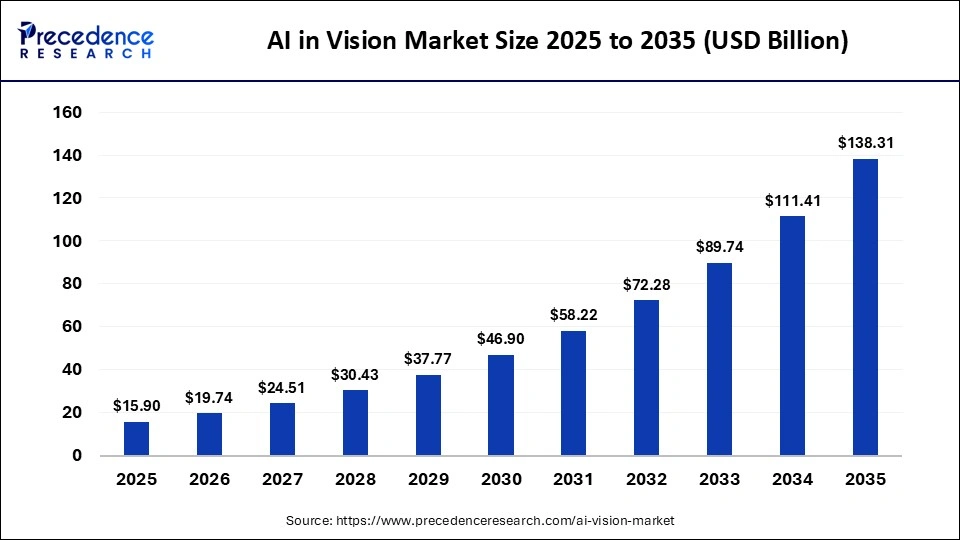
The global AI in vision market size was calculated at USD 15.90 billion in 2025 and is predicted to increase from USD 19.74 billion in 2026 to approximately USD 138.31 billion by 2035, expanding at a CAGR of 24.15% from 2026 to 2035.The market is driven by the growing adoption of computer vision and deep learning for automation and real-time image analysis.
Key Takeaways
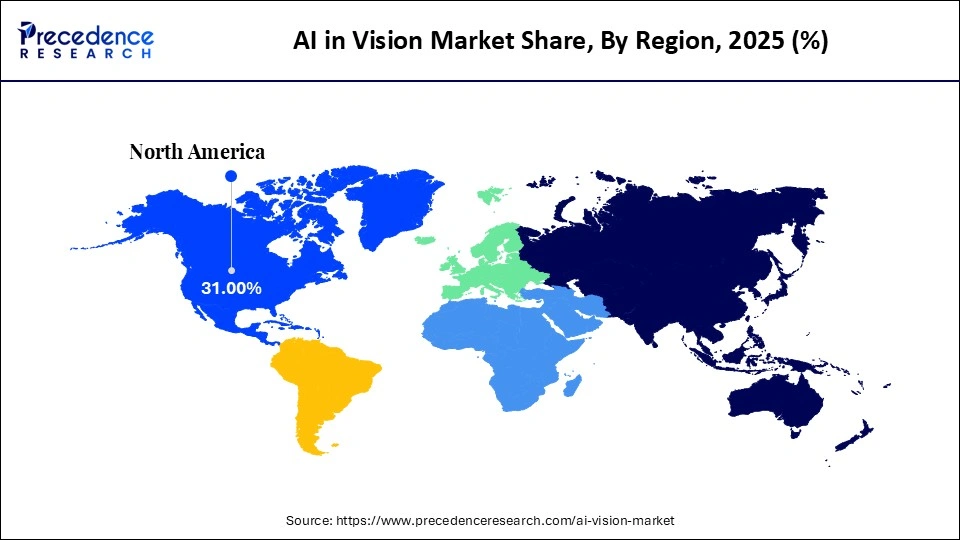
- North America led the market with the largest share of 31% in 2025.
- Asia Pacific is anticipated to grow at the fastest rate during the forecasted years.
- By service type, the image recognition segment held the largest market share in 2025.
- By service type, the behavioral analysis segment is anticipated to show the fastest growth in the market over the forecast period.
- By technology, the machine learning segment held the largest share of the market in 2025.
- By technology, the generative AI segment is anticipated to grow at the fastest CAGR in the market over the forecast period.
- By component, the hardware segment dominated the market in 2025.
- By component, the services segment is expected to grow rapidly in the market over the forecast period.
- By vertical, the consumer electronics segment held a major share of the market in 2025.
- By vertical, the banking and finance segment is expected to show rapid growth in the market over the forecast period.
Market Overview
The AI in vision market is expanding due to the rising use of intelligent visual analysis technologies to support efficiency, accuracy, and decision-making, which is gaining popularity among businesses. AI vision is a combination of artificial intelligence, machine learning, and computer vision that is used to process and analyze images and videos in real time to allow automated monitoring and analysis in various industries, including retail, healthcare, manufacturing, and automotive. The primary factor that is propelling the growth of the market is the increasing need for automation to reduce human interventions in critical operations. Companies are implementing AI-based vision systems in various applications, such as quality inspection, surveillance, and analyzing customer behavior, contributing to the market growth.
AI in Vision Market Trends
- The adoption of AI vision systems is growing rapidly across industries due to their ability to perform real-time image processing with low latency, improved data privacy, and greater operational efficiency.
- Rising integration of AI vision with IoT and smart sensors is likely to drive market growth. This conjunction enables seamless data collection, advanced analytics, and automated decision-making in smart factories, healthcare diagnostics, and intelligent transportation systems.
- There is a rising usage of AI vision in the healthcare sector to enhance early disease detection, robotic-assisted surgery, and advanced diagnostic imaging through more accurate deep learning models and increased digital healthcare investments.
- In the manufacturing sector, the demand for AI-driven quality inspection is rising to improve defect detection, reduce waste, and boost efficiency by enabling rapid scene analysis and predictive maintenance.
- The demand for facial recognition and behavioral analytics in retail and security sectors is driving applications that deliver superior customer insights, threat detection, and personalized experiences.
Market Scope
| Report Coverage | Details |
| Market Size in 2025 | USD 15.90 Billion |
| Market Size in 2026 | USD 19.74 Billion |
| Market Size by 2035 | USD 138.31 Billion |
| Market Growth Rate from 2026 to 2035 | CAGR of 24.15% |
| Dominating Region | North America |
| Fastest Growing Region | Asia Pacific |
| Base Year | 2025 |
| Forecast Period | 2026 to 2035 |
| Segments Covered | Service Type , Technology, Component, Vertical, and Region |
| Regions Covered | North America, Europe, Asia-Pacific, Latin America, and Middle East & Africa |
Segment Insights
Service Type Insights
Why Did the Image Recognition Segment Lead the AI in Vision Market?
The image recognition segment led the market, accounting for the largest revenue share in 2025 because it is widely applied across multiple industries, including manufacturing, healthcare, retail, and autonomous systems. Its ability to accurately detect objects, analyze scenes in real time, and support applications like quality inspection, diagnostic imaging, facial recognition, and threat detection has made it a key driver of AI vision adoption. In the retail sector, it is used for automated checkout and inventory tracking systems; in healthcare, it aids in radiotherapy and pathology image analysis; and in security, it supports facial authentication and threat detection applications. Additionally, advances in deep learning, increased computational power, and growing investments in AI technologies have further strengthened the dominance of the image recognition segment.
The behavioral analysis segment is expected to grow at the fastest CAGR over the forecast period due to the increasing demand for contextual and predictive information based on visual information. Vision-based behavioral analytics is used to determine foot traffic and store layout in retail, crowd safety in smart cities, and security in the workplace in corporations. Advanced video analytics systems leverage machine learning and process real-time video data to determine anomalies and signs of suspicious activity. The growth is further fueled by advancements in AI algorithms, deep learning, and smart camera technologies that allow real-time tracking and predictive analytics, making behavioral analysis more accurate and actionable.
Technology Insights
What Made Machine Learning the Dominant Segment in the AI in Vision Market?
The machine learning segment dominated the market by holding the largest share in 2025 because it enables systems to learn from vast amounts of visual data and improve performance over time without explicit programming. Such systems find application in the detection of objects, image segmentation, face recognition, and the detection of anomalies in diverse industries such as manufacturing, transportation, and healthcare. Additionally, advances in deep learning, increased computational power, and the availability of large annotated datasets have further strengthened machine learning's role as the foundation of most AI vision solutions.
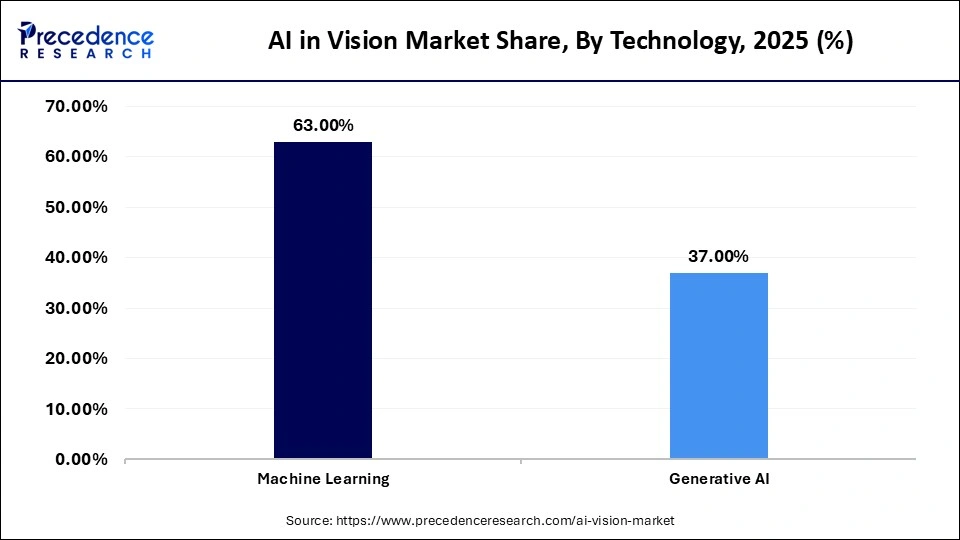
The generative AI segment is expected to grow at the fastest CAGR in the market throughout the forecast period. This is because it enables the creation of realistic images, videos, and simulations from minimal input data, opening new possibilities across industries. This capability addresses challenges such as limited labeled data, data privacy, and class imbalance, particularly in autonomous systems and medical imaging. Beyond data augmentation, generative AI can also be used to develop advanced simulation environments for robotics and self-driving cars, accelerating system validation and safety testing.
Component Insights
Why Did the Hardware Segment Lead the AI in Vision Market?
The hardware segment led the market while holding the largest share in 2025 because it is critical in enabling high-performance visual data processing. High-performance GPUs, AI accelerators, vision processors, and edge computing devices are key components of AI vision systems, which are used to handle computationally intensive workloads. These hardware components enable real-time analysis of high-resolution images and video streams with low latency, supporting applications in autonomous driving, industrial automation, and camera surveillance. Continuous advancements in semiconductor technology have also improved efficiency and reduced power consumption, allowing these systems to be deployed in mobile and compact devices.
The services segment is expected to grow at a significant CAGR over the forecast period. This is because organizations are increasingly relying on managed services, specialized consulting, and integration to effectively implement AI vision solutions within their IT ecosystems. Consulting services help identify high-impact use cases, develop tailored deployment strategies, and ensure interoperability with enterprise platforms. Managed services provide continuous monitoring, performance optimization, and model retraining, ensuring AI models remain accurate as data patterns evolve.
Vertical Insights
Why Did the Consumer Electronics Segment Contribute the Most Revenue in the AI in Vision Market?
The consumer electronics segment held the largest share of the market in 2025, driven by the widespread adoption of smart visual features in everyday devices. Smartphones, tablets, smart TVs, wearables, and home security systems increasingly incorporate AI vision functionalities such as facial recognition, AR filters, gesture recognition, and object tracking. These features enhance user convenience, personalization, and device security. Strong global demand for smart and connected devices has further fueled mass adoption, supporting continued growth in this segment.
The banking and finance segment is expected to grow at a rapid pace in the market due to increasing digitalization and heightened security requirements. Financial institutions are adopting AI vision technologies to enhance identity verification, fraud detection, and regulatory compliance. Facial recognition and document authentication systems streamline customer onboarding while reducing manual errors and operational costs. Additionally, AI vision–based behavioral analytics monitors branch environments and transactions in real time to detect suspicious activity.
Region Insights
North America AI in Vision Market Size and Growth 2026 to 2035
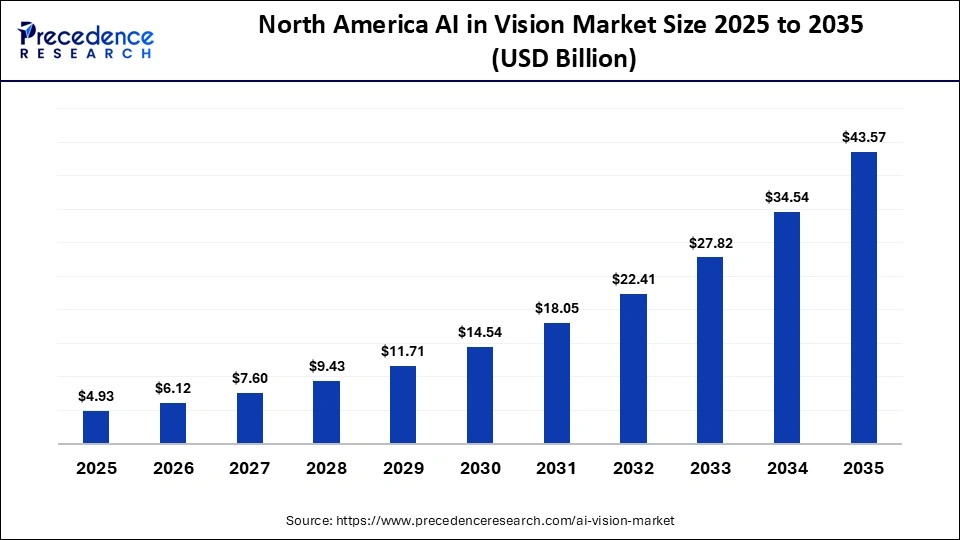
The North America AI in vision market size is estimated at USD 4.93 billion in 2025 and is projected to reach approximately USD 43.57 billion by 2035, with a 24.35% CAGR from 2026 to 2035.
What Made North America the Leading Region in the Global AI in Vision Market?
North America led the AI in vision market while capturing the largest share in 2025. This is mainly due to the presence of leading companies that deliver AI solutions and large investments in the research and development of artificial intelligence, boosting the development of advanced vision technologies. The presence of major AI vision technology providers, advanced semiconductor manufacturing, and widespread deployment of smart devices across consumer, industrial, and healthcare sectors further drive growth. Additionally, supportive government policies, well-established data privacy frameworks, and high demand for automation and security solutions contribute to North America's market dominance.
U.S. AI in Vision Market Size and Growth 2026 to 2035
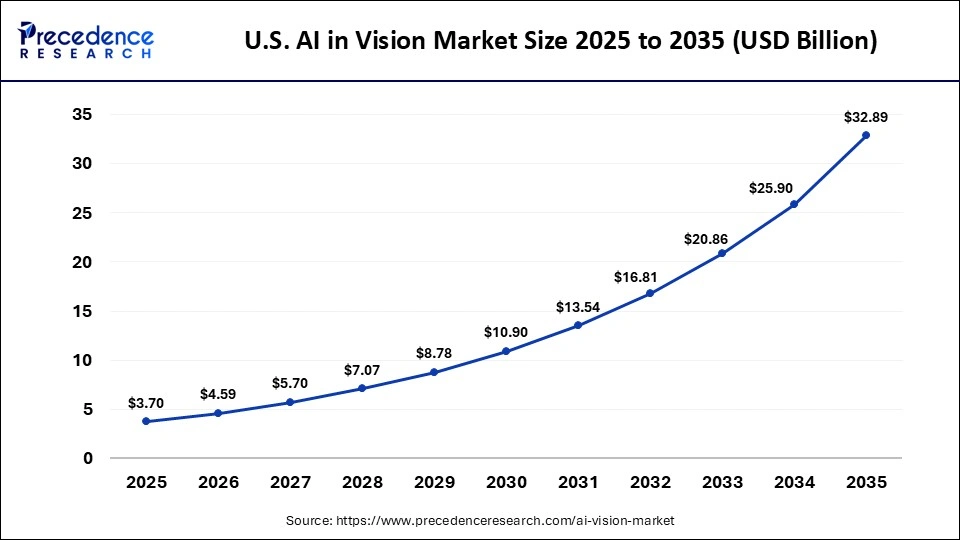
The U.S. AI in vision market size is calculated at USD 3.70 billion in 2025 and is expected to reach nearly USD 32.89 billion in 2035, accelerating at a strong CAGR of 24.42% between 2026 and 2035.
U.S. Market Analysis
The AI in vision market in the U.S. is growing due to widespread adoption of AI technologies across industries such as healthcare, manufacturing, retail, and automotive. Growth is driven by increased demand for real-time image processing, advanced surveillance, automation, and smart device integration. Additionally, strong technological infrastructure, high R&D investment, and supportive regulatory and reimbursement policies are fueling innovation and adoption of AI vision solutions.
Why is Asia Pacific Witnessing the Fastest Growth in the AI in Vision Market?
Asia Pacific is expected to grow at the fastest CAGR during the forecast period, owing to the expansion of digital ecosystems and active government support for AI vision initiatives. Countries such as China, India, Japan, and South Korea are investing heavily in smart city infrastructure, industrial automation, and healthcare modernization programs that leverage advanced visual analytics. Additionally, the region's large and technologically savvy consumer base is accelerating the adoption of AI-driven retail analytics, facial recognition, and intelligent transportation systems.
Why is the European AI in Vision Market Experiencing Notable Growth?
The market in Europe is expected to grow at a notable CAGR in the upcoming period, supported by well-developed regulatory frameworks emphasizing data protection and ethical AI use. Strict privacy regulations and disclosure requirements encourage secure and compliant AI solutions, fostering trust and driving enterprise adoption. Europe's established automotive industry is increasingly integrating AI vision into advanced driver assistance systems, safety surveillance, and automated production lines. Additionally, AI-powered imaging and diagnostics are gaining traction in healthcare, improving accuracy and patient outcomes.
AI in Vision Market Companies
- Intel Corporation
- Amazon Web Services, Inc.
- Clarifai, Inc.
- Google LLC
- IBM Corporation
- Basler AG
- Everseen Limited
- Microsoft
- NVIDIA Corporation
- Cognex Corporation
Recent Developments
- In June 2025, LuminX raised USD 5.5 million in seed funding to speed up the design of its warehouse robotic automation solutions with Artificial Intelligence. The investment will facilitate the commercialization of its edge-based vision-language models that aim at enhancing inventory accuracy, real-time monitoring, and supply chain efficiency.(Source: https://www.globenewswire.com)
- In June 2025, Made4net collaborated with Flymingo to improve the work of the warehouse with the help of AI-based computer vision integration. The partnership will enhance operational precision, compliance with the SOP, and provide more automation and real-time visibility of the supply chain processes.(Source: https://www.prnewswire.com)
- In March 2025, Samsung Electronics presented its renewed vision of AI Home during the Welcome to Bespoke AI event in Seoul, South Korea. The project incorporates the latest AI technologies into the linked home gadgets to enhance security, personalization, and quality non-interrupted smart home experiences.(Source: https://news.samsung.com)
Segments Covered in the Report
By Service Type
- Behavioral Analysis
- Optical Character Recognition
- Spatial Analysis
- Image Recognition
By Technology
- Machine Learning
- Generative AI
By Component
- Hardware
- Software
- Services
By Vertical
- Government
- Banking and Finance
- Consumer Electronics
- Healthcare
- Transport/Logistics
- Defense and Security
- Others
By Region
- North America
- Europe
- Asia-Pacific
- Latin America
- Middle East & Africa
For inquiries regarding discounts, bulk purchases, or customization requests, please contact us at sales@precedenceresearch.com
Frequently Asked Questions
Tags





Ask For Sample
No cookie-cutter, only authentic analysis – take the 1st step to become a Precedence Research client
 Get a Sample




 sales@precedenceresearch.com
 Schedule a Meeting
