






 Request Consultation
Introduction to the Global GPU Industry
The global graphics processing unit (GPU) industry is undergoing massive expansion, with the market expected to surpass hundreds of billions in the coming decade, largely driven by enterprise and data center expansion. Moreover, once simple tools for gaming graphics, GPUs have transformed into the core hardware base for modern technological advancement across AI, cloud computing, and even scientific research.
The explosive growth of generative AI and large language models requires parallel processing capabilities, which only advanced graphics processing units (GPUs) can provide. This continuous need for immense computational power has skyrocketed the need for GPUs across both model training and live enterprise applications. Tech giants, along with cloud providers, are pouring billions into creating hyperscale data centers. These firms continuously upgrade to the newest GPU architectures to manage both internal foundation model research and commercial workloads.
NVIDIA dominates the global GPU market, thus holding market share in data center AI workloads and discrete graphics. This leadership stems from its visionary "AI Factory" strategy, blending cutting-edge hardware, such as Hopper and Blackwell architectures, with the proprietary CUDA software ecosystem, creating a deep competitive moat.
Understanding the Evolution of the GPU Market
Over the last two decades, GPUs have changed from fixed-pipeline 3D rendering chips into massively parallel computing engines. By executing thousands of simultaneous tasks, they changed computing away from linear, sequential processing, historically dominated by CPUs, to become the undisputed backbone of modern AI, scientific computing, along with enterprise cloud infrastructure. GPUs have evolved from niche gaming chips into the most valuable semiconductor segment. Further, this transformation stems from a fundamental shift: continuous hardware innovation which multiplies parallel processing power is paired with a proprietary software ecosystem that enables developers to easily harness this performance for AI, machine learning, and even supercomputing.
Ecosystem builders offer pre-optimized libraries; for instance, cuDNN for deep learning, tailored for specific workloads. This allows researchers and enterprises to deploy highly complex AI algorithms without mastering hardware design.
What is Graphic Processing Unit (GPU) Market Size?
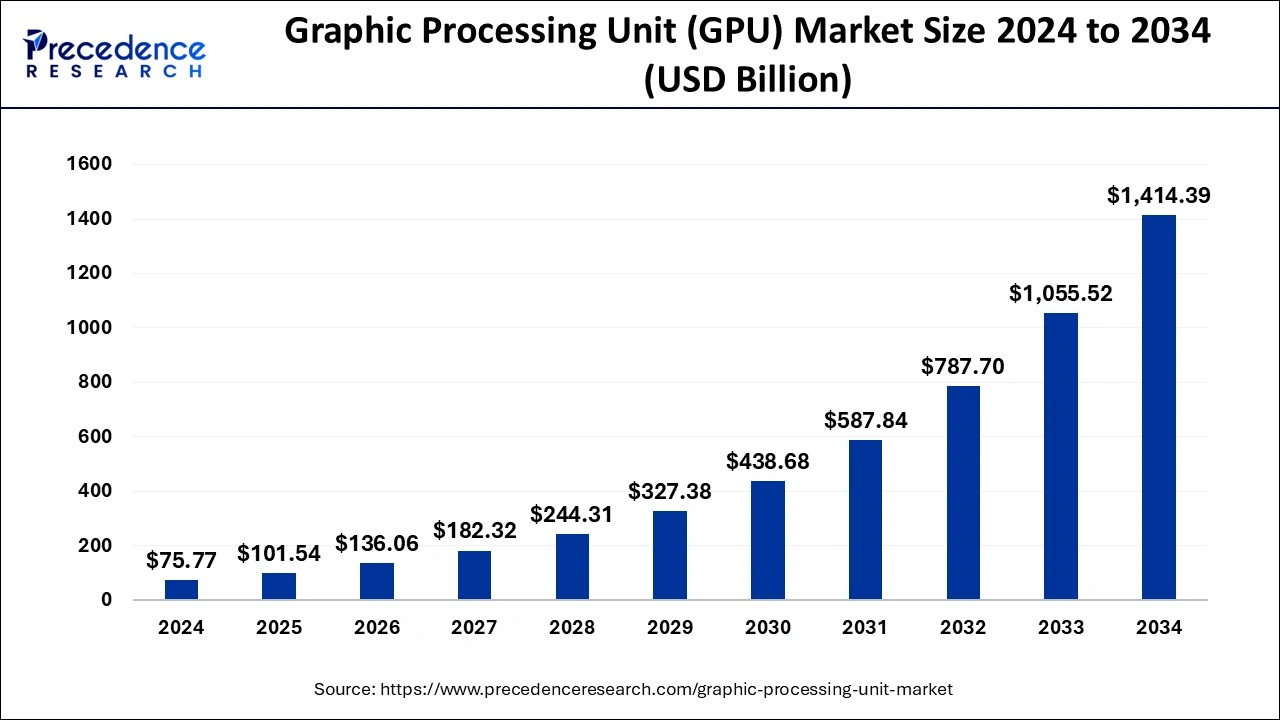
The global graphics processing unit (GPU) market was valued at USD 101.54 billion in 2025 and is projected to grow from USD 136.06 billion in 2026 to approximately USD 1,712.56 billion by 2035, registering a CAGR of 32.62% during the forecast period from 2026 to 2035. This remarkable growth is driven by increasing demand for GPUs across AI applications, gaming, data centers, and high-performance computing, along with rising sales of portable electronic devices and the expanding adoption of the Internet of Things (IoT) and wearable technologies.
Get a Free Sample Report with Key Market Trends: https://www.precedenceresearch.com/sample/1096
From Gaming Graphics to Artificial Intelligence Acceleration
The evolution of the GPU represents one of the most remarkable pivots in computing history, transforming the chip from a specialized user gaming accelerator into the foundational hardware for enterprise AI factories, cloud computing, along with high-performance computing. Cloud providers, for example, AWS and Google Cloud, built specialized, GPU-powered cloud environments. These services enable organizations to rent high-end hardware for specific machine learning tasks without bearing the capital cost of purchasing physical servers. Moreover, GPUs power the world's top scientific supercomputers. They tackle complex simulations in fields such as molecular dynamics, meteorology, and astrophysics.
Why GPUs Have Become the Foundation of Modern Computing
GPUs are thus indispensable across modern industries because their thousands of cores divide massive, complex workloads into thousands of concurrent tasks. This parallel processing, combined with dedicated AI acceleration, and delivers unmatched computational throughput while optimizing energy consumption per watt. It processes real-time sensor and video data in autonomous vehicles. Engineers utilize GPU clusters to run complex virtual crash simulations and aerodynamics tests, improving safety and design.
Key Drivers Accelerating Global GPU Demand
The explosion of artificial intelligence fundamentally drives the fast adoption of graphics processing units (GPUs), shifting data center economics and even increasingly immersive digital environments. GPUs are uniquely built with highly parallel processing architectures, which enable them to process thousands of tasks simultaneously, thus making them the indispensable "brains" powering modern high-performance computing (HPC) and deep learning workloads. Intelligent agents demand constant context retrieval (RAG) and reinforcement learning training loops. GPU clusters enable enterprise bots to interpret unstructured text, automate customer support, along with execute workflows seamlessly.
High-end consumer GPUs, along with cloud-based GPUs powering game-streaming services, process complex geometry, lighting, and even real-time physics to render photorealistic virtual environments for players.
GPU Market Segmentation by Application and End-User Industry
The GPU market is segmented by product categories like integrated, discrete, workstation, deployment models such as on-premises, cloud, or GPU-as-a-Service, computing workloads such as AI training or inference, HPC, and industry applications. The need is shaped by the scalability of AI across sectors and an accelerated convergence of AI and consumer gaming. Demand is centered around Edge-AI, smart cities, and also automated manufacturing. Demand is for highly specialized, ruggedized GPUs capable of real-time sensor processing and even predictive maintenance.
Consumer graphics architectures utilize built-in, hardware-based AI processors to drive AI upscaling and neural rendering, for example, NVIDIA's DLSS or AMD's FSR. This enables gamers to achieve higher resolutions and frame rates while reducing raw power demand.
Gaming and Consumer Graphics
These markets form an interconnected ecosystem as modern high-fidelity gaming, esports, virtual reality (VR), and content creation all need highly specialized, computationally heavy hardware. As developers push visual and interactive boundaries, user demand shifts from standard, integrated computing to premium hardware. Moreover, video editors, 3D modelers, and live streamers need the same heavy-duty hardware as gamers. Rendering 4K video or streaming while running a game demands powerful processors, massive amounts of RAM, and hardware-accelerated encoding from a discrete GPU.
Data Centers and Artificial Intelligence Infrastructure
GPUs accelerate AI because their massively parallel architecture, thus, featuring thousands of compute cores, can execute the thousands of simultaneous matrix calculations demanded for deep learning exponentially faster than traditional CPUs. Researchers utilize GPU superclusters to tackle complex scientific problems. GPUs offer the massive raw compute required for high-performance computing (HPC) tasks such as molecular dynamics, climate modeling, and genomic sequencing.
Professional Visualization and Workstations
GPUs act as massively parallel processors which accelerate complex mathematical and even geometric calculations. By dividing heavy workloads across thousands of small, efficient cores, they dramatically reduce the time demanded to render photorealistic visuals, run physical simulations, and process huge datasets compared to traditional, sequential CPUs. GPU-accelerated algorithms quickly iterate via thousands of design variations to optimize for weight, strength, and material usage.
GPUs process vast amounts of data from MRI, CT, and X-ray scans, allowing doctors to instantly reconstruct high-resolution 3D models of internal organs and even quickly detect anomalies.
Automotive, Robotics, and Edge AI
Deploying GPUs at the edge offers ultra-low latency, localized decision-making, and even high-bandwidth data triage. Instead of streaming massive raw sensor feeds to the cloud, GPUs thus, installed directly on autonomous machines and edge nodes allow real-time machine learning inference for safety-critical systems, operational efficiency, along with rapid threat detection. Deployments involve AI-enabled edge cameras and even localized GPU servers that process video streams at the point of capture. This enables for instant threat detection, facial recognition, and also behavioral analysis while saving bandwidth and preserving data privacy.
NVIDIA and the Leading GPU Companies
The world's leading GPU producers, NVIDIA, AMD, and Intel, drive the trillion-dollar semiconductor industry via relentless architectural innovation, strategic manufacturing partnerships, and unified AI software ecosystems. NVIDIA pioneered the modern AI renaissance by integrating specialized hardware such as Tensor Cores and Transformer Engines directly into its GPU architectures, thus driving massive parallel processing throughput. NVIDIA dominates hyperscaler deployments, directly collaborating with cloud providers such as AWS and Google Cloud to deploy its DGX Cloud infrastructure. AMD focuses on heterogeneous computing and embedded systems, thus notably expanding its enterprise capabilities via its strategic acquisition of Xilinx.
NVIDIA
NVIDIA has transformed from a gaming GPU firm into a full-stack AI infrastructure powerhouse. It dominates by integrating silicon, networking, software, along with cloud services. Its absolute revenue continues to grow despite rising competition. Thus, CUDA is NVIDIA's most formidable competitive advantage, creating massive switching expenses. By shifting from imperative to declarative APIs, CUDA libraries, such as cuBLAS, allow for "kernel fusion," overcoming memory bottlenecks to improve AI model training and inference. NVIDIA's Data Center market platform serves as the main revenue driver, reaching record levels. Products range from HGX and DGX systems to MGX platforms, optimized to deliver high computational density for large language models along with agentic AI workloads.
AMD (Advanced Micro Devices)
AMD has transformed into an end-to-end computing powerhouse, thus directly challenging NVIDIA. By executing a dual-architecture strategy, like RDNA for consumer gaming, CDNA for data centers, and then moving toward an upcoming unified UDNA architecture, AMD offers specialized, open-source-driven hardware across all segments. The CDNA architecture is purpose-built for exascale High-Performance Computing (HPC) and AI. Moreover, the Instinct MI400 series features HBM4 memory and the CDNA Next architecture, thus doubling compute capability over previous generations for large-scale training and inference. AMD is combating CUDA's supremacy with the ROCm open-source software stack, making it easier for developers to transition workloads without being locked into a proprietary ecosystem.
Intel
Intel's GPU and AI strategy aims at an open, hardware-agnostic software ecosystem powered by localized manufacturing. Intel focuses on bridging AI from edge devices to enterprise servers, utilizing Xe architectures for scale and then cost-efficiency compared to high-end alternatives. Intel has cultivated a vast open ecosystem, partnering with IBM Cloud for Gaudi 3 deployments. They have additionally allied with OEM leaders such as Dell, HPE, and Lenovo, alongside establishing open standards alliances with SAP and Red Hat for secure enterprise GenAI.
Qualcomm
Qualcomm is aggressively changing from a mobile-centric chipmaker into a diversified edge-AI platform company. Its unified graphics, computing, and even AI strategy scales custom architectures across PCs, vehicles, smartphones, and spatial computing to deliver desktop-quality performance and on-device generative AI.
Apple
Apple’s custom GPU architecture and system-on-chip design offer a massive leap in processing efficiency. By tightly coupling the GPU with the CPU along with the neural engine via a unified memory architecture, Apple bypasses traditional data transfer bottlenecks, thus fundamentally transforming hardware, software, and AI capabilities. Apple’s proprietary graphics and compute API offer low-level hardware access, allowing developers to scale workloads smoothly across iPhone, iPad, and Mac. As Apple designs both the hardware and the operating system, like macOS or iOS, they maintain control over the entire stack. Features like temporal upscaling and spatial audio utilize this deep integration to operate efficiently.
Imagination Technologies
Imagination Technologies’ PowerVR is an industry-leading semiconductor intellectual property provider, thus renowned for its highly efficient embedded graphics and AI accelerators. The firm operates as a fabless IP licensor, dominating automotive and even embedded markets via its unique architectural advantages, robust functional safety features, and then flexible neural network accelerators.
ARM
ARM’s comprehensive compute IP spans a wide range of markets from mobile graphics to embedded IoT to data centers. By leveraging flexible licensing models, collaborative partnerships, and even scalable architectures, ARM continues to drive energy-efficient along with highly customized semiconductor solutions across the global tech industry.
Moore Threads
Moore Threads is central to China’s drive for semiconductor self-reliance; the Beijing-origin firm provides homegrown “universal” GPUs, vast AI data center clusters, and then vertically integrated developer suites to counter Western technology export restrictions.
Biren Technology
Biren Technology specializes in general-purpose graphics processing units along with scalable high-performance computing clusters. Their strategy centers on achieving technological self-sufficiency and bridging the gap for domestic clients thus affected by U.S. export controls on advanced AI chips.
NVIDIA's Market Leadership and Competitive Advantages
NVIDIA’s sustained dominance in AI infrastructure and accelerated computing stems from a strategic, "full-stack" flywheel which ties together cutting-edge hardware, an entrenched proprietary software ecosystem, and even vital manufacturing relationships. This unified approach creates high barriers to entry and massive switching expenses for competitors. The proprietary CUDA parallel computing platform is the industry standard, enabling developers to utilize GPUs for general-purpose processing. NVIDIA layers vertical-specific software on top of this, like NVIDIA Omniverse for industrial simulation, to create full-stack solutions.
NVIDIA goes beyond individual chips by providing integrated networking and system architecture, for instance, NVLink and InfiniBand. This enables data centers to scale tens of thousands of GPUs seamlessly, optimizing the total expense of ownership per token.
CUDA Software Ecosystem and Developer Leadership
NVIDIA’s competitive edge depends on a "flywheel effect" driven by the CUDA Platform. Over 17 years of continuous optimization have made CUDA the universal standard for AI development, thus resulting in a self-reinforcing network of developers, libraries, and even frameworks that makes switching to rival hardware both costly and complex. NVIDIA's moat relies heavily on optimized, closed-source libraries such as cuDNN, cuBLAS, and NCCL. These pre-built math kernels guarantee that complex AI computations run at peak efficiency, requiring huge resources for competitors to replicate.
AI Infrastructure and Data Center Dominance
NVIDIA has changed from a semiconductor manufacturer into a full-stack AI platform provider. By tightly coupling proprietary hardware for example, Blackwell and Rubin architectures, advanced networking (Spectrum-X), along with AI-native software (NVIDIA AI Enterprise), NVIDIA powers hyperscale AI factories, enterprise private clouds, along with sovereign-AI projects globally. It overcomes bandwidth bottlenecks using platforms such as Spectrum-X Ethernet and BlueField DPUs, thus, delivering massive throughput and power efficiency for scale-out AI clusters. It delivers on-demand supercomputing via NVIDIA DGX Cloud and partnerships with top-tier public cloud providers.
Innovation Through Hardware and Software Integration
NVIDIA integrates its hardware and software into an end-to-end "AI Factory" ecosystem. By high-speed networking fabrics, co-designing specialized GPUs, and optimized system architectures with comprehensive developer tools, software stack, and enterprise cloud solutions, it enables organizations to scale AI workloads and generate "intelligence" seamlessly.
Market Share Analysis of Leading GPU Companies
The GPU market is dominated by NVIDIA, AMD, and Intel, with Intel dominating volume with integrated graphics. NVIDIA leads in high-margin AI and data center segments. AMD holds the console market and maintains strong positions in user and enterprise hardware.
Consumer and Gaming GPU Market Share
The consumer GPU market is dominated by three semiconductor giants: NVIDIA, AMD, and Intel. Each producer targets different hardware segments across laptops, desktops, and integrated graphics to secure market share. NVIDIA's high-efficiency laptop GPUs, for example, RTX Max-Q lineup, control the premium gaming laptop space. AMD offers strong mobile APUs that combine capable graphics with competitive battery life. Intel also features thus, heavily in this segment, with its Core processors pairing integrated graphics or their own discrete Arc mobile chips. Moreover, integrated GPUs hold the largest absolute market share by volume because of widespread enterprise and casual laptop adoption. However, dedicated gaming laptops are seeing the highest expansion rate, as buyers prioritize portability alongside AI-powered features such as DLSS.
AI Accelerator and Data Center GPU Market Share
Market leadership across hyperscale cloud, supercomputing, enterprise AI, and training infrastructure is defined by a vast arms race in GPU cluster scale, proprietary silicon, and even energy-efficient data center architectures. Providers are decreasing reliance on third-party silicon by deploying custom accelerators. Further, AWS is leveraging Trainium, while Google leads with TPU architectures to improve both training and inference. Enterprises need faster time-to-production without building data centers from scratch. Partnerships such as HPE Private Cloud AI offer integrated hardware-software appliances that limit Total Cost of Ownership.
Mobile and Embedded GPU Market Share
- Qualcomm: A fabless semiconductor giant that offers Snapdragon processors, modems, and also connectivity components. While known for mobile (Android), they have thus heavily expanded into automotive telematics or ADHD and edge IoT.
- Apple: Designs custom, Arm-origin processors. Apple focuses on vertical integration and coupling hardware architecture tightly with their own operating systems.
- Arm: Arm develops and licenses fundamental instruction set architectures, like the Cortex series. They do not produce chips but design the power-efficient blueprints utilized by almost all mobile and embedded devices.
- Imagination Technologies: A British semiconductor IP firm that specializes in designing GPUs, such as the PowerVR series, AI accelerators, and even CPU cores for mobile, automotive, and consumer tech.
Competitive Landscape of the Global GPU Industry
The GPU market is defined by a three-way battle among NVIDIA, AMD, along with Intel.
NVIDIA
- Strengths: Unrivaled parallel compute software ecosystem (CUDA), first-mover advantage, along with massive generative AI model deployment.
- Weaknesses: Extremely high hardware expenses for clients; reliant on TSMC for manufacturing.
- Opportunities: Extending the moat into sovereign robotics, AI infrastructure, and DGX Cloud services.
- Threats: Intensifying US-China export restrictions along with the rise of custom, in-house ASICs by hyperscalers for example, Google, Amazon.
AMD
- Strengths: High memory bandwidth along with large VRAM capacities on Instinct Accelerators; thus, excellent CPU-to-GPU ecosystem synergy.
- Weaknesses: Late acceptance of a unified, mature, open-source AI software layer compared to CUDA.
- Opportunities: Capturing the massive and rising enterprise AI inference market where costs are scrutinized.
- Threats: Competitor lock-in to NVIDIA hardware along with an accelerating trend of hyperscalers developing their own custom silicon.
Comparison Based on GPU Architecture and Technology Innovation
- Architectural Advancements: The industry has moved away from the "one-size-fits-all" computing approach, changing toward heterogeneous designs and domain-specific architectures. Advanced packaging techniques, like Intel Foundry EMIB, utilize high-speed silicon bridges to link specialized chiplets, decreasing data path lengths and significantly lowering latency.
- AI Acceleration Capabilities: The focus has expanded beyond GPUs to dedicated Neural Processing Units (NPUs) along with Application-Specific Integrated Circuits (ASICs). Frameworks now tightly couple hardware with optimized dataflows and then software stacks programmed specifically for deep neural network operations.
- Computing Performance: Peak compute power has exploded, driven by architectural changes to manage massive parallel processing. Modern processors use dense tensor cores and matrix-multiply units to accelerate deep learning training along with inference.
- Memory Technologies: To prevent the infamous "memory wall," developers are deploying high-bandwidth solutions. Technologies such as HBM3e and Compute Express Link (CXL) enable memory disaggregation, pooling, and massive bandwidth increases over standard DDR5. In addition, innovations in compute-in-memory (CIM) and non-volatile memory, such as MRAM, are being tested to eliminate data transfer delays.
Comparison Based on Software Ecosystems and Developer Support
CUDA (NVIDIA)
- Type: Proprietary hardware-software co-programmed parallel computing platform.
- Architecture: Tailored exclusively to aim NVIDIA GPUs and their microarchitectures.
- Current Status: Serves as the gold standard for AI acceleration, thus, capturing the vast majority of enterprise training workloads.
- Libraries: Feature-rich ecosystem which includes NVIDIA cuDNN for deep neural networks, cuBLAS for linear algebra, and even TensorRT for optimized runtime deployment.
ROCm (AMD)
- Type: Radeon Open Compute, an open-source, community-based compute platform.
- Architecture: Mainly powers AMD Instinct server accelerators and also high-end Radeon desktop graphics cards.
- Current Status: Gaining vast ground in enterprise data centers due to cost-effective alternatives such as the MI300X, backed by mature out-of-the-box PyTorch and even vLLM tooling.
- Libraries: Features AMD MIOpen (mirroring cuDNN) along with rocBLAS. It uses the HIP translation layer so developers can now compile CUDA source code cleanly for AMD hardware.
Comparison Based on Product Portfolio Diversification
Companies driving the global GPU and semiconductor market are categorized by the important areas of industry specialization. These companies design or manufacture the critical hardware driving artificial intelligence, gaming, and automotive computing.
- Qualcomm: Industry leader in mobile processing. They now develop Snapdragon processors featuring Adreno GPUs, Snapdragon Ride, and low-power AI accelerators for edge devices.
- Imagination Technologies: A specialized silicon IP firm focusing on PowerVR GPUs as well as embedded and even automotive graphics.
- Arm: It offers intellectual property (IP) architectures. They program Immortalis and Mali GPUs, which are licensed to power billions of mobile, embedded, along with automotive devices globally.
- Cerebras Systems: It develops massive, wafer-scale AI accelerators marketed as powerful options to traditional GPUs for training heavy AI models.
Investments Driving GPU Innovation and Market Expansion
To maintain long-term competitiveness, GPU firms invest holistically across the entire technology stack. As hardware performance is fundamentally constrained by physics, the semiconductor industry has changed from selling standalone chips to delivering highly integrated, software-defined AI platforms. Advanced packaging is the new bottleneck in semiconductor manufacturing. Firms pay a premium to secure capacity. They invest in high-density integration, such as TSMC's CoWoS, to place GPUs and High-Bandwidth Memory (HBM) on the same silicon substrate. This tightly combined packaging solves data-transfer bottlenecks, allowing models to feed data into processing units at blistering speeds.
Research and Development Investments
Companies such as NVIDIA are pushing past traditional limits with multi-die platforms, such as the NVIDIA Blackwell Architecture and DGX Platforms, to improve enterprise compute and model development. Meanwhile, Cerebras combined with Tesla are pioneering wafer-scale compute to condense massive data center servers. Moreover, electrical copper interconnects are struggling to meet the bandwidth along with energy demands of large-scale AI. To solve this, firms are heavily backing silicon photonics and even co-packaged optics, which utilize light to move massive volumes of data with lower latency and even higher energy efficiency.
Strategic Partnerships and Manufacturing Collaborations
United Software Solutions drives technological scalability via its cloud-native integrations, AI-powered systems, and global delivery model. The firm collaborates across the technology ecosystem, working with hardware foundries, enterprise software platforms, hyperscale cloud providers, AI innovators, and system integrators.
Acquisitions Expanding Technology Capabilities
Strategic acquisitions are fundamentally thus, reshaping the tech industry's value chain. Major players are buying firms across compute, data, and power to secure long-term AI dominance, with 2026 M&A activity surpassing historic highs. Tech giants are attempting to decrease their reliance on Nvidia by buying or partnering with custom silicon and logic startups. For instance, Apple is actively evaluating semiconductor startup deals to boost its AI server infrastructure, while AMD obtained ZT Systems to accelerate data center compute scaling.
Industry Applications Driving GPU Adoption
Accelerated computing uses specialized hardware, mainly Graphics Processing Units (GPUs), to offload compute-intensive tasks from traditional CPUs and execute thousands of calculations simultaneously. Moreover, GPUs process massively parallel operations and accelerate data science workflows. This processing power drives breakthroughs in artificial intelligence, digital design, along with simulation across major industries.
- Healthcare & Life Sciences: Medical institutions and biotechnology companies utilize GPU compute to rapidly sequence genomes and train diagnostic AI models for medical imaging, alongside simulating complex molecular dynamics for drug discovery.
- Manufacturing & Automotive: Industry 4.0 applications depend on GPUs for computer vision-based quality control, autonomous vehicle training, predictive maintenance of heavy machinery, and finite element analysis.
- Banking, Financial Services, and Insurance (BFSI): Financial institutions deploy GPU-accelerated algorithms to determine transaction streams, execute high-frequency algorithmic trading, score creditworthiness, along with process massive datasets for risk management and fraud detection.
Artificial Intelligence and Machine Learning
AI models depend on training and inference. Large language models (LLMs) combine with Generative AI to use these phases to understand and even generate text or code, while recommendation engines curate personalized experiences. Moreover, enterprise AI applications integrate these tools to automate workflows and also drive autonomous operations.
Scientific Research and High-Performance Computing
GPUs power modern high-performance computing by processing thousands of tasks simultaneously. Their parallel architecture accelerates highly complex, data-heavy workloads across science along with engineering, transforming weeks of CPU-bound computations into simulations that complete in hours.
Healthcare and Medical Imaging
GPU acceleration powers the convergence of AI and medicine, thus processing massive, complex datasets at unprecedented speeds. Platforms such as NVIDIA Clara deliver open-source tools, pre-trained models, along with pipelines that reduce diagnostic delays, accelerate drug delivery, and improve precision care globally.
Automotive and Autonomous Mobility
GPU technologies are the foundational engines that are driving the future of intelligent mobility. They offer the massive parallel processing power required to train complex deep learning networks, simulate rare-edge driving scenarios utilizing digital twins, and run real-time perception and even reasoning models inside the vehicle.
Media, Entertainment, and Gaming
GPUs function as the main engines for real-time parallel processing, transforming the limits of visual computing. They allow creators to instantly render complex 3D scenes, process AI-driven upscaling, simulate physics, and output interactive, high-fidelity graphics across numerous media and entertainment sectors.
Emerging Trends Reshaping the GPU Industry
Rapidly scaling generative AI along with the physical limits of Moore's Law are forcing a complete overhaul of GPU development. Major trends involve the shift toward edge AI for local processing, chiplet architectures bypassing monolithic design constraints, along with massive infrastructure investments to satisfy the need for sovereign AI. Soaring data center electricity consumption has spurred innovations in algorithmic energy efficiency, dynamic power management, and direct-to-chip liquid cooling. Energy management is now designed from the rack level downward.
Generative AI Is Redefining GPU Demand
Continuous advancements in AI are creating an insatiable demand for massive parallel processing hardware. Foundation models, multimodal AI, AI assistants, enterprise deployments, and AI infrastructure investments multiply GPU need by requiring exponential increases in both the raw compute demanded for initial training and the continuous, low-latency processing required for user interactions. Processing text, video, audio, and live sensor data simultaneously needs advanced tensor operations that map directly to GPU parallelism. Tools like generative video models demand extreme tensor bandwidth.
Hyperscale cloud providers, enterprise IT teams, along with specialized providers, are rapidly expanding their footprints. Moreover, massive capital is being poured into building purpose-built AI data centers, accepting liquid cooling, and deploying high-speed networking to prevent GPU starvation.
Energy Efficiency and Sustainable Computing
Data centers are tackling surging processing requirements with comprehensive efficiency upgrades. Power optimization uses AI-driven load management and predictive software to balance grids dynamically. Advanced cooling changes to direct-to-chip liquid and immersion systems, decreasing cooling energy by up to 20% compared to air. Efficient architectures focus on high-density silicon and also modular hardware, while sustainable operations prioritize waste heat recovery and renewable microgrids.
Modern uninterruptible power supply (UPS) units utilize lithium-ion batteries and advanced monitoring to decrease energy loss during conversion, while also participating in grid-balancing programs.
Challenges Facing GPU Manufacturers
The GPU and semiconductor industry is in the midst of an unprecedented paradigm shift. To sustain vast infrastructure deployment amidst severe manufacturing bottlenecks and geopolitical fragmentation, leading firms are aggressively diversifying their foundries, developing open-source software, thus, building highly specialized application-specific integrated circuits (ASICs), and shifting toward modular chip architectures. Entrenched proprietary software platforms, such as NVIDIA's CUDA, previously locked in developers, forcing competitors to spend years developing viable open-source alternatives.
Supply Chain and Manufacturing Constraints
The global semiconductor supply chain remains highly vulnerable, mainly driven by explosive AI infrastructure demand, extreme regional concentration, along with capacity limits. Bottlenecks at foundries, advanced packaging facilities, and even memory plants are forcing OEMs to navigate prolonged allocation constraints and also escalating component costs. An unprecedented memory crisis is unfolding as manufacturers aggressively change DRAM and NAND production toward high-margin high bandwidth memory for AI data centers. Major suppliers thus, have already pre-sold available capacity, creating severe allocation difficulties for consumer electronics and automotive manufacturers.
Increasing Competition in AI Accelerators
Custom AI chips and specialized silicon such as ASICs, TPUs, and NPUs are shattering the traditional data center monopoly. By bypassing general-purpose processors, these workload-specific accelerators deliver massive leaps in watts, TFLOPS, and bandwidth. Next-gen companies, for example, Tenstorrent, Cerebras, along with SambaNova are tackling the memory and compute bottlenecks of large language models via unique architectures like wafer-scale engines, dataflow processing, and RISC-V integration.
Future Outlook for the Global GPU Industry
The GPU market is undergoing a structural change into a vertically integrated, accelerated computing industry, boosted by explosive generative AI, autonomous systems, and even edge computing demands. The GPU sector is anticipated to surge within the next decade. AI has become a core business utility. Through GPU as a Service and even decentralized marketplaces, businesses of all sizes can access computing resources on demand without massive upfront CapEx. From automotive ride-hailing networks to robotics in manufacturing, GPUs thus act as the localized brains for real-time physical AI. This needs low-latency, high-bandwidth processing directly on the machine.
GPUs are actively being utilized to program, scale, and orchestrate future quantum processors. High-speed interconnects, like NVQLink, enable hybrid quantum-classical computing, paving the way for complex applications in drug discovery, cryptography, and materials science.
AI Infrastructure Will Continue Driving GPU Market Expansion
Growing enterprise AI adoption, hyperscale cloud expansion, sovereign AI initiatives, and scientific computing will sustain long-term GPU need by transitioning AI from a novelty into foundational, mission-critical infrastructure. These pillars guarantee ongoing hardware procurement via massive data center buildouts, continuous model retraining, and decentralized compute needs.
Enterprises are changing from experimental generative AI chatbots to highly specialized, domain-specific AI. As businesses integrate cognitive automation, predictive modeling, and agentic AI across their workflows, the computational load thus multiplies exponentially. Because enterprise datasets are huge and constantly updating, companies continuously require massive GPU clusters for fine-tuning, retrieval-augmented generation, alongside real-time inference. This creates a steady pipeline of procurement, where businesses leverage hybrid deployments, on-premise AI factories, and even GPU-as-a-Service to meet scaling needs.
Software Ecosystems Will Become the Primary Competitive Differentiator
Hardware performance is rapidly becoming commoditized as the software, along with ecosystem layers, dictates market dominance. Firms now win by abstracting raw computing power into seamless enterprise workflows, accessible developer tools, and robust partner networks that generate scalable, compounding value. Moreover, competitive edge no longer stems from isolated computing tasks, but from how easily these systems integrate with core business logic (ERP, CRM). Thus, cloud integration platforms (iPaaS) break down silos so that AI models can access up-to-date, trusted enterprise information in real time. Rather than just consuming data, modern enterprise software deploys autonomous AI agents to automate decision-making processes, thus directly reducing operational costs and accelerating decision cycles.
Conclusion: NVIDIA Continues to Lead a Rapidly Evolving GPU Industry
NVIDIA has cemented worldwide leadership by creating a highly integrated ecosystem. By combining rapid hardware advancements, the massive data center scale, entrenched CUDA software platform, and strategic venture investments, NVIDIA dictates the pace of modern accelerated computing. Moreover, both continue investing in x86/GPU hybrid architectures and open software ecosystems, such as AMD's ROCm and Intel's oneAPI, to steadily siphon enterprise market share away from NVIDIA's data center monopoly. Thus, major cloud providers, for example, Google, AWS, and specialized silicon startups, are bypassing traditional merchant vendors by designing custom ASICs aimed at specific AI inference workloads.
About the Authors

Aditi Shivarkar
Aditi, Vice President at Precedence Research, brings over 15 years of expertise at the intersection of technology, innovation, and strategic market intelligence. A visionary leader, she excels in transforming complex data into actionable insights that empower businesses to thrive in dynamic markets. Her leadership combines analytical precision with forward-thinking strategy, driving measurable growth, competitive advantage, and lasting impact across industries.



Aman Singh
Aman Singh with over 13 years of progressive expertise at the intersection of technology, innovation, and strategic market intelligence, Aman Singh stands as a leading authority in global research and consulting. Renowned for his ability to decode complex technological transformations, he provides forward-looking insights that drive strategic decision-making. At Precedence Research, Aman leads a global team of analysts, fostering a culture of research excellence, analytical precision, and visionary thinking.

Piyush Pawar
Piyush Pawar brings over a decade of experience as Senior Manager, Sales & Business Growth, acting as the essential liaison between clients and our research authors. He translates sophisticated insights into practical strategies, ensuring client objectives are met with precision. Piyush’s expertise in market dynamics, relationship management, and strategic execution enables organizations to leverage intelligence effectively, achieving operational excellence, innovation, and sustained growth.