



Japan's Pharmaceutical Distribution Market Size, Companies, Share, Patient Volume, Treatment Adoption Rates, Pricing Analysis, Regulatory Landscape, Competitive Positioning, and Demand Forecast
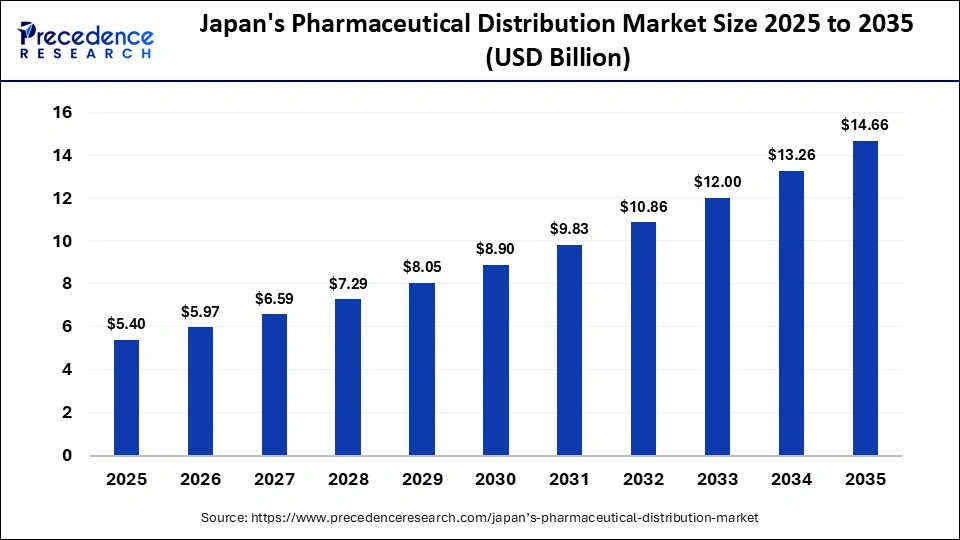
Rohan Patil, a Healthcare Industry Expert, highlights that the japan's pharmaceutical distribution market has reached USD 5.97 billion in 2026 and is on track to reach USD 14.66 billion by 2035, advancing at a CAGR of 10.50%. Key japan's pharmaceutical distribution market companies shaping the market include AS ONE Corporation, WIN-Partners Co., Ltd., Toho Holdings Co., Ltd., Vital KSK Holdings, Inc., while major growth segments span By Service Type, By Distribution Model, By Product Type, By End User.
Source: https://www.precedenceresearch.com/japans-pharmaceutical-distribution-market
 Get a Sample
 Table Of Content


What is the Japan's Pharmaceutical Distribution Market Size in 2026?
The Japan's pharmaceutical distribution market size accounted for USD 5.40 billion in 2025 and is predicted to increase from USD 5.97 billion in 2026 to approximately USD 14.66 billion by 2035, expanding at a CAGR of 10.50% from 2026 to 2035. This market is growing due to the country's aging population, increasing demand for prescription drugs, and the expansion of cold chain logistics for biologics and specialty medicine.
Key Takeaways
- By service type, the transportation & logistics segment dominated the market with a 28% share in 2025.
- By service type, the cold chain management segment is expected to grow at the fastest rate between 2026 and 2035.
- By distribution model, the full-line wholesaling segment dominated the market with a 34% share in 2025.
- By distribution model, the third-party logistics (3PL) segment is the second-largest shareholder and is expected to grow at the fastest rate between 2026 and 2035.
- By product type, the prescription drugs segment dominated the market with a 70% share in 2025.
- By product type, the over-the-counter (OTC) drugs segment is the second-largest shareholder and is expected to grow at a significant rate between 2026 and 2035.
- By end user, the hospitals segment dominated the market with a 45% share in 2025.
- By end user, the retail pharmacies segment is the second-largest shareholder and is expected to grow at a significant rate between 2026 and 2035.
Why is the Japan's Pharmaceutical Distribution Market Gaining Momentum?
The Japan's pharmaceutical distribution market is growing because of the country's aging population, growing demand for specialty and prescription medications, and improvements in cold chain logistics. Consistent drug supply is further supported nationwide by effective wholesale networks and a robust healthcare infrastructure. The adoption of advanced logistics, cold chain systems, and digital supply chain solutions is improving efficiency and ensuring timely delivery of medicines. Additionally, government initiatives to streamline distribution, enhance drug safety, and support e-pharmacy services are further fueling growth in the market.
How is AI Influencing the Japan's Pharmaceutical Distribution Market?
Artificial intelligence is significantly influencing the Japan's pharmaceutical distribution market by optimizing supply chain operations, improving demand forecasting, and reducing drug shortages. Intelligent systems analyze real-time data to enhance inventory management, route planning, and warehouse efficiency, ensuring the timely delivery of medications. Additionally, AI-driven analytics support decision-making for regulatory compliance, quality control, and personalized distribution strategies, increasing overall efficiency and reliability in the pharmaceutical supply chain.
Major Market Trends
- Cold Chain Logistics: Increasing biologics and vaccine distribution is driving demand for temperature-controlled logistics.
- Aging Population: The growing elderly population is driving higher demand for prescription drugs and healthcare services.
- Supply Chain Digitalization: Companies are adopting automated warehouses, inventory tracking, and digital logistics systems.
- Growth of Specialty Drugs: Distribution of specialty and personalized medicines is increasing in Japan.
- Direct-to-Pharmacy Distribution: Manufacturers are increasingly supplying medicines directly to pharmacies and hospitals.
- Distributor Consolidation: Mergers among pharmaceutical wholesalers are strengthening distribution networks.
- Last-Mile Delivery Expansion: Companies are improving last-mile delivery for faster and more efficient medicine supply.
- Government Pricing Regulations: Strict drug pricing policies continue to impact distributor profit margins and strategies.
Makret Scope
| Report Coverage | Details |
| Market Size in 2025 | USD 5.40 Billion |
| Market Size in 2026 | USD 5.97 Billion |
| Market Size by 2035 | USD 14.66 Billion |
| Market Growth Rate from 2026 to 2035 | CAGR of 10.50% |
| Base Year | 2025 |
| Forecast Period | 2026 to 2035 |
| Segments Covered | Type, Converter Architecture, Sampling Rate, Application, and End User |
Market Dynamics
Drivers
The country's rapidly aging population, rising demand for prescription drugs, and expanding distribution of specialty drugs and biologics, all of which call for effective temperature-controlled logistics systems, which are the main drivers of Japan's pharmaceutical distribution market. A sophisticated healthcare infrastructure and a significant number of pharmaceutical wholesalers also drive market expansion.
Restraint
Strict government regulations, regulated drug prices under Japan's national healthcare system, and high operating costs associated with cold chain storage and transportation all pose challenges to the market. Additionally, government reimbursement policies put pressure on prices, which lowers distributors' profit margins.
Opportunity
Opportunities are presented by the expanding cold chain logistics infrastructure, rising use of digital supply chain and automated warehouse management systems, and rising demand for biologics and customized medications. New growth prospects are also being created by the growth of last-mile delivery services and direct-to-pharmacy distribution.
How is the Japanese Government Supporting the Market?
The Japanese government is actively strengthening the Japan's pharmaceutical distribution market through initiatives focused on supply chain digitalization, expansion of cold chain logistics, and ensuring stable medicine supply across the country. Improvements in temperature-controlled logistics gained traction following the COVID-19 pandemic, and policies spearheaded by the Ministry of Health, Labor, and Welfare encourage effective inventory management and lessen drug shortages. Furthermore, the Pharmaceuticals and Medical Devices Agency's regulatory support helps improve coordination between manufacturers and distributors to secure a steady supply of drugs, and the National Health Insurance System's stringent pricing regulations guarantee affordability while preserving distribution stability.
Segment Insights
Service Type Insights
Japan's Pharmaceutical Distribution Market Share, By Service Type, 2025-2035 (%)
| Service Type | 2025 |
| Transportation & Logistics | 28.00% |
| Storage & Warehousing | 20.00% |
| Inventory Management | 15.00% |
| Cold Chain Management | 18.00% |
| Order Fulfillment | 10.00% |
| Value-added Services | 9.00% |
The Transportation & Logistics Segment Held a 28% Market Share in 2025
The transportation & logistics segment dominated the Japan's pharmaceutical distribution market while holding a 28% share in 2025 because pharmaceutical goods are constantly being moved between Japanese pharmacies, clinics, and hospitals. Because pharmaceutical distribution primarily relies on dependable transportation systems, prompt deliveries, and well-established logistics networks to maintain medicine availability, this segment leads the market. The expanding distribution of specialty drugs, vaccines, and prescription medications further boosts the demand for transportation services. Additionally, the demand for logistics and transportation services is rising due to the necessity of delivering pharmaceuticals in a timely and secure manner.
The cold chain management segment held a 18% share of the market in 2025 and is expected to grow at the fastest rate during the forecast period. This is because biologics, specialty drugs, and pharmaceutical products that need to be transported and stored under strict conditions are becoming more in demand. The need for temperature-controlled logistics systems is being driven by the growing use of vaccines, injectable medications, and advanced therapies. Additionally, this segment is expanding because of rising investments in temperature monitoring systems and cold storage facilities.
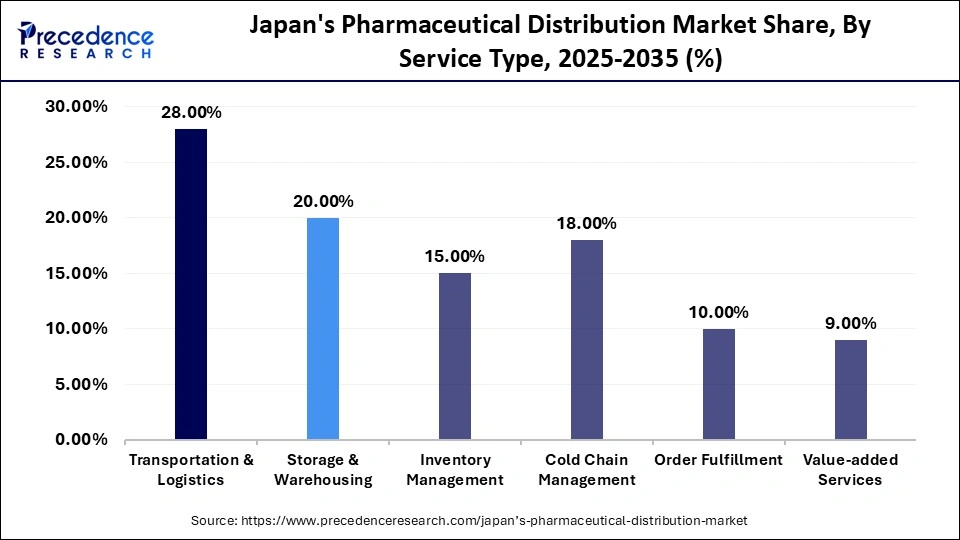
The storage & warehousing segment was the second-largest shareholder, holding a 20% share in 2025. This is because of Japan's sophisticated pharmaceutical wholesale system, which uses centralized networks to deliver a variety of pharmaceutical products to healthcare providers. By streamlining the supply chain and enhancing inventory control, these services guarantee uniform drug availability throughout healthcare facilities. Additionally, these services enable pharmaceutical companies to efficiently distribute their goods via a single distribution channel.
The inventory management segment held a 15% share of the market in 2025 due to the critical need for accurate tracking and timely replenishment of medicines in a highly regulated industry. Efficient inventory management ensures the availability of essential drugs, minimizes stockouts and expiries, and reduces operational costs for distributors and pharmacies. Additionally, the integration of advanced technologies, such as AI and automated systems, enhances inventory accuracy and responsiveness, further strengthening the segment's importance in the market.
Distribution Model Insights
The Full-Line Wholesaling Segment Held a 34% Share of the Market in 2025
The full-line wholesaling segment dominated the Japan's pharmaceutical distribution market while holding a 34% share in 2025 due to its capacity to offer a variety of pharmaceutical products through a single distribution channel for the full-line wholesaling. These wholesalers provide effective nationwide delivery, bulk purchasing, and storage services. Their solid connections with producers and medical professionals guarantee a steady supply and dependability. Because of its established infrastructure and affordability, this model continues to be favored.
The third-party logistics (3PL) segment held a 18% share of the market in 2025 and is expected to grow at the fastest rate over the forecast period because pharmaceutical companies are increasingly outsourcing their logistics operations to cut costs and boost productivity. Specialized services like transportation, warehousing, and cold chain management are provided by 3PL companies. Dependency on 3PL partners is increasing due to the growing demand for biologics and temperature-sensitive medications. Technological developments in logistics tracking are also promoting segment expansion.
Japan's Pharmaceutical Distribution Market Share, By Distribution Mode, 2025-2035 (%)
| Distribution Mode | 2025 |
| Full-line Wholesaling | 34.00% |
| Short-line Wholesaling | 14.00% |
| Direct-to-Pharmacy | 18.00% |
| Direct-to-Hospital | 16.00% |
| Third-party Logistics (3PL) | 18.00% |
The direct-to-pharmacy segment held a 18% share of the market in 2025 due to the increasing demand for quicker and more effective drug delivery. By cutting out middlemen, this model lowers costs and increases supply chain transparency. Direct distribution is being made easier by the growing use of digital ordering platforms and e-prescriptions. For retail pharmacies, it also facilitates faster replenishment and improved inventory control.
The direct-to-hospital segment held a 16% market share in 2025, driven by the growing need for critical and specialized medications to be delivered on time. To guarantee the availability of expensive and life-saving medications, hospitals favor direct sourcing. This model decreases treatment delays and improves supply chain efficiency. Segment expansion is being further supported by expanding hospital networks and increasing patient volumes.
Product Type Insights
Japan's Pharmaceutical Distribution Market Share, By Product Type, 2025-2035 (%)
| Product Type | 2025 |
| Prescription Drugs | 70.00% |
| Over-the-Counter (OTC) Drugs | 30.00% |
The Prescription Drugs Segment Held a 70% Market Share in 2025
The prescription drugs segment dominated the Japan's pharmaceutical distribution market while holding the largest share of 70% in 2025. This is due to the country's aging population and the corresponding rise in chronic diseases, which drives consistent demand for prescription medications. Strict regulations on prescription-only drugs and the need for controlled distribution further emphasize their prominence in the market. Additionally, strong healthcare infrastructure and widespread physician-driven prescribing practices ensure steady consumption, making prescription drugs the largest segment in the market.
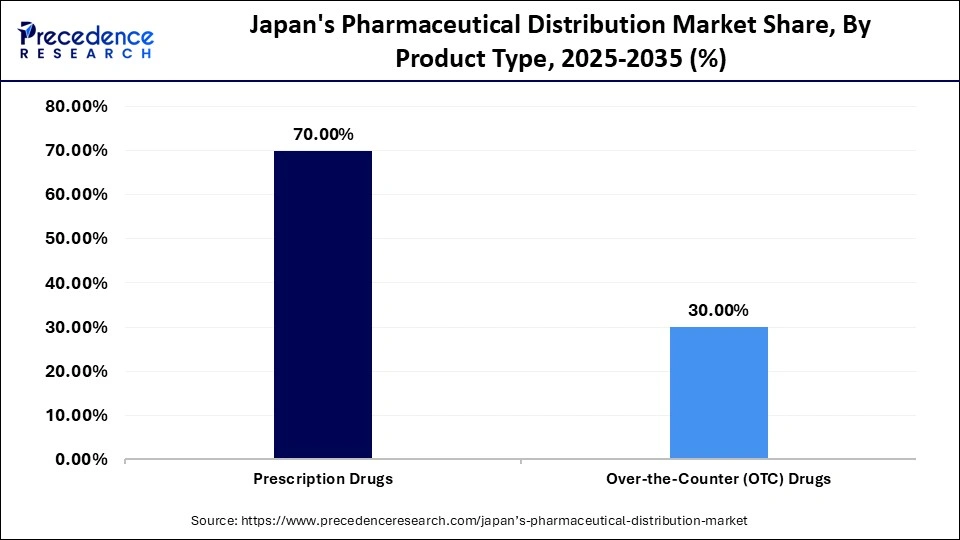
The over-the-counter (OTC) drugs segment held a 30% share of the market in 2025 because self-medication is becoming more popular among consumers, and non-prescription medications are readily available. Sales of preventive healthcare products are increasing due to growing health awareness and demand. The growth of the segment is also aided by the expansion of e-commerce platforms and retail pharmacy networks. OTC medications are very popular among consumers because they are convenient and affordable.
End User Insights
Japan's Pharmaceutical Distribution Market Share, By End User, 2025-2035 (%)
| End User | 2025 |
| Hospitals | 45.00% |
| Retail Pharmacies | 35.00% |
| Clinics | 10.00% |
The Hospitals Segment Held a 45% Share of the Market in 2025
The hospitals segment dominated the Japan's pharmaceutical distribution market while holding a 45% market share in 2025 due to the high volume of drug consumption for inpatient and outpatient treatments. Hospitals need a steady supply of a variety of drugs, including emergency and specialty medications. Demand is being driven by rising hospital admissions and sophisticated medical procedures. Direct procurement models also improve the efficiency and dependability of supply.
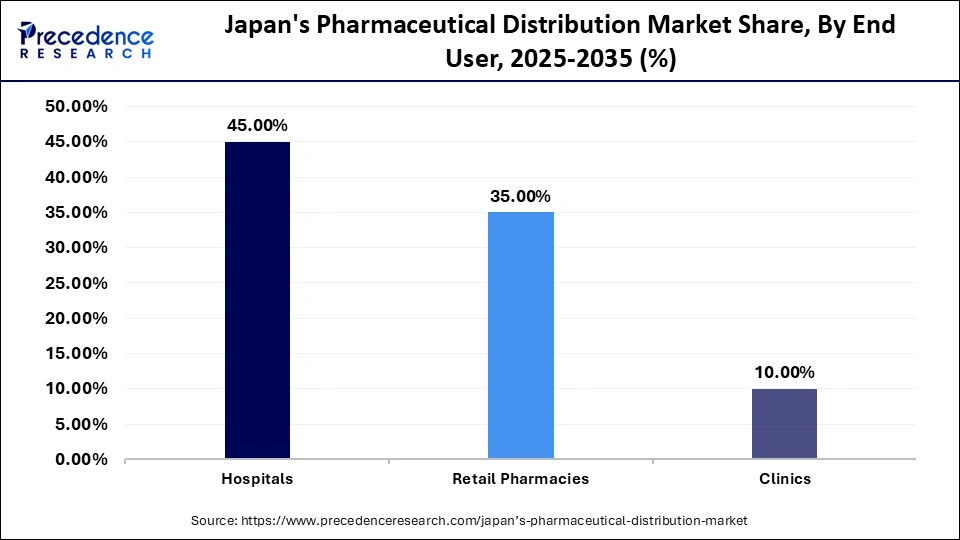
The retail pharmacies segment was the second-largest shareholder, holding a 35% share in 2025, and is expected to grow at a significant rate in the coming years, fueled by consumers' growing reliance on pharmacies for prompt access to medications and medical supplies. Accessibility is being aided by the growth of chain pharmacies and online pharmacy platforms. The segment is expanding because of the growing demand for over-the-counter and chronic illness medications.
The clinics segment held a 10% share of the market in 2025 because clinics serve as the first point of care for a large portion of the population, driving consistent demand for prescription and over-the-counter medications. Their frequent patient interactions require timely and reliable drug supplies, making efficient distribution critical. Additionally, the integration of modern inventory and supply chain management systems in clinics ensures smooth operations, further strengthening their role as a key end user in the market.
Japan's Pharmaceutical Distribution Market Companies
- AS ONE Corporation
- WIN-Partners Co., Ltd.
- Toho Holdings Co., Ltd.
- Vital KSK Holdings, Inc.
- Nippon Express Holdings
- Suzuken Co., Ltd.
- Alfresa Holdings Corporation
- Mediceo Corporation
- McKesson Corporation
- AmerisourceBergen Corporation
- Cardinal Health
- DHL Supply Chain
- Kuehne + Nagel
- UPS Healthcare
- DB Schenker
Recent Developments
- In February 2026, Mitsubishi Logistics, Takeda Pharmaceutical, and JR Freight announced the launch of Japan's first 31-foot temperature-controlled rail containers for the sustainable, GDP-compliant nationwide distribution of prescription medicines. This joint initiative aims to enhance logistics efficiency while ensuring the secure transport of pharmaceutical products. (Source: https://www.mitsubishi-logistics.co.jp)
- In January 2026, Otsuka Pharmaceutical Co., Ltd. announced a basic agreement with Towa Pharmaceutical Co., Ltd. to establish a strategic collaborative framework for pharmaceutical manufacturing. The partnership aims to ensure a stable supply of long-listed products by transferring manufacturing and creating a mutual backup system. This initiative addresses the social issue of unstable medicine supply in Japan through cooperation between an originator and a generic manufacturer. (Source: https://www.otsuka.co.jp)
Segments Covered in the Report
By Service Type
- Transportation & Logistics
- Storage & Warehousing
- Inventory Management
- Cold Chain Management
- Order Fulfillment
- Value-added Services
By Distribution Model
- Full-line wholesaling
- Short-line Wholesaling
- Direct-to-Pharmacy
- Direct-to-Hospital
- Third-party Logistics (3PL)
By Product Type
- Prescription Drugs
- Over-the-Counter (OTC) Drugs
By End User
- Hospitals
- Retail Pharmacies
- Clinics
- Others (homecare, e-pharmacy)
For inquiries regarding discounts, bulk purchases, or customization requests, please contact us at sales@precedenceresearch.com
Frequently Asked Questions





Ask For Sample
No cookie-cutter, only authentic analysis – take the 1st step to become a Precedence Research client
 Get a Sample




 sales@precedenceresearch.com
 Schedule a Meeting
