



Japans Pharmaceutical Distribution Market Revenue to Attain USD 14.66 Bn by 2035
Published: 10 Apr 2026
Author: Precedence Research



Japans Pharmaceutical Distribution Market Revenue and Trends 2026 to 2035
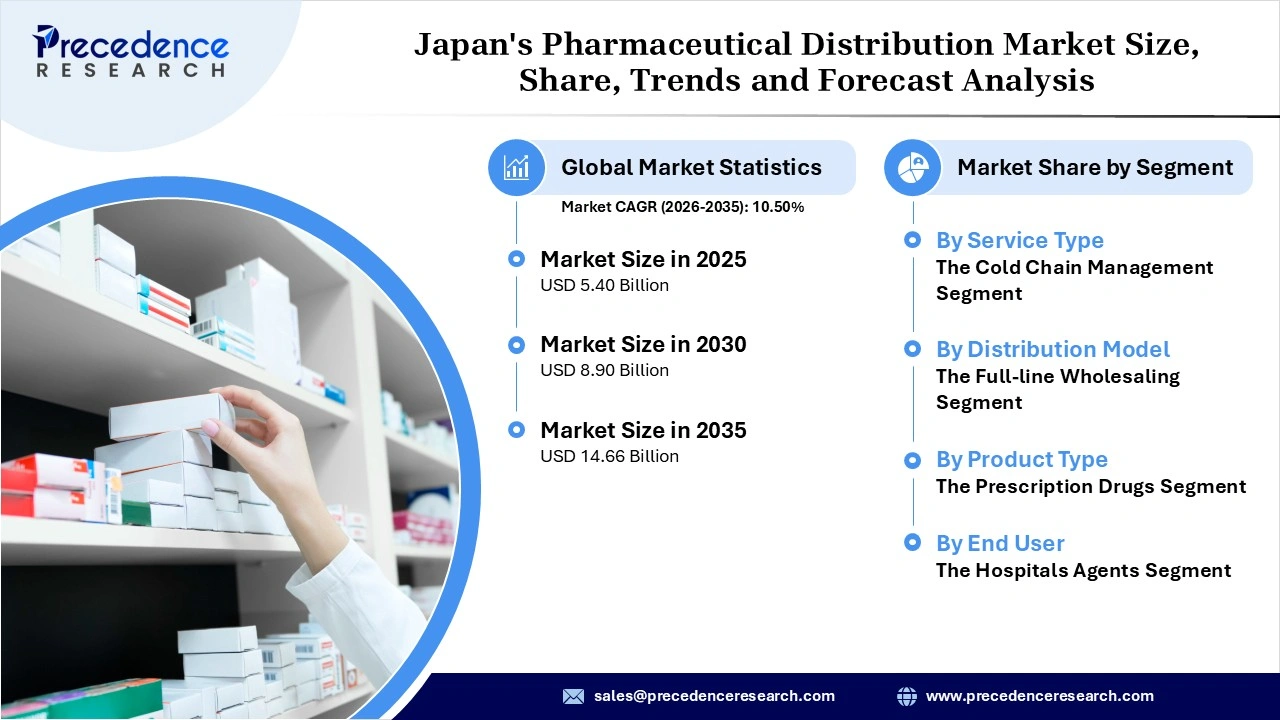
The global Japans pharmaceutical distribution market revenue surpassed USD 5.40 billion in 2025 and is predicted to attain around USD 14.66 billion by 2035, growing at a CAGR of 10.50%. The market is driven by the aging population, rising demand for prescription and specialty drugs, and increasing need for cold chain and efficient pharmaceutical logistics systems.
Market Overview
Transportation, storage, and supply chain management of pharmaceutical goods from producers to clinics, hospitals, and pharmacies are all part of the Japan’s pharmaceutical distribution market. The market consists of cold chain services, logistics companies, and wholesalers who guarantee the prompt and safe delivery of biologics, prescription drugs, and specialty medications. The demand for services like inventory control, packaging, transportation, temperature-controlled logistics, and distribution via hospital and retail pharmacies is rising, driving the growth of the market. Moreover, the increasing demand for both branded and generic medications and a strong emphasis on enhancing supply chain efficiency contribute to market expansion.
What Opportunities Exist in the Market?
The Japan’s pharmaceutical distribution market is expected to witness strong opportunities fueled by the growing need for biologics, specialty medications, and customized medications, all of which call for sophisticated cold chain logistics and expert handling. Efficiency-driven growth prospects are being created by the growing use of digital supply chain technologies such as automated warehousing and AI-based inventory management.
Furthermore, distribution speed and cost-effectiveness are being improved by the growth of direct-to-pharmacy and last-mile delivery models. Long-term market growth and supply chain resilience are anticipated to be supported by increasing investments in temperature-controlled infrastructure and collaborations between distributors and pharmaceutical companies.
In February 2026, Japanese pharmaceutical logistics providers introduced upgraded digital track-and-trace platforms using IoT sensors and cloud dashboards to enable real-time temperature monitoring and automated compliance reporting for temperature-sensitive drug shipments.
In 2026, Suzuken Co., Ltd. continued expanding pharmaceutical logistics and distribution services to support Japan’s growing demand for medicines, driven by the aging population and increasing healthcare demand
Overview of Organizations and Databases Used in Market Analysis
| Source Type | Organization/Database | Data Provided |
| Government Data | Ministry of Health, Labour and Welfare | Drug consumption, healthcare spending, and pharmaceutical policies |
| Regulatory Authority | Pharmaceuticals and Medical Devices Agency | Drug approvals, regulations, supply chain compliance |
| Industry Association | Japan Pharmaceutical Manufacturers Association | Industry statistics, production, and distribution data |
| Trade Data | Ministry of Finance, Japan | Import and export data for pharmaceuticals |
| Company Reports | Alfresa Holdings, Medipal Holdings | Revenue, distribution network, logistics investments |
| International Data | World Health Organization, OECD | Healthcare expenditure, pharmaceutical market data |
While regulatory bodies provide information on drug approvals and distribution rules, government organizations provide data on healthcare spending, pharmaceutical consumption, and policies. Production, import, and distribution statistics are available from trade databases and industry associations. Understanding market share distribution networks and logistics investments is made easier with the aid of the company's annual reports. International organizations offer comparisons of the pharmaceutical and healthcare markets. When combined, these secondary sources aid in the estimation of the Japan’s pharmaceutical distribution market size, growth patterns, distribution structure, regulatory environment, and competitive landscape.
Market Segmentation Overview
By Service Type
The transportation & logistics segment led the market with a 28% share in 2025 because pharmaceutical products are transported in large quantities throughout Japan's clinics, hospitals, and pharmacies. Pharmaceutical distributors rely heavily on effective transportation networks, prompt delivery systems, and national logistics infrastructure to guarantee a steady supply of medications. The expansion of transportation and logistics services in the market is further supported by the rising demand for specialty medications, vaccines, and prescription drugs.
On the other hand, the cold chain management segment is expected to grow at the fastest rate from 2026 to 2035. This is because of the growing need for specialty medications, biologics, and temperature-sensitive medications that need to be transported and stored under controlled conditions. The demand for sophisticated temperature-controlled logistics monitoring systems and cold storage facilities is rising throughout Japan due to the expansion of vaccines, injectable medications, and personalized medications.
By Distribution Model
The full-line wholesaling segment dominated the Japan’s pharmaceutical distribution market with a 34% share in 2025. This is because of Japan's well-established pharmaceutical wholesale system, in which wholesalers use centralized distribution networks to provide a variety of pharmaceutical products to clinics, hospitals, and pharmacies. This model guarantees effective drug availability throughout healthcare facilities, streamlines inventory management, and simplifies the supply chain.
The third-party logistics (3PL) segment is expected to expand at the fastest rate during the forecast period, fueled by pharmaceutical companies' growing outsourcing of transportation, warehousing, and logistics services. The use of third-party logistics service providers in pharmaceutical distribution is growing because of businesses' emphasis on cost reduction, supply chain efficiency, and specialized cold chain logistics.
By Product Type
The prescription drugs segment led the market with a 70% share in 2025 because of Japan's high demand for hospital-administered pharmaceuticals, specialty drugs, prescription medications, and treatments for chronic illnesses. The nation's universal healthcare system and aging population greatly boost the use of prescription drugs, which in turn drives the demand for these medications.
On the other hand, the over-the-counter (OTC) drugs segment is expected to grow at the highest CAGR from 2026 to 2035 because OTC medications are readily available through retail pharmacies and online pharmacy platforms, self-medication is becoming more common, and consumer awareness is growing. OTC drug distribution is expanding due to rising demand for painkillers, health supplements, and preventive healthcare products.
By End User
The hospitals segment dominated the market with a 45% share in 2025 because hospitals use a lot of pharmaceuticals for emergency care, inpatient treatments, surgeries, and the administration of specialty drugs. Hospital pharmacies receive a greater volume of distribution because hospitals need a constant supply of biologics, injectable medications, and prescription drugs. The segment's expansion is also being aided by the rise in surgical procedures and hospital admissions.
The retail pharmacies segment was the second-largest shareholder, holding a 35% share in 2025, and is expected to grow at a significant rate in the coming years because OTC medications, prescription refills, and home healthcare medications are becoming increasingly popular. Pharmaceutical distribution to retail pharmacies is expanding in part due to the aging population and the growth of retail pharmacy chains. The expansion of home delivery services and internet pharmacies is also fueling the segment's expansion.
Country-Level Analysis
A rapidly aging population, high pharmaceutical consumption, and universal healthcare coverage all contribute to the Japan’s pharmaceutical distribution market. The nation's robust pharmaceutical wholesale and distribution network guarantees effective drug delivery to clinics, hospitals, and retail pharmacies in both urban and rural areas.
Strict rules and drug pricing policies put in place by the Ministry of Health, Labour, and Welfare, which guarantee drug affordability and supply stability, also have an impact on the market. The need for sophisticated cold chain logistics, automated warehousing, and digital supply chain systems is being driven by the growing demand for biologics, specialty medications, and vaccines. These technologies are anticipated to support the future expansion of pharmaceutical distribution services in Japan.
Japan's Pharmaceutical Distribution Market Coverage
| Report Attribute | Key Statistics |
| Market Revenue in 2025 | USD 5.40 Billion |
| Market Revenue by 2035 | USD 14.66 Billion |
| CAGR from 2026 to 2035 | 10.50% |
| Quantitative Units | Revenue in USD million/billion, Volume in units |
| Largest Market | North America |
| Base Year | 2025 |
| Regions Covered | North America, Europe, Asia-Pacific, Latin America, and the Middle East & Africa |
Top Companies in the Market
Major companies operating in the Japan’s pharmaceutical distribution market include Medipal Holdings, Alfresa Holdings, Suzuken Co., Ltd., and Toho Holdings Co., Ltd. These companies are driving market growth by strengthening national pharmaceutical distribution networks, increasing cold chain logistics, and making investments in digital supply chain systems and automated warehouses. To increase the effectiveness of the supply chain, they are also concentrating on last-mile delivery services and specialty drug distribution.
Segments Covered in the Report
By Service Type
- Transportation & Logistics
- Storage & Warehousing
- Inventory Management
- Cold Chain Management
- Order Fulfillment
- Value-added Services
By Distribution Model
- Full-line wholesaling
- Short-line Wholesaling
- Direct-to-Pharmacy
- Direct-to-Hospital
- Third-party Logistics (3PL)
By Product Type
- Prescription Drugs
- Over-the-Counter (OTC) Drugs
By End User
- Hospitals
- Retail Pharmacies
- Clinics
- Others (homecare, e-pharmacy)
Get this report to explore global market size, share, CAGR, and trends, featuring detailed segmental analysis and an insightful competitive landscape overview @ https://www.precedenceresearch.com/sample/8284
You can place an order or ask any questions, please feel free to contact us at sales@precedenceresearch.com |+1 804 441 9344