



Transmission Control Module Market Size, Companies, Share, Vehicle Production Volume, Sales Performance, Export & Import Analysis, Technology Adoption, Competitive Positioning, and Demand Trends
Transmission Control Module Market (By Transmission Type: Automatic Transmission (AT), Dual-Clutch Transmission (DCT), Continuously Variable Transmission (CVT), Automated Manual Transmission (AMT); By Vehicle Type: Passenger Cars, Light Commercial Vehicles (LCVs), Heavy Commercial Vehicles (HCVs); By Sales Channel: OEM, Aftermarket) - Global Industry Analysis, Size, Trends, Leading Companies, Regional Outlook, and Forecast 2026 to 2035
Source: https://www.precedenceresearch.com/transmission-control-module-market
 Get a Sample
 Table Of Content


What is Transmission Control Module Market Size in 2026?
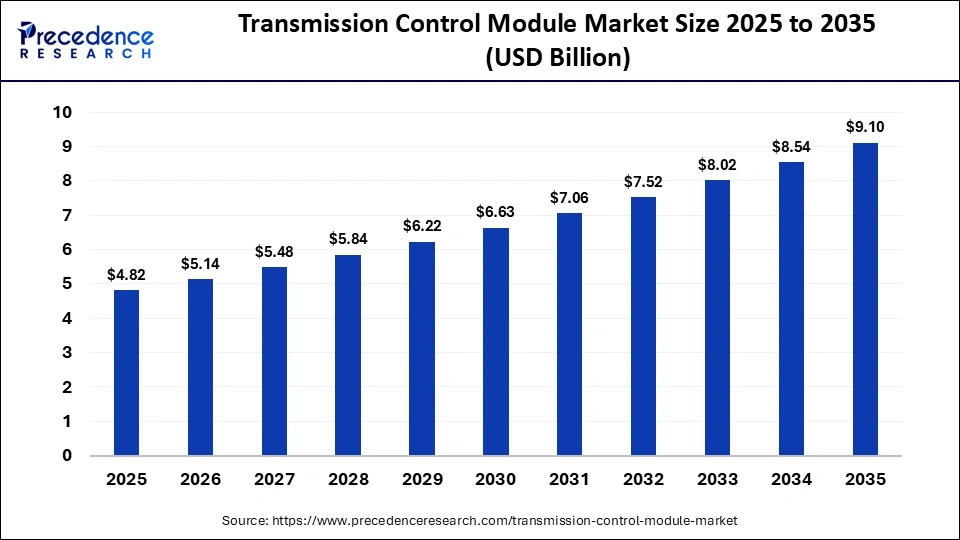
The global transmission control module market size was calculated at USD 4.82 billion in 2025 and is predicted to increase from USD 5.14 billion in 2026 to approximately USD 9.10 billion by 2035, expanding at a CAGR of 6.55% from 2026 to 2035. The transmission control module market is experiencing unprecedented growth, driven by the rapid adoption of advanced driver-assistance systems (ADAS) and the rising integration of AI/smart sensors in modern vehicles.
Key Takeaways
- Asia Pacific held the largest revenue share in the transmission control module market in 2025.
- North America is expected to expand at the fastest CAGR in the transmission control module market.
- By transmission type, the automatic transmission (AT) segment held a dominant share of approximately 46% in 2025.
- By transmission type, the dual-clutch transmission (DCT) segment is expected to grow at the highest CAGR of approximately 7.2% from 2026 to 2035.
- By vehicle type, the passenger cars segment contributed the biggest revenue share of approximately 68% in the market in 2025.
- By vehicle type, the light commercial vehicles (LCVs) segment is expected to expand at the fastest growth rate of approximately 7.1% between 2026 and 2035.
- By sales channel, the OEM (first fit) segment registered its dominance with the highest revenue share of approximately 91% during 2025.
- By sales channel, the aftermarket segment is expected to grow at the highest CAGR of approximately 6.2% during the forecast period.
Market Overview
The transmission control module (TCM) is an integral component of a vehicle with an automatic transmission system. TCM controls and manages various functions within the transmission to ensure that the vehicle shifts gears smoothly and performs efficiently. TCM is responsible for controlling the transmission's operations and maintaining optimal performance. TCM works through a series of sensors located in different parts of the vehicle. These sensors collect information about vehicle speed, throttle position, and more. A well-maintained TCM improves the vehicle's overall performance by reducing emissions, prolonging transmission life, and improving fuel efficiency.
How is Artificial Integration impacting the growth of the Transmission control module market?
In the rapidly evolving technological landscape, the integration of Artificial Intelligence (AI) is significantly accelerating the growth of the transmission control module market by enhancing fuel efficiency, enabling predictive maintenance, and supporting the rising shift towards software defined vehicles (SDVs). AI integration allows for the efficient monitoring of transmission health. AI enables the TCM to process massive amounts of data, including vehicle speed, engine RPM, throttle position, and others. AI analyzes sensor data from transmissions such as temperature, vibration, and torque to predict potential mechanical failures before they occur, which reduces downtime and maintenance costs. AI-driven machine learning and computer vision systems are also widely used in the production of TCMs to detect micro-defects, enhance precision, and improve quality control.
What are the emerging trends in the market?
- The increasing shift towards electric and hybrid vehicles necessitates high-performance transmission control modules to manage powertrain efficiency, which is expected to drive the transmission control module market's growth in the coming years.
- The growing demand for fuel-efficient vehicles is expected to promote the market's growth in the coming years. A well-maintained TCM can contribute to higher fuel efficiency. By optimizing gear shifts based on driving conditions, TCM ensures that your engine operates at its most efficient level and reduces the need for unnecessary fuel consumption.
- The strict government emission regulations are expected to accelerate the growth of the market during the forecast period. Stringent environmental norms of various governments are compelling automakers to utilize transmission control modules for optimizing engine and transmission performance to reduce carbon emissions.
The rising shift towards autonomous and semi-autonomous vehicles is expected to contribute to the overall growth of the transmission control module market. - Autonomous and semi-autonomous vehicles require advanced TCMs to efficiently and smoothly handle complex gear.
- The rising driver preference for convenience in urban and high-traffic environments has significantly increased the adoption of Automatic Transmission (AT), Continuously Variable Transmission (CVT), and Dual-Clutch Transmission (DCT) systems, which is anticipated to fuel the expansion of the market.
Market Scope
| Report Coverage | Details |
| Market Size in 2025 | USD 4.82 Billion |
| Market Size in 2026 | USD 5.14 Billion |
| Market Size by 2035 | USD 9.10 Billion |
| Market Growth Rate from 2026 to 2035 | CAGR of 6.55% |
| Dominating Region | Asia Pacific |
| Fastest Growing Region | North America |
| Base Year | 2025 |
| Forecast Period | 2026 to 2035 |
| Segments Covered | Transmission Type, Vehicle Type, Sales Channel, and region |
| Regions Covered | North America, Europe, Asia-Pacific, Latin America, and Middle East & Africa |
Segmental Insights
Transmission Type Insights
What caused the Automatic Transmission (AT) Segment to Dominate the Market?
The automatic transmission (AT) segment held the largest transmission control module market share of approximately 46% in 2025. The segment's dominance is driven by the growing consumer demand for hassle-free driving experiences in congested urban environments and the rising adoption of multi-speed gearboxes in passenger vehicles. Automatic Transmission (AT) automatically shifts gears based on load conditions and speed, providing a more convenient and pleasant driving experience.
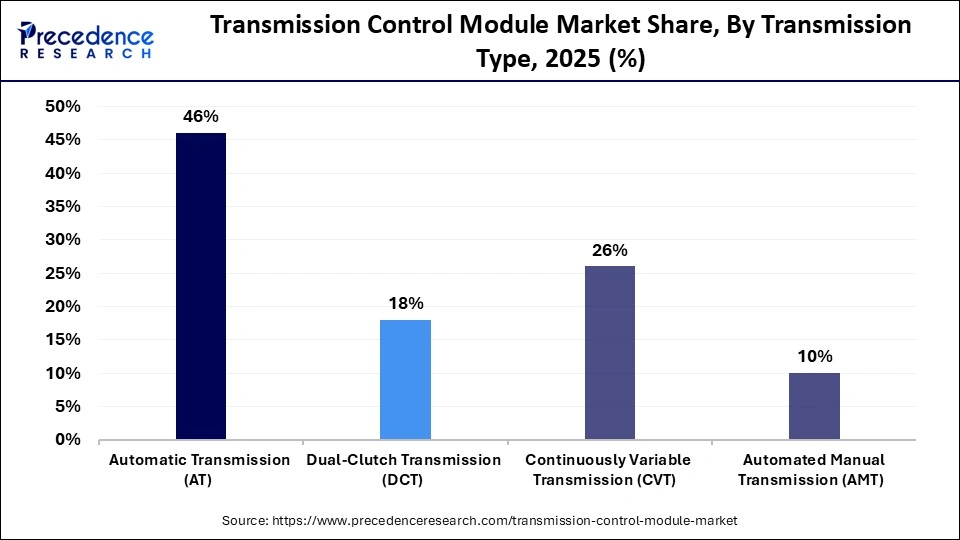
The dual-clutch transmission (DCT) segment is expected to grow at a remarkable CAGR of approximately 7.2% between 2026 and 2035, owing to its ability to deliver high-performance and superior fuel efficiency. DCTs offer roughly better fuel consumption with gear shifts occurring in milliseconds. DCTs are widely adopted in hybrid electric vehicles (HEVs) to manage power from both electric motors and internal combustion engines. The rising demand for a seamless driving experience and strict emission regulations has accelerated the adoption of dual-clutch transmission (DCT).
Vehicle Type Insights
What made the Passenger Cars Segment Dominate the Market?
The passenger cars segment contributed the highest revenue share of approximately 68% in the transmission control module market in 2025. The dominance of the segment is mainly driven by the high production & sales volume of passenger cars and increasing consumer preference for automatic transmissions for high comfort and a smoother driving experience. Modern passenger cars are rapidly incorporating advanced driver assistance systems (ADAS), and powertrain management necessitates advanced control modules. Governments worldwide are enforcing strict emission standards that push automakers to adopt electronically controlled transmissions to reduce fuel consumption and CO2 emissions. Efficient gear shifting contributes to lower emissions, as the engine operates at its optimal level, producing fewer harmful emissions.
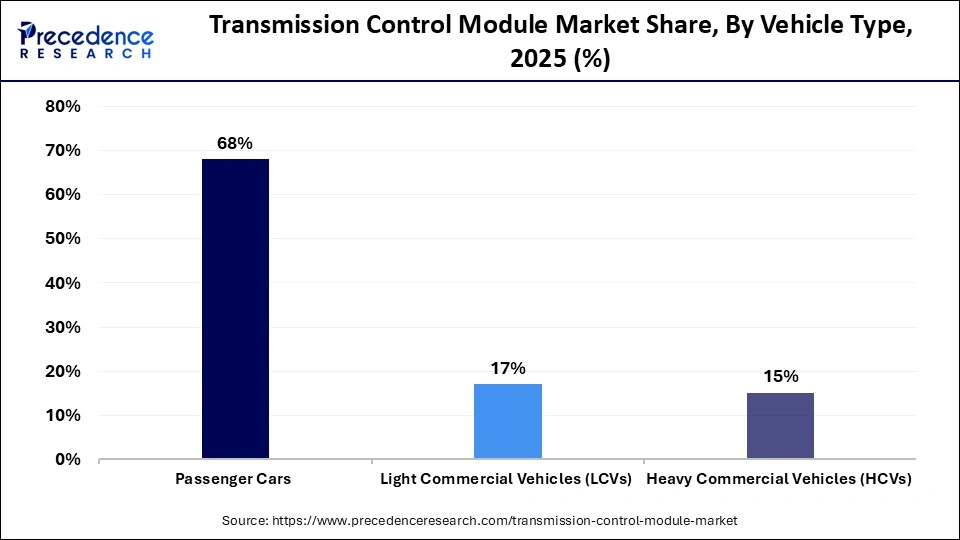
The light commercial vehicles (LCVs) segment is expected to grow at a notable rate of approximately 7.1% from 2026 to 2035, owing to the massive volume of light commercial vehicles (LCVs) production, the rapid expansion of the e-commerce industry, and the growing demand for last-mile delivery. The stringent global emission regulations compel automotive manufacturers to deploy high-efficiency automatic transmissions that require complex TCMs to optimize engine performance and reduce fuel consumption. The rising shift toward Automated Manual Transmissions (AMT) and Automatic Transmissions (AT) in LCVs has substantially increased to reduce driver fatigue and improve fuel efficiency in urban traffic.
Sales Channel Insights
What Factors are Contributing to the Dominance of the OEM (First Fit) Segment in the Market?
The OEM (first fit) segment held the dominant share of approximately 91% in the transmission control module market, owing to the strict quality assurance required for modern and complex transmissions. TCMs are integrated directly into new vehicle production as they are designed as a "perfect fit" for the specific transmission, which ensures optimal performance and compatibility. OEM parts often provide improved safety and consistent performance as they are subjected to rigorous testing. High-value OEM parts maintain vehicle safety standards and meet fuel economy targets.
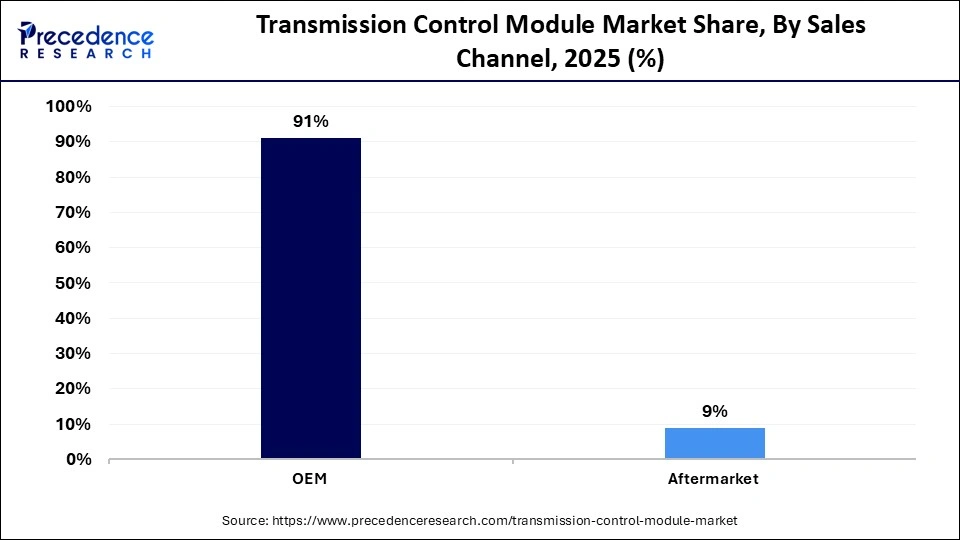
The aftermarket segment is expected to grow with the highest CAGR of approximately 6.2% in the automation and protection system market during the studied year. The segment's growth is attributed to the increasing age of vehicles and the growing demand for replacement parts, including complex electronics like TCMs. The aftermarket often provides a more cost-effective alternative than OEM parts, making them more attractive to older vehicle owners looking for cost-effective repair solutions. Moreover, the expansion of e-commerce platforms has significantly improved the availability and distribution of aftermarket TCM.
Regional Insights
Asia Pacific Transmission Control Module Market Analysis
Asia Pacific dominated the market, holding the largest market share in 2025. The region has a massive automotive production base, which propels the demand for TCM in modern vehicles. Modern passenger cars and Light Commercial Vehicles (LCVs) are increasingly equipped with smart telematics and connectivity features that rely on integrated TCMs for real-time monitoring of engine health, predictive maintenance, enhancing efficiency, and route optimization.
Countries like China, Japan, South Korea, and India are leading the market, owing to their massive vehicle production volumes, rapid urbanization, the rise of electric/hybrid vehicles, stringent emission regulations, and the rapid shift from manual to automatic gearboxes in urban centers. Governments in the region have implemented stringent emission regulations, driving the adoption of more advanced electronic control units (TCMs) as they efficiently manage gear shifts to keep the engine in its most efficient operating range, which results in reducing fuel consumption and emissions. Such a combination of factors is anticipated to bolster the growth of the market in the region.
China Transmission Control Module Market Analysis
China holds a substantial share and major contributor to the market. China has a large automotive industry and is a major manufacturing hub for critical automotive components, with the advanced technology that enables cost-effective and high-volume TCU production. The country has a strong presence of the leading market players, such as United Automotive Electronic Systems Co., Ltd. (UAES), Bosch, Continental, BYD Semiconductor Co., Ltd., StarPower Semiconductor Ltd., and others. The country's rapid growth is also largely driven by the massive production of hybrid and electric vehicles, a surge in consumer purchasing power, strict government emission norms, and increasing demand for fuel efficiency and advanced driver assistance systems (ADAS). Additionally, the country is experiencing a strong shift from manual to automatic transmissions for more comfortable driving experiences, particularly in urban areas.
- According to data from the China Association of Automobile Manufacturers (CAAM), China's automotive industry achieved a significant milestone in 2025, with vehicle production reaching 34.531 million units and sales totaling 34.4 million units, up 10.4% and 9.4% year on year, respectively.
North America Transmission Control Module Market Analysis
North America is expected to grow at the fastest CAGR in the market during the forecast period. The growth of the region is mainly driven by the rising demand for EVs and hybrid vehicles, increasing adoption of advanced driver assistance systems (ADAS), strong consumer preference for automatic transmissions, and stringent environmental norms. The region is also experiencing increasing demand for automatic, dual-clutch, and CVT transmissions to enhance vehicle performance and driver comfort. Moreover, the rising integration of advanced technologies like AI, smart sensors, and autonomous driving features is anticipated to accelerate the regional market's growth in the coming years.
The U.S. Transmission Control Module Market Analysis
The United States market holds a notable revenue share. The growth of the country is also largely driven by the rising shift toward electric/hybrid vehicles (EV/HEV) for sustainability, the growing popularity of automated driving systems, rising consumer demand for fuel-efficient vehicles, and increasing adoption of advanced driver-assistance systems (ADAS). The strict government emission regulations compel vehicle manufacturers to adopt advanced TCMs that optimize engine performance and fuel efficiency. In addition, the rising consumer preference for automatic transmissions (AT), dual-clutch transmissions (DCT), and continuous variable transmissions (CVT) over manual options for smooth and hassle-free driving experiences in urban and high-traffic environments drives the market growth in the country. These collective factors are anticipated to propel the country's growth during the forecast period.
Transmission Control Module Market Companies
- Continental AG
- Robert Bosch GmbH
- Aisin Seiki Co., Ltd.
- Eaton Corporation PLC
- Infineon Technologies AG
- Valeo SA
- ZF Friedrichshafen AG
- Delphi Technologies PLC
- Denso Corporation
- Mitsubishi Electric Corporation
- Hitachi Automotive Systems Ltd.
- Magneti Marelli S.p.A.
- BorgWarner Inc.
- HELLA GmbH & Co. KGaA
- Hyundai Mobis Co., Ltd.
- Lear Corporation
- NXP Semiconductors N.V.
Recent Developments
- In November 2025, Emtron launched the TM16, a fully programmable Transmission Control Module aimed at controlling the most complex transmission and driveline components. Applications include Dual Clutch Transmission Control, Multi-Clutch Automatic Transmission Control, and Traditional Automatic Transmission Control.(Source: https://emtron.world)
- In January 2024, Transtar Industries, a leading distributor of automotive aftermarket repair solutions, announced the launch of its newest brand, Transmaxx, a line of customer-driven, high-quality remanufactured transmission products. Transtar partnered with ETE REMAN to launch three remanufactured transmission electro-hydraulic control modules (TEHCMs) designed for General Motors' 6-speed transmission applications. (Source: https://www.prnewswire.com)
Segment Covered in the Report
By Transmission Type
- Automatic Transmission (AT)
- Dual-Clutch Transmission (DCT)
- Continuously Variable Transmission (CVT)
- Automated Manual Transmission (AMT)
By Vehicle Type
- Passenger Cars
- Light Commercial Vehicles (LCVs)
- Heavy Commercial Vehicles (HCVs)
By Sales Channel
- OEM
- Aftermarket
By Region
- North America
- Europe
- Asia-Pacific
- Latin America
- Middle East & Africa
For inquiries regarding discounts, bulk purchases, or customization requests, please contact us at sales@precedenceresearch.com
Frequently Asked Questions





Ask For Sample
No cookie-cutter, only authentic analysis – take the 1st step to become a Precedence Research client
 Get a Sample




 sales@precedenceresearch.com
 Schedule a Meeting
