



Automotive Transmission Market Revenue, Leading Companies, Company Production Capacity, Manufacturing Efficiency, Vehicle Sales Trends, Distribution Network, Production Volume, Company Market Share, and Growth Forecast
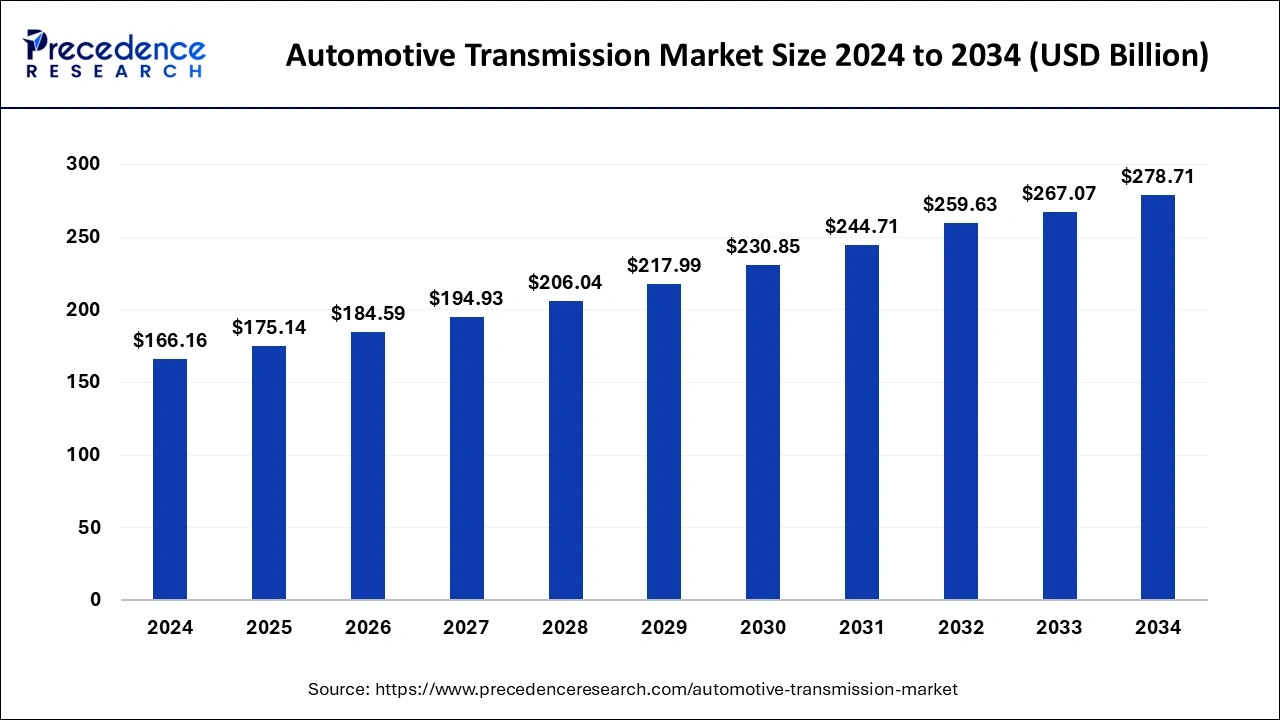
The global automotive transmission market is projected to grow from USD 184.59 billion in 2026 to USD 287.55 billion by 2035, registering a CAGR of 5.08%. Growth is driven by rising demand for fuel-efficient vehicles, advancements in automatic and CVT systems, vehicle electrification, lightweight transmission components, and AI-powered transmission controls that optimize gear shifts, efficiency, and predictive maintenance. Asia Pacific dominated the market in 2025 with a 31% share, supported by rising vehicle production and EV adoption, while North America is expected to witness the fastest growth due to strong demand for advanced transmissions, commercial vehicles, luxury vehicles, and electrified powertrains.
Source: https://www.precedenceresearch.com/automotive-transmission-market
 Get a Sample
 Table Of Content


Automotive Transmission Market Size and Forecast 2026 to 2035
The global automotive transmission market size accounted for USD 184.59 billion in 2026 and is anticipated to reach around USD 287.55 billion by 2035, growing at a CAGR of 5.08% from 2026 to 2035. The automotive transmission market is driven by the growing demand for fuel-efficient vehicles.
Automotive Transmission Market Key Takeaways
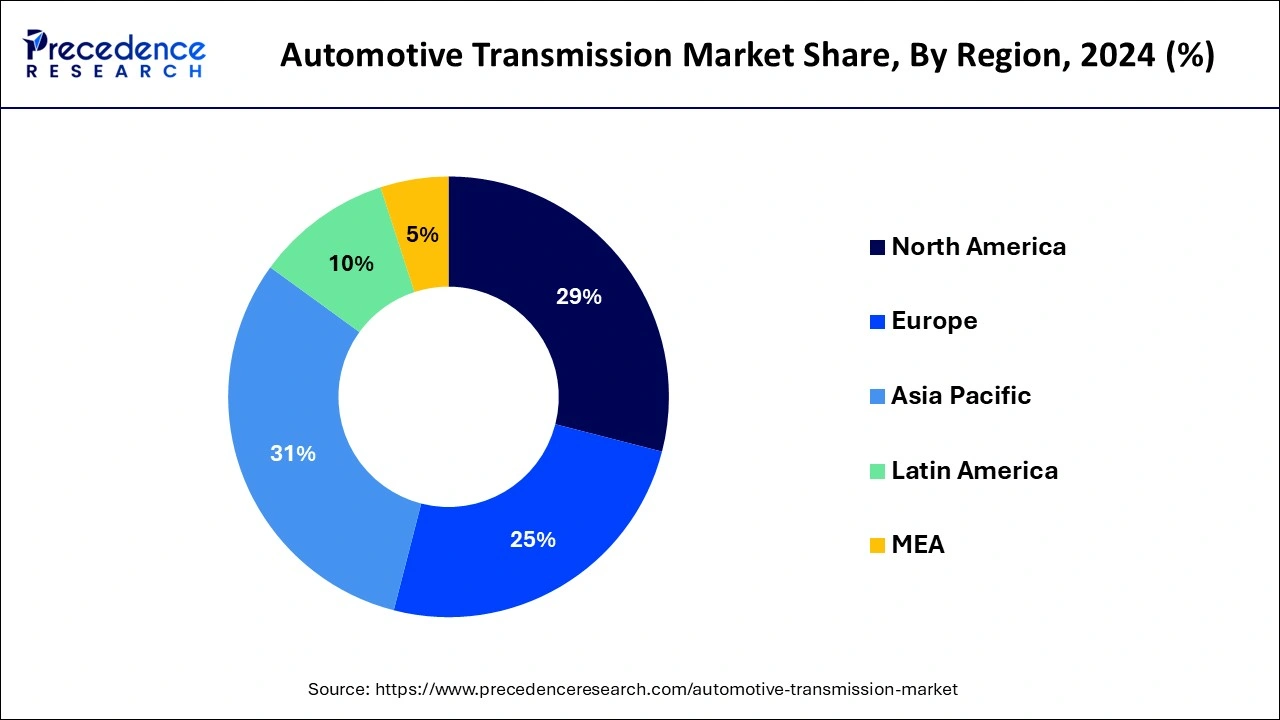
- Asia-Pacific dominated the global automotive transmission market with the largest market share of 31% in 2025.
- North America is expected to expand at the fastest CAGR during the forecast period.
- By vehicle type, the passenger vehicle segment has held the biggest market share of 66% in 2025.
- By product, the electric vehicle segment is projected to grow at a remarkable CAGR during the projected period.
Global Automotive Transmission Market Overview
The automotive transmission is a system that controls a vehicle's power and speed. It helps in transferring energy from the engine to the wheels. Transmissions can be manual, automatic, or semi-automatic. They help improve fuel efficiency and driving performance. Modern transmissions use advanced technology to ensure smoother gear shifts and better control.
The automotive transmission market includes the production and sales of transmission systems. Market demand is driven by the rising number of vehicles and advancements in fuel-efficient technologies. Key players are seen actively investing in electric and hybrid transmission systems, with a high focus on sustainability, lightweight materials, and improved efficiency to meet global regulations.
How is AI improving the Automotive Transmission?
Artificial Intelligence systems, like driver assistance, reduce human error and enhance reaction times, contributing to fewer accidents. It can locate potential hazards and take action quicker than a human driver. AI brings a more customized and intuitive driving experience, such as voice assistants acknowledging commands, advanced navigation systems forecasting the best routes, and AI-powered apps offering real-time traffic updates.
AI makes driving more enjoyable and stress-free. It will continue to improve vehicle safety. These systems, from real-time traffic monitoring to predictive hazard alerts, will aid in reducing accidents and keep drivers safe. Advancements in AI are heading toward a future where cars are safer, greener, smarter, and designed to meet the latest advanced demands of drivers and the environment.
Automotive Transmission Market Trends
- Rise in 3D Printing: The use of 3D printing for transmission component manufacturing is gaining traction in the market. This technology enables the production of complex and lightweight components with high precision. It also reduces material waste and production costs, making transmission manufacturing more efficient and sustainable.
- Advancements in EVs: The shift toward fully electrified and multi-speed transmissions in EVs is one of the most significant trends in the automotive transmission market. While traditional EVs use single-speed transmissions, new multi-speed systems improve efficiency and driving range. Automakers are seen actively developing advanced transmission solutions in order to enhance EV performance and save energy.
- Shift Towards Electrification: The market is witnessing a shift towards electrification, driven by the increasing adoption of electric vehicles. This trend also indicates a rethinking of traditional transmission systems, as manufacturers explore new designs that cater to electric powertrains. As a result, the market is likely to see a rise in innovative transmission solutions in the upcoming years.
- Focus on Sustainability: Sustainability is emerging as a critical focus within the market. Manufacturers are increasingly prioritizing eco-friendly materials and processes in their production methods. This trend reflects a broader commitment to reducing the environmental impact of automotive components.
Automotive Transmission Market Growth Factors
The automotive transmission market is fueled by a variety of benefits for users, including a smooth driving experience and rapid acceleration. It also had more usable power and uses less fuel than manual transmission systems. Furthermore, the advantages of automotive transmission include achieving maximum speed at low engine speeds, resulting in fuel savings, and efficient ploughing drive with accurate work at the power take off.
The automotive transmission market is being driven by an increase in the number of passenger vehicles and light weight commercial vehicles, as well as a growing need for fuel-efficient vehicles and a consumer desire for a comfortable driving experience. Furthermore, the automotive transmission market expansion has been aided by strict regulatory standards, particularly in developed regions such as North America and Europe.The expensive cost of enhanced transmission systems, on the other hand, is a major hurdle to market expansion.
The automotive transmission market expansion is projected to be aided by rapid technological developments in automotive transmission production. Moreover, owing to the shift in demand for zero-emission products with increased performance, the market is expected to be driven by the increasing adoption of Dual-clutch Transmission (DCT) and Continuously Variable Transmission (CVT) technologies over manual and automatic systems during the forecast period. In addition, the Asia-Pacific region is registering substantial growth in the countries such as India and China.
Market Outlook
- Industry Growth Overview: The automotive transmission market is steadily growing due to an increase in global vehicle production, the increased use of automatic and hybrid transmissions, and the continuous technological improvements to increase driving comfort and fuel efficiency.
- Sustainability Trends: The increasing use of lightweight/low-friction parts for transmission designs and alignment to the world's emission regulations, as well as decreasing vehicles' lifecycle environmental footprints, are being driven by sustainability trends.
- Global Expansion: Emerging economies are driving the growth of global expansion due to an increase in small motorization, localization of manufacturing facilities, and a rise in investment from major auto manufacturers (OEMs) to provide regional demand while reducing costs and increasing supply chain resilience.
- Startup Ecosystem: Innovators in the startup ecosystem are creating software for smart transmissions, AI-based diagnostics, and electric drivelines, and developing partnerships with OEMs to provide new ways to improve efficiency, predict maintenance needs, and support next-generation mobility platforms.
Strategic Growth Opportunities
- High Growth Commercial Opportunities: Dedicated Hybrid Transmissions and fleet efficiency drive high-growth commercial opportunities. Surging demand for dual-motor hybrid architectures optimizes fuel burn and enables electric-only launches. Meanwhile, medium and heavy commercial vehicle sectors focus on automated manual and advanced automatic systems to maximize fuel uptime. Drivetrain technology also transitions toward recurring revenue streams through OTA software monetization via software-defined shift-map updates.
- Emerging Technology Opportunities: Emerging technology opportunities emphasize electronics, smart monitoring, and lightweight materials. Shift-by-Wire (SbW) systems replace physical linkages with electrical signals to streamline electronic integration and reduce mechanical failure downtime. Additionally, AI-enabled predictive maintenance leverages embedded sensors and IoT to monitor fluid health and gear wear in real-time, while lightweight material integration adopts high-strength aluminum and magnesium alloys to lower drivetrain weight and satisfy rigid emission metrics.
- White Space Analysis: The automotive transmission market is advancing core innovations by compacting multi-speed e-axle gearboxes for modular electric platforms, affordable automated clutch systems for entry-level vehicles in developing economies, and lightweight modular retrofit transmission kits that help aging commercial logistics fleets in developing nations to meet retrofit emission mandates.
Future Outlook and Strategic Recommendations
- Long-Term Industry Outlook: The long-term industry outlook prioritizes a dual shift toward electrification dominance with single-speed e-axles and hybrid persistence necessitating advanced dual-clutch transmissions over the next decade. Whereas mechanical controls with software integration are further paving the way to software-defined gear management and thermally efficient electric drive units.
- Emerging Business Models: These business models focus on servitization through Drive-as-a-Service subscriptions for commercial fleets and modular platforms with interchangeable e-drive modules. Furthermore, companies are adopting circular-economy partnerships to remanufacture used gearboxes and recycle rare materials from electric drive systems.
- Strategic Recommendations: To succeed in the evolving auto market, companies must invest in research into lightweight materials, quiet electric-vehicle gears, and thermal systems. They should also balance production between old automatic parts and new electric components, while partnering with software firms to improve torque control and energy recovery.
Market Report Coverage and Key Metrics
| Report Scope | Details |
| Market Size in 2025 | USD 175.14 Billion |
| Market Size in 2026 | USD 184.59 Billion |
| Market Size by 2035 | USD 287.55 Billion |
| Growth Rate from 2026 to 2035 | CAGR of 5.08% |
| Largest Market | Asia Pacific |
| Base Year | 2025 |
| Forecast Period | 2026 to 2035 |
| Segments Covered | Engine, Type, Vehicle Type, and Region |
| Regions Covered | North America, Europe, Asia-Pacific, Latin America, and Middle East & Africa |
Market Dynamics
Driver
Advanced Transmission Technologies and Vehicle Electrification
The growing adoption of automatic and continuously variable transmissions (CVTs) in passenger vehicles is a major key driver, significantly propelling the automotive transmission market forward. Consumers prefer automatic transmissions due to their convenience, smoother gear shifts, and improved fuel efficiency. This trend is especially strong in urban areas, where stop-and-go traffic makes automatic systems more practical in nature.
Stringent fuel efficiency and emission regulations are further driving innovation in transmission technologies. Governments worldwide are imposing stricter norms to reduce carbon emissions, compelling automakers to develop advanced transmission systems that optimize fuel consumption. Technologies such as dual-clutch and multi-speed transmissions are also gaining traction, helping in achieving better mileage while also maintaining performance.
Restraint
High Costs and Technical Challenges
The high cost of advanced transmission systems is a major restraint that limits market expansion. Modern transmission technologies, such as dual-clutch and continuously variable transmissions, require complex engineering and high-quality materials, increasing production costs. These costs are often passed on to consumers, making advanced transmissions less accessible for budget-conscious buyers.
Technical complexity also poses several challenges, especially in retrofitting modern transmissions into older vehicles. Many car owners prefer to upgrade their existing vehicles rather than purchase new ones, but integrating advanced transmission systems into older models is quite difficult and costly. This limits the adoption of newer transmission technologies and slows down market growth.
Opportunity
Technological Advancements
The market is significantly influenced by rapid technological advancements. Innovations such as dual-clutch transmissions (DCT) and intelligent transmission control systems are gaining traction, helping in enhancing vehicle performance and driving dynamics. These technologies not only help to improve acceleration and responsiveness but also lead to better fuel efficiency. Furthermore, the integration of artificial intelligence in transmission systems is enabling adaptive learning, allowing vehicles to optimize gear shifts based on driving conditions.
Another promising area of opportunity is the integration of smart and AI-based transmission control systems. These systems analyze driving patterns and road conditions to optimize gear shifts automatically. AI-driven transmissions improve fuel efficiency and vehicle performance by making real-time adjustments, thus reducing wear and tear on components.
Market Segmentation Insights
Engine Insights
Which Engine Segment Dominated the Automotive Transmission Market?
The internal combustion engine segment dominated the global market in 2025. To improve fuel economy, IC engines are now combined with hybrid electric vehicles. These engines are also used in conjunction with plug-in hybrid electric systems to broaden the range of plug-in electric vehicles. These advantages are expected to provide opportunities for the growth of the internal combustion engine segment in the upcoming years.
The electric engine segment is expected to have the fastest growth during the forecast period. This growth is due to increased urbanization and increased demand for electric automobiles. The electric engine segment will benefit from the growth and expansion of the automobile sector, as well as increased personal disposable income. The electric engine segment expansion will further be boosted by rising global power consumption and the use of electrical equipment.
Type Insights
Which Type Segment Led the Automotive Transmission Market?
The automatic manual transmission (AMT) segment led the global market in 2025, due to rising demand for fuel-efficient transmission systems. The change from mechanical to automated driving technologies is creating a huge market opportunity. Thus, the automatic manual transmission (AMT) is widely used in the market.
The continuously variable transmission (CVT) segment is expected to be the fastest-growing segment during the forecast period. This rapid growth is because it allows for maximum speed at low engine speeds, saving fuel and allowing for more efficient ploughing. CVT systems are favored by vehicle manufacturers around the world because they are light in weight, small in size, and have fewer moving components.
Vehicle Type Insights
How the Passenger Vehicle Segment Dominated the Automotive Transmission Market?
The passenger vehicle segment held the largest market share in 2025, driven by a robust demand for personal mobility and a growing preference for automatic transmissions. The demand for passenger vehicles is also influenced by volatile fuel prices and road infrastructure. The improving economic outlook in developing nations is likely to boost the demand for this segment in the near future.
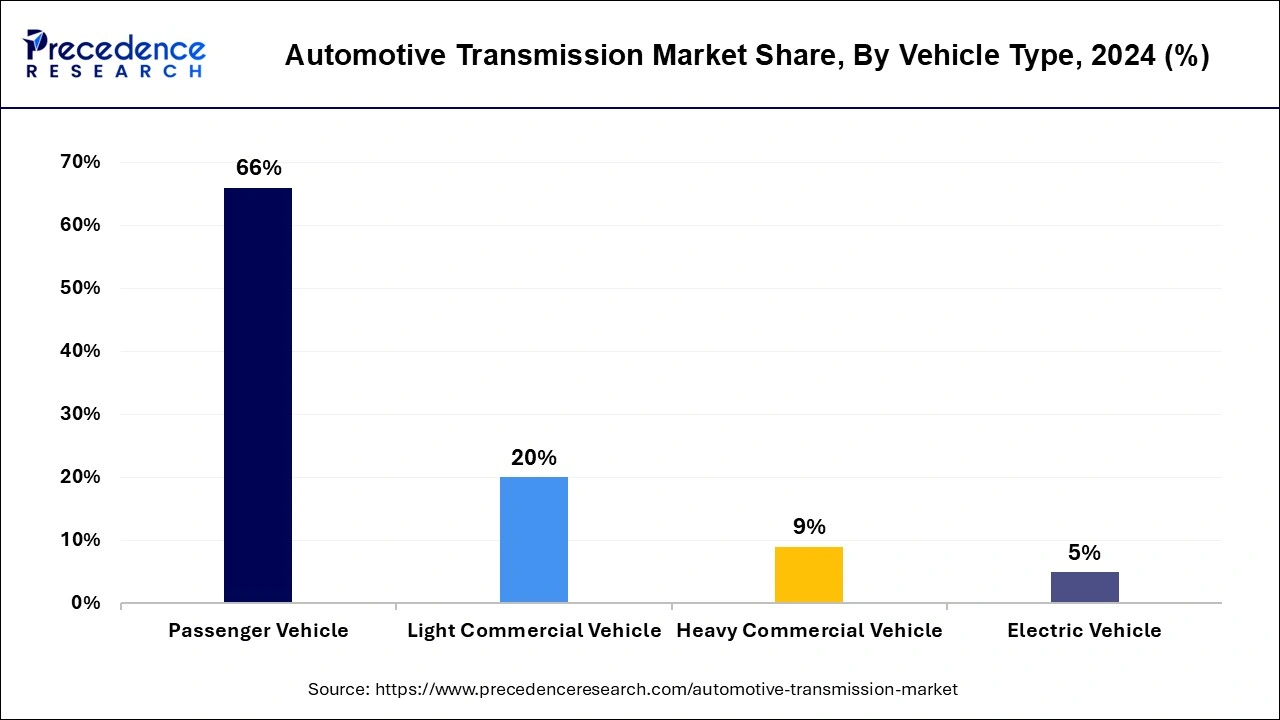
The electric vehicle segment is expected to show the fastest growth over the forecast period. Technological advancements are resulting in a surge in demand for automotive transmission systems during the forecast period. The shift towards electrification in commercial vehicles also plays a role in enhancing the performance and appeal of this segment.
Market Regional Analysis: North America, Europe, Asia-Pacific
Asia Pacific Automotive Transmission Market Size and Growth 2026 to 2035
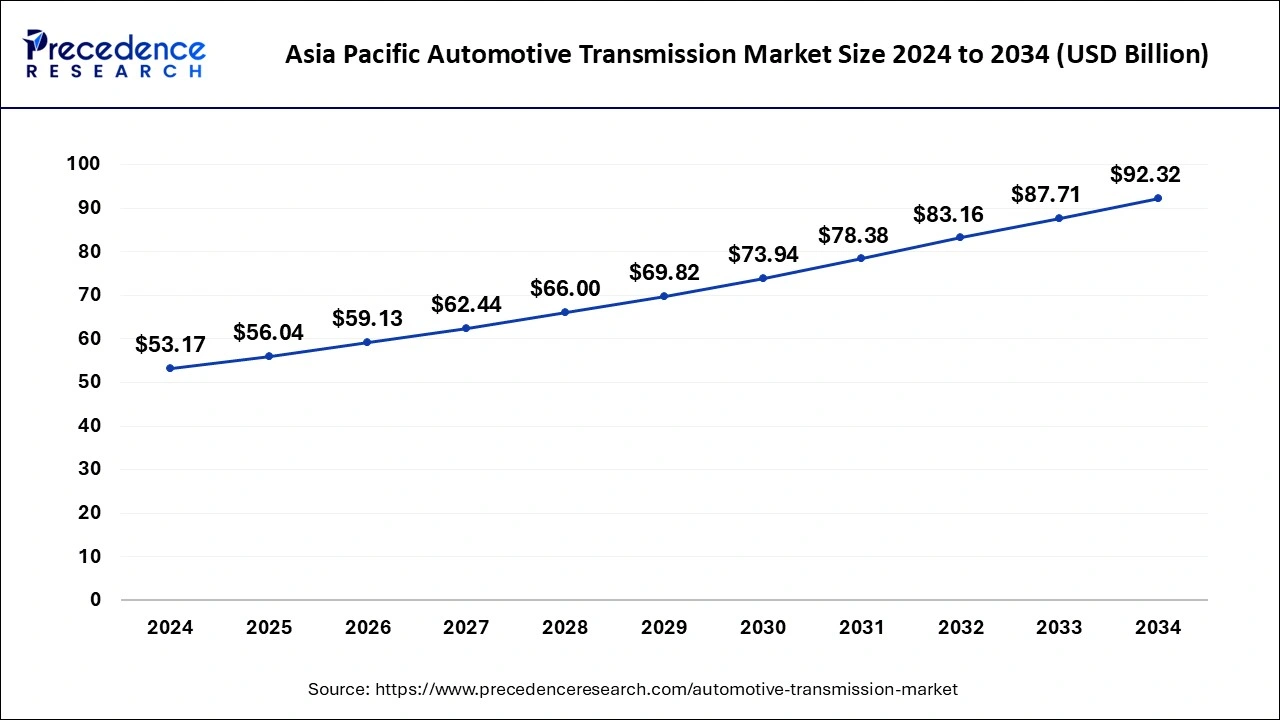
The Asia Pacific automotive transmission market size was evaluated at USD 56.04 billion in 2025 and is predicted to be worth around USD 96.89 billion by 2035, rising at a CAGR of 5.63% from 2026 to 2035.
Asia-Pacific Market Outlook
The Asia-Pacific dominated the global automotive transmission market with the largest market share of 31% in 2025 , in terms of revenue. The market growth is projected to be aided by rising electric vehicles sales in the region. The automotive transmission market is expected to rise due to an increase in demand for automatic manual transmission (AMT) enabled commercial vehicles in the Asia-Pacific.
China Market Trends
The region's growth is supported by industrialization, rising disposable incomes, and the ongoing shift towards more fuel-efficient and technologically advanced vehicles. The competitive landscape is evolving steadily, with local manufacturers emerging alongside established global players. The region's focus on innovation and technology adoption is fostering a dynamic market environment, making it a critical area for future growth in automotive transmissions.
India Automotive Transmission Market Trends
India is solidifying its position as a global automotive powerhouse, moving beyond being a cost-effective sourcing hub for transmission parts to becoming a leader in high-tech manufacturing. Supported by a substantial Production-Linked Incentive (PLI) scheme aimed at enhancing localization, the sector is rapidly adopting advanced technologies, including automatic transmission modules and Continuously Variable Transmissions (CVTs), to drive the future of mobility.
North America Market Outlook
On the other hand, the North America is estimated to be the most opportunistic segment during the forecast period. The growing demand for commercial vehicles in North America is also major driver for the global automotive transmission system. Furthermore, North America is a key market for luxury vehicles and sports vehicles, and are expected to develop at a consistent rate during the forecast period. The North America have high demand for aftermarket transmission systems, which might boost the automotive transmission market.
U.S. Automotive Transmission Market Trends
In the U.S., there is a booming demand for high-efficiency transmissions, especially in light trucks and SUVs. Industry leaders like BorgWarner and Allison Transmission are shifting towards an electrified future. By quickly developing electric vehicle gearboxes and adopting advanced Dual-Clutch Transmissions, they are bridging the gap between traditional powertrains and stringent Corporate Average Fuel Economy (CAFE) standards to power the next generation of vehicles.
Europe Market Outlook
Europe is a leader in the development of leading technologies related to vehicle transmissions. The rise of better vehicle development, the entry of the OEMs (original equipment manufacturers), is driven by the need to comply with government emissions legislation as well as the increasing demand for fleet vehicle performance. There is a major focus on dual clutch, as well as hybrid engine solutions, with OEMs investing heavily to meet regulatory requirements as well as customer expectations.
Germany Automotive Transmission Market Trends
German engineering continues to lead in transmission technology, with companies like ZF and Porsche at the forefront, pioneering high-performance 8-speed, 9-speed, and hybrid-compatible Dual-Clutch Transmission (DCT) systems. These German firms are heavily investing in 8HP evo automatic transmissions and integrating sophisticated software-defined controls to enhance efficiency and performance.
Latin America Market Outlook
In Latin America, as more people adopt a vehicle-based transport system, the demand for light vehicles is expected to rise over the next few decades or so. Brazil and Mexico have become the focus of technology transfer, with assembly plants in the region combining an increased implementation of automatic transmissions and continuously variable transmission solutions.
Brazil Automotive Transmission Market Trends
Brazil is enhancing its substantial passenger car and SUV production by transitioning from manual systems to advanced automatic and Automated Manual Transmission systems. As Latin America's foremost automotive manufacturing hub, Brazil is uniquely positioned to dominate flex-fuel capabilities. The market is also evolving into a strategic center for hybrid and electric vehicle transmissions, with investments increasing to meet a surge in electrified vehicle sales.
Middle East and Africa Market Outlook
The Middle East and African transmission markets are being driven by the demand for low-cost, durable solutions that are well-suited for harsh operating conditions. The wealthiest countries in the GCC region are adding aftermarket support products (repairing, remanufacturing, and replacing) their transmission products. In Africa, there is a growing demand for used and reconditioned automatic units, due to the varied levels of purchasing power and infrastructure gaps.
The UAE Automotive Transmission Market Trends
The UAE is rapidly emerging as a premier automotive hub, fueled by high luxury vehicle ownership and growing demand for advanced, high-performance transmissions. As a logistics center, the market is poised for significant growth in smart, automated gearbox technology, while also fostering a robust aftermarket sector for repairs and performance upgrades.
Saudi Arabia Market Trends
The country's market landscape is experiencing growing demand for automotive transmissions due to increasing vehicle sales and economic diversification efforts. This region's market is seen to be expanding gradually, with investments in automotive infrastructure playing a significant role. The landscape is characterized by a mix of established companies and new entrants, all of whom are focusing on meeting the rising demand for efficient transmission systems.
Regulatory Guidelines for Automotive Transmission Market
- U.S.: Driven by federal greenhouse gas emissions and Corporate Average Fuel Economy (CAFE) standards managed through the U.S. Environmental Protection Agency, pushing transmission designs to maximize gear ratios and parasitic loss reduction.
- EU: Regulated under the EU Automotive Industry Legislation framework, imposing strict fleet-wide CO2 emission reduction targets that dictate electronic transmission optimization and shift-pattern efficiencies.
- India: Governed through the Central Motor Vehicles Rules and Automotive Industry Standards overseen by the Ministry of Road Transport and Highways, aligning domestic powertrains with Bharat Stage emission benchmarks and type-approval mandates
Automotive Transmission Market-Value Chain Analysis
- Sourcing Raw Materials and Manufacturing Components: Prioritize the sourcing of the highest-quality steel, aluminum alloys, precision bearings, and electronic sensors to manufacture durable, heat-resistant, lightweight transmission systems. Automation and advancements in metallurgy are beginning to improve consistency, decrease defects, and ease the development of next-generation hybrid and electric drivetrains.
- Key Players: NSK Ltd., SKF Group, JTEKT Corporation, Schaeffler AG.
- Key Players: NSK Ltd., SKF Group, JTEKT Corporation, Schaeffler AG.
- Design/Engineering/Assembly of Transmission Systems: Components must be designed and integrated to create complete manual, automated, continuously variable transmission (CVT), dual-clutch transmissions (DCT), or hybrid transmission systems. Precision machining, software integration with components, testing for efficiency, and compliance with fuel economy and emissions regulations (OEM) are also significant aspects of the transmission system.
- Key Players: ZF Friedrichshafen AG, Aisin Corporation, Magna International, BorgWarner Inc.
- Key Players: ZF Friedrichshafen AG, Aisin Corporation, Magna International, BorgWarner Inc.
- Dealer integration, global distribution, after-market service of transmission systems: Dealer networks are strong; refurbishment services or new parts provide substantial revenue potential, especially in older vehicle markets.
- Key Players: Toyota Motor Corporation, Hyundai Motor Group, Stellantis, Continental AG.
- Key Players: Toyota Motor Corporation, Hyundai Motor Group, Stellantis, Continental AG.
Market Competitive Landscape: Leading Companies and Strategies
The automotive transmission market is currently characterized by a dynamic competitive landscape, driven by technological advancements and a growing emphasis on sustainability. Key players such as Aisin Seiki Co., Ltd., BorgWarner Inc, and ZF Friedrichshafen AG are at the forefront of this evolution.
In terms of business tactics, companies are localizing manufacturing to reduce costs and improve supply chain efficiency. This approach is particularly evident in regions with burgeoning automotive markets, where local production can mitigate tariffs and logistical challenges. The market structure appears to be moderately fragmented, with several key players exerting influence while also facing competition from emerging firms.
Automotive Transmission Market Companies
- Aisin Seiki Company Ltd.
- GKN PLC
- ZF Friedrischschafen AG
- Continental AG
- Magna International Inc.
- Borgwarner Inc.
- Eaton Corporation PLC
- JATCO Ltd.
- Schaeffler AG
- Allison Transmission Inc.
Key Companies & Market Share Insights
The market is moderately fragmented with the presence of several local companies. These market players are striving to gain higher market share by adopting different marketing strategies, such as new product launch, investments, partnerships, and mergers & acquisitions. The companies are also spending on the development of improved products. Moreover, they are also focusing on competitive pricing.
The various developmental strategies such as business expansion, investments, new product launches, acquisition, partnerships, joint venture, and mergers fosters market growth and offers lucrative growth opportunities to the market players.
Recent Developments
- In January 2026, JSW Group entered India's automobile industry with JSW Motors, launching a new SUV based on the Jetour T2, set to debut around Diwali 2026. The SUV features a boxy design inspired by notable off-roaders, with a bold front fascia, large rectangular grille, and squared LED headlamps, making it suitable for both off-road and city driving. (Source: https://www.cardekho.com)
- In May 2026, Škoda Auto updated the Kushaq, with deliveries already underway. The brand, seeing growth in India, plans to launch more products, including an updated Slavia, which will feature revised styling and an upgraded infotainment system while retaining its 1.0-litre TSI engine. (Source: https://www.cartoq.com)
- In September 2025, BorgWarner Inc. completed the acquisition of a prominent electric vehicle component manufacturer. This strategic acquisition is likely to bolster BorgWarner's capabilities in the electric vehicle segment, aligning with the industry's shift towards electrification. By expanding its portfolio, BorgWarner positions itself to capture a larger share of the growing electric vehicle market, which is expected to see substantial growth in the coming years. (Source: https://www.borgwarner.com)
- In July 2025, Aisin Seiki Co., Ltd. launched a new line of lightweight transmission systems designed specifically for electric vehicles. This innovation not only enhances vehicle efficiency but also aligns with global sustainability goals. Aisin's focus on lightweight materials and energy-efficient designs reflects a broader trend within the industry towards reducing carbon footprints and improving overall vehicle performance. (Source: https://www.aisin.com)
- In October 2024, Schaeffler AG completed the merger with Vitesco Technologies Group AG, which was declared almost a year ago. The merger of Vitesco into Schaeffler took effect upon the final entry of the merger in Schaeffler's commercial register.
- In August 2024, Citroen India started the new C3, which is now equipped with a 6-speed automatic transmission and advanced features. The latest Citroen C3 is available at all La Maison Citroen dealerships, with introductory prices starting at Rs 6.16 lakh.
Segments Covered in the Report
By Engine
- Internal Combustion (IC) Engine
- Electric Engine
By Type
- Manual
- Automatic
- Automatic Manual Transmission (AMT)
- Continuously Variable Transmission (CVT)
- Dual-clutch Transmission (DCT)
- Others
By Vehicle Type
- Passenger Vehicle
- Light Commercial Vehicle
- Heavy Commercial Vehicle
- Electric Vehicle
By Region
- North America
- Europe
- Asia Pacific
- Latin America
- Middle East & Africa
For inquiries regarding discounts, bulk purchases, or customization requests, please contact us at sales@precedenceresearch.com
Frequently Asked Questions





Ask For Sample
No cookie-cutter, only authentic analysis – take the 1st step to become a Precedence Research client
 Get a Sample




 sales@precedenceresearch.com
 Schedule a Meeting
