



U.S. Regenerative Medicine Market Size, Key Companies, Company Market Share, Patient Volume, Treatment Adoption Rates, Pricing Analysis, Regulatory Landscape, Competitive Positioning, and Demand Forecast
Rohan Patil, a Healthcare Industry Expert, highlights that the U.S. regenerative medicine market has reached USD 24.10 billion in 2026 and is on track to reach USD 102.23 billion by 2035, advancing at a CAGR of 17.86%. Key U.S. regenerative medicine market companies shaping the market include Integra LifeSciences Corporation (U.S.), Bristol-Myers Squibb Company (U.S.), American CryoStem Corporation (U.S.), while major growth segments span By Product, By Material, By Application, By End User.
Source: https://www.precedenceresearch.com/us-regenerative-medicine-market
 Get a Sample
 Table Of Content


U.S. Regenerative Medicine Market Size and Forecast 2026 to 2035
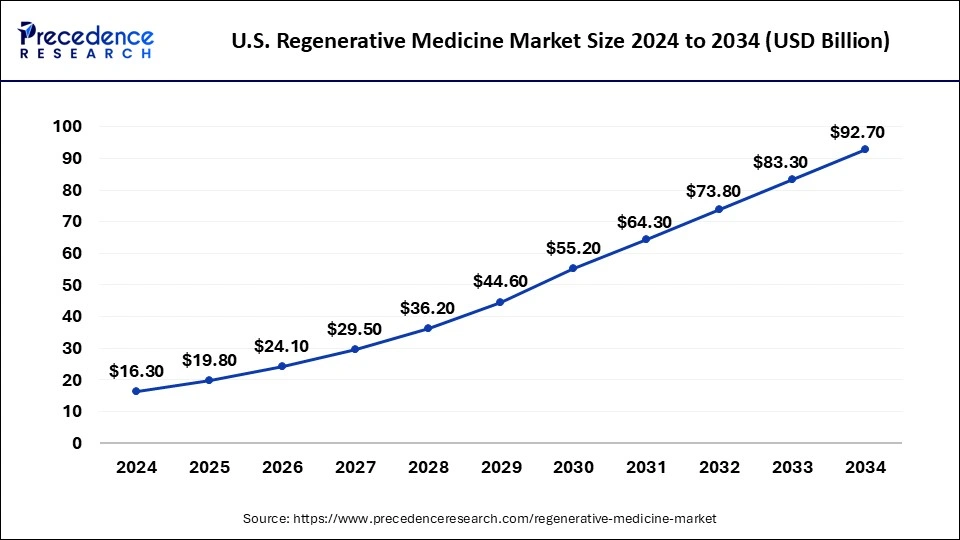
The global U.S. regenerative medicine market size was calculated at USD 19.77 billion in 2025 and is predicted to increase from USD 24.10 billion in 2026 to approximately USD 102.23 billion by 2035, expanding at a CAGR of 17.86% from 2026 to 2035. The market is driven by the increasing prevalence of chronic and degenerative diseases, rising investment in stem cell and gene therapy research, and growing adoption of advanced tissue engineering and personalized treatment approaches.
Key Takeaways
- By product, the cell therapy segment held the largest share of the market in 2025.
- By product, the tissue engineering segment is expected to grow with the highest CAGR during the forecast period.
- By material, the biologically derived material segment dominated the market in 2025.
- By material, the synthetic material segment is expected to grow with a significant CAGR between 2026 and 2035.
- By application, the musculoskeletal segment led the market in 2025.
- By application, the oncology segment is expected to grow with a significant CAGR during the forecast period.
- By end user, the hospitals & clinics segment held the largest share of the market in 2025.
- By end-user, the government & academic research institutes segment is expected to grow with a notable CAGR during the forecast period.
Market Overview
The U.S. regenerative medicine market is expanding rapidly due to the modernization of the healthcare infrastructure, along with the opening of new hospitals across the nation. Pharmaceutical companies are conducting clinical trials to check the efficacy of regenerative medicines. Also, the rising focus of the government on developing the biotechnology sector, as well as the technological advancements in biopharma institutes, has been contributing to the growth of this market.
How is AI Influencing the U.S. Regenerative Medicine Market?
AI is significantly impacting the U.S. regenerative medicine industry by enhancing biomanufacturing processes and enabling the production of personalized therapies. AI is used to monitor process-critical variables in real-time to enhance product consistency and scalability. It also finds application in evaluating the efficiency, quality, and potency of stem cells and predicting the cells' behavior after being implanted in the human body. These platforms can streamline the design of biomaterials and 3D printing scaffolds by analyzing biocompatibility and tissue interactions.
- In April 2026, FacialDx launched a new AI-based platform. This AI-enabled platform is designed to enhance the capabilities of regenerative medicine providers in the U.S. region.
Market Report Coverage and Key Metrics
| Report Coverage | Details |
| Market Size by 2025 | USD 19.77 Billion |
| Market Size by 2026 | USD 24.10 Billion |
| Market Size by 2035 | USD 102.23 Billion |
| Growth Rate from 2026 to 2035 | CAGR of 17.86% |
| Largest Market | North America |
| Fastest Growing Market | Asia Pacific |
| Base Year | 2024 |
| Forecast Period | 2026 to 2035 |
| Segments Covered | Product, Material, Application, End User, and Region |
Market Dynamics
Drivers
Establishment of New Hospitals and Surging Prevalence of Rare Diseases
The healthcare providers are engaged in opening new hospitals to provide high-quality treatments to patients suffering from neurological disorders, cancers, and CVDs. With the rise in the number of hospitals, the demand for regenerative medicines has increased significantly. The increasing cases of rare diseases such as Hutchinson-Gilford Progeria Syndrome (HGPS), Methemoglobinemia, and Aquagenic Urticaria have further increased the application of regenerative medicines in the U.S.
- In February 2026, Ohio State opened a new hospital in the U.S. This new hospital was designed to deliver high-quality care to needy patients.
Restraint
Strict Compliances and Supply-Chain Issues
The U.S. government has been implementing stringent regulations for the approval of regenerative medicines. Also, the ongoing wars in the Middle East have disrupted global supply chains for regenerative medicines. Thus, geopolitical issues and critical rules governing drug approval are hampering the industry.
Opportunity
Popularity of 3D Bioprinting and Advancements in Induced Pluripotent Stem Cells
The 3D bioprinting has been gaining popularity in the U.S. for the production of functional tissues and artificial organs. The researchers are pairing iPSCs with advanced gene editing tools to correct genetic mutations before differentiating cells into transplant-ready, healthy, patient-specific tissues. Thus, the rapid advancements in induced pluripotent stem cells and developments in 3D bioprinting technology are expected to create various opportunities for the market players in the future.
How is the Government Contributing to the U.S. Regenerative Medicine Market?
The government of the U.S. has been playing a transformative role in strengthening the regenerative medicine industry. The government is making significant investments and collaborating with pharma companies to develop regenerative medicines. Moreover, the FDA is engaged in approving a wide range of regenerative medicines for the end-users.
- In February 2026, the U.S. Food and Drug Administration launched the FDA PreCheck pilot program. FDA PreCheck was designed to develop the domestic pharmaceutical supply chain by enhancing regulatory predictability and facilitating the construction of manufacturing sites across the U.S.
Market Segmentation Analysis
Product Insights
The Cell Therapy Segment Dominated the Market in 2025
The cell therapy segment led the market with the largest share in 2025. This is due to the rapid adoption of next-generation CAR-T & TCR therapies for the treatment of solid tumors and lupus. There are several benefits of cell therapy, including tissue regeneration, targeted cancer elimination, and reduced side effects, which make it a suitable choice among healthcare professionals. The biotech companies are investing significantly in developing advanced cell therapies for treating a wide range of rare diseases.
The tissue engineering segment is expected to expand at the highest CAGR during the forecast period. This is because tissue engineering is used in the repair of human tissues and organs that are damaged by chronic diseases. The government of the U.S. is making a significant investment in strengthening the tissue engineering sector.
Material Insights
What Made Biologically Derived Material the Leading Segment in the Market?
The biologically derived material segment held the largest share of the U.S. regenerative medicine market in 2025. This is mainly due to the increasing use of collagen for the manufacturing of wound healing substances. Also, the pharma brands are widely adopting biologically derived materials for producing dermal items.
The synthetic material segment is expected to grow with a significant CAGR between 2026 and 2035, due to the growing use of biodegradable synthetic polymers for the production of artificial hearts. The scarcity of organic substances in the U.S. has increased the demand for synthetic materials for biomedical use.
Application Insights
The Musculoskeletal Segment Dominated the Market in 2025
The musculoskeletal segment dominated the market while holding a major share in 2025. This is primarily due to the growing use of regenerative medicines for the treatment of arthritis and spinal disorders. The government is engaged in opening new orthopedic hospitals in urban areas to deliver 24*7 treatment.
The oncology segment is expected to grow with a significant CAGR during the forecast period. This is due to the surging use of gene therapy for the treatment of blood cancers and prostate cancers. Additionally, numerous cancer research institutions are established by public-sector entities to develop advanced therapies for oncological disorders. The U.S. government is launching favorable initiatives to provide free treatment to cancer patients.
End-User Insights
The Hospitals & Clinics Segment Led the Industry in 2025
The hospitals & clinics segment led the U.S. regenerative medicine market in 2025. This is due to the rapid integration of advanced machinery in hospitals to enhance diagnostic procedures. The governments are making significant investments to establish new hospitals to deliver high-quality treatment in this nation.
The government & academic research institutes segment is expected to expand with a notable CAGR during the forecast period. This is owing to the increasing focus of the government on establishing new biopharma research centers. The academic research centers are widely adopting regenerative medicines to teach medical students about the outcomes of therapies on specific patients.
Country-Level Analysis
California: California leads the U.S. regenerative medicine market due to its strong biotechnology ecosystem, world-class research institutions, and substantial funding for stem cell and regenerative medicine research. The presence of numerous biotech companies and clinical trial centers continues to drive innovation and commercialization.
Massachusetts: Massachusetts is a major hub for regenerative medicine, supported by leading academic institutions, biotechnology firms, and research hospitals. The state's focus on cell therapy, gene therapy, and tissue engineering is accelerating clinical development and investment activity.
Texas: Texas is experiencing significant growth due to expanding biomedical research infrastructure, increasing clinical trial activity, and rising investments in advanced therapeutics. The state's large healthcare network also supports the adoption of regenerative medicine treatments.
North Carolina: North Carolina benefits from a strong life sciences ecosystem centered around the Research Triangle region. Growing collaboration among universities, biotechnology companies, and contract development organizations is fostering regenerative medicine research and manufacturing.
U.S. Regenerative Medicine Market Value Chain Analysis
- Raw Materials Sourcing
Raw materials used in the manufacturing of regenerative medicines comprise biological components, biomaterials, and ancillary/ancillary processing agents.
Key Companies: Evonik, Corbion, and Zimmer Biomet.
- Clinical Trials and Regulatory Approvals
The clinical trials of regenerative medicine follow a multi-phase process designed to test the optimal dosing, safety, and effectiveness of various therapies, including stem cell treatments, gene therapy, and tissue engineering.
Key Companies: FDA and CVM.
- Distribution Channel
The distribution channels of regenerative medicines in the U.S. include offline stores, online channels, and retail pharmacies.
Key Companies: Integra LifeSciences Corporation, Bristol-Myers Squibb Company (U.S.), and MIMEDX Group, Inc.
Market Competitive Landscape: Leading Companies and Strategies
The U.S. regenerative medicine market is highly fragmented. This industry is highly competitive due to the presence of numerous well-established brands, along with the surging proliferation of startups. The leading brands, such as Bristol-Myers Squibb Company, MIMEDX Group, Inc, Stryker, and American CryoStem Corporation. These companies are constantly engaged in R&D of regenerative medicines and adopting numerous strategies, such as product launches and business expansions, to strengthen their position in this competitive sector.
- In May 2026, MiMedx Group, Inc. launched the G4Derm Plus. G4Derm Plus is a self-assembling peptide regenerative therapy designed for patients in the U.S. region.
The problems associated with high prices of raw materials, as well as technological complexities in the healthcare sector, negatively hamper the industry. Advancements in CRISPR technology and the rapid investments in exosome-based therapeutics are likely to reshape the future landscape of this industry.
U.S. Regenerative Medicine Market Companies
- Integra LifeSciences Corporation (U.S.)
- Bristol-Myers Squibb Company (U.S.)
- American CryoStem Corporation (U.S.)
- Kite (Gilead Sciences, Inc.) (U.S.)
- Allergan Aesthetics (AbbVie Inc.) (U.S.)
- MIMEDX Group, Inc. (U.S.)
- Stryker (U.S.)
- AlloSource (U.S.)
- Bluebird bio, Inc. (U.S.)
Recent Developments U.S. Regenerative Medicine Market (2025-2026)
- In May 2026, the Maryland Stem Cell Research Commission invested US$ 12.6 million. This investment was made to strengthen the cutting-edge stem cell and regenerative medicine research in the U.S.(Source: http://sg.finance.yahoo.com/)
- In May 2026, Wonderlab Bio launched a new range of next-generation therapies. These therapies are designed for the consumers of the U.S. region.(Source: https://www.citybiz.co)
- In March 2026, StimLabs launched the Architect Fx. Architect Fx is an innovative extracellular collagen matrix designed for enhancing wound management across the U.S.(Source: https://www.biospace.com)
Segments Covered in the Report
By Product
- Gene Therapies
- Cell Therapies
- Tissue-Engineering
- Small Molecules & Biologics
By Material
- Synthetic material
- Biodegradable synthetic polymers
- Scaffold
- Artificial Vascular Graft
- Materials Hydrogel Material
- Biologically derived material
- Collagen
- Xenogeneic material
- Genetically Engineered Material
- Deoxyribonucleic Acid Transfection Vectors
- Genetically Manipulated Cell
- Three-Dimensional Polymer Technology
- Transgenics
- Fibroblast
- Neural Stem Cell
- Gene-Activated Matrices
- Pharmaceutical
- Biologics
- Small Molecules
By Application
- Wound Care
- Musculoskeletal
- Ophthalmology
- Oncology
- Cardiovascular
- Dermatology
- Neurology
- Others
By End User
- Hospitals & Clinics
- Commercial Industries
- Government & Academic Research Institutes
For inquiries regarding discounts, bulk purchases, or customization requests, please contact us at sales@precedenceresearch.com
Frequently Asked Questions





Ask For Sample
No cookie-cutter, only authentic analysis – take the 1st step to become a Precedence Research client
 Get a Sample




 sales@precedenceresearch.com
 Schedule a Meeting
