



U.S. Viral Vectors and Plasmid DNA Manufacturing Market Size, Companies, Share, Patient Volume, Treatment Adoption Rates, Pricing Analysis, Regulatory Landscape, Competitive Positioning, and Demand Forecast
U.S. Viral Vectors and Plasmid DNA Manufacturing Market (By Vector Type: Adenovirus, Plasmid DNA, Lentivirus, Retrovirus, AAV, Others; By Application: Gene Therapy, Antisense &RNAi, Cell Therapy, Vaccinology; By Workflow: Upstream Processing, Vector Recovery/Harvesting, Vector Amplification & Expansion, Downstream Processing, Fill-finish, Purification; By End-User: Biopharmaceutical and Pharmaceutical Companies, Research Institutes; By Disease: Genetic Disorders, Cancer, Infectious Diseases, Others) - Industry Analysis, Size, Trends, Leading Companies, Regional Outlook, and Forecast 2026 to 2035
Source: https://www.precedenceresearch.com/us-viral-vectors-and-plasmid-dna-manufacturing-market
 Get a Sample
 Table Of Content


What is the U.S. Viral Vectors and Plasmid DNA Manufacturing Market Size in 2026?
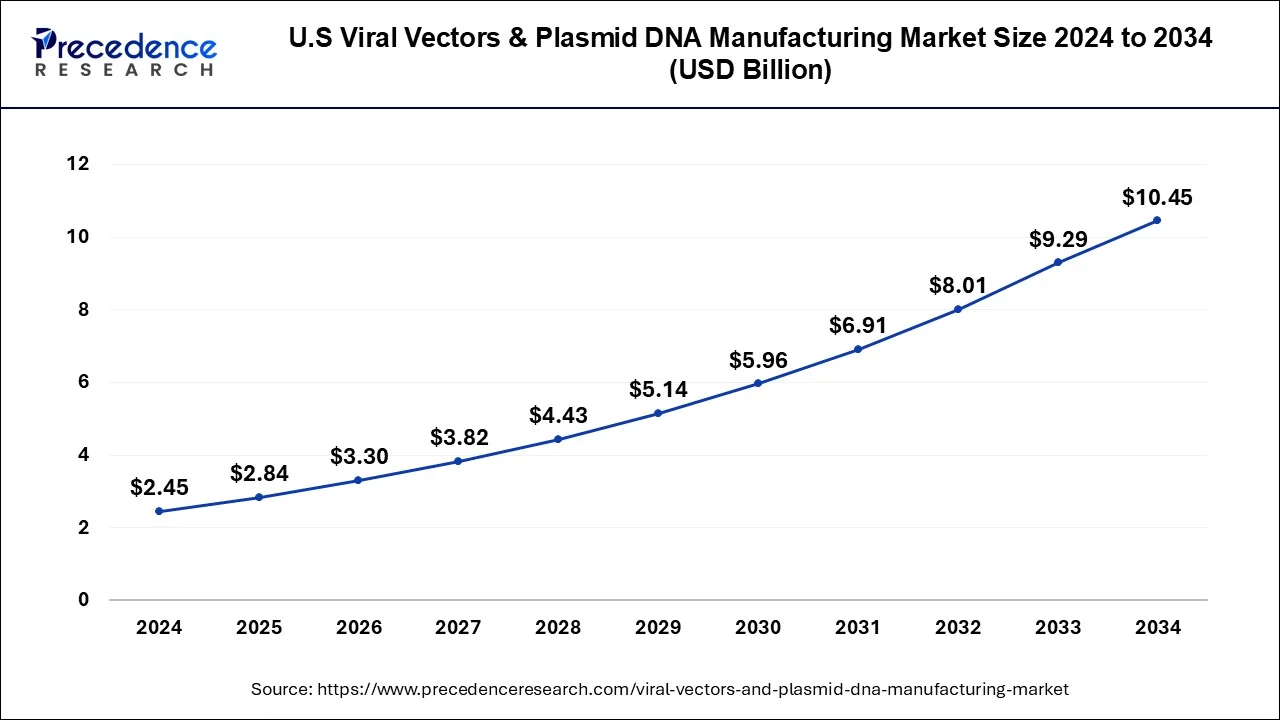
The U.S. viral vectors and plasmid DNA manufacturing market size accounted for USD 2.84 billion in 2025 and is predicted to increase from USD 3.30 billion in 2026 to approximately USD 11.69 billion by 2035, expanding at a CAGR of 15.20% from 2026 to 2035. The market growth is attributed to increasing gene therapy commercialization, expanding clinical trial activity, and rising investments in advanced biomanufacturing infrastructure.
Key Takeaways
- By vector type, the adenovirus segment held the largest market share in 2025.
- By vector type, the lentivirus segment is expected to expand at the highest CAGR during the forecast period.
- By application, the vaccinology segment held the largest share of the market in 2025.
- By application, the cell therapy segment is expected to grow at a significant CAGR between 2026 and 2035.
- By workflow, the downstream processing segment held the highest share of the market.
- By workflow, the upstream processing segment is expected to grow at the highest CAGR during the forecast period.
- By end-user, the research institutes segment held the highest share of the market.
- By end-user, the biopharmaceutical and pharmaceutical companies segment is expected to grow at the fastest CAGR during the forecast period.
- By disease, the genetic disorders segment held the largest share of the market in 2025.
- By disease, the cancer segment is expected to grow at a significant CAGR between 2026 and 2035.
Market Overview
The growing commercialization of gene therapies is driving the U.S. viral vectors and plasmid DNA manufacturing market. Viral vectors and plasmid DNA are essential for delivering therapeutic genes targeting specific cells. These vectors are also used in the development of various advanced therapies for rare diseases, cancer, and inherited diseases.
The U.S. Food and Drug Administration is expanding its approved products based on cell and gene therapies to require commercial production across the country. Around 3,200 were ongoing in the world in 2025, which is a very impressive pipeline growth, according to the American Society for Gene and Cell Therapy. Furthermore, the recent FDA approvals, including new gene therapies for rare immune disorders and genetic skin diseases, further accelerated demand for high-quality GMP-compliant vector production platforms.
Impact of Artificial Intelligence on the U.S. Viral Vectors and Plasmid DNA Manufacturing Market
Artificial intelligence is greatly influencing the market by optimizing the manufacturing processes during the production of gene therapies. AI-driven analytics are helping manufacturers fine-tune upstream and downstream operations, yielding higher viral vector yields and better plasmid DNA productivity. Furthermore, top manufacturers are utilizing machine learning models to expedite process development, minimize experimental cycles, and enhance process scalability from the clinical to the commercial.
Market Scope
| Report Coverage | Details |
| Market Size in 2025 | USD 2.84 Billion |
| Market Size in 2026 | USD 3.30 Billion |
| Market Size by 2035 | USD 11.69 Billion |
| Market Growth Rate from 2026 to 2035 | CAGR of 15.20% |
| Base Year | 2025 |
| Forecast Period | 2026 to 2035 |
| Segments Covered | Vector Type, Application, Workflow, End-User, and Disease |
Market Dynamics
Drivers
Rising Commercialization of Gene Therapies
Rising commercialization of gene therapies is driving the U.S. viral vectors and plasmid DNA manufacturing market. The production of adeno-associated viral (AAV) vectors, lentiviral vectors, and plasmid DNA used in gene therapy formulations must be carried out under strict Good Manufacturing Practice (GMP) standards.
By 2025, more than 40 cell and gene therapy products had received FDA approval, driving increasing demand for specialized manufacturing capabilities. In response, commercial launches are prompting manufacturers to expand production suites, analytical testing capacity, and quality control operations across the U.S.
Restraint
Complex Manufacturing Processes
Complex manufacturing processes are projected to hamper the market growth in the coming years. Viral vector production requires tightly controlled upstream and downstream processes, including cell culture optimization and detailed analytical characterization. Additionally, scale-up challenges during the transition from clinical development to commercial manufacturing often create bottlenecks, limiting production efficiency and slowing market expansion.
Opportunity
Increasing Investments in Cell and Gene Therapy Manufacturing Infrastructure
Increasing investments in cell and gene therapy manufacturing infrastructure are creating opportunities in the market. Higher investments in the manufacturing of cell and gene therapy equipment are expected to drive growth in the market.
Advanced bioprocessing capacities also continued to grow in 2025, with Thermo Fisher Scientific, Cytiva, Sartorius and Fujifilm Diosynth Biotechnologies all further developing advanced bioprocessing capacities. Furthermore, the surging demand for rare disease and genetic disorder treatments is likely to increase the utilization of viral vectors and plasmid DNA products.
Segment Insights
Vector Type Insights
The Adenovirus Segment Dominated the Market in 2025
The adenovirus segment dominated the U.S. viral vectors and plasmid DNA manufacturing market in 2025. This is mainly due to the critical role of adenoviral vectors in vaccine production and gene therapies. They enable high expression of the transgene and highly efficient transduction into cells during many therapeutic programs.
The lentivirus segment is expected to grow at a significant CAGR from 2026 to 2035, owing to the increasing commercialization of cell and gene therapies. Lentiviral vectors are a crucial element in CAR-T, hematopoietic stem cell modification, and ex vivo gene transfer applications. Additionally, the rising number of regulatory approvals for advanced cell therapies is further increasing the demand for high-quality lentiviral vector manufacturing services.
Application Insights
Why Did the Vaccinology Segment Lead the Market in 2025?
The vaccinology segment dominated the market with a major share in 2025 due to the widespread use of viral vectors and plasmid DNA in advanced vaccine development programs. Plasmid DNA templates and viral vector platforms are extensively utilized across research, process development, and commercial-scale vaccine manufacturing, supporting their strong demand.
The cell therapy segment is expected to grow at a significant CAGR from 2026 to 2035, driven by rapid advancements in engineered cellular medicine research. The production of CAR-T cells, stem cell engineering, and gene-modified immune cells relies heavily on viral vectors and plasmid DNA, and increasing therapeutic success in cell therapy programs is further supporting strong long-term growth momentum.
WorkFlow Insights
The Downstream Processing Segment Dominated the Market in 2025
The downstream processing segment dominated the U.S. viral vectors and plasmid DNA manufacturing market in 2025 due to the critical role of purification and quality control in viral vector and plasmid DNA production. The need for comprehensive characterization and quality testing, especially for regulatory agencies, further emphasizes the significance of downstream operations throughout the production process.
The upstream processing segment is expected to grow at the fastest CAGR in the coming years, driven by increasing efforts to enhance yield and improve efficiency in viral vector and biologics manufacturing. Upstream activities include cell line development, cell expansion, transfection, media optimization, and bioreactor-based production, all of which are critical for scalable gene therapy manufacturing. Additionally, process intensification strategies are becoming a key focus for gene therapy developers, enabling higher productivity in shorter timelines and supporting the growing demand for advanced cell and gene therapy products.
End-User Insights
Research Institutes Held the Largest Market Share in 2025
The research institutes segment led the market with the largest share in 2025 due to the extensive use of viral vectors and plasmid DNA in translational research, preclinical studies, and early-stage therapeutic development. Novel vector technologies have also been developed by research institutions, which have contributed to commercial product development.
The biopharmaceutical and pharmaceutical companies segment is expected to grow at a significant CAGR between 2026 and 2035. This is mainly due to the increasing commercialization of gene therapies, cell therapies, and advanced biologics. These companies heavily invest in developing cell and gene therapies, supporting segmental growth.
Disease Insights
The Genetic Disorders Segment Dominated the Market in 2025
The genetic disorders segment dominated the U.S. viral vectors and plasmid DNA manufacturing market with a major share in 2025, driven by a strong focus on developing curative therapies for inherited diseases. Biopharmaceutical companies have expanded both clinical and commercial activities across multiple rare and inherited disease categories. In 2025, the National Organization for Rare Disorders reported that nearly 30 million Americans are living with a rare disease, underscoring the significant patient population driving demand for innovative therapies.
The cancer segment is expected to grow at the fastest CAGR between 2026 and 2035, driven by increasing development of cell therapies, oncolytic viral therapies, and gene-based oncology treatments. Biotechnology companies are actively expanding oncology pipelines targeting solid tumors, hematological malignancies, and treatment-resistant cancers. In 2025, the American Cancer Society estimated around 2.04 million new cancer cases in the U.S., further supporting strong and sustained demand for advanced gene and cell therapy approaches.
Country-Level Analysis
Massachusetts
Massachusetts is a significant player in the market due to the presence of a large number of biotechnology companies, academic research institutions, and advanced therapy developers. In 2025, the Alliance for Regenerative Medicine (ARM) noted continued expansion of RMDP programs in key biotechnology hubs in the area. Massachusetts's translational gene therapy research labs remained active, and there is an ongoing demand for viral vectors and plasmid DNA materials.
California
California is a significantly growing region in the market, supported by its strong biotechnology ecosystem, deep venture capital (VC) network, and high concentration of gene therapy companies. The state hosts a growing number of firms focused on genetic medicines, cell therapies, and next-generation biologics, making it a key innovation hub in the United States. Companies such as CRISPR Therapeutics, Sangamo Therapeutics, and Genentech, along with numerous emerging biotechnology startups, maintain significant R&D operations across California, further strengthening its leadership in advanced therapeutic development and biomanufacturing innovation.
Competitive Landscape
The U.S. viral vectors and plasmid DNA manufacturing market is relatively fragmented, comprising key manufacturers, specialized CDMOs, and new technology providers. Top players include Thermo Fisher Scientific, Lonza, Catalent, Charles River Laboratories, Fujifilm Diosynth Biotechnologies, Aldevron, and Oxford Biomedica. These companies have maintain strong market positions through large-scale GMP manufacturing capabilities, broad service portfolios, and long-term customer partnerships.
Companies are increasingly leveraging artificial intelligence, automation, and advanced bioprocessing technologies to improve vector yield, enhance process efficiency, and develop next-generation manufacturing platforms. As a result, future competition is expected to focus heavily on technological differentiation, scalable production capabilities, and continuous improvements in biomanufacturing performance.
U.S. Viral Vectors and Plasmid DNA Manufacturing Market Companies
- Andelyn Biosciences
- BioReliance
- Bluebird Bio
- Brammer Bio
- Catalent Cell & Gene Therapy
- Catalent Viral Vector Manufacturing
- Charles River Laboratories
- FUJIFILM Diosynth Biotechnologies
- Lonza Houston
- Novartis Gene Therapies
- Oxford Biomedica Solutions
- Resilience
- Sarepta Therapeutics
- Vigene Biosciences
- Virovek
- Wuxi Advanced Therapies
Recent Developments
- In May 2026, Orphan Therapeutics Accelerator (OTXL), a non-profit biotech focused on advancing rare disease treatments, announced that AGC Biologics has joined its Clinical Development Network as a manufacturing partner. This partnership enhances OTXL's capabilities for developing cell and gene therapies for ultra-rare conditions. (Source: https://www.agcbio.com)
- In May 2026, Ribbon Bio announced the launch of two major products aimed at improving DNA production: the MiroSynth Cell-Free DNA, which eliminates cloning steps, and the MiroMine kit, enabling access to its assembly algorithms and synthesis processes.(Source: https://finance.yahoo.com)
Segments Covered in the Report
By Vector Type
- Adenovirus
- Plasmid DNA
- Lentivirus
- Retrovirus
- AAV
- Others
By Application
- Gene Therapy
- Antisense &RNAi
- Cell Therapy
- Vaccinology
By Workflow
- Upstream Processing
- Vector Recovery/Harvesting
- Vector Amplification & Expansion
- Downstream Processing
- Fill-finish
- Purification
By End-User
- Biopharmaceutical and Pharmaceutical Companies
- Research Institutes
By Disease
- Genetic Disorders
- Cancer
- Infectious Diseases
- Others
For inquiries regarding discounts, bulk purchases, or customization requests, please contact us at sales@precedenceresearch.com
Frequently Asked Questions





Ask For Sample
No cookie-cutter, only authentic analysis – take the 1st step to become a Precedence Research client
 Get a Sample




 sales@precedenceresearch.com
 Schedule a Meeting
