



Solid State LiDaR Market Trends, Companies, Revenue / Sales Performance, Manufacturing Yield, Fab Capacity, Export & Import Dynamics, Supply Chain Analysis, Competitive Landscape, and Growth Forecast
Solid State LiDaR Market (By Component: Laser Source, Receiver, Optics, Processing Unit; By Technology: Flash LiDAR, Phased Array LiDAR, Scanning LiDAR; By Application: Autonomous Vehicles, Mapping and Surveying, Infrastructure Monitoring, Agriculture, Robotics; By End Use: Automotive, Aerospace, Defense, Construction, Environmental Monitoring) - Global Industry Analysis, Size, Trends, Leading Companies, Regional Outlook, and Forecast 2026 to 2035
Source: https://www.precedenceresearch.com/solid-state-lidar-market
 Get a Sample
 Table Of Content


What is the Solid State LiDaR Market Size in 2026?
The global solid state LiDaR market size accounted for USD 2.20 billion in 2025 and is predicted to increase from USD 2.64 billion in 2026 to approximately USD 13.79 billion by 2035, expanding at a CAGR of 20.15% from 2026 to 2035. This market is growing due to the soaring need for cost-effective, high-reliability sensors in advanced driver-assistance systems and autonomous vehicles.
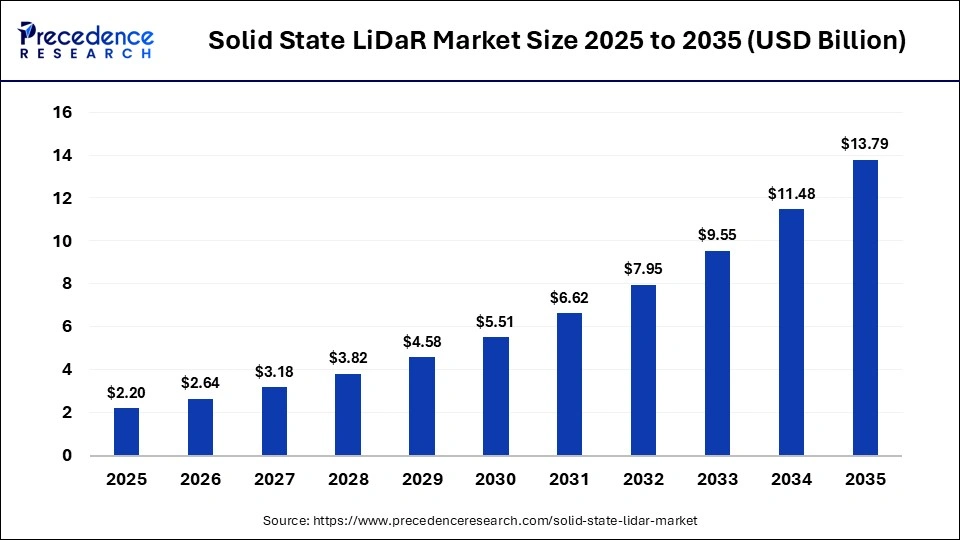
Key Takeaways
- North America dominated the global solid state LiDaR market in 2025.
- Asia-Pacific is expected to grow at the fastest CAGR between 2026 and 2035.
- By component, the laser source segment held a dominant position in the market in 2025.
- By component, the processing unit segment is expected to expand at the fastest CAGR between 2026 and 2035.
- By technology, the flash LiDAR segment held the largest market share in 2025.
- By technology, the phased array LiDAR segment is expected to expand at the fastest CAGR between 2026 and 2035.
- By application, the autonomous vehicles segment contributed the biggest market share in 2025.
- By application, the agriculture segment is expected to expand at the fastest CAGR between 2026 and 2035.
- By end use, the automotive segment accounted for the highest market share in 2025.
- By end use, the aerospace segment is expected to expand at the fastest CAGR between 2026 and 2035.
What Drives the Solid State LiDaR Market?
The solid-state LiDAR industry is mainly driven by the surging need for autonomous vehicles and advanced driver assistance systems, demanding compact, reliable, and cost-effective sensors for safety and navigation. Major factors include technological advancements like miniaturization, enhanced resolution, regulatory mandates for vehicle safety, and rising adoption in industrial robotics and smart city infrastructure.
How is AI Influencing the Solid State LiDaR Market?
AI is transforming the market by changing raw, high-density point clouds into actionable and even real-time 3D intelligence for autonomous vehicles and robotics. AI algorithms improve object detection, classification, and even tracking while reducing sensor noise, allowing smarter, safer navigation in complex environments. Machine learning models enable vehicles to anticipate the movement of surrounding objects, enhancing safety and decision-making. AI aids in interpreting complex, unstructured 3D data, changing the industry from manual, labor-heavy labeling to AI-driven annotation.
What are the Key Trends Influencing the Solid State LiDaR Market?
- Cost Reduction and Mass Adoption: A major trend is the reduction of sensor expenses to below $200, with a long-term aim of approaching $100 for broader integration into standard user vehicles, rather than just premium models.
- Shift from Mechanical to Solid-State: The industry is moving away from spinning mechanical LiDAR to smaller, more reliable, and durable solid-state designs that have no moving parts, improving longevity in harsh automotive environments.
- Performance Improvements: Advancements in technology are improving range, resolution, and field-of-view, enabling better perception, 360-degree coverage, and even real-time data processing.
- Automotive ADAS and Autonomous Driving: The rapid expansion of autonomous vehicles and sophisticated driver-assistance systems is the main driver, with LiDAR acting as a vital sensor for safety-critical tasks such as object detection and collision avoidance.
- Data Fusion and Software Integration: Solid-state LiDAR is increasingly integrated with other sensors like cameras and radar to offer comprehensive environmental perception, utilizing advanced software for enhanced scene interpretation.
- Expansion into New Applications: Beyond cars, solid-state LiDAR is seeing increased usage in smart city infrastructure, robotics, drones, industrial automation, and mapping services.
Future Market Outlook
- Expansion in Emerging Markets: Strong government funds for smart city development, autonomous mobility, and industrial automation, mainly in China and India, accelerate the acceptance of these sensors in infrastructure and transportation. The booming EV industry in Japan demands advanced sensing, with many automakers thus integrating solid-state LiDAR for L2-L4 automation.
- Infrastructure Development: Solid-state LiDAR is increasingly installed at traffic intersections to offer real-time, 3D tracking of vehicles, pedestrians, and cyclists. Unlike cameras, these sensors function reliably in all lighting conditions and offer accurate, privacy-compliant data (without license plates) to adjust traffic signals and thus, optimize flow. City planners are utilizing LiDAR to create accurate 3D digital twins, aiding in urban planning, flood modeling, and even disaster management. Meanwhile, the high resolution of solid-state systems enables meticulous mapping of urban environments.
Market Scope
| Report Coverage | Details |
| Market Size in 2025 | USD 2.20 Billion |
| Market Size in 2026 | USD 2.64 Billion |
| Market Size by 2035 | USD 13.79 Billion |
| Market Growth Rate from 2026 to 2035 | CAGR of 20.15% |
| Dominating Region | North America |
| Fastest Growing Region | Asia Pacific |
| Base Year | 2025 |
| Forecast Period | 2026 to 2035 |
| Segments Covered | Component, Technology, Application, End Use, and Region |
| Regions Covered | North America, Europe, Asia-Pacific, Latin America, and Middle East & Africa |
Segmental Insights
Component Insights
What Made Laser Source the Dominant Segment in the Solid State LiDaR Market?
The laser source segment accounted for the highest revenue share in the market in 2025 due to the transition from rotating mechanical LiDAR to solid-state systems like MEMS, OPA, and flash demands compact laser sources, for example, 905nm or 1550nm, which can be integrated directly onto chips. Advancements in laser technology, like multijunction VCSELs and antireflective VCSELs, such as AR-VCSELs, have enhanced power density and efficiency, allowing longer detection ranges without the demand for large, rotating assemblies.
The processing unit segment is expected to grow at the fastest CAGR throughout the forecast period. Solid-state LiDAR produces exceptionally high-density point clouds, demanding significant computational power, usually >96 teraflops to analyze and even filter data in real-time for safety-critical applications such as advanced driver assistance systems. To enable autonomous vehicles to react in real-time, the processing unit must reduce the latency between capturing a 3D image and identifying an obstacle.
Technology Insights
Why Did the Flash LiDAR Segment Dominate the Solid State LiDAR Market?
The flash LiDAR segment registered its dominance in the market in 2025. This is due to its simple, no-moving-parts architecture, which provides high reliability, low cost, and a broad field of view. It captures full-scene 3D data in a single pulse, creating it ideal for short-to-mid-range ADAS, robotics, and industrial automation, where fast, accurate, and durable sensing is needed. By eliminating mechanical and rotating components, flash LiDAR decreases wear and tear, enabling better performance in harsh environments and even higher reliability in automotive applications.
The phased array LiDAR segment is expected to show the fastest growth over the forecast period, by providing a 100% solid-state design with zero moving parts, ensuring superior durability and, vital for automotive, low-cost, high-volume production through CMOS silicon manufacturing. It excels with electronic beam steering, high reliability, and adaptable, high-resolution scanning.
Application Insights
How the Autonomous Vehicles Segment Dominated the Solid State LiDaR Market?
The autonomous vehicles segment dominated the market in 2025. This is because of the growing demand for compact, durable, and even cost-effective sensors to enable Level 2/3 ADAS features. Solid-state LiDAR offers high-resolution 3D environmental data, vital for lane-keeping and collision avoidance. Government initiatives, mainly in China, are accelerating the acceptance of vehicles with advanced driver assistance systems.
The agriculture segment is expected to expand rapidly in the market in the coming years, due to the growing demand for precision farming and the increasing adoption of sensing technology in the agriculture sector, especially in developing economies. Solid-state LiDAR is widely used for object detection, mapping, and localization. It is also used to measure agricultural landscaping and topography, and structural characteristics of trees, such as leaf area index.
End Use Insights
Which End Use Segment Led the Solid State LiDaR Market?
The automotive segment led the market in 2025. This is because of the fast integration of advanced driver assistance systems and even Level 2/3 autonomous features, which need high-resolution, reliable, and compact sensors for safety. Increased adoption of safety features such as adaptive cruise control, lane assistance, and even automatic emergency braking in passenger cars is driving the need for precise 3D environmental mapping. Companies such as HesaiRoboSense and Luminar are scaling up production to meet the high volume of demand, mainly in regions like China.
The aerospace segment is expected to grow with the highest CAGR in the market during the studied years, due to aerial mapping, defense, and UAV applications. The absence of moving sections in solid-state LiDAR makes them more resilient to the vibrations as well as harsh environments experienced by aircraft.
Regional Insights
What Made North America the Dominant Region in the Solid State LiDaR Market?
North America held a major market share in 2025. This is due to the high concentration of major manufacturers, e.g., VelodyneOuster, massive investment in autonomous vehicle development, and early adoption in industries such as defense and construction. The region has a suitable infrastructure to manufacture automobiles and other machinery. Government organizations launch initiatives and provide funding to leverage manufacturing equipment and build a better infrastructure.
U.S. Market Trends
The U.S. leads the market in North America. It is driven by its compact, durable, and cost-effective benefits over mechanical sensors. The transition from bulky mechanical scanners to compact solid-state designs is reducing expenses significantly, with an aim to make sensors more accessible for mass-produced vehicles.
What Makes Asia-Pacific the Fastest-Growing Region in the Solid State LiDaR Market?
Asia-Pacific is expected to grow at the fastest CAGR throughout the forecast period, due to the presence of key local producers and even strong production capabilities for cost-efficient, compact, and high-performance sensors, which thus accelerate adoption. Growing use of LiDAR in Logistics, drones, and industrial automation, along with agricultural and environmental monitoring, drives market expansion. Companies like Hesai Group and RoboSense are dominant, offering scalable, cost-efficient LiDAR solutions.
China Market Trends
Solid-state LiDAR is shifting from luxury cars to mass-market models in China because of competitive pricing from local suppliers. Key automakers are integrating these sensors into premium EVs, like Zeekr 009, Rising Auto F7, and even IM Motors' LS6 and LS7. Regulations, like rules for and tests of Level 3 autonomous vehicles, are now accelerating adoption. Government-backed initiatives in smart cities and robotics are thus fueling the demand for solid-state LiDAR.
What Makes Europe a Significant Region in the Solid State LiDaR Market?
Europe is expected to grow at a significant CAGR throughout the forecast period. The region has a strong aim for electric vehicle adoption, which usually comes integrated with advanced sensor suites, boosting the need for compact and robust solid-state LiDAR. Germany leads with its producers. These firms are early adopters, integrating solid-state LiDAR into premium vehicles to improve perception and safety.
UK Market Trends
The UK market is driven by advancements in autonomous vehicles, ADAS integration, and smart city infrastructure. The increasing need for compact, reliable, and even cost-effective sensors in the UK is contributing to increased investment and market expansion. The market is shifting towards smaller, more durable, and even more affordable solid-state, which includes semi-solid state, technologies.
Which Factors Drive the Solid State LiDaR Market in Latin America?
Latin America is expected to grow at a notable CAGR throughout the forecast period. It is driven by rapid development in urban planning along with public infrastructure, mainly in Brazil and Chile, which is driving the need for high-precision 3D mapping. The region's rich deposits of lithium, copper, and nickel, essential for clean technologies, are driving the need for advanced sensing as well as monitoring technologies.
Brazil Market Trends
The automotive sector leads the market, with rising integration of solid-state LiDAR in passenger vehicles to improve safety, navigation, and even meet regulatory standards. Beyond automotive, the market is expanding via the use of LiDaR for aerial mapping, urban planning, and, mainly in Brazil, industrial automation and mining.
Will the Middle East and Africa Grow in the Solid State LiDaR Market?
The Middle East and Africa are expected to grow at a considerable CAGR in the upcoming period. It allows the essential shift from mechanical, bulky, and even expensive systems to compact, durable, and cost-efficient "solid-state" or "semi-solid-state" architectures, making them suitable for mass-market automotive and industrial adoption. By removing rotating mechanical components, solid-state LiDAR sensors provide 10+ year lifespans, higher vibration resistance, and even minimal maintenance requirements, thus meeting the strict standards of the automotive industry.
UAE Market Trends
The UAE'S market is driven by the high need for 3D mapping in urban planning, traffic management, and surveillance, working with the UAE's sustainable urban development goals. Rising preference for scalable, modular platforms and even managed service or subscription models to decrease the total cost of ownership.
Solid State LiDAR Market Companies
- Velodyne Lidar
- Luminar Technologies
- Ouster
- Waymo
- LeddarTech
- Aeva
- Innoviz Technologies
- Robosense
- Xenomatix
Recent Developments
- In July 2025, Innoviz Technologies Ltd. declared that it had transferred the first InnovizTwo LiDAR section from Fabrinet's high-volume production line. This marks a huge milestone in Innoviz's journey to mass-manufacture its InnovizTwo LiDAR technology, thus, for the autonomous vehicle industry. (Source: https://ir.innoviz.tech)
- In November 2024, Peachtree Corners announced a collaboration with Opsys to launch and deploy its Advanced LiDAR Technology Opsys Sensors (ALTOS) Gen 2 LiDAR at Curiosity Lab. The solid-state LiDAR enables the best-in-class performance with high resolution and extreme reliability.(Source: https://www.prnewswire.com)
Segments Covered in the Report
By Component
- Laser Source
- Receiver
- Optics
- Processing Unit
By Technology
- Flash LiDAR
- Phased Array LiDAR
- Scanning LiDAR
By Application
- Autonomous Vehicles
- Mapping and Surveying
- Infrastructure Monitoring
- Agriculture
- Robotics
By End Use
- Automotive
- Aerospace
- Defense
- Construction
- Environmental Monitoring
By Region
- North America
- Europe
- Asia-Pacific
- Latin America
- Middle East & Africa
For inquiries regarding discounts, bulk purchases, or customization requests, please contact us at sales@precedenceresearch.com
Frequently Asked Questions
Tags





Ask For Sample
No cookie-cutter, only authentic analysis – take the 1st step to become a Precedence Research client
 Get a Sample




 sales@precedenceresearch.com
 Schedule a Meeting
