



Telecom Internet of Things (IoT) Market Trends, Companies, Revenue / Sales Performance, Subscriber Growth, Pricing Strategies, Cloud Adoption, Infrastructure Expansion, Competitive Landscape, and Industry Outlook
Telecom Internet of Things (IoT) Market (By Connectivity Technology: Cellular Technologies, NB-IoT, LPWAN, RF-Based; By Offering: Solution, Services; By Network Management Solution: Network Traffic Management, Network Performance Monitoring and Optimization, Network Security Management; By End User: Automotive, Industrial, Energy and Power, Commercial Infrastructure, Healthcare, Others) - Global Industry Analysis, Size, Trends, Leading Companies, Regional Outlook, and Forecast 2026 to 2035
Source: https://www.precedenceresearch.com/telecom-internet-of-things-market
 Get a Sample
 Table Of Content


What is the Telecom Internet of Things (IoT) Market Size in 2026?
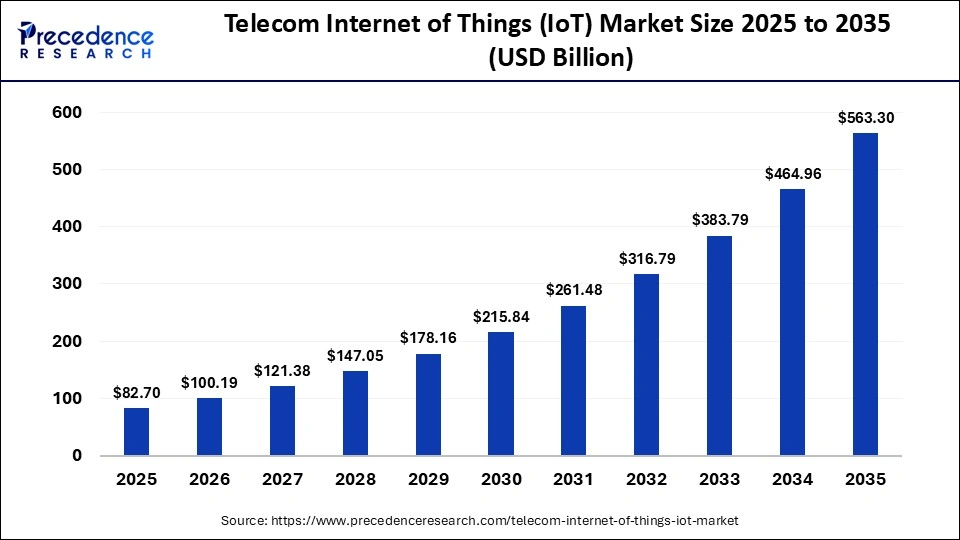
The global telecom internet of things (IoT) market size was calculated at USD 82.70 billion in 2025 and is predicted to increase from USD 100.19 billion in 2026 to approximately USD 563.30 billion by 2035, expanding at a CAGR of 21.15% from 2026 to 2035. The market is driven by the rapid proliferation of IoT, supportive government initiatives, the expansion of 5G, and the deployment of advanced infrastructure.
Key Highlights
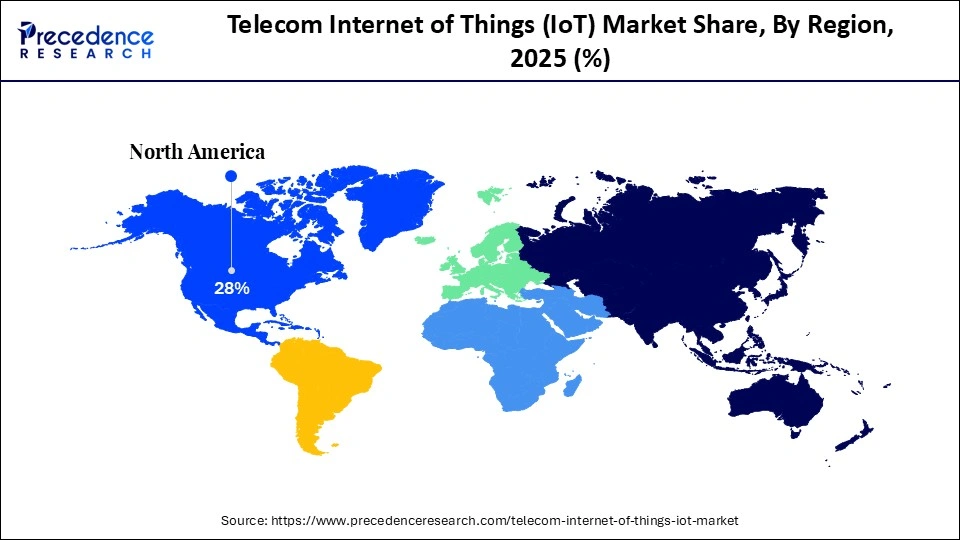
- By region, North America led the telecom internet of things (IoT) market with the highest share of 28% in 2025.
- By region, Asia Pacific is observed to be the fastest-growing region in the market.
- By connectivity technology, the cellular technologies segment led the market with the largest share of 49% in 2025.
- By connectivity technology, the NB-IoT segment is expected to grow at the fastest CAGR in the upcoming period.
- By offering, the solution segment led the global market with the largest share of 58% in 2025.
- By offering, the services segment is expected to expand at the fastest CAGR in the foreseeable period.
- By network management solution, the network traffic management segment led the global market with the largest share of 45% in 2025.
- By network management solution, the network performance monitoring and optimization segment is observed to grow at the fastest CAGR in the foreseeable period.
- By end user, the industrial segment dominated the market in 2025.
- By end user, the healthcare segment is observed to grow at the fastest CAGR in the coming years.
Telecom Internet of Things (IoT) Market Overview
In the telecommunication industry, the rapid expansion of IoT is positioning it as a keystone, since it relies on reliable communication networks to enable enhanced connectivity, monitoring, and management. To ensure the easy deployment of smart connectivity technologies across their networks and business processes, telecom firms offer Internet of Things (IoT) telecom services to their commercial clients. These services offer enhanced data security and privacy, interoperability, asset management, real-time analytics, and more. The scope of the IoT telecom services market spans components, connectivity technologies, services, applications, and regions.
Impact of Artificial Intelligence on the Telecom Internet of Things (IoT) Market
Telecom Internet of Things (IoT) is one of the sectors where artificial intelligence integration creates remarkable opportunities. AI is reshaping how companies operate and interact with customers, ushering in a new era of digital ecosystems. By integrating AI into IoT networks, telecom operators can transform massive volumes of data into actionable insights. This enables intelligent behavior and autonomous decision making with minimal human intervention across key areas such as network optimization, fraud detection and prevention, customer experience management, and business assurance.
Moreover, by combining generative AI with OSS/BSS, CSPs can gain intelligent insights that lower operational costs, minimize revenue leakage, enhance marketing strategies, elevate customer experience, reduce churn, and unlock new revenue opportunities. In the telecommunications industry, artificial intelligence is supporting the evolving needs of communication service providers and other stakeholders.
Telecom Internet of Things (IoT) Market Trends
- The increasing adoption of advanced programming and network engineering capabilities, supported by a strong understanding of data analytics systems, is enabling telecom companies to enhance network performance significantly while unlocking new revenue opportunities.
- Rising demand for scalable, low-latency connectivity is accelerating investment in advanced network architecture, strengthening IoT -focused telecom infrastructure to support seamless, high-performance, and large-scale device connectivity. Government initiatives supporting IoT adoption, 5G expansion, eSIM deployment, and a strengthened cybersecurity framework are accelerating growth in the market.
Market Scope
| Report Coverage | Details |
| Market Size in 2025 | USD 82.70 Billion |
| Market Size in 2026 | USD 100.19 Billion |
| Market Size by 2035 | USD 563.30 Billion |
| Market Growth Rate from 2026 to 2035 | CAGR of 21.15% |
| Dominating Region | North America |
| Fastest Growing Region | Asia Pacific |
| Base Year | 2025 |
| Forecast Period | 2026 to 2035 |
| Segments Covered | Connectivity Technology, Offering,Network Management Solution, End User, and Region |
| Regions Covered | North America, Europe, Asia-Pacific, Latin America, and Middle East & Africa |
Segment Insights
Connectivity Technology Insights
How Does the Cellular Technologies Segment Dominate the Market?
The cellular technologies segment dominated the telecom internet of things (IoT) market with the largest share in 2025. This dominance is primarily attributed to the widespread global infrastructure supporting cellular networks and the rapid deployment of advanced 5G technologies. Cellular IoT solutions provide a dependable framework that helps enterprises minimize risks while improving operational efficiency. Additionally, the growing need for wider network coverage, the increasing focus on expanding business operations beyond traditional mobile broadband, the rising adoption of cellular IoT modules in medical wearables, and expanding applications in vehicle telematics are further driving the growth of the segment.
The NB-IoT segment is expected to grow at the fastest rate in the coming years, driven by increasing demand for real-time monitoring and analytics in logistics and supply chain management, as it enables timely and accurate data collection. Its low power consumption is further accelerating adoption across industries. Precisely, NB-IoT operates either through direct sequence spread spectrum modulation, functioning independently in unused 200 kHz bands, or through LTE base stations that allocate a resource block accordingly. Additionally, it offers enhanced network coverage for M2M communications and supports a large number of connections, which significantly contributes to its expansion.
Offering Insights
What Made Solutions the Dominant Segment in the Market in 2025?
The solutions segment dominated the telecom internet of things (IoT) market while holding the largest share in 2025. This is primarily due to enterprises' growing demand for end-to-end services, including device integration, connectivity management, data analytics, and application platforms, enabling businesses to deploy IoT networks efficiently. Solutions help organizations simplify complex IoT ecosystems, improve operational efficiency, and accelerate time-to-market for connected services. Additionally, growing demand for customized IoT applications across industries has reinforced the dominance of solutions over standalone services or hardware offerings.
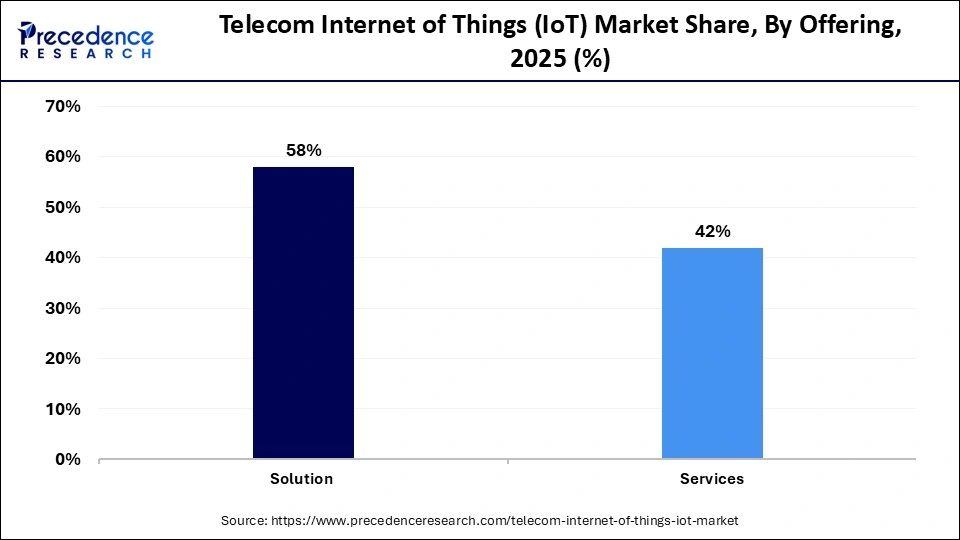
The services segment is expected to witness the fastest growth over the forecast period, supported by an evolving regulatory framework and increasing standardization efforts aimed at ensuring interoperability and security across diverse applications. IoT services encompass a comprehensive set of end to end offerings, such as support, maintenance, consulting, and managed services that help businesses deploy and optimize IoT solutions effectively. These services enable organizations to reduce operational complexity, ensure seamless connectivity, and enhance system reliability across large-scale IoT networks.
Network Management Solution Insights
Why Did the Network Traffic Management Segment Dominate the Market?
The network traffic management segment dominated the telecom internet of things (IoT) market, holding the largest share in 2025. This is primarily due to its ability to prioritize critical data, evenly distribute loads across servers, and set specific data flow limits to prevent bottlenecks. It has become essential amid the exponential rise in connected devices generating vast volumes of data traffic that must be efficiently managed. Network traffic management involves controlling and optimizing how data moves across a network to ensure seamless performance, minimize congestion, and maintain overall network health.
Network traffic management solutions play a crucial role in enabling networks to function smoothly, efficiently, and continuously, especially as organizations expand and handle growing data volumes. Furthermore, ongoing digital transformation across industries is driving demand for advanced network management solutions capable of meeting the evolving requirements of IoT telecom.
The network performance monitoring and optimization segment is expected to grow at the fastest rate over the forecast years, driven by the need to proactively detect and resolve issues, enhance overall network performance, and deliver a superior end user experience. Network performance monitoring and optimization refers to the process of measuring, diagnosing, and optimizing the quality of network services as experienced by users. It enables real time, historical, and predictive analysis of network performance over time.
The rising focus on cybersecurity is significantly increasing demand for network monitoring and optimization solutions. Additionally, the integration of advanced AI and machine learning technologies supports predictive analytics and automated issue resolution. The telecommunications industry is increasingly adopting network performance monitoring and optimization solutions due to its complex IT infrastructure and the growing need for robust network security services amid escalating cyberattack threats across enterprises.
End User Insights
How Does the Industrial Segment Lead the Telecom Internet of Things (IoT) Market?
The industrial segment dominated the market in 2025, accounting for the largest market share. This is because industries are increasingly adopting IoT for automation, predictive maintenance, asset tracking, and operational efficiency. Telecom IoT solutions enable real-time monitoring, data analytics, and remote management of machinery and processes, reducing downtime and costs.
Industries heavily use IoT to remotely monitor and manage equipment using real-time data. It is particularly valuable for stock management and automated replenishment, shifting from reactive to proactive operations, and generating more actionable insights by improving the quality and granularity of asset data. Additionally, the rising demand for smart factories, Industry 4.0 initiatives, and digital transformation in manufacturing and logistics has positioned the industrial sector as the largest end-user segment in the market.
The healthcare segment is expected to grow at a significant rate throughout the forecast period, driven by increasing adoption of connected medical devices, remote patient monitoring, and telehealth solutions. Telecom IoT enables remote patient monitoring, glucose monitoring for diabetic patients, heart rate monitoring, and depression and mood tracking. It also enables the collection and transmission of patient data, improving diagnosis, treatment, and care management while reducing hospital visits. Additionally, rising demand for efficient healthcare delivery, chronic disease management, and digital health solutions is driving the expansion of IoT applications in the healthcare sector.
Regional Insights
North America Telecom Internet of Things (IoT) Market Size and Growth 2026 to 2035
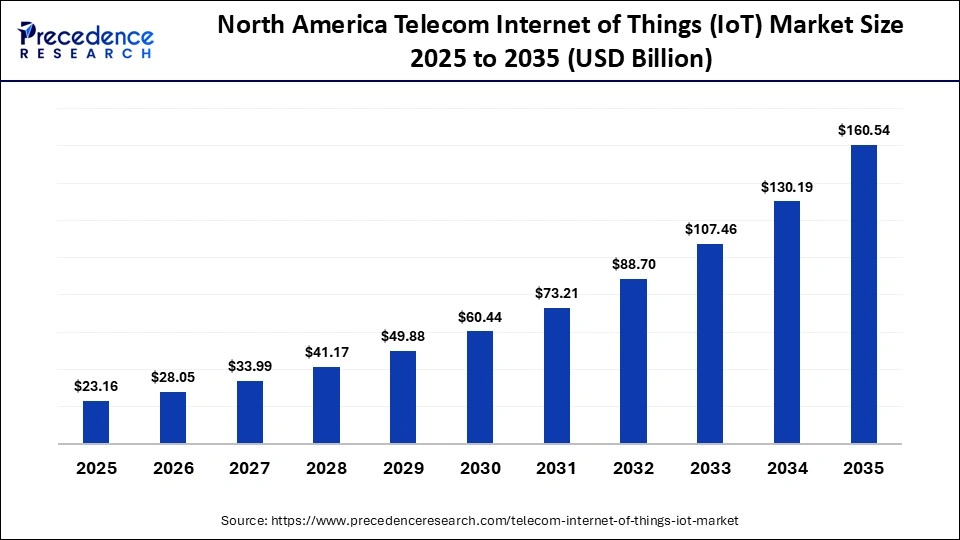
The North America telecom internet of things (IoT) market size is estimated at USD 23.16 billion in 2025 and is projected to reach approximately USD 160.54 billion by 2035, with a 21.36% CAGR from 2026 to 2035.
What Made North America the Leading Region in the Telecom Internet of Things (IoT) Market?
North America led the Telecom internet of things (IoT) market by holding the largest share in 2025. This is mainly due to its advanced 5G infrastructure, high enterprise adoption of IoT solutions, and widespread industrial automation. Strong collaboration between telecom operators, cloud providers, and technology companies has created a robust ecosystem for smart cities and connected devices. Additionally, substantial R&D investments, the presence of major telecom players, and supportive regulatory frameworks have further reinforced the region's market dominance.
U.S. Telecom Internet of Things (IoT) Market Size and Growth 2026 to 2035
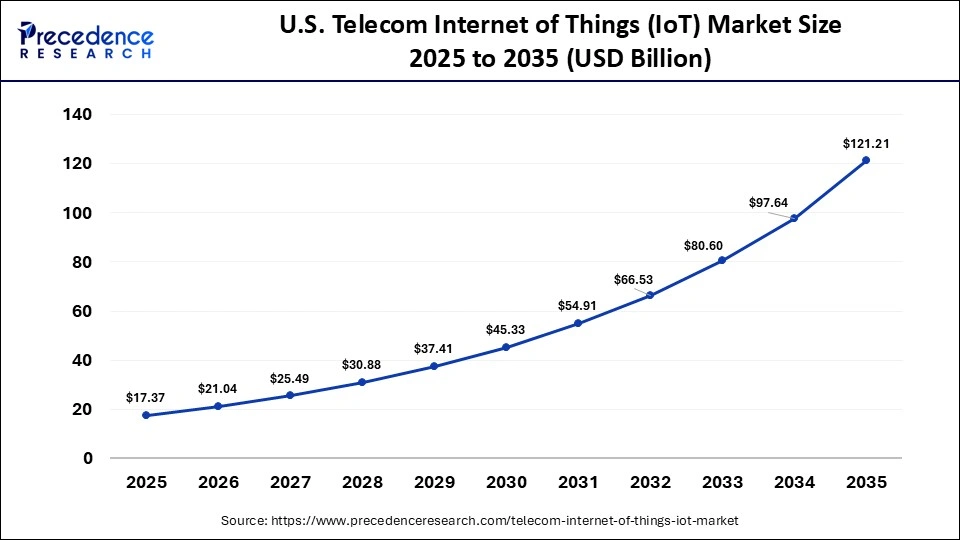
The U.S. telecom internet of things (IoT) market size is calculated at USD 17.37 billion in 2025 and is expected to reach nearly USD 121.21 billion in 2035, accelerating at a strong CAGR of 21.44% between 2026 and 2035.
U.S. Market Trends
The U.S. is the major contributor to the North American telecom internet of things (IoT) market, driven by advanced technological infrastructure, significant 5G investments, and high mobile and broadband penetration. Major cities like New York, Los Angeles, and Chicago act as key hubs due to dense populations and strong demand for advanced telecom services. There is a high level of adaptation of connected devices in numerous industries, which positively contributed to the market.
What Makes Asia Pacific the Fastest-Growing Region in the Market?
Asia Pacific is emerging as the fastest-growing region in the telecom internet of things (IoT) market, driven by the extensive adoption of IoT technologies across key sectors such as manufacturing, healthcare, transportation, and agriculture. The growing use of smart devices and expanding connectivity options are significantly accelerating IoT deployment across the region. Market growth is further supported by large-scale IoT network expansion in countries such as China and India, while government-backed smart city initiatives are fueling widespread adoption. Telecom operators are actively collaborating with manufacturers to scale LPWAN and NB-IoT ecosystems across industries, strengthening the overall market landscape.
Furthermore, strong government support and continuous advancements in 5G deployment are contributing to market expansion. Heavy investment in 5G networks, smart city projects, and industrial automation is creating a solid foundation for large-scale IoT adoption, positioning Asia Pacific as the fastest-growing market.
What Drives the Market Within the Middle East & Africa?
The market in the Middle East & Africa (MEA) is growing due to the rising IoT adoption, driven by investments in smart infrastructure and public safety projects. GCC countries are channeling significant capital into 5G-enabled smart city initiatives, while African countries are increasingly deploying LPWAN. Across the region, telecom operators are prioritizing strategic partnerships to extend network coverage and improve service affordability.
How is the Opportunistic Rise of Latin America in the Market?
Latin America is experiencing an opportunistic rise in the telecom internet of things (IoT) market, underpinned by strong momentum in logistics and smart energy applications. Governments are upgrading digital infrastructure through ongoing 4G/5G rollout programs and the development of regional innovation hubs. Emerging economies like Brazil and Mexico are increasingly adopting IoT solutions for transportation, utilities, and healthcare, creating new market opportunities.
Telecom Internet of Things (IoT) Market Companies
- Vodafone Group
- AT&T
- Verizon Communications
- Deutsche Telekom
- China Mobile
- Huawei Technologies
- Ericsson
- Orange S.A.
- Telefónica
- T-Mobile US
- Nokia
- NTT Docomo
- Sierra Wireless
- Aeris Communications
- Telit Cinterion
Recent Developments
- In 2026, the Telecommunication Engineering Centre (TEC), the technical arm of the Department of Telecommunications (DoT) under the Ministry of Communications, signed a Memorandum of Understanding (MoU) with the Indian Institute of Technology Kanpur (IIT Kanpur). The MoU is intended to conduct research, testing, and standardization in next-gen telecom technologies.(Source: https://affairscloud.com)
- In 2026, the Telecom Regulatory Authority of India (TRAI) issued recommendations to establish a regulatory framework for the sale of foreign telecom service providers' SIM and eSIM cards used in machine-to-machine (M2M) and Internet of Things (IoT) devices intended exclusively for export. This initiative aims to unlock India's export potential in connected devices while ensuring regulatory clarity, safeguarding national security, and promoting ease of doing business.(Source: https://telecomlead.com)
- In 2025, the Department of Telecommunications (DoT) issued an advisory urging ministries, government organizations, and industry stakeholders to adopt oneM2M standards-based IoT solutions. This marks a significant step toward strengthening India's Internet of Things (IoT) ecosystem.(Source: https://www.storyboard18.com)
- In 2025, the National Telecom Regulatory Authority (NTRA) entered into licensing agreements with seven automotive manufacturers to roll out Internet of Things (IoT) services for vehicles in Egypt. These services will support capabilities such as navigation, vehicle tracking, and emergency assistance.(Source: https://cairoscene.com)
Segments Covered in the Report
By Connectivity Technology
- Cellular Technologies
- NB-IoT
- LPWAN
- RF-Based
By Offering
- Solution
- Services
By Network Management Solution
- Network Traffic Management
- Network Performance Monitoring and Optimization
- Network Security Management
By End User
- Automotive
- Industrial
- Energy and Power
- Commercial Infrastructure
- Healthcare
- Others
By Region
- North America
- Europe
- Asia-Pacific
- Latin America
- Middle East & Africa
For inquiries regarding discounts, bulk purchases, or customization requests, please contact us at sales@precedenceresearch.com
Frequently Asked Questions





Ask For Sample
No cookie-cutter, only authentic analysis – take the 1st step to become a Precedence Research client
 Get a Sample




 sales@precedenceresearch.com
 Schedule a Meeting
