



US Drug Discovery Market Size, Share and Trends 2026 to 2035
US Drug Discovery Market (By Drug Type: Small Molecule, Large Molecule; By End User: Pharmaceutical Companies, CROs, Others) - Industry Analysis, Size, Trends, Leading Companies, Regional Outlook, and Forecast 2026 to 2035
 Get a Sample
 Table Of Content


US Drug Discovery Market Size and Forecast 2026 to 2035
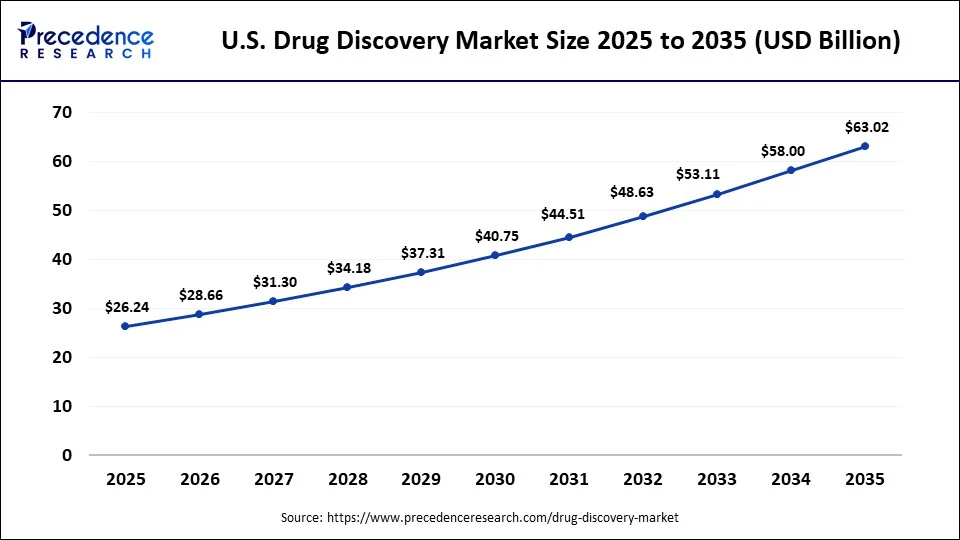
The US drug discovery market size accounted for USD 26.24 billion in 2025 and is predicted to increase from USD 28.66 billion in 2026 to approximately USD 63.02 billion by 2035, expanding at a CAGR of 9.16% from 2026 to 2035. The market is witnessing substantial growth due to escalating prevalence of chronic conditions, a surging demand for targeted precision therapies, and the integration of AI in preclinical research. This is further supported by significant private and federal research and development investments and robust clinical pipelines across major therapeutic areas.
Key Takeaways
- By drug type, the small molecule segment generated the biggest market share in 2025.
- By drug type, the large molecule segment is expanding at the fastest CAGR between 2026 and 2035.
- By end user, the pharmaceutical companies segment accounted for the largest market share in 2025.
- By end user, the contract research organizations segment is projected to grow at a solid CAGR between 2026 and 2035.
Market Overview
The U.S. drug discovery market includes the technologies, platforms, and outsourced services used to identify, validate, and optimize new therapeutic candidates like small molecules, biologics, and gene therapies. This market focuses on discovering novel medications by progressing from disease-relevant biological targets to hit-to-lead identification and lead optimization before entering human clinical trials. The market is primarily driven by the rapid integration of AI and ML, which are transforming this field by reducing the timeline and attrition rates for new drugs and accelerating growth.
How is AI revolutionizing the U.S. Drug Discovery Industry?
Artificial intelligence (AI) is revolutionizing the market by serving as a backbone for drug repurposing, target identification, de novo molecular design, and predicting drug toxicity in the U.S. Generative AI models and deep learning tools create entirely new molecular structures that exhibit optimized drug-like properties, reducing the heavy reliance on physical compound libraries. Additionally, AI is extensively used in predicting drug toxicity, pharmacokinetics, and efficacy, enabling in silico testing that lowers costs and reduces the need for animal trials, thus shortening clinical trial timelines.
Market Report Coverage and Key Metrics
| Report Coverage | Details |
| Market Size in 2025 | USD 26.24 Billion |
| Market Size in 2026 | USD 28.66 Billion |
| Market Size by 2035 | USD 63.02 Billion |
| Growth Rate from 2026 to 2035 | CAGR of 9.16% |
| Base Year | 2025 |
| Forecast Period | 2026 to 2035 |
| Segments Covered | Drug Type, and End User |
Market Dynamics
Drivers
The Convergence of Multi-Omics and AI
The integration of multi-omics with generative AI platforms is transforming drug development by uncovering hidden patterns in intricate disease datasets. This data-driven approach significantly shortens target identification and validation timelines, allowing for the rapid screening of small molecules and biologics. Utilizing foundational AI models enables researchers to conduct in silico experiments with highly accurate predictive models, cutting down preclinical testing timelines and improving the success rate of therapeutic candidates entering human trials.
Restraint
Data Silos and Complex Supply Chains
Despite its great promise, the market faces challenges from fragmented multi-omics data silos, which impede interoperability and reduce the predictive accuracy necessary for seamless AI-driven design. Furthermore, next-generation modalities of customized cell and gene therapies encounter severe logistical and supply chain bottlenecks. These therapies are specialized, requiring robust cryoshipping, complex handling, and localized manufacturing networks, which keep patient access costs prohibitively high.
Opportunity
The Rise of Targeted Protein Degradation
Targeted Protein Degradation (TPD) presents a unique opportunity to tackle previously undruggable disease-causing proteins. TPD utilizes the cell's natural ubiquitin-proteasome system to eliminate faulty proteins, leading to higher therapeutic efficacy at lower doses and reduced drug resistance. Companies are harnessing AI to optimize PROTACs, creating a growing market for highly customized, precision therapeutics across oncology, immunology, and neurodegenerative disorders.
How are Government Initiatives Supporting the U.S. Drug Discovery Market?
Government programs are significantly driving the adoption of AI in pharmaceutical research through substantial NIH grants and targeted initiatives like the Accelerating Medicines Partnership. These efforts provide researchers access to extensive biological datasets and high-performance computing resources, reducing research and development costs. Additionally, the FDA's adaptive regulatory pathways for AI-designed drugs offer expedited processes, ensuring rapid growth within the sector.
- For instance, the EMA and FDA have established ten principles for good AI practices throughout the medicine lifecycle to guide the use of AI in evidence generation and monitoring.
Market Segmentation Analysis
Drug Type Insights
The small molecule segment dominated the U.S. drug discovery market in 2025, primarily due to its cost-effective manufacturing, high oral bioavailability for patient convenience, and established pathways for target validation. Small molecules are organic compounds with low molecular weights, allowing them to easily penetrate cell walls and target intracellular molecules. Because they are typically easier to synthesize, small molecules feature significantly lower manufacturing costs and are heavily favored for oral solid dosing, which improves patient compliance and reduces the overall risk in new therapeutic pipelines.
The large molecule segment is expected to experience the fastest growth during the forecast period. This growth is driven by advanced AI platforms, protein engineering, and an increasing focus on targeted therapies for complex diseases. Advanced therapies such as monoclonal antibodies, cell therapies, and gene therapies require specialized discovery platforms. These molecules target complex biological processes with higher precision and fewer side effects. Additionally, the tools available allow researchers to decode intricate biological data and shorten the overall drug development timeline.
End User Insights
The pharmaceutical companies segment held market dominance in 2025. This is largely due to substantial investments in research and development, extensive internal infrastructure, and aggressive adoption of innovative workflows. Established pharmaceutical companies possess the capital reserves necessary to support high-risk, early-phase development pipelines. Major firms leverage high-throughput screening, advanced molecular modeling, and cloud-based informatics to scale their candidate pipelines, significantly lowering discovery timelines and costs.
The contract research organizations segment is expected to have the fastest growth during the forecast period. This growth stems from an increasing outsource early-stage research, bioinformatics, hit-to-lead identification, and preclinical trials to specialized, flexible service providers, thereby cutting costs and accelerating development timelines. CROs are integrating artificial intelligence, machine learning, and in-silico predictive modeling to drastically reduce timelines for target identification and virtual screening. They are transitioning to automated, cloud-based laboratory workflows with higher accuracy.
U.S. Drug Discovery Market: Country-Level Analysis
- Pennsylvania and California are Surging Migraine Hotspots: Pennsylvania reports some of the highest migraine prevalence rates in the nation, while California has a large number of migraine sufferers, prompting pharmaceutical companies to target these populations for therapeutic botulinum toxin clinical trials.
- Advancing Biotech Horizons in Massachusetts and New Jersey: Known as the medicine chest of the world, New Jersey is a hub for USFDA compliance and expedited drug approvals. Meanwhile, biotech alliances in Massachusetts continue to drive joint ventures for developing next-generation neurotoxins.
- Hyperhidrosis and Dystonia Solutions in Texas and New York: The surging urban populations in these densely populated states have accelerated the establishment of new hospital networks, creating localized demand for treatments for medical hyperhidrosis and cervical dystonia.
- Advanced OAB Therapeutics across Florida: Florida's growing senior and geriatric demographic is fueling a significant increase in cases of overactive bladder, making it a primary testing and rollout region for therapeutic neurotoxin applications.
- North Carolina's Manufacturing Revolution: Heavy government investment and aggressive biotech zoning laws are encouraging key players to open state-of-the-art manufacturing plants in this region, thereby solidifying local supply chains.
US Drug Discovery Market Value Chain Analysis
- Research and Development
This focuses on target identification, vector development, and preclinical laboratory and animal testing, promising molecules, and significant reductions in preclinical timelines.
Key Players: Charles River Laboratories, IQVIA, Pfizer, Novartis, and Sarepta Therapeutics.
- Clinical Trials and Regulatory Approval
This involves testing drug safety and efficacy in human subjects through progressive phases to optimize trial design, patient recruitment, and synthetic control groups.
Key Players: Sarepta Therapeutics, Novartis, Pfizer, and Bluebird Bio.
- Manufacturing
This involves the manufacturing of highly sterile, specialized, and scalable production, often known as fill-and-finish operations.
Key Players: Catalent, FUJIFILM Diosynth Biotechnologies, Lonza, Biogen, and Gilead Sciences.
- Logistics and Patient Delivery
This focuses on specialized cryogenic and robust cold-chain networks to transport fragile payloads safely from manufacturing sites to hospitals.
Key Players: DHL Group, FedEx Logistics, Marken, and UPS Healthcare.
Market Competitive Landscape: Leading Companies and Strategies
The U.S. drug discovery market is highly established, featuring major players like Eli Lilly, Johnson and Johnson, and AbbVie. Fueled by a surge in blockbuster therapies and competition to address chronic diseases, these leaders strategically concentrate on research and development in oncology, metabolic conditions, and autoimmune diseases. For instance, Eli Lilly's substantial expansion into metabolic disorders and targeted biotherapeutics is accelerating clinical timelines through AI and genomics.
Looking ahead, emerging companies such as Recursion Pharmaceuticals, Insilico Medicine, and Eikon Therapeutics are leveraging AI, ML, and structural biology to discover breakthrough therapies. However, they face significant challenges due to the high costs of early-stage failures and lengthy development cycles. Regulatory complexities and the steep costs associated with clinical trials serve as major constraints for smaller biotech firms that lack substantial capital.
US Drug Discovery Market Companies
- Johnson and Johnson
- Pfizer Inc.
- Merck and Co.
- AbbVie Inc.
- Eli Lilly and Company
- Bristol Myers Squibb
- Amgen Inc.
- Gilead Sciences, Inc.
- Vertex Pharmaceuticals
- Regeneron Pharmaceuticals
Recent Developments US Drug Discovery Market (2025-2026)
- In April 2026, AWS launched Amazon Bio Discovery, an AI-powered application that assists scientists in designing and testing novel drugs. This platform provides access to biological foundation models to generate and evaluate drug candidates while streamlining communication through a Health AI interface for virtual care, thereby enhancing the drug discovery process.(Source: https://www.aboutamazon.com)
- In March 2026, Insilico Medicine launched PandaClaw, an autonomous AI agent within the PandaOmics platform that allows biologists to conduct complex multi-omics analyses using simple natural language. This tool eliminates the need for specialized computational experts, autonomously formulates workflows, cross-references expansive databases, and generates actionable disease hypotheses in real time.(Source: https://www.prnewswire.com)
Segments Covered in the Report
By Drug Type
- Small Molecule
- Large Molecule
By End User
- Pharmaceutical Companies
- CROs
- Others
For inquiries regarding discounts, bulk purchases, or customization requests, please contact us at sales@precedenceresearch.com
Frequently Asked Questions





Ask For Sample
No cookie-cutter, only authentic analysis – take the 1st step to become a Precedence Research client




 sales@precedenceresearch.com
 Schedule a Meeting



