



AI in Networking and Edge Platform Market Trends, Companies, Revenue / Sales Performance, Subscriber Growth, Pricing Strategies, Cloud Adoption, Infrastructure Expansion, Competitive Landscape, and Industry Outlook
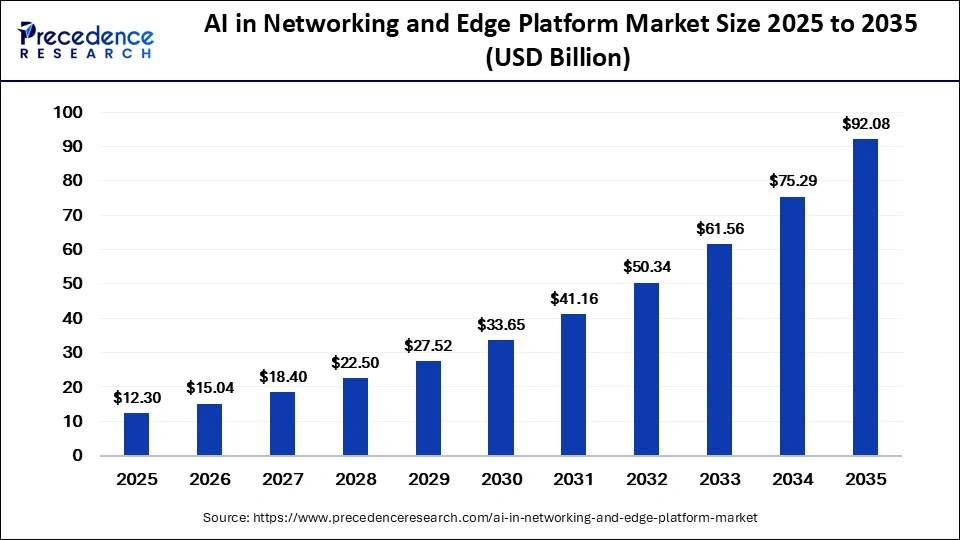
ICT industry specialist Gautam Mahajan estimates the AI in networking and edge platform market at USD 15.04 billion in 2026, with continued technology adoption expected to take the market to USD 92.08 billion by 2035 at a CAGR of 22.30%. Leading AI in networking and edge platform market providers such as Juniper Networks, Inc., Arista Networks, Inc., Hewlett Packard Enterprise (HPE), Nokia Corporation are expanding their capabilities across segments including By Component, By Deployment Type, By Infrastructure Type, By Application, By End-Use Industry.
Source: https://www.precedenceresearch.com/ai-in-networking-and-edge-platform-market
 Get a Sample
 Table Of Content


What is the AI in Networking and Edge Platform Market Size in 2026?
The global AI in networking and edge platform market size accounted for USD 12.30 billion in 2025 and is predicted to increase from USD 15.04 billion in 2026 to approximately USD 92.08 billion by 2035, expanding at a CAGR of 22.30% from 2026 to 2035. The market is growing due to the increasing demand for real-time decision-making in applications, such as autonomous systems and IoT, coupled with the need for better data privacy and reduced network latency.
Key Takeaways
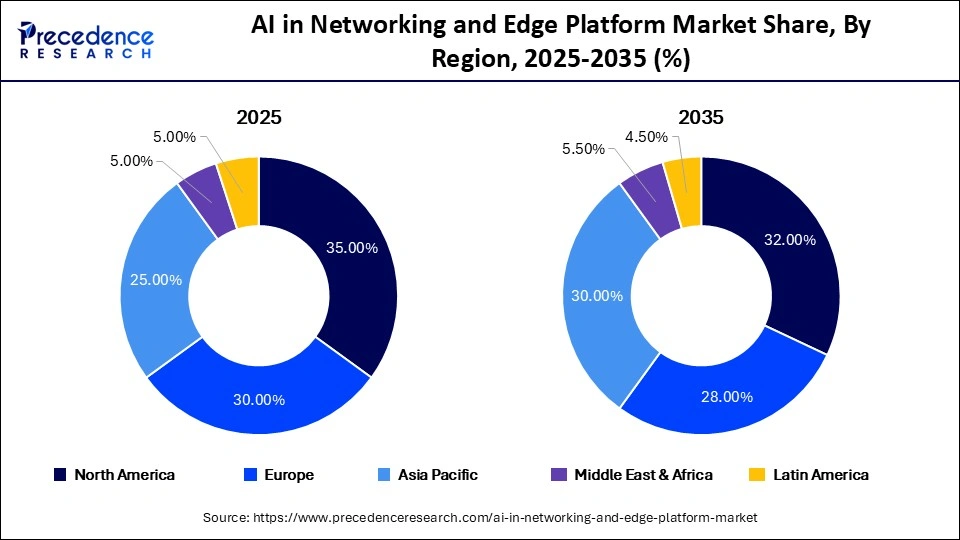
- North America dominated the AI in networking and edge platform market with the largest share of 35% in 2025.
- Asia Pacific is expected to grow at the fastest CAGR between 2026 and 2035.
- By component, the hardware segment contributed the highest market share of 52% in 2025.
- By component, the software segment held a 30% share of the market in 2025 and is expected to grow at a significant rate between 2026 and 2035.
- By deployment mode, the cloud segment held a major market share of 52% in 2025.
- By deployment mode, the on-premises segment held a 28% share in 2025 and is expected to register significant growth during 2026 and 2035.
- By infrastructure type, the hyperscale data centers segment contributed the highest market share of 46% in 2025.
- By infrastructure type, the enterprise data centers segment contributed 32% market share in 2025 and is estimated to grow at a strong CAGR over the projected period.
- By application, the networking optimization segment contributed the highest market share of 28% in 2025.
- By application, the security and threat detection segment held a 20% share of the market in 2025 and is expected to grow at a significant rate between 2026 and 2035.
- By end-use industry, the telecommunications segment contributed the highest market share of 33% in 2025.
- By end-use industry, the IT and data centers segment held a 22% share of the market in 2025 and is expected to grow at a significant rate of CAGR between 2026 and 2035.
Market Overview
The market for AI in networking and edge platforms is growing, driven by increased data traffic, adoption of cloud and edge architectures, and demand for intelligent network management. The AI in the networking and edge platform market refers to the deployment of artificial intelligence (AI) and machine learning (ML) technologies to optimize, automate, and secure networking infrastructure and edge computing platforms. These solutions enable real-time data processing, predictive analytics, anomaly detection, traffic optimization, and resource management at the network edge, supporting IoT, 5G, autonomous systems, smart cities, and industrial applications.
- In March 2025, Akamai Cloud Inference launched a new service that enables companies to achieve a 3x improvement in throughput, 60% lower latency, and an 86% reduction in cost compared to traditional infrastructure. It sharpens Akamai's edge platform with enhanced AI capabilities.
How is Artificial Intelligence Redefining Networking and Edge Platforms?
Artificial intelligence is revolutionizing the functions of networking and edge platforms by enabling the real-time, low-latency processing, enhancing privacy and security, processing sensitive data locally on edge devices, keeping it within a secure network perimeter, minimizing exposure to cyber threats, and aiding compliance with regulations like GDPR and HIPAA. Edge AI facilitates easier and more cost-effective scaling of AI deployments by distributing processing across numerous edge devices rather than relying solely on centralized cloud infrastructure.
According to BSO, the evolution of AI in networking has transitioned from manual systems to today's autonomous, AI-driven infrastructure essential for managing modern digital businesses. AI now enables self-optimizing networks with capabilities like intent-based networking, real-time optimization, and advanced threat detection.
Major Market Trends
- Rapid shift toward edge AI and distributed intelligence: Organizations are deploying AI workloads closer to data sources at the edge to enable real-time decision-making with ultra-low latency. This shift is driven by IoT growth, smart applications, and the need for faster, localized processing instead of relying solely on centralized cloud systems.
- AI-driven autonomous network operations (AIOps and agentic networking): AI is increasingly automating network management tasks such as monitoring, incident response, and configuration. Networks are becoming self-optimizing and self-healing, reducing human intervention and improving efficiency and reliability.
Market Scope
| Report Coverage | Details |
| Market Size in 2025 | USD 12.30 Billion |
| Market Size in 2026 | USD 15.04 Billion |
| Market Size by 2035 | USD 92.08 Billion |
| Market Growth Rate from 2026 to 2035 | CAGR of 22.30% |
| Dominating Region | North America |
| Fastest Growing Region | Asia Pacific |
| Base Year | 2025 |
| Forecast Period | 2026 to 2035 |
| Segments Covered | Component, Deployment Type, Infrastructure Type, Application, End-Use Industry, and Region |
| Regions Covered | North America, Europe, Asia-Pacific, Latin America, and Middle East & Africa |
Market Dynamics
Drivers
Demand for Real-Time Decision-Making
The AI in the networking and edge platform market is being driven by industries like autonomous vehicles, industrial automation, and remote healthcare, which require ultra-low latency and immediate data processing to make critical decisions at the point of data generation. Edge AI minimizes delays by processing information locally.
Advancements in AI Hardware and Chipsets
The development of specialized, energy-efficient AI processors (like GPUs, TPUs, ASICs) optimized for edge devices allows for powerful AI inference and even lightweight training on hardware with limited resources. The continuous progression of semiconductor fabrication technology, with the transition from 7nm to 5nm and 3nm processes, is making chips smaller and more power-efficient.
- In June 2024, HPE and NVIDIA teamed up to launch an AI computing solution, while Raspberry Pi collaborated with Hailo to release an AI kit. This reflects the high-stakes, competitive environment where players seek to build complete hardware software solutions.
Restraints
Technical Complexity
Implementing and managing distributed edge infrastructure with AI models is complex. Challenges include integration with legacy systems, ensuring compatibility across diverse hardware and software, meaning large and varied datasets, optimizing models for resource-constrained edge devices, and addressing latency requirements for real-time applications. The heterogeneous nature of edge devices and network connectivity complicates deployment, management, and interoperability. Significant data governance and security challenges arise from processing sensitive information locally, demanding new strategies to ensure privacy and resilience against evolving threats.
Data Privacy and Security
Processing sensitive data at the edge raises concerns about privacy breaches and security vulnerabilities, as edge devices can be more susceptible to physical and cyberattacks than centralized cloud systems.
Opportunities
5G and loT Integration
The proliferation of Internet of Things devices, combined with the capabilities of 5G networks, is creating a massive volume of data that centralized cloud infrastructure cannot efficiently handle. Managing device connectivity, telecom operations are bringing AI closer to their network components to develop next-generation solutions.
- In March 2025, Nokia and industry partners, including KDDI, SoftBank Corp., T-Mobile US, and NVIDIA, showcased advancements in Artificial Intelligence-Radio Access Networks (AI-RAN) at MWC.
Enhanced Security and Privacy
Less sensitive data needs to be sent to a centralized cloud for processing. Edge computing minimizes the amount of sensitive data transmitted over wide area networks (WANs) to centralized clouds. This reduction in data movement significantly shrinks the potential attack surface for malicious actors, as less data is "in transit." Localized processing greatly aids in complying with strict data privacy regulations like GDPR (General Data Protection Regulation), CCPA (California Consumer Privacy Act), and HIPAA (Health Insurance Portability and Accountability Act). Edge AI allows organizations to retain data residency, control access, and enforce privacy policies more effectively.
Segment Insights
Component Insights
AI in Networking and Edge Platform Market Share, By Component, 2025-2035 (%)
| Component | 2025 | 2035 |
| Hardware | 52.00% | 42.00% |
| Software | 30.00% | 38.00% |
| Services | 18.00% | 20.00% |
The Hardware Segment Dominated the Market with a 52% Share in 2025
The hardware segment dominated the AI in networking and edge platform market with a share of 52% in 2025, as a result of faster adoption of edge servers, AI accelerators, and intelligent network devices, both in telecom and enterprise settings. The increasing popularity of low-latency applications, such as autonomous systems and industrial automation, placed customers under more pressure to seek out specialized chips, like GPUs and NPUs. The segment further grew with the introduction of AI capabilities embedded into routers, gateways, and switches that amplified intelligence on the devices.
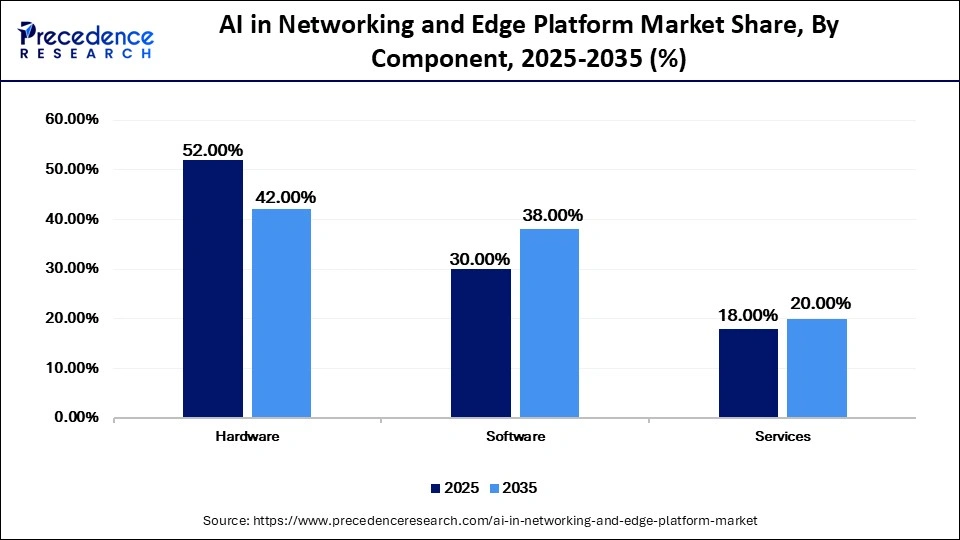
The software segment held the second-largest market share of 30% in 2025, supported by the rising adoption of AI-driven network management and orchestration tools. Organizations were also publishing smart analytics environments to facilitate optimal traffic control, anticipate outages, and make decisions autonomously. Additionally, increasing reliance on APIs and open ecosystems is estimated to drive innovation and interoperability in software technology across vendors.
The service segment held a 18% market share in 2025, due to growing demand for integration, consulting, and managed services. Organizations need specialized skills to implement AI-powered networking infrastructures in complex and distributed infrastructures. The improvement of edge computing posed new requirements on matters of latency, scalability, and security, making the use of service providers more important.
Deployment Mode Insights
AI in Networking and Edge Platform Market Share, By Deployment Mode, 2025-2035 (%)
| Deployment Mode | 2025 | 2035 |
| Cloud | 52.00% | 46.00% |
| On-Premises | 28.00% | 22.00% |
| Hybrid | 20.00% | 32.00% |
The Cloud Segment Dominated the Market in 2025
The cloud segment dominated the AI in networking and edge platform market with a share of 52% in 2025, due to rapid enterprise migration toward centralized AI model training and orchestration environments. Companies needed to use hyperscale cloud systems in order to handle huge amounts of network data streams and to have real-time analytics. Moreover, the AI network, utilizing the cloud and edge platforms, continued to grow, with the ability to scale compute resources to efficiently serve AI workloads without incurring large upfront infrastructure costs.
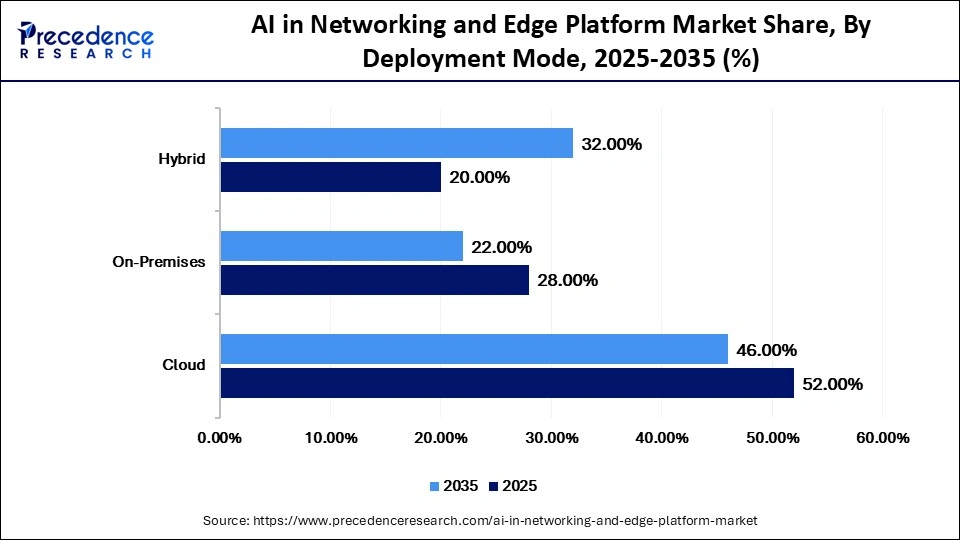
The on-premises segment held the second-largest market share of 28% in 2025, due to industries requiring strict data control and low-latency processing. The manufacturing, defense, and healthcare sectors have put a premium on localized infrastructure as it guarantees data privacy and reliability in operations. Businesses that invested in clusters of private edges to execute AI inference got them closer to the areas of critical operations.
The hybrid segment held a 20% share of the market in 2025, driven by early adoption among enterprises balancing cloud scalability and on-premises control. It introduced hybrid architectures to place workloads in centralized data centers and at edge locations for organizations. This strategy allowed managing latency-sensitive applications effectively, and with the help of cloud resources, intensive processing activities were being realized.
Infrastructure Type Insights
The Hyperscale Data Centers Segment Held a 46% Market Share in 2025
The hyperscale data centers segment dominated the AI in networking and edge platform market with a share of 46% in 2025, due to massive investments from cloud providers building high-density AI training clusters. These are infrastructure-driven, extensive model formation, network analysis, and central arrangement of distributed edge nodes. Mighty collaboration of ecosystems between telecom providers and hyperscale providers boosted implementation in smart networking settings.
AI in Networking and Edge Platform Market Share, By Infrastructure Type, 2025-2035 (%)
| Infrastructure Type | 2025 | 2035 |
| Hyperscale Data Centers | 46.00% | 36.00% |
| Enterprise Data Centers | 32.00% | 26.00% |
| Edge Data Centers | 22.00% | 38.00% |
The enterprise data centers segment held the second-largest market share of 32% in 2025, owing to the organizations maintaining in-house infrastructure for sensitive operations. These facilities were used by industries dealing with regulated data to ensure compliance and security. Companies have installed AI-powered network management devices in their respective data centers to streamline the company traffic and improve the visibility of the performance.
Application Insights
The Network Optimization Segment Dominated the Market with a 28% Share in 2025
The network optimization segment dominated the AI in networking and edge platform market with a share of 28% in 2025, due to the need for automated decision-making in multi-cloud and edge-integrated infrastructures. The focus of AI-based optimization tools to handle more complex software-defined network environments has become prioritized by enterprises. Smart Algorithms examined traffic patterns, reduced traffic jams, and improved bandwidth utilization across distributed architectures.
The security & threat detection segment held the second-largest market share of 20% in 2025, owing to escalating cyber threats targeting distributed network infrastructures. Artificial intelligence-based systems got suspicious cases, recognized intrusions, and reacted to attacks in real time. Businesses focused on superior security designs to secure the confidential data traversing edge and cloud-based systems.
AI in Networking and Edge Platform Market Share, By Application, 2025-2035 (%)
| Application | 2025 | 2035 |
| Network Optimization | 28.00% | 24.00% |
| Predictive Maintenance | 12.00% | 14.00% |
| Traffic Management | 17.00% | 15.00% |
| Security & Threat Detection | 20.00% | 23.00% |
| Edge Analytics / Real-time AI | 18% | 20% |
| Others | 5% | 4% |
The predictive maintenance segment held a 12% share of the market in 2025, driven by growing reliance on proactive infrastructure management. AI models processed data on equipment performance, detecting anomalies, and predicting possible failures to prevent disruptions in advance. Businesses implemented these solutions at network devices, edge devices, and data centers to reduce downtime.
The traffic management segment held a 17% market share in 2025, supported by its role in handling dynamic data flows across modern networks. AI-based solutions were more efficient at optimizing the routing to distribute loads using multiple paths to avoid bottlenecks.
The edge analytics/real-time AI segment held a 18% market share in 2025, due to growing demand for instant data processing at the network edge. The implementation of the AI models was locally in the enterprises to interpret streaming data with sensors, devices, and applications. This method transformed latency and data transfer to centralized systems.
End-use Industry Insights
The Telecommunications Segment Dominated the Market in 2025
The telecommunication segment dominated the AI in networking and edge platform market with a share of 33% in 2025, due to aggressive global 5G Standalone deployments during 2025, where operators expanded AI-driven radio access optimization and self-organizing networks. According to the 2025 network transformation brief published by the International Telecommunication Union (ITU), operators started to add AI-based traffic steering to cope with the skyrocketing amount of mobile data across urban clusters. Telecom providers deployed intelligent edge nodes to reduce backhaul congestion and support ultra-low latency services.
The IT & data centers segment held the second-largest market share of 22% in 2025, driven by accelerated hyperscale cloud expansion and enterprise AI integration. The Uptime Institute 2025 global data center survey revealed that there was rampant implementation of AI-based workload balancing systems at the Tier III and Tier IV. Businesses implemented smart orchestration engines to run distributed compute environments that operated generative AI tasks.
The manufacturing segment held a 13% share of the market in 2025, due to the adoption of digital twins for real-time simulation of production environments. Examples of automated assembly lines with latency-critical robotics control systems with enabled edge computing systems. Manufacturing ecosystems became more and more 5G-based, which were approved by updates to 3GPP industrial connectivity standards in 2025.
AI in Networking and Edge Platform Market Share, By End-Use Industry, 2025-2035 (%)
| End-Use Industry | 2025 | 2035 |
| Telecommunications | 33.00% | 30.00% |
| IT & Data Centers | 22.00% | 25.00% |
| Manufacturing | 13.00% | 16.00% |
| Healthcare | 10% | 12% |
| Retail | 8% | 9% |
| Smart Cities / Public Sector | 9% | 6% |
| Others | 5% | 2% |
The healthcare segment held a 10% market share in 2025, supported by the rising adoption of telemedicine platforms validated through national digital health missions in India and Europe during 2025. Clinical decision support systems that are powered by artificial intelligence enhance the early detection of chronic diseases. Ensuring adherence to healthcare data protection rules was done with secure networking frameworks.
The retail segment held a 8% market share in 2025, due to increasing use of smart checkout systems and real-time recommendation engines. Edge computing facilitated prompt response to customer behavior data, both between physical and digital stores. Furthermore, the AI integration enhanced demand prediction and logistic efficiencies, thus facilitating the market growth in this segment.
The smart cities/public sector segment held a 9% market share in 2025, owing to the increasing investments in urban digital infrastructure. Governments deployed AI-powered networking systems for traffic control, surveillance, and utility management.
Regional Insights
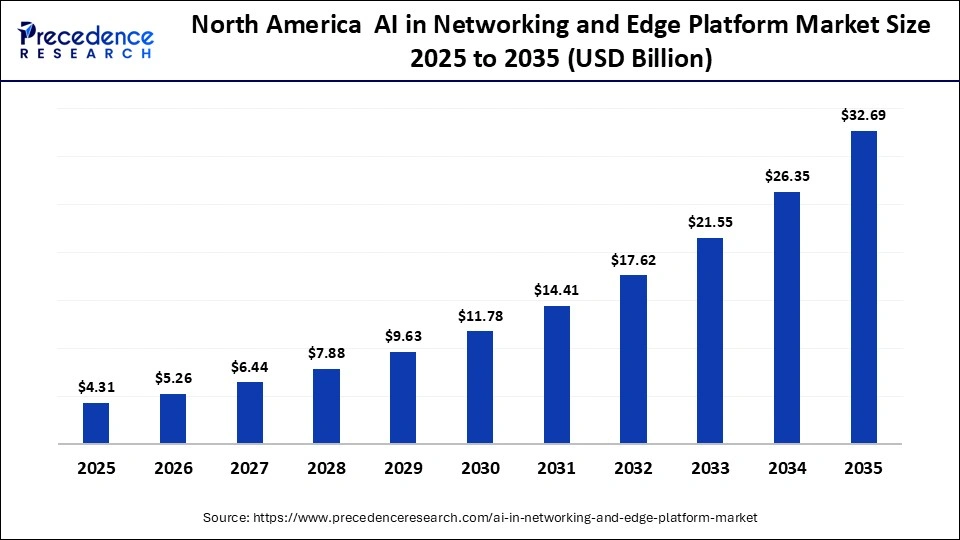
North America AI in Networking and Edge Platform Market Size and Growth 2026 to 2035
The North America AI in networking and edge platform market size is estimated at USD 4.31 billion in 2025 and is projected to reach approximately USD 32.69 billion by 2035, with a 22.46% CAGR from 2026 to 2035.
What Made North America the Dominant Region in the AI in Networking and Edge Platform Market?
North America dominated the AI in networking and edge platform market with the largest share in 2024. This is mainly due to its advanced technological infrastructure and significant investments in AI research and development. There is a high adoption of emerging technologies like Edge computing and AI, with notable contributions from areas such as smart cities and autonomous vehicles. The demand for low-latency processing in various industries is facilitated by Edge AI's ability to process data locally.
U.S. AI in Networking and Edge Platform Market Size and Growth 2026 to 2035
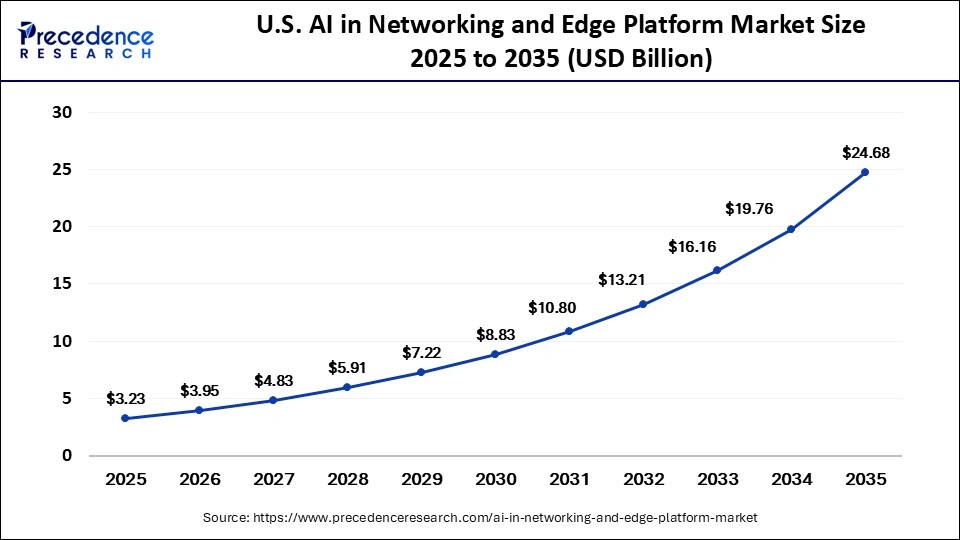
The U.S. AI in networking and edge platform market size is calculated at USD 3.23 billion in 2025 and is expected to reach nearly USD 24.68 billion in 2035, accelerating at a strong CAGR of 22.55% between 2026 and 2035.
U.S. Market Analysis
U.S. leads the market, driven by large-scale hyperscale cloud expansion and advanced 5G deployment programs. The U.S. National Science Foundation focused on the swift introduction of AI to network orchestration systems in both the federal and enterprise ecosystems. Large technology players implemented intelligent edge infrastructure to aid real-time analytics and autonomous systems, as well as distributed workloads on clouds.
Asia Pacific: The Fastest-Growing Region
Asia Pacific is the fastest-growing region, driven by the network optimization demand, government support, and robust technological adoption across diverse sectors. The region's expanding 5G networks and increasing IoT device deployment further fueled the need for localized AI processing. Strategic investments in digital infrastructure and industry-specific AI solutions cemented Asia Pacific's leadership in this rapidly evolving market.
China Market Analysis
In China, the market is driven by large-scale adoption of IoT devices generating continuous data streams requiring real-time processing. Powerful government programs assisted the growth of the hyperscale data centers and the creation of domestic AI chips. Telecom operators played a central role in building ultra-dense network infrastructure supporting AI workloads.
AI in Networking and Edge Platform Market Companies
- Juniper Networks, Inc.
- Arista Networks, Inc.
- Hewlett Packard Enterprise (HPE)
- Nokia Corporation
- Intel Corporation
- NVIDIA Corporation
- IBM Corporation
- Ciena Corporation
- Extreme Networks, Inc.
- Dell Technologies, Inc.
- VMware, Inc.
- Keysight Technologies
- HCL Technologies (Networking AI Solutions)
- Qualcomm Technologies, Inc.
Recent Developments
- In September 2025, Dell's Single-Server Solution (XR8720t) was unveiled. The rugged server is designed to transform edge and telecom infrastructure. It enables advanced edge AI use cases like agentic AI and real-time analytics for telecommunications providers and other industries.(Source: https://investors.delltechnologies.com)
- In September 2024, HPE announced expanded AI features for its management tool. Integrations with OpsRamp technology offer enhanced observability, and new APIs simplify large-scale network configurations.(Source: https://www.hpe.com)
Segments Covered in the Report
By Component
- Hardware
- Software
- Services
By Deployment Type
- On-Premises
- Cloud
- Hybrid
By Infrastructure Type
- Hyperscale Data Centers
- Enterprise Data Centers
- Edge Data Centers
By Application
- Network Optimization
- Predictive Maintenance
- Traffic Management
- Security & Threat Detection
- Edge Analytics / Real-time AI
- Others
By End-Use Industry
- Telecommunications
- IT & Data Centers
- Manufacturing
- Healthcare
- Retail
- Smart Cities / Public Sector
- Others
By Region
- North America
- Latin America
- Europe
- Asia-pacific
- Middle and East Africa
For inquiries regarding discounts, bulk purchases, or customization requests, please contact us at sales@precedenceresearch.com
Frequently Asked Questions





Ask For Sample
No cookie-cutter, only authentic analysis – take the 1st step to become a Precedence Research client
 Get a Sample




 sales@precedenceresearch.com
 Schedule a Meeting
