



Automotive LiDAR Sensor Market Size, Companies, Share, Vehicle Production Volume, Sales Performance, Export & Import Analysis, Technology Adoption, Competitive Positioning, and Demand Trends
Automotive LiDAR Sensor Market (By Technology Type: Solid-State LiDAR, Mechanical/Scanning LiDAR; By Range: Long-Range (>150-200 m), Medium-Range (50-150 m), Short-Range (<50-m); By Vehicle Type: Passenger Cars, Light Commercial/HCV/Robo-Taxis, EV & Autonomous Shuttles; By Application: ADAS, Autonomous Driving; By End User: OEMs, Tier-1 Suppliers, Aftermarket) - Global Industry Analysis, Size, Trends, Leading Companies, Regional Outlook, and Forecast 2026 to 2035
Source: https://www.precedenceresearch.com/automotive-lidar-sensor-market
 Get a Sample
 Table Of Content


What is the Automotive LiDAR Sensor Market Size in 2026?
The global automotive LiDAR sensor market size accounted for USD 1.90 billion in 2025 and is predicted to increase from USD 2.24 billion in 2026 to approximately USD 9.94 billion by 2035, expanding at a CAGR of 18.00% from 2026 to 2035. This market is growing due to the rising adoption of advanced driver assistance systems (ADAS) and increasing development of autonomous vehicles.

Key Takeaways
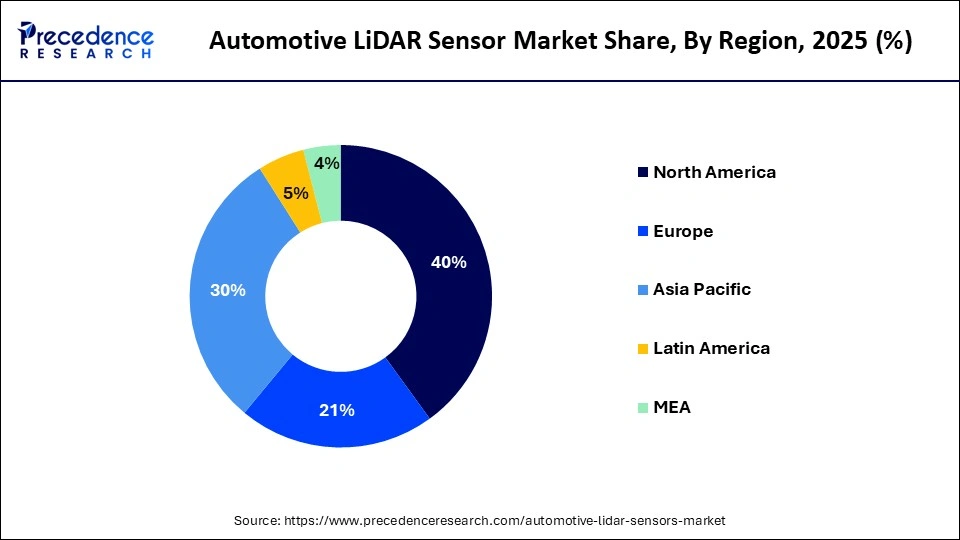
- North America dominated the automotive LiDAR sensor market with a 40% share in 2025.
- Asia Pacific is expected to grow at the fastest CAGR between 2026 and 2035.
- By technology type, the solid-state LiDAR segment held the biggest market share of 58% in 2025.
- By technology type, the mechanical/scanning LiDAR segment is expected to expand at a significant rate between 2026 and 2035.
- By range, the long-range segment contributed to the highest market share of 51% in 2025.
- By range, the medium range segment is expected to grow at a notable CAGR between 2026 and 2035.
- By vehicle type, the passenger cars segment held a major market share of 72% in 2025.
- By vehicle type, the EV & autonomous shuttles segment is expected to expand at the fastest CAGR of 18.1% from 2026 to 2035.
- By application, the ADAS segment held the biggest market share of 85% in 2025.
- By application, the autonomous driving segment is expected to expand at the fastest CAGR of 18.4% between 2026 and 2035.
- By end user, the OEMs segment held a major market share of 50% in 2025.
- By end user, the aftermarket segment is expected to expand at the fastest CAGR from 2026 to 2035.
What Drives the Growth of the Automotive LiDAR Sensor Market?
The automotive LiDAR sensor market is expanding rapidly because of the increasing production of autonomous vehicles and the growing integration of advanced driver assistance systems (ADAS). Vehicle safety and navigation accuracy are increased by LiDAR technologys ability to provide accurate 3D mapping and real-time object detection. The market is expanding thanks to growing regulatory emphasis on road safety and technological developments in sensor miniaturization. Commercialization is also accelerated by falling sensor costs and rising investments from top automakers and tech companies. The trend toward connected and electric cars is also driving up demand for high-performance sensing technologies, which will support market growth even more.
How is Artificial Intelligence Transforming the Automotive LiDAR Sensor Market?
Artificial Intelligence (AI) is significantly enhancing the capabilities of automotive LiDAR systems by enabling real-time data processing, object recognition, and predictive decision-making. By assisting in the interpretation of intricate 3D point cloud data produced by LiDAR sensors, artificial intelligence algorithms increase the precision of identifying cars, pedestrians, and road obstructions. In addition to improving overall vehicle safety and navigation effectiveness, the combination of AI and sensor fusion technologies improves autonomous driving performance and lowers false detections. Overall, AI is shifting LiDAR from a basic sensing tool to an intelligent, data-driven technology critical for next-generation mobility.
Major Market Trends
- Shift Toward Solid State LiDAR: Automakers are increasingly adopting solid-state LiDAR technology because it offers improved durability, lower manufacturing costs, and easier scalability for mass production compared to traditional mechanical systems.
- Growing ADAS Integration: LiDAR sensors are being widely integrated into advanced driver assistance systems to enhance vehicle safety, improve object detection, and ensure greater driving accuracy under various road conditions.
- Sensor Miniaturization: Manufacturers are focusing on compact and lightweight LiDAR designs that can be seamlessly integrated into vehicle structures without affecting aesthetics or aerodynamics.
- Declining Sensor Costs: Continuous technological advancements and high-volume production are significantly reducing the overall cost of LiDAR sensors, making them more accessible for mainstream vehicle models.
- Strategic Partnerships: Collaborations between automakers and technology firms are accelerating LiDAR development, enabling faster innovation, improved system performance, and quicker commercialization.
- Improved Detection Accuracy: Advancements in 3D mapping, real-time data processing, and long-range sensing capabilities are strengthening vehicle perception and enabling more precise environmental awareness.
- AI and Sensor Fusion: LiDAR technology is increasingly being combined with cameras and radar systems through AI driven sensors fusion to enhance reliability, minimize errors, and improve decision making inn autonomous systems.
- Rising EV and Autonomous Vehicle Demand: The rapid growth of electric vehicles and autonomous driving technologies is driving higher adoption of LiDAR sensors to support enhanced navigation, safety, and automation capabilities.
Future Market Outlook
- Mass-Market Vehicle Adoption: Declining prices and technological improvements are creating opportunities for LiDAR integration in mid-range and mass-market passenger vehicles.
- Autonomous Vehicle Expansion: Higher levels of vehicle autonomy require advanced and highly accurate LiDAR systems, creating significant growth potential for manufacturers.
- Emerging Market Growth: Developing regions present untapped demand for advanced safety technologies, offering new expansion opportunities for LiDAR suppliers.
- Smart Mobility Integration: The rise of connected vehicles and smart city initiatives is supporting the integration of LiDAR-enabled vehicles into intelligent transportation ecosystems.
- Aftermarket Installations: Fleet retrofitting and aftermarket LiDAR installations are opening additional revenue streams for sensor manufacturers and solution providers.
- Long-Range LiDAR Development: The increasing demand for highway autopilot systems is creating strong growth potential for advanced long-range LiDAR solutions.
- Government Safety Regulations: Stricter vehicle safety regulations and mandatory ADAS requirements are encouraging broader adoption of LiDAR technology across vehicle segments.
- Mobility-as-a-Service Growth: The expansion of autonomous ridesharing and mobility-as-a-service platforms is expected to significantly increase demand for high-performance LiDAR systems.
Market Scope
| Report Coverage | Details |
| Market Size in 2025 | USD 1.90 Billion |
| Market Size in 2026 | USD 2.24 Billion |
| Market Size by 2035 | USD 9.94 Billion |
| Market Growth Rate from 2026 to 2035 | CAGR of 18.00% |
| Dominating Region | North America |
| Fastest Growing Region | Asia Pacific |
| Base Year | 2025 |
| Forecast Period | 2026 to 2035 |
| Segments Covered | Technology Type, Range, Vehicle Type, Application, End User, and Region |
| Regions Covered | North America, Europe, Asia-Pacific, Latin America, and Middle East & Africa |
Government Initiatives Supporting the Automotive LiDAR Sensors Market
| Country/Region | Government Initiative | Impact on Market |
| India | Bharat NCAP (New Car Assessment Program) | Encourages adoption of advanced safety technologies, including ADAS, indirectly supporting LiDAR integration. |
| U.S. | NHTSA Autonomous Vehicle Guidelines | Promotes safe testing and deployment of autonomous vehicles, boosting demand for LiDAR sensors. |
| EU | Euro NCAP Safety Regulations | Strengthens vehicle safety standards, increasing the need for advanced sensing systems. |
| China | Intelligent Connected Vehicle (ICV) Strategy | Supports the development of autonomous and smart vehicles, accelerating LiDAR adoption. |
| Japan | Autonomous Driving Roadmap | Encourages R&D and commercialization of self-driving technologies, creating opportunities for LiDAR manufacturers. |
| South Korea | K-City Autonomous Testbed Program | Provides infrastructure for autonomous vehicle testing, driving demand for high-precision sensors. |
Segment Insights
Technology Type Insights
Why did the solid-state LiDAR segment dominate the automotive LiDAR sensor market?
The solid-state LiDAR segment dominated the market with the largest share of 58% in 2025 and is expected to sustain its position in the upcoming period. This is because of its smaller size, increased robustness, and cheaper manufacturing costs. Its lack of moving parts, in contrast to mechanical systems, increases dependability and makes it suitable for mass vehicle deployment. For easier vehicle design compatibility and smooth ADAS integration, automakers favor solid state LiDAR. The segment's leadership position is further reinforced by growing large-scale commercialization and developments in semiconductor based LiDAR technologies.
The mechanical/scanning LiDAR segment is expected to grow at a significant CAGR in the coming years because of its 360-degree environmental scanning capabilities and exceptional high-resolution imaging. These systems are widely used in robotaxi prototypes and advanced autonomous vehicles that require precise mapping and long-range object detection. Demand is being driven by increasing investments in Level 4 and Level 5 autonomous vehicle testing, while ongoing improvements in performance and durability continue to support segment growth.
Range Insights
What made long-range the dominant segment in the automotive LiDAR sensor market?
The long-range (>150-200 m) segment dominated the market with a 51% share in 2025 and is expected to sustain its growth trajectory in the coming years. This is because it enables vehicles, particularly autonomous and ADAS-equipped cars, to detect objects and obstacles at greater distances, allowing more reaction time for high-speed driving. Long-range LiDAR is essential for highway and expressway applications, where early detection of vehicles, pedestrians, or debris is critical for safety. Additionally, advancements in sensor technology and increasing investments in Level 2 and Level 3 automation features in high-end automobiles and regulatory emphasis on safety performance contribute to the segment's growth.
The medium range (50-150 m) segment is expected to grow at a notable rate during the forecast period because of its growing application in affordable cars and urban mobility solutions. These systems are perfect for parking assistance, traffic navigation, and city driving. The need for medium-range LiDAR is rising as automakers add ADAS features to mid-range car models. Its lower cost and compact design compared to long-range sensors make it attractive for mass-market vehicles, driving adoption and segment growth.
Vehicle Type Insights
Why did the passenger cars segment dominate the automotive LiDAR sensor market?
The passenger cars segment dominated the market with the largest share of 72% in 2025 because of rising consumer demand for safety technologies and large production volumes worldwide. To improve ADAS performance, automakers are quickly incorporating LiDAR into high-end and electric passenger cars. Adoption has been further accelerated by government regulations requiring advanced safety systems. Segment dominance is also aided by growing knowledge of car safety ratings.
The EV & autonomous shuttles segment is expected to grow at the fastest CAGR of 18.1% in the coming years, driven by the rising adoption of driverless and shared mobility solutions in urban areas. Public and private organizations are increasingly deploying autonomous shuttles for last-mile transport and smart city initiatives, which require precise 3D environmental sensing for safe navigation. Additionally, advancements in electric vehicle platforms, government support for sustainable transport, and growing investments in autonomous mobility projects are fueling the demand for LiDAR-equipped EV and shuttle fleets.
Application Insights
What made ADAS the dominant segment in the automotive LiDAR sensor market?
The ADAS segment dominated the market with the highest share of 85% in 2025. This is because of the extensive use of features such as automated emergency braking, adaptive cruise control, and lane departure warning. LiDAR enhances detection accuracy and enables real-time decision-making for these safety systems. Global road safety regulations have accelerated ADAS deployment across vehicle categories, and automakers are prioritizing ADAS as a key differentiator in competitive automotive markets.
The autonomous driving segment is expected to grow at the fastest CAGR of 18.4% in the coming years, as the industry moves toward higher levels of vehicle automation. LiDAR plays a crucial role in enabling 3D mapping, object recognition, and navigation in fully autonomous systems. Rising R&D investments and pilot deployments of self-driving vehicles are boosting demand. Continuous software and AI integration advancements further support growth.
End User Insights
Why did the OEM segment dominate the automotive LiDAR sensor market?
The OEM segment dominated the market with the highest share of 85% in 2025 because original equipment manufacturers directly integrate LiDAR systems into new vehicles during production, ensuring optimized performance, reliability, and compliance with safety standards. OEMs lead adoption for both ADAS and autonomous driving applications, driven by regulatory requirements and consumer demand for advanced safety features. Their strong R&D capabilities, strategic partnerships with LiDAR suppliers, and ability to deploy sensors at scale give the OEM segment a major advantage over aftermarket and Tier-2 installation channels.
The aftermarket segment is expected to grow at the fastest CAGR throughout the forecast period due to the increasing demand for retrofitting advanced driver-assistance systems (ADAS) and autonomous features in existing vehicles. Fleet operators, ride-sharing services, and individual consumers are upgrading vehicles with LiDAR sensors to enhance safety, navigation, and automation capabilities. Additionally, the availability of cost-effective, plug-and-play LiDAR solutions and rising awareness of vehicle safety technologies are driving the adoption of aftermarket LiDAR systems.
Regional Insights
North America Automotive LiDAR Sensor Market Size and Growth 2026 to 2035
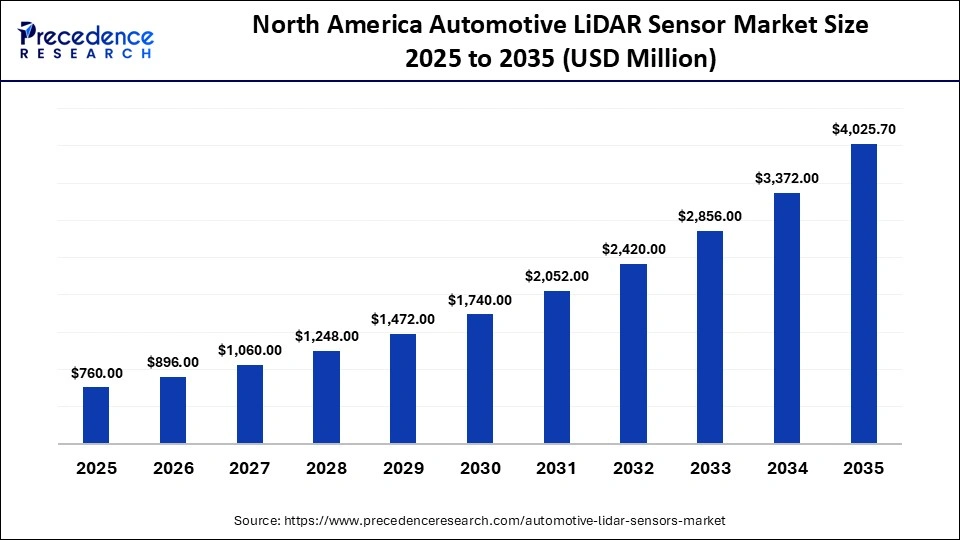
The North America automotive LiDAR sensor market size is estimated at USD 760.00 million in 2025 and is projected to reach approximately USD 4,025.70 billion by 2035, with a 18.14% CAGR from 2026 to 2035.
What made North America the dominant region in the automotive LiDAR sensor market?
North America dominated the automotive LiDAR sensor market while capturing a 40% share in 2025. This is mainly due to the presence of major market players, a high adoption rate of innovative solutions, and an advanced technological infrastructure. Significant investments in research and development, established regulatory frameworks, and early adoption of emerging technologies have all supported the region's leadership. High investments in autonomous vehicles, ADAS, and smart mobility initiatives, combined with widespread adoption of advanced technologies like AI, IoT, and 5G, have accelerated LiDAR integration. Supportive government policies, robust R&D infrastructure, and early adoption of electric and autonomous vehicle platforms further reinforce North America's leadership in the market.
U.S. Automotive LiDAR Sensor Market Size and Growth 2026 to 2035
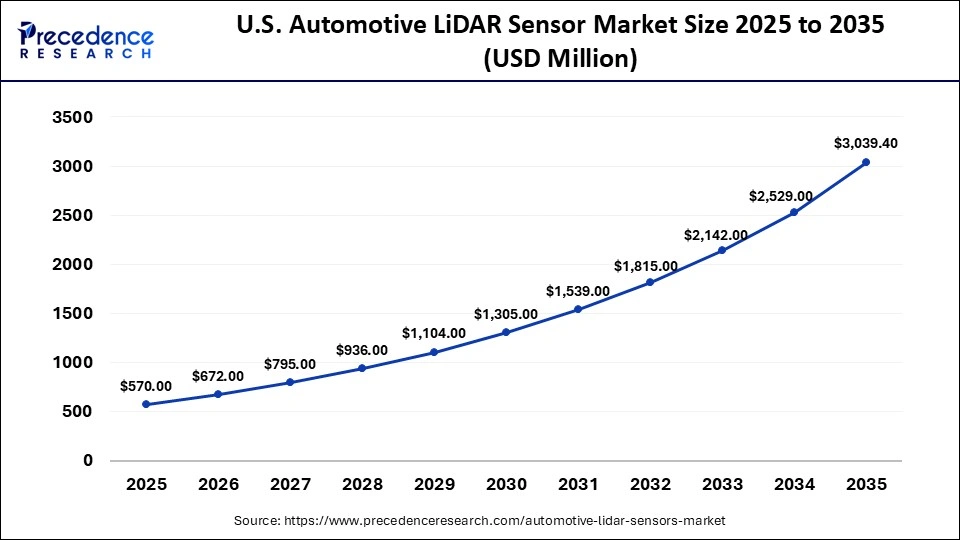
The U.S. automotive LiDAR sensor market size is calculated at USD 570.00 million in 2025 and is expected to reach nearly USD 3,039.40 million in 2035, accelerating at a strong CAGR of 18.22% between 2026 and 2035.
U.S. Automotive LiDAR Sensor Market Analysis
The automotive LiDAR sensor market in the U.S. is growing due to the increasing adoption of advanced driver-assistance systems (ADAS) and the push toward autonomous vehicle technologies. Strong investments by automotive manufacturers and tech companies in LiDAR integration for safety and navigation are accelerating market demand. Additionally, supportive regulations, consumer focus on vehicle safety, and the development of smart infrastructure are further driving market growth in the U.S.
How is the opportunistic rise of Asia Pacific in the automotive LiDAR sensor market?
Asia Pacific is expected to grow rapidly with a CAGR of 20.5% throughout the forecast period, fueled by growing disposable incomes, rapid urbanization, rising vehicle production, and increasing investments in electric and autonomous vehicles. Governments in countries like China, Japan, and South Korea are promoting smart mobility and autonomous driving initiatives, creating strong demand for advanced sensing technologies. Additionally, the presence of automotive OEMs, Tier-1 suppliers, and growing local LiDAR manufacturers, coupled with supportive regulatory frameworks, is accelerating adoption and regional market growth.
What are the Advancements in the Automotive LiDAR Sensor Market in Europe?
Europe is expected to have significant amount of market growth during the forecast years. The region's growth and development is characterized by stringent safety regulations and a strong focus on reducing carbon emissions, which is thus driving the adoption of electric and autonomous vehicles. There is also significant research and development activity in countries like Germany, France, and the UK, with a strong focus on developing high-resolution, long-range LiDAR systems.
Germany Market Trends
The country is witnessing a shift towards electrification, which is expected to open up new opportunities for LiDAR technology, as manufacturers seek to differentiate their offerings through enhanced safety features. Furthermore, collaborations between automotive companies and technology firms are gaining traction, leading to innovative applications of LiDAR.
What are the Key Trends in the Automotive LiDAR Sensor Market in Latin America?
Latin America is anticipated to have significant market growth all throughout the forecast period. This growth is due to the fact that the region is witnessing a strong push for autonomous vehicle technology, particularly in countries like Brazil and Mexico, where government support and investments are driving market expansion. The region is also seeing a rise in domestic LiDAR manufacturers, challenging established Western players.
Brazil Market Trends
The region is witnessing increased collaboration between automakers and tech companies, which helps in fostering innovation in areas such as autonomous driving and AI-powered user interfaces. Additionally, the diverse market condition across the region is driving the development of scalable solutions that can cater to both premium and budget vehicle segments.
How is the Middle East and Africa Region Growing in the Automotive LiDAR Sensor Market?
Middle East and Africa is witnessing significant market growth, driven by advancements in sensor technology and increasing demand for autonomous vehicles. As manufacturers strive to enhance vehicle safety and navigation capabilities, LiDAR sensors are becoming vital components in modern automotive systems. The growing emphasis on smart transportation solutions and the integration of artificial intelligence into vehicle systems further boosts the automotive lidar sensor market in the region. Countries like Saudi Arabia and the UAE are leading players.
Saudi Arabia Market Trends
Rising demand for advanced driver assistance systems and the growth of electric and autonomous vehicles are key drivers of market expansion in the country's market landscape. Technological advancements in LiDAR are further helping in enhancing sensor capabilities and performance.
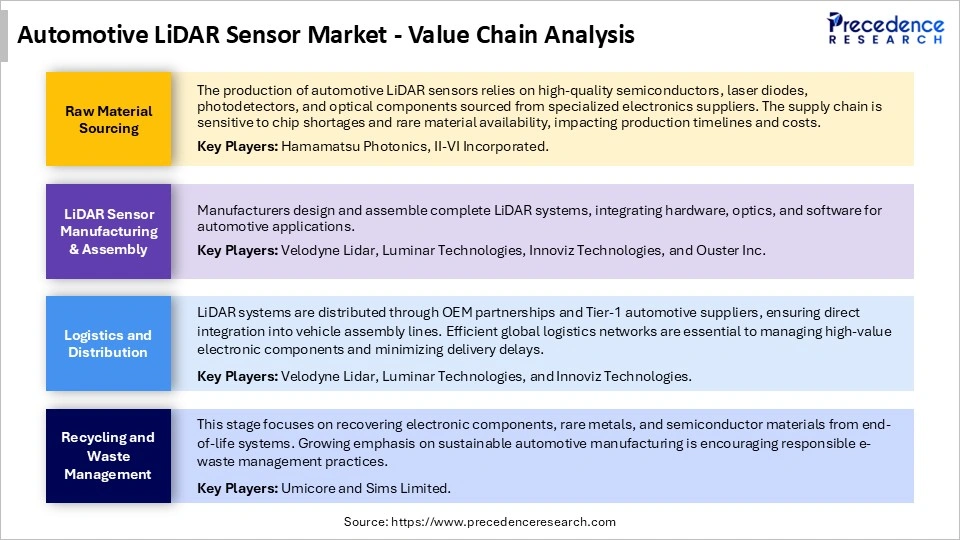
Automotive LiDAR Sensor Market Supply Chain Analysis
Competitive Landscape
The competitive landscape of the global automotive LiDAR market is dynamic and is characterized by a mix of established players, innovative startups, and new entrants. Major automotive OEMs and technology companies are increasingly investing in the vertical integration of LiDAR technology, aiming to have more control over the supply chain and differentiate their offerings. Partnerships and collaborations between LiDAR suppliers, automotive OEMs, and technology companies are becoming more prevalent in order to drive the adoption and integration of LiDAR in the automotive industry.
As the technology matures, differentiation through software capabilities, manufacturing scalability, and integration expertise will be becoming increasingly important in automotive LiDAR market.
Automotive LiDAR Sensor Market Companies
- Velodyne (Ouster)
- Luminar Technologies
- RoboSense
- Hesai Technology
- Innoviz Technologies
- Valeo
- Continental AG
- DENSO
- Ibeo
- Quanergy Systems
- Leddartech
- Trilumina
- Phantom Intelligence
- Leishen
- Cepton Inc.
Recent Developments
- In January 2026, Hesai Technology announced plans at CES 2026 to double its annual production capacity to 4 million units. The company is expanding to meet surging global demand for high-performance automotive LiDAR in mass-market ADAS vehicles. This strategy solidifies Hesai's position as a high-volume leader in the LiDAR sensor market.(Source: https://www.prnewswire.com)
- In January 2026, Hesai Technology announced the launch of its next-generation L3-series LiDAR suite, including the ultra-long-range ETX and solid-state FTX sensors, at CES 2026. These sensors, designed for Physical AI applications, aim to enable advanced autonomous driving capabilities in mass-market vehicles.
(Source: https://www.therobotreport.com) - In January 2026, Innoviz Technologies announced the world premiere of InnovizThree, a high-performance LiDAR sensor at CES 2026. The new sensor features a 300-meter detection range and ultra-high resolution designed for L3/L4 autonomous driving applications. It boasts a compact form factor and lower power consumption, enabling seamless integration into mass-market vehicles.(Source: https://ir.innoviz.tech)
Segments Covered in the Report
By Technology Type
- Solid-State LiDAR
- Mechanical/Scanning LiDAR
By Range
- Long-Range (>150-200 m)
- Medium-Range (50-150 m)
- Short-Range (≤50-m)
By Vehicle Type
- Passenger Cars
- Light Commercial/HCV/Robo-Taxis
- EV & Autonomous Shuttles
By Application
- ADAS
- Autonomous Driving
By End User
- OEMs
- Tier-1 Suppliers
- Aftermarket
By Region
- North America
- Europe
- Asia-Pacific
- Latin America
- Middle East & Africa
For inquiries regarding discounts, bulk purchases, or customization requests, please contact us at sales@precedenceresearch.com
Frequently Asked Questions





Ask For Sample
No cookie-cutter, only authentic analysis – take the 1st step to become a Precedence Research client
 Get a Sample




 sales@precedenceresearch.com
 Schedule a Meeting
