



Hybrid Packaging Market Size, Companies, Production Capacity, Production & Manufacturing Efficiency, Sales Volume, Export & Import Dependency, Adoption Rates, Cost Structure, Recycling Rate, and Supply Chain Metrics
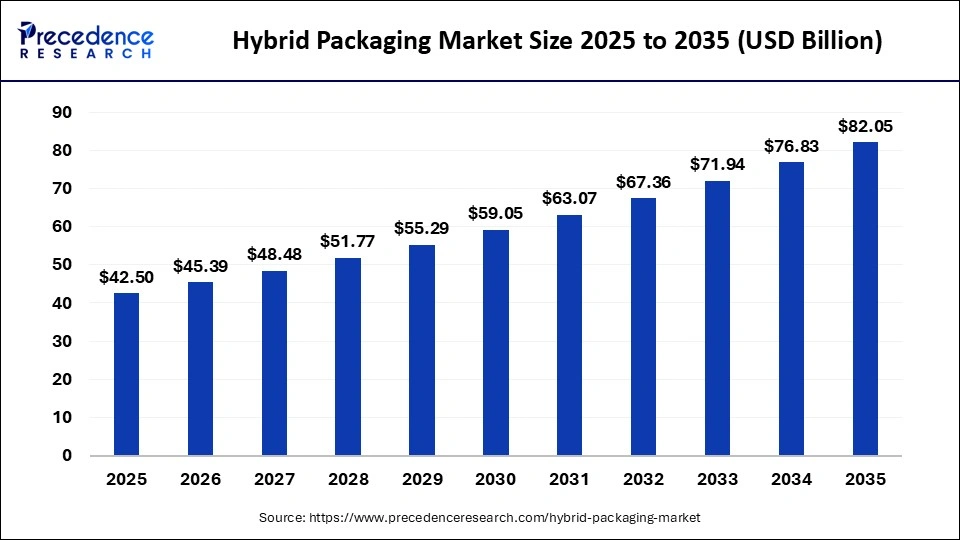
Packaging industry expert Vidyesh Swar values the hybrid packaging market at USD 45.39 billion in 2026 and anticipates growth to USD 82.05 billion by 2035 at a CAGR of 6.80%. Leading hybrid packaging market companies, including Amcor plc, Berry Global Inc., Constantia Flexibles Group GmbH, Coveris Holdings S.A., are responding to evolving demand across key segments such as By Material Type, By Packaging Type, By Application, By End-Use.
Source: https://www.precedenceresearch.com/hybrid-packaging-market
 Get a Sample
 Table Of Content


What is the Hybrid Packaging Market Size in 2026?
The global hybrid packaging market size accounted for USD 42.50 billion in 2025 and is predicted to increase from USD 45.39 billion in 2026 to approximately USD 82.05 billion by 2035, expanding at a CAGR of 6.80% from 2026 to 2035. The market growth is attributed to rising regulatory pressure, increasing sustainability demand, and rapid adoption of high-performance multi-material packaging solutions.
Key Takeaways
- North America dominated the hybrid packaging market with a 30% share in 2025.
- Asia Pacific is expected to grow at the fastest CAGR of 7.8% between 2026 and 2035.
- By material type, the plastic segment contributed the highest market share of 40% in 2025.
- By material type, the paper & paperboard segment held a 30% share of the market in 2025 and is expected to grow at the fastest CAGR of 7.8% between 2026 and 2035.
- By packaging type, the rigid hybrid packaging segment held a major market share of 55% in 2025.
- By packaging type, the flexible hybrid packaging segment held a 45% share in 2025 and is expected to grow at a 7.5% CAGR from 2026 to 2035.
- By application, the food & beverages segment contributed the highest market share of 40% in 2025.
- By application, the pharmaceuticals segment held the second-largest share of 20% in the market in 2025 and is expected to grow at a strong CAGR of 6.8% over the projected period.
- By end-use, the consumer goods segment contributed the highest market share of 50% in 2025.
- By end-use, the healthcare segment held the second-largest share of 25% in 2025 and is expected to grow at a significant rate of CAGR of 6.8% between 2025 and 2035.
Market Overview
Rising global pressure to reduce plastic waste and carbon emissions is strongly driving the hybrid packaging market, as industries shift toward sustainable-driven packaging solutions. Hybrid packaging technology combines paper, polymers, aluminum, and bio-based coatings to enhance performance and sustainability. It has a multi-layered structure, which enhances protection of barriers, durability, and shelf life as opposed to the conventional packaging solutions that use a single material.
- According to the Ellen MacArthur Foundation, organizations representing 20% of global plastic packaging production have committed to circular packaging targets by 2025. This further accelerates the adoption of hybrid formats that balance functionality and sustainability, further boosting the market.
Impact of Artificial Intelligence on the Hybrid Packaging Market
AI technology has significantly transformed the hybrid packaging market by improving the performance and recyclability of barriers made from hybrid materials. Companies are increasingly utilizing machine learning algorithms to analyze consumer preferences and tailor hybrid packaging solutions accordingly, ensuring better alignment with market demands. Additionally, AI-powered sorting devices in recycling facilities enable more efficient separation of multi-material packaging, advancing the goals of a circular economy by improving recycling rates and reducing waste. This integration of AI into the packaging value chain is driving innovation and sustainability in the industry.
Major Market Trends
- Recyclability Infrastructure Alignment Driving Hybrid Packaging Formats: There is a significant increase in the development of hybrid packaging, as it is suitable for current recycling and waste management systems globally. This is driving industries to simpler hybrid forms that balance performance and the practicality of recyclability.
- Transition from Experimental to Scalable Hybrid Packaging Solutions: Hybrid packaging is developing beyond its experimental application to scalable, industrial-level use in global markets. This market momentum is driving hybrid technology commercialization, which is a combination of performance, compliance, and cost-efficiency.
- Advancements in Barrier Coating Technologies: Continuous innovation in coatings is propelling hybrid packaging performance across food, pharmaceutical, and industrial applications.
- Increasing Adoption in Premium Product Segments: Growing demand for aesthetic and functional packaging is driving hybrid packaging usage in luxury and high-end markets.
Market Scope
| Report Coverage | Details |
| Market Size in 2025 | USD 42.50 Billion |
| Market Size in 2026 | USD 45.39 Billion |
| Market Size by 2035 | USD 82.05 Billion |
| Market Growth Rate from 2026 to 2035 | CAGR of 6.80% |
| Dominating Region | Asia-Pacific |
| Fastest Growing Region | North America |
| Base Year | 2025 |
| Forecast Period | 2026 to 2035 |
| Segments Covered | Material Type, Packaging Type, Application, End-Use, and Region |
| Regions Covered | North America, Europe, Asia-Pacific, Latin America, and Middle East & Africa |
Market Dynamics
Drivers
Increasing Regulatory Pressure
Increasing regulatory pressure to reduce plastic waste is expected to drive the hybrid packaging market. The tough directives of packaging waste and recyclability requirements for major economies are being undertaken by governments and international bodies. The benefits of the hybrid forms include compliance due to lower plastic intensity and enhanced material efficiency.
Restraint
Multi-Material Complexity Limiting Recyclability
Multi-material recyclable complexity is expected to limit large-scale adoption across regulated markets, thus hindering market growth. The hybrid structure of this packaging makes recycling and separating materials complicated. Regulatory frameworks are focusing more on single-material solutions, making it difficult to comply with complex hybrid designs.
Opportunity
Rising Expansion of E-Commerce and Logistics
The rising expansion of the e-commerce and logistics sectors is projected to boost the demand for durable and lightweight hybrid packaging formats. Growth in online retail is creating a requirement for packaging that is resistant to handling, transportation, and environmental stress. Furthermore, the high demand for premium and aesthetic packaging is estimated to drive the adoption of hybrid formats in luxury and high-value product segments.
Segment Insights
Material Type Insights
Hybrid Packaging Market Share, By Material Type, 2025-2035 (%)
| Material Type | 2025 | 2035 | CAGR (%) |
| Plastic | 40.00% | 37.00% | 5.80% |
| Paper & Paperboard | 30.00% | 33.00% | 7.80% |
| Metal | 15.00% | 15.00% | 6.00% |
| Glass | 15.00% | 15.00% | 6.20% |
The Plastic Segment Dominated the Market With a 40% Share in 2025
The plastic segment dominated the hybrid packaging market with a major share of 40% in 2025. This is due to its unmatched flexibility and lightweight performance. Plastic provides excellent sealing, waterproofing, and a long shelf life for packaging. Its ability to combine with other materials also enhances barrier protection and durability. Furthermore, the rising demand for durable packaging solutions and established processing and recycling infrastructure for plastic reinforced the segment's dominance.
The paper & paperboard segment held a 30% share of the market in 2025 and is expected to grow at the fastest CAGR of 7.8% throughout the forecast period. This is mainly due to the growing regulatory pressure to reduce packaging waste and demand for sustainable substitutes. Hybrid formats are made by mixing paper and polymer-based coatings to ensure both performance and recyclability. Paper-based hybrid structures are gaining immense popularity in foodservice, retail, and e-commerce sectors, driving segmental growth.
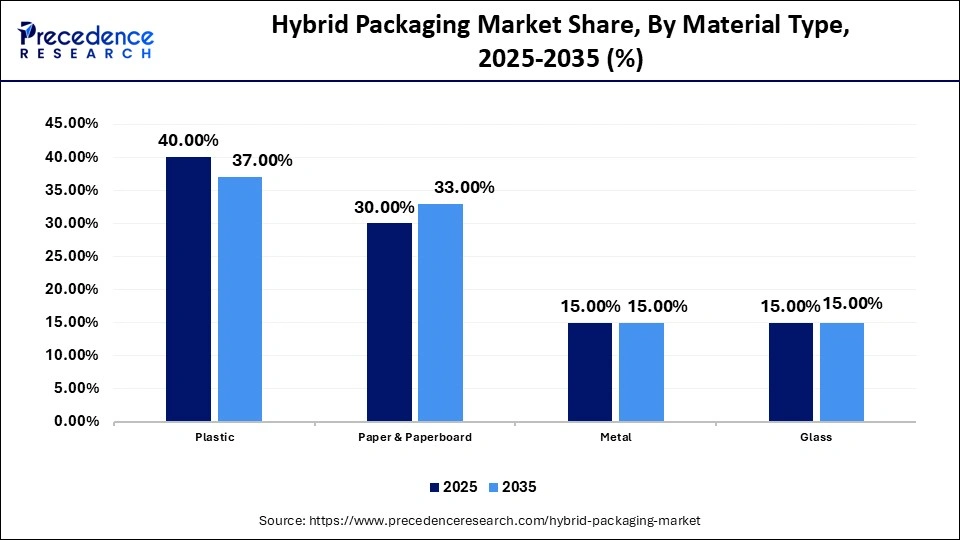
The metal segment held a 15% market share in 2025 and is expected to grow at a 6% CAGR during the projection period. This is primarily due to its superior barrier properties against oxygen, light, and contamination. The rising demand for hybrid packaging solutions made of metal, such as retort containers, aerosols, and specialty containers, across industries is driving segmental growth.
The glass segment accounted for a 15% share of the market in 2025 and is expected to grow at a strong CAGR of 6.2% over the projected period. This is due to its inert nature and strong product protection capabilities. The segment growth is also driven by an increase in demand for high-quality and safe packaging solutions, especially in the cosmetics and food & beverages industries.
Packaging Type Insights
Hybrid Packaging Market Share, By Packaging Type, 2025-2035 (%)
| Packaging Type | 2025 | 2035 | CAGR (%) |
| Rigid Hybrid Packaging | 55.00% | 52.00% | 6.20% |
| Flexible Hybrid Packaging | 45.00% | 48.00% | 7.50% |
The Rigid Hybrid Packaging Segment Dominated the Market in 2025
The rigid hybrid packaging segment dominated the market while holding a 55% share in 2025. This is because of its widespread use for its structural integrity and product safety. Food & beverage, pharmaceutical, and industrial goods sectors rely heavily on rigid formats for secure storage and transport. Furthermore, hybrid construction involves the use of rigid materials with barrier layers to aid stability and durability.
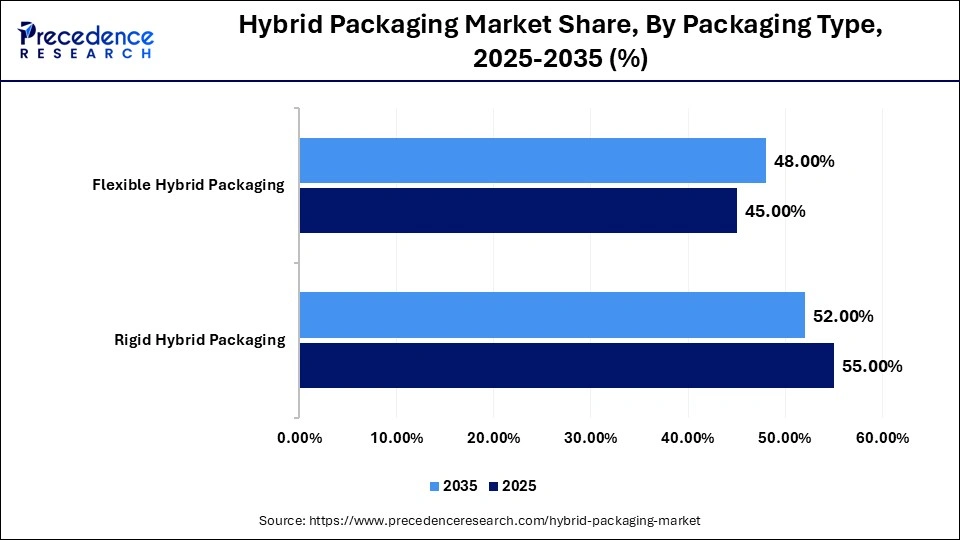
The flexible hybrid packaging segment held a 45% share of the market in 2025 and is expected to grow at the fastest CAGR of 7.5% during the studied period. The growth of this segment is attributed to the rising demand for lightweight and cost-efficient packaging formats. Innovation in materials is enhancing the barrier properties of flexible packaging, thereby driving its use across industries such as food & beverages and e-commerce.
Application Insights
Why Did the Food & Beverage Segment Dominated the Market in 2025?
The food & beverage segment dominated the hybrid packaging market with a 35% share in 2025. The dominance of the segment is driven by increasing demand for extended shelf life of products and convenient packaging solutions. Ready meals, processed foods, and beverages require hybrid packaging solutions to ensure that they are fresh.
The pharmaceuticals segment held a 20% share of the market in 2025 and is expected to grow at a 6.8% CAGR between 2026 and 2035. This is due to strict regulatory requirements and safety standards. Sensitive drug formulations need to be protected against moisture, light, and contamination, boosting the demand for hybrid packaging. Increasing production of biologics and specialty drugs is driving the need to develop sophisticated hybrid forms of packaging.
Hybrid Packaging Market Share, By Application, 2025-2035 (%)
| Application | 2025 | 2035 | CAGR (%) |
| Food & Beverage | 40.00% | 38.00% | 6.50% |
| Pharmaceuticals | 20.00% | 21.00% | 6.80% |
| Personal Care & Cosmetics | 15.00% | 16.00% | 7.20% |
| Industrial Goods | 15.00% | 15.00% | 6.00% |
| Others | 10.00% | 10.00% | 5.50% |
The personal care & cosmetics segment contributed 15% share of the market in 2025 and is expected to grow at the fastest CAGR of 7.2% over the projected period. This is due to increasing demand for premium and visually appealing packaging solutions. Hybrid packaging involves using a mixture of materials to improve aesthetics and preserve both product protection and stability. These packaging formats are in high demand in the personal care & cosmetics industry for their superior barrier properties.
The industrial goods segment held a 15% share of the market in 2025 and is expected to grow at a significant CAGR of 6% between 2026 and 2035 due to growing demand for long-lasting and protective packaging solutions. There is a need for strong barrier and impact-resistant packaging formats to transport and store chemicals, machinery components, and bulk materials, contributing to segmental growth.
End-Use Insights
The Consumer Goods Segment Led the Market With a 50% Share in 2025
The consumer goods segment held a 50% share of the hybrid packaging market in 2025. This is mainly due to high consumption of packaged food, beverages, and personal care products. Furthermore, e-commerce growth has increased demand for packaging that ensures product safety during transit, reinforcing the segment's dominance.
Hybrid Packaging Market Share, By End-Use, 2025-2035 (%)
| End-Use | 2025 | 2035 | CAGR (%) |
| Consumer Goods | 50.00% | 48.00% | 6.50% |
| Healthcare | 25.00% | 26.00% | 6.80% |
| Industrial | 15.00% | 16.00% | 7.00% |
| Others | 10.00% | 10.00% | 5.50% |
The healthcare segment held a 25% share of the market in 2025 and is expected to grow at a significant CAGR of 6.8% from 2026 to 2035, owing to increasing demand for sterile and protective packaging systems. Hybrid packaging offers excellent protection for pharmaceuticals, medical devices, and surgical equipment when in storage and transportation. Stringent regulations regarding the safety and efficacy of healthcare products are driving the demand for durable packaging solutions, thereby driving segmental growth.
The industrial segment held a 15% share of the market in 2025 and is projected to grow at a robust CAGR of 7% over the projection period. This is because heavy machinery components and bulk materials require durable packaging that ensures safe handling and transportation. Several industries are investing in protective packaging solutions that minimize damage and enhance the product's quality in the supply chain, further propelling market growth.
Regional Insights
North America Hybrid Packaging Market Size and Growth 2026 to 2035
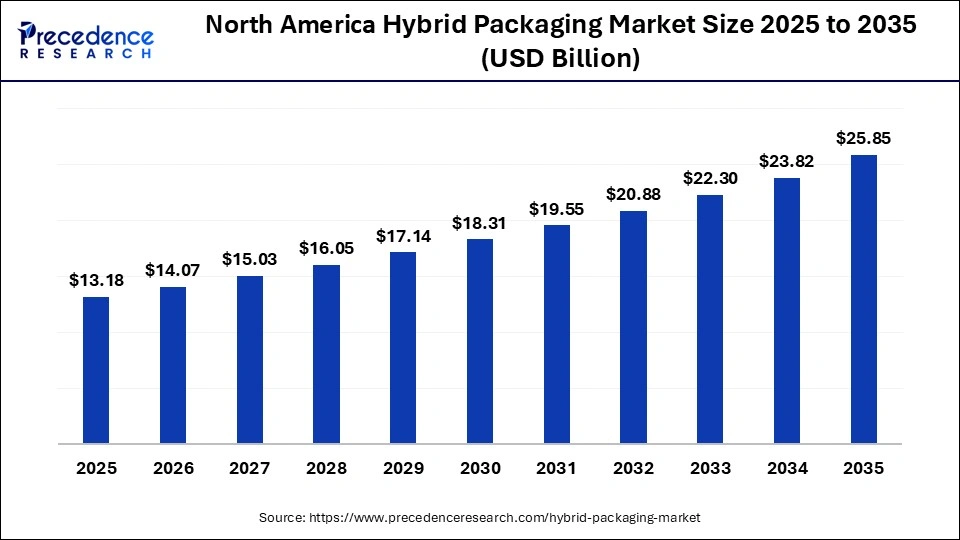
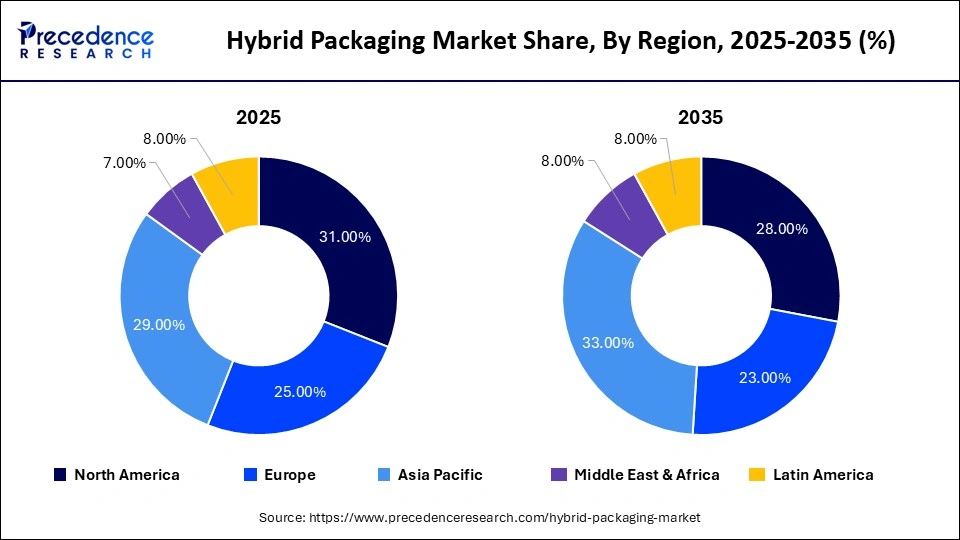
The North America hybrid packaging market size is estimated at USD 13.18 billion in 2025 and is projected to reach approximately USD 25.85 billion by 2035, with a 6.97% CAGR from 2026 to 2035.
What Made North America the Dominant Region in the Hybrid Packaging Market?
North America led the hybrid packaging market by capturing a major revenue share of 30% in 2025. This is mainly due to the strong presence of established packaging manufacturers and advanced recycling infrastructure. Government regulations on sustainability are promoting investments in packaging projects and innovative materials. According to the Flexible Packaging Association, flexible and hybrid packaging usage in North America contributed over USD 151 billion to the U.S. economy in 2025. Furthermore, the growth of e-commerce and the expansion of logistics networks boosted the demand for hybrid packaging solutions in the region.
U.S. Hybrid Packaging Market Size and Growth 2026 to 2035
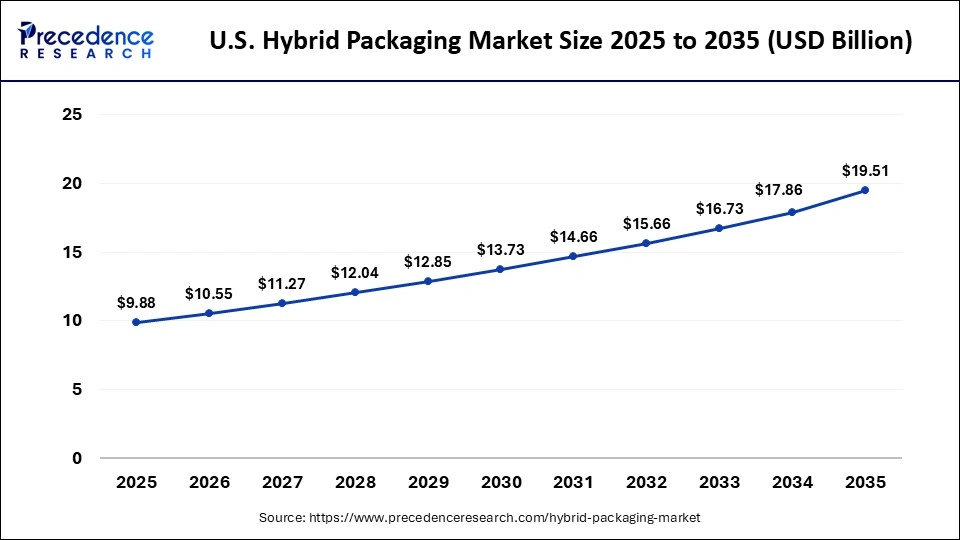
The U.S. hybrid packaging market size is calculated at USD 9.88 billion in 2025 and is expected to reach nearly USD 19.51 billion in 2035, accelerating at a strong CAGR of 7.04% between 2026 and 2035.
U.S. Market Analysis
The U.S. leads the hybrid packaging market within North America, driven by high consumption of packaged goods and the presence of a robust packaging industry. Growing consumer awareness regarding environmental sustainability also contributes to market growth. A 2025 survey shows 44% of U.S. consumers consider environmental sustainability to be highly important, boosting demand for sustainable hybrid packaging formats.
How is the Opportunistic Rise of Europe in the Hybrid Packaging Market?
Europe held a 25% share of the market in 2025 and is expected to grow at a 6.5% CAGR in the coming years. This is mainly due to the strict environmental regulations and strong sustainability commitments. Governments around the region are implementing policies that are centered on recyclability, waste minimization, and a circular economy. The use of hybrid packaging is on the rise, with companies trying to comply with the changing packaging requirements.
Germany Market Analysis
Germany is a major contributor to the European hybrid packaging market, driven by its strong presence in the recycling economy and commitment to sustainability. Businesses in Germany are actively investing in fiber-based and recyclable hybrid materials to comply with stringent environmental regulations, ensuring their packaging solutions are both eco-friendly and legally compliant. Furthermore, sustainability-driven innovation continues to fuel the adoption of hybrid packaging technologies across key sectors, including food, automotive, and industrial applications, further enhancing Germany's position in the market.
Asia Pacific: The Fastest-Growing Region
Asia Pacific is expected to grow at the fastest CAGR of 7.8% during the forecast period, driven by increased consumption of food, beverages, and personal care items. Adoption of hybrid packaging is rising in manufacturing and retail industries due to cost-effectiveness and performance. Additionally, the strong economic growth and evolving consumer behavior toward sustainability further boost the market.
China Market Analysis
In China, the market is driven by a growing middle-class population, which is increasing the demand for packaged food, beverages, and personal care products. This rising consumer demand is supported by robust production capabilities, enabling the mass production of hybrid packaging materials at competitive prices. Businesses around the country are demanding cost-effective, sustainable packaging solutions to meet the evolving needs of the consumer, contributing to market growth.
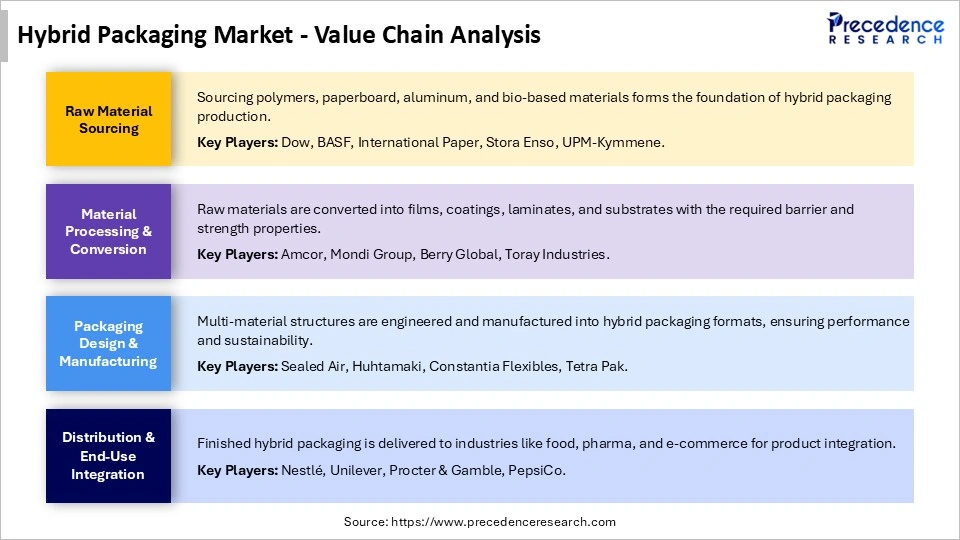
Hybrid Packaging Market Value Chain Analysis
Hybrid Packaging Market Companies
- Amcor plc
- Berry Global Inc.
- Constantia Flexibles Group GmbH
- Coveris Holdings S.A.
- DS Smith Plc
- Huhtamaki Oyj
- Mondi Group
- ProAmpac LLC
- Sealed Air Corporation
- Smurfit Kappa Group
- Sonoco Products Company
- Stora Enso Oyj
- Tetra Pak International S.A.
- UFlex Limited
- WestRock Company
Recent Developments
- In April 2026, Zerolys expanded into sustainable packaging by introducing plastic-free paper bottles designed for consumer goods applications. The company developed its proprietary biomaterial, Phyber, using engineered plant fibres to replace conventional PET and composite packaging formats. These bottles support a wide range of uses, including beverages, sauces, dairy alternatives, and dry food products, highlighting a strong shift toward fiber-based hybrid solutions.
- In March 2026, Comex partnered with Trinity College Dublin to advance circular packaging innovation under the EU-funded IMPRESS project. The collaboration integrates NFC-enabled smart-labeling technology with biobased packaging prototypes, enabling traceability and sustainability throughout packaging lifecycles. This development reflects growing adoption of intelligent hybrid packaging solutions aligned with circular bioeconomy goals.
(Source: https://www.foodanddrinktechnology.com)
(Source: https://witnews.eu)
(Source: https://thepackman.in)
Segments Covered in the Report
By Material Type
- Plastic
- Paper & Paperboard
- Metal
- Glass
By Packaging Type
- Rigid Hybrid Packaging
- Flexible Hybrid Packaging
By Application
- Food & Beverage
- Pharmaceuticals
- Personal Care & Cosmetics
- Industrial Goods
- Others
By End-Use
- Consumer Goods
- Healthcare
- Industrial
- Others
By Region
- North America
- Latin America
- Europe
- Asia-pacific
- Middle and East Africa
For inquiries regarding discounts, bulk purchases, or customization requests, please contact us at sales@precedenceresearch.com
Frequently Asked Questions
Tags





Ask For Sample
No cookie-cutter, only authentic analysis – take the 1st step to become a Precedence Research client
 Get a Sample




 sales@precedenceresearch.com
 Schedule a Meeting
