



Injection Molding Market Size, Companies, Share, Production Capacity, Raw Material Pricing, Export & Import Analysis, Manufacturing Cost, Competitive Positioning, and Demand Forecast
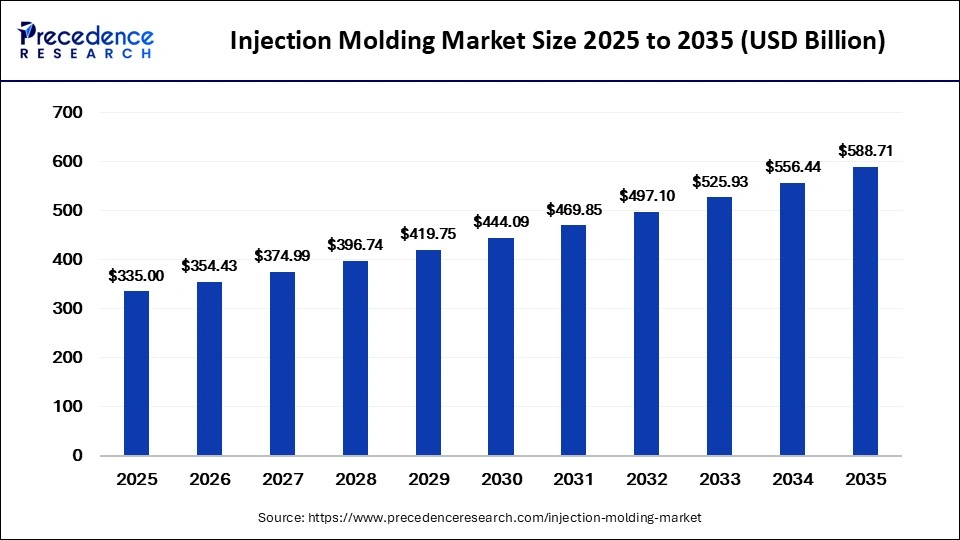
Yogesh Kulkarni, a Chemical and Materials Industry Expert, estimates the injection molding market at USD 354.43 billion in 2026, with the market projected to reach USD 588.71 billion by 2035 at a CAGR of 5.80%. Major injection molding market companies such as Husky Technologies, ENGEL, ARBURG, Milacron, Sumitomo Heavy Industries are competing across key material and application segments, including By Material, By Machine Type, By Process, By Application, By End-Use Industry, By Clamping Force.
Source: https://www.precedenceresearch.com/injection-molding-market
 Get a Sample
 Table Of Content


What is the Injection Molding Market Size in 2026?
The global injection molding market size accounted for USD 335.00 billion in 2025 and is predicted to increase from USD 354.43 billion in 2026 to approximately USD 588.71 billion by 2035, expanding at a CAGR of 5.80% from 2026 to 2035. The market is driven by growing demand for lightweight and cost-efficient plastic components.
Key Takeaways
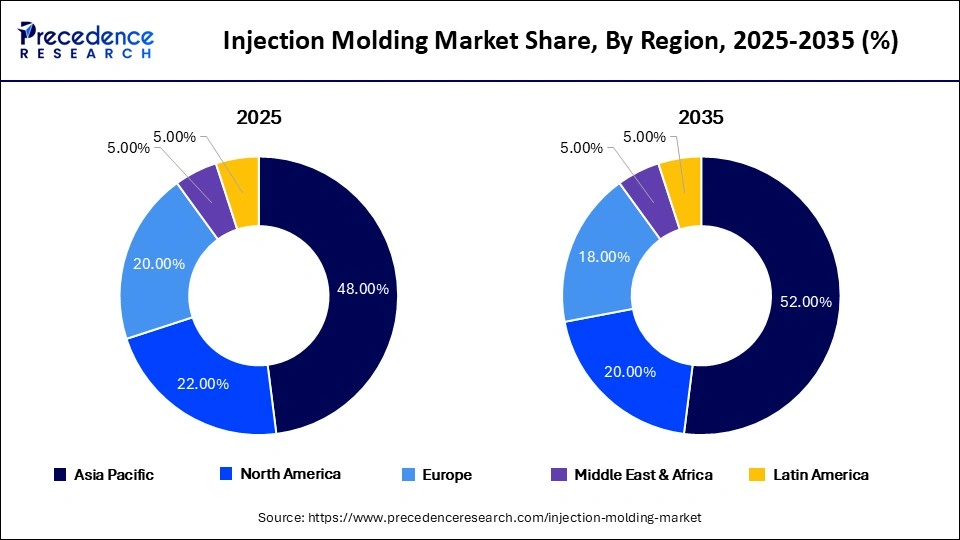
- Asia-Pacific dominated the global injection molding market with a share of 48% in 2025 and is expected to experience the fastest growth with a CAGR of 7.2% in the coming years.
- North America is expected to grow at a notable CAGR of 4.8% during the forecast period.
- By material, the plastic segment held a dominant position in the market, accounting for 72% of the market share in 2025.
- By material, the metal segment is the second-largest shareholder and is expected to grow at a 7% CAGR between 2026 and 2035.
- By machine type, the hydraulic machines segment accounted for a considerable revenue share of 45% in the market in 2025.
- By machine type, the electric machines segment is the second-largest shareholder and is expected to grow at a 8.5% CAGR between 2026 and 2035.
- By process, the thermoplastic injection molding segment led the global injection molding market with a share of 68% in 2025.
- By process, the thermoset injection molding segment is the second-largest shareholder and is expected to grow at a 4.8% CAGR between 2026 and 2035.
- By application, the packaging segment accounted for a considerable revenue share of 28% in the market in 2025.
- By application, the automotive segment is the second-largest shareholder and is expected to grow at a 6.5% CAGR between 2026 and 2035.
- By end-use industry, the packaging segment led the global market with a share of 26% in 2025.
- By end-use industry, the automotive segment is the second-largest shareholder and is expected to grow at a 6.8% CAGR between 2026 and 2035.
Revolutionizing Manufacturing: Innovation Driving the Injection Molding Market
Injection molding is a manufacturing technology that involves the transfer of molten plastic or other material under high pressure into a mold to create a molded product. Injection molding's popularity in the healthcare industry stems from its ability to manufacture highly complex parts; its use is popular in the consumer goods industry, packaging, the electronics industry, medical devices, and even in the automobile industry. It is fuelled by the introduction of automation and smart manufacturing technologies, sustainable and lightweight requirements, and speedy industrialization. The growth factors are high photo performance of medical parts, growth packaging requirements, and the growth of the EV market.
Key AI Integration in the Injection Molding Market
The injection molding industry is transforming with the rollout of artificial intelligence (AI) to improve production, quality control, and process automation throughout manufacturing operations. An AI-based system can constantly track the performance of the machine and give analysis on thousands of process parameters, which can help to optimize the injection pressure, temperature, cooling times, and material flow. AI's power can help manufacturers decrease machine downtime, maintenance costs, and machine operation reliability. The use of AI also helps in intelligent fault detection, helping manufacturers minimize scrap and material waste and boost productivity.
Injection Molding Market Trends
- Thermal electrical energy injection molding machines are becoming the mainstream of manufacturing because of their thermal energy efficiency, low maintenance expenses, low emissions, and high precision. These machines are increasingly being used in the fields of medicine, packaging, and electronic manufacturing throughout the world.
- The rising waves of sustainability are prompting manufacturers to use materials that are recyclable, bioplastics, and low-energy molding techniques. Firms are turning to lowering their carbon footprint and plastic waste while complying with more stringent environmental laws and the demand for "green" goods from consumers.
- Precision injection molding is in great demand for the medical and packaging industries due to the growth of hygiene norms and the requirement for mass volume. The global market continues to be fueled by medical devices, pharmaceutical packaging, caps/closures, and containers.
Market Scope
| Report Coverage | Details |
| Market Size in 2025 | USD 335.00 Billion |
| Market Size in 2026 | USD 354.43 Billion |
| Market Size by 2035 | USD 588.71 Billion |
| Market Growth Rate from 2026 to 2035 | CAGR of 5.80% |
| Dominating Region | Asia Pacific |
| Fastest Growing Region | North America |
| Base Year | 2025 |
| Forecast Period | 2026 to 2035 |
| Segments Covered | Material, Machine Type, Process, Application, End-Use Industry, Clamping Force, and Region |
| Regions Covered | North America, Europe, Asia-Pacific, Latin America, and Middle East & Africa |
Market Dynamics
Drivers
Growing Demand from the Automotive Lightweighting
The injection molding industry is driven by the increasing adoption of vehicle-related components made with plastic, which are light, durable, and economical. In vehicle designs to replace conventional metal body parts, government regulations for emissions, higher fuel economy objectives, and reducing vehicle weight. In addition, there has been product innovation in polymer materials, and with the high-performance thermoplastics, which have expanded the number of product uses for automotive design and engineering.
Restraints
Environmental Regulations and Sustainability Challenges
The plastic waste and carbon emission concerns are generating of grave challenge to the injection molding market. Globally, governments and regulators are tightening the noose on plastic parts production, use, and disposal to reduce pollution entering the environment. The regulation is making manufacturers adopt production processes that conserve resources and use recyclable materials and environmentally friendly substitutes. Moreover, increased awareness of plastic contamination promotes industries to adopt biodegradable materials and the circular economy.
Opportunity
Expansion of Micro Injection Molding
The trend of the growth of compaction, lightweight, and highly precise components, the market for micro injection molding offers a good opportunity in the medical, electronics, and telecommunications industries. The micro injection molding process can be used by a manufacturer to produce extremely small, complex plastic parts with high accuracy, consistency, and minimal waste of material. The medical field is growing rapidly, with the demand for minimally invasive surgical devices, diagnostic systems, drug delivery systems, and wearable health care products driving the demand for micro-molded parts.
Segmental Insights
Material Insights
Injection Molding Market Share, By Material, 2025-2035 (%)
| Material | 2025 | 2035 | CAGR (%) |
| Plastic | 72.00% | 70.00% | 5.50% |
| Metal | 15.00% | 17.00% | 7.00% |
| Rubber | 8.00% | 8.00% | 5.00% |
| Ceramic | 5.00% | 5.00% | 4.50% |
The Plastic Segment Holds a 72% Share for the Injection Molding Market in 2025
The plastic segment held a dominant position in the market with a share of 72% in 2025, driven by increasing demands for lightweight, durable, and economical packaging applications. Plastics offer design flexibility, corrosion resistance, and low cost; large-scale production make it strong. The rise of engineering plastics in the various industries and sustainable materials also contributes to the rising demand.
The metal segment held 15% of the market share in 2025 and is expected to grow at the fastest CAGR of 7% during the projection period, due to its viable process for its excellent manufacturing capability of complex shape design, good mechanical properties, and tolerance. Factors such as advanced technology and miniaturization requirements in medical products are expected to fuel the segment's growth.
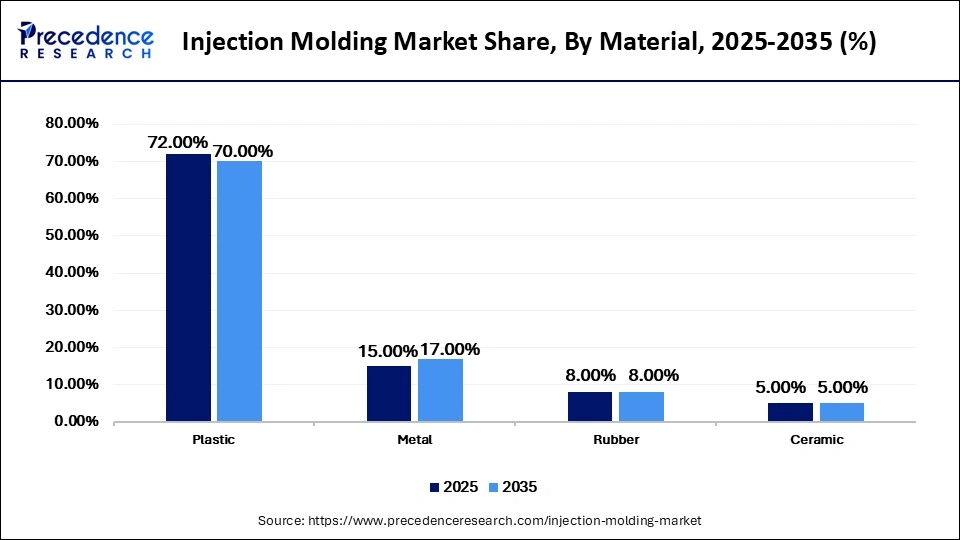
The rubber segment held 8% of the market share in 2025 and is expected to grow at a significant CAGR of 5% during the projection period, driven by the growing demand for flexible molded parts in the automotive, industrial, and medical industries for their longer life, easier assembly, and higher performance. Rubber injection molding is widely used as a method for creating rubber products, seals and gaskets, hoses and vibration-damping parts.
The ceramic segment held 5% of the market share in 2025 and is expected to grow at a CAGR of 4.5% during the projection period. Complex and precise ceramic parts can be produced by ceramic injection molding. Growing demand for it in electronic parts like insulators, sensors, and semiconductors is driving up its usage significantly. The aerospace industry uses ceramics for lightweight applications and for components requiring resistance to high temperatures.
Machine Type Insights
Injection Molding Market Share, By Machine Type, 2025-2035 (%)
| Machine Type | 2025 | 2035 | CAGR (%) |
| Hydraulic Machines | 45.00% | 38.00% | 3.80% |
| Electric Machines | 35.00% | 42.00% | 8.50% |
| Hybrid Machines | 20.00% | 20.00% | 5.80% |
The Hydraulic Machines Segment Held 45% of the Market Share in 2025
The hydraulic machines segment held a dominant position in the injection molding market with a share of 45% in 2025, driven by the force of strong clamping and low cost. They can be employed effectively in processing large molds and applications at high pressures, which explains their popularity in the automotive, packaging, and heavy industry sectors. Performance consistencies such as hydraulic systems offer very good capabilities in terms of mass production, reliability, and performance endurance.
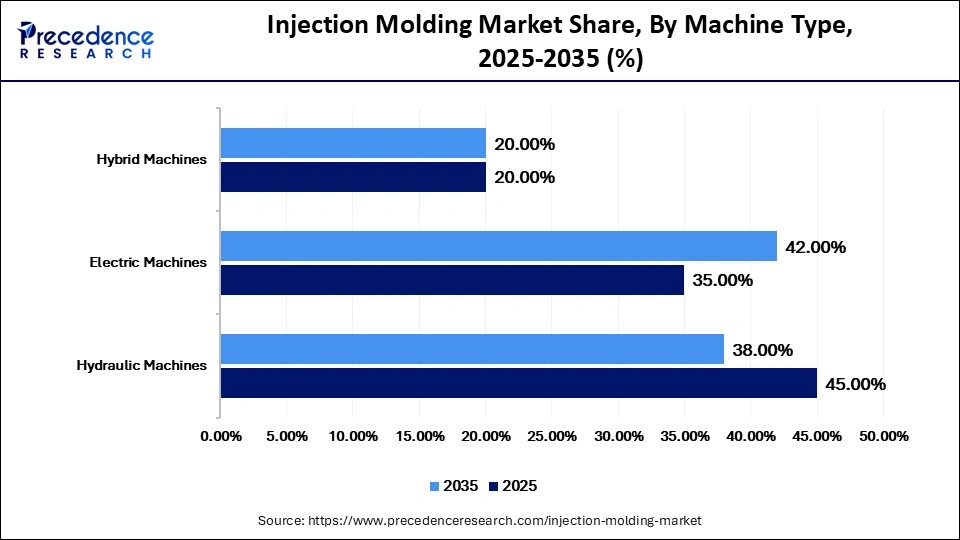
The electric machines segment held 35% of the market share in 2025 and is expected to grow at the fastest CAGR of 8.5% during the projection period, driven by increasing energy efficiency, accuracy, and environmental requirements for these injection molding applications. The increased cycle times, accuracy, and repeatability in comparison to the hydraulic systems make these machines applicable. Their usage is increasing at a rapid pace throughout the world due to their focus on energy usage and operational cost reduction.
The hybrid machines segment held 20% of the market share in 2025 and is expected to grow at a CAGR of 5.8% in the coming years, fueled by manufacturers and developers of systems that integrate the scalability of hydraulic power with the electrical efficiency, resulting in enhanced energy efficiency, flexibility, and performance. The productivity of hybrid systems is higher, and their cost and energy consumption are lower compared to conventional hydraulic systems.
Process Insights
Injection Molding Market Share, By Process, 2025-2035 (%)
| Process | 2025 | 2035 | CAGR (%) |
| Thermoplastic Injection Molding | 68.00% | 66.00% | 5.50% |
| Thermoset Injection Molding | 18.00% | 17.00% | 4.80% |
| Liquid Silicone Rubber Injection Molding | 14.00% | 17.00% | 8.20% |
The Thermoplastic Injection Molding Segment Held 68% of Market Share in 2025
The thermoplastic injection molding segment dominated the global injection molding market with a share of 68% in 2025, driven by the applications for lightweight, recyclable, and versatile materials. Thermoplastics are also very flexible, are much longer lasting than possible with thermosets, are highly cost-effective, and can be used to produce a lot of parts. Improving skills and awareness on clean and green technology, such as recycling and reusing materials.
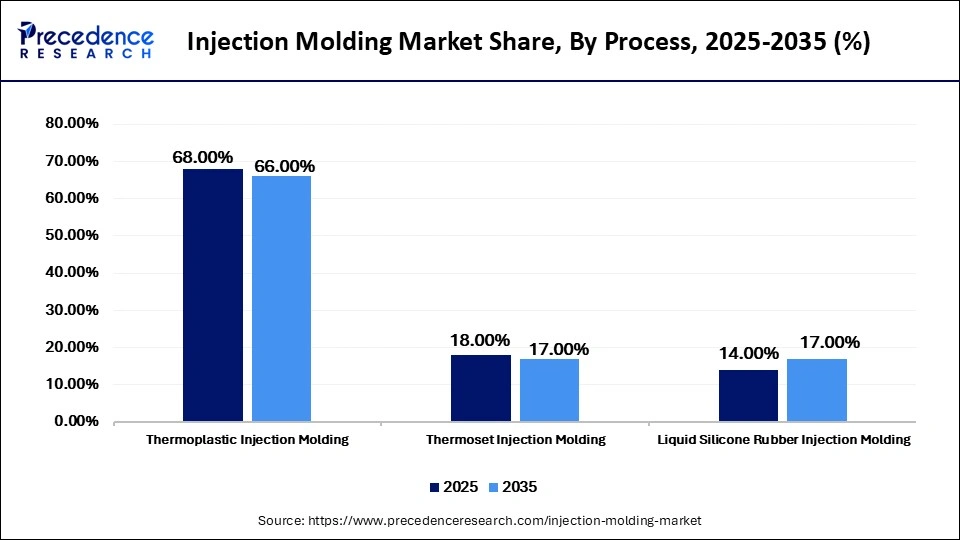
The thermoset injection molding segment held 18% of the market share in 2025 and is expected to grow at a CAGR of 4.8% during the projection period, as it is durable, chemically stable, and heat resistant. Thermoset materials have good dimensional stability and high heat and mechanical resistance, and they are suitable for high-performance applications. Thermoset injection molding can also be utilized in the field of electrical insulating products, durable parts of auto motors/lubricating equipment, etc.
The liquid silicone rubber injection molding segment held 14% of the market share in 2025 and is expected to grow at the fastest CAGR of 8.2% over the studied years, due to the growing need for flexible, high-accuracy biocompatible parts in medical, healthcare, electronics, and wearable applications. The properties of the LSR materials are high thermal resistance, chemical resistance, and elastic resistance, suitable for sensitive and high-performance materials. Rising demand from the medical sector for use in medical devices, such as seals, tubing, and surgical components.
Application Insights
The Packaging Segment Dominated the Market with 28% of Market Share in 2025
The packaging segment registered its dominance over the global injection molding market with a share of 28% in 2025, due to the demand for sustainable packaging solutions. The lightweight, strong, and recyclable packaging material, including containers, caps, and closures, can be made with high precision and consistency using injection molding. Some of the growth factors are consumers' preference for convenient packs and the increasing consumption of packaged foods around the world.
The automotive segment held 24% of the market share in 2025 and is expected to grow at a CAGR of 6.5% during the projection period, driven by increasing demand for reduced fuel consumption, fuel economy, and emission reduction. Lighting systems, bumpers, and dashboards are a few of the interior and exterior auto parts that are made using injection molding. The increasing complexity of vehicles is driving the need for high-temperature, high-performance plastics parts that can withstand complex environments.
Injection Molding Market Share, By Application, 2025-2035 (%)
| Application | 2025 | 2035 | CAGR (%) |
| Packaging | 28.00% | 27.00% | 5.20% |
| Automotive | 24.00% | 25.00% | 6.50% |
| Consumer Goods | 18.00% | 17.00% | 5.00% |
| Electronics | 15.00% | 16.00% | 6.80% |
| Healthcare | 10.00% | 11.00% | 7.50% |
| Construction | 5.00% | 4.00% | 4.50% |
The consumer goods segment held 18% of the market share in 2025 and is expected to grow at a CAGR of 5% during the projection period, driven by increasing demand for consumer durables, lifestyle, and household goods produced by a cost-effective mass production method. In daily use, a plastic product can be made lightweight, of good quality, in large quantities, and cost-effective by using the injection moulding process.
The electronics segment held 15% of the market share in 2025 and is expected to grow at a significant CAGR of 6.8% during the projection period. The modern electronics industry requires highly precise housings, connectors, and insulators, which are produced by the main technology of injection molding. Rapid technological advances and increasing semiconductor manufacturing are further contributors to demand growth.
The healthcare segment held 10% of the market share in 2025 and is expected to grow at the highest CAGR of 7.5% during the forecast period, driven by the increasing demand for disposable medical products. Stringent regulatory policies potentiate the demand for medical-grade molded components, boosting the segment's growth. The expansion of healthcare infrastructure, especially in developing economies, and the rising adoption of precision molding in diagnostic devices contribute to the segment's growth.
End-Use Industry Insights
The Packaging Segment Led the Market with 26% of Market Share in 2025
The packaging segment led the injection molding market with a share of 26% in 2025, owing to the skyrocketing demand from the FMCG industry. With the rising demand for lightweight, long-life, and cost-effective packaging materials, the trend towards sustainable and recyclable plastics, including the importance of reducing environmental footprint, is another key consideration.
The automotive segment held 24% of the market share in 2025 and is expected to grow at a CAGR of 6.8% during the projection period, driven by the increasing adoption of EVs, reduced component mass for EVs, better fuel economy, and lower emissions. High-tech parts used in the bodies of automobiles, circuit cameras, and other advanced parts are also a factor in driving up the market demand.
Injection Molding Market Share, By End-Use Industry, 2025-2035 (%)
| End-Use Industry | 2025 | 2035 | CAGR (%) |
| Packaging | 26.00% | 25.00% | 5.20% |
| Automotive | 24.00% | 26.00% | 6.80% |
| Electronics & Electrical | 18.00% | 19.00% | 6.50% |
| Consumer Products | 15.00% | 14.00% | 5.00% |
| Medical Devices | 10.00% | 11.00% | 7.80% |
| Industrial Manufacturing | 7.00% | 5.00% | 4.50% |
The electronics & electrical segment held 18% of the market share in 2025 and is expected to grow at a CAGR of 6.5% during the projection period, fueled by the tremendous growth of consumer electronics and a need for small high-performance devices. Smartphones, laptop computers, and wearable electronics are moving towards the use of precision-molded parts. Rising investment in semiconductors and in advanced electronics equipment is also stimulating demand.
The consumer products segment held 15% of the market share in 2025 and is expected to grow at a significant CAGR of 5% during the projection period, supported by high global demand for personal care and lifestyle products. The growing innovativeness of plastic products and the customization preferences of consumers are boosting the segment's growth. Large-scale manufacturing with high consistency and low cost, injection molding is suitable for the manufacturing of consumer goods.
Region Insights
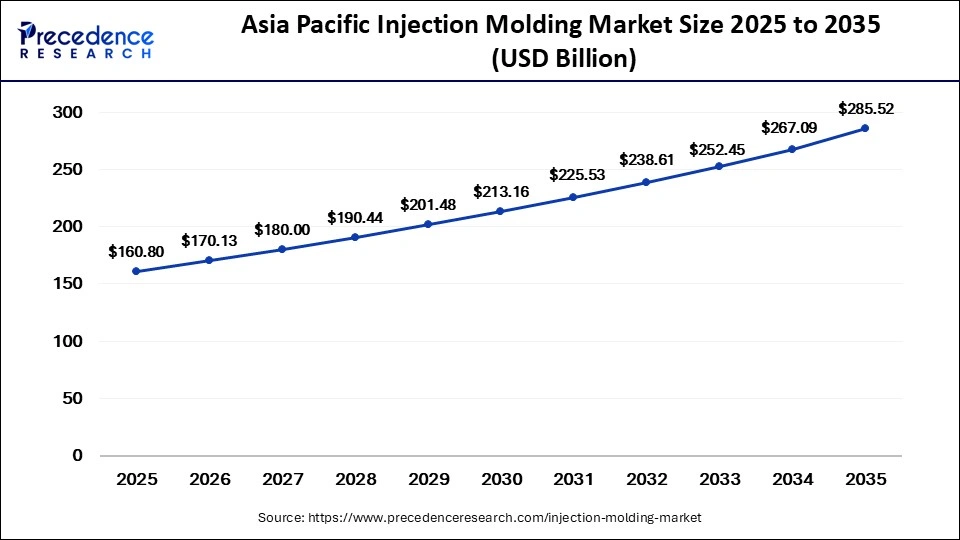
Asia Pacific Injection Molding Market Size and Growth 2026 to 2035
The Asia Pacific injection molding market size is estimated at USD 160.80 billion in 2025 and is projected to reach approximately USD 285.52 billion by 2035, with a 5.91% CAGR from 2026 to 2035.
Asia-Pacific Led the Global Injection Molding Market with 48% of Market Share in 2025
Asia-Pacific held a major market share of 48% in 2025 and is expected to expand rapidly with a CAGR of 7.2% in the coming years, due to both the manufacturing and industrialization capabilities of the region. The availability of raw materials, which are located within the region, coupled with the availability of cheap labor, keeps the region as one of the world's plastic production centers. The growth rate of injection molding is being boosted by the injection molding machines being used in sectors like automotive, packaging, consumer electronics, and the medical industry.
China Market Trends
China leads the market in Asia-Pacific, due to its industrial base, quality, and the size of its injection molding manufacturing. Injection molding is used in the production of components for cars, in electronic products, and in packaging, and the country is a global leader in producing these products. The increasing demand for EVs has been boosted by the impressive development of EVs and production methods used by the high-tech industry, supported by the government.
How is North America Growing in the Injection Molding Market?
North America held 20% of the market share in 2025 and is expected to grow at a CAGR of 4.8% during the projection period, owing to technological advancements and industrial modernization. The automation, robotics, and AI-based injection molding systems are improving production efficiency and accuracy. The shift of manufacturing away from Asia towards local production is also bolstering manufacturing capabilities. Furthermore, key investments in advanced manufacturing equipment and technology for sustainable manufacturing are helping to drive long-term growth of the market.
U.S. Market Trends
The U.S. is a market that is growing fast in injection molding due to the strong industrial demand and technological leadership. The trend of manufacturing automation technologies, AI systems, and smart manufacturing technologies is playing a vital role in improving efficiency and quality of manufacturing. The U.S. is an important growth market for the injection molding business as it has experienced significant research and development (R&D) activities and innovations in advanced materials.
Europe Experiencing Notable Growth in the Injection Molding Market
Europe held 22% of the market share in 2025 and is expected to grow at a notable CAGR of 4.5% during the projection period, fueled by its presence of strong manufacturing infrastructure. It is a region with developed industries, e.g., automotive, aerospace, industrial machinery, and industrial precision injection molding technologies are needed. There is also an increasing trend towards automation and smart manufacturing systems throughout Europe for maximized productivity and minimum waste.
Germany Market Trends
Germany plays a major role in this expansion in Europe, aided by strong automotive and industrial manufacturing industries. This has been spot-on in capacity building in terms of high-performance manufacturing of automotive sophisticated machines, and high-complexity automotive injection-molded finished goods, etc. One of the major reasons is Germany's technological advancements and strong industrial practices, which have been enhancing the market growth in the European region.
Injection Molding Market Companies
- Husky Technologies
- ENGEL
- ARBURG
- Milacron
- Sumitomo Heavy Industries
- Nissei Plastic Industrial
- KraussMaffei
- Toshiba Machine
- Chen Hsong Holdings
- Shibaura Machine
- Fu Chun Shin Machinery
- JSW Plastics Machinery
- Bole Machinery
- Yizumi
- Negri Bossi
Recent Developments
- In May 2025, HTI Plastics showcased its pharmaceutical injection molding skills at CPHI North America. The company has a specialization for high-precision, quality components for pharmaceutical applications. They offer design, development, and manufacturing of parts for drug delivery and medical devices of critical components.(Source: https://www.htiplastic.com)
- In April 2025, C&J Industries completed 12,000 square feet more of a class 8 clean room that has medical-grade plastic injection molding capabilities. This unit is equipped with all-electric Toshiba molding presses and special 3-axis molding robots for efficient production and inspection.(Source: https://www.plasticstoday.com)
- In October 2024, Biomerics started metal injection molding (MIM) services that enable precision metal parts for medical devices. The company offers end-to-end solutions starting from the design phase through to the prototype level, right up to their full-scale production.(Source: https://www.prnewswire.com)
Segments Covered in the Report
By Material
- Plastic
- Metal
- Rubber
- Ceramic
By Machine Type
- Hydraulic Injection Molding Machines
- Electric Injection Molding Machines
- Hybrid Injection Molding Machines
By Process
- Thermoplastic Injection Molding
- Thermoset Injection Molding
- Liquid Silicone Rubber Injection Molding
By Application
- Packaging
- Automotive
- Consumer Goods
- Electronics
- Healthcare
- Construction
By End-Use Industry
- Automotive
- Packaging
- Electronics & Electrical
- Medical Devices
- Consumer Products
- Industrial Manufacturing
By Clamping Force
- Below 200 Tons
- 200-500 Tons
- Above 500 Tons
By Region
- North America
- Latin America
- Europe
- Asia-pacific
- Middle and East Africa
For inquiries regarding discounts, bulk purchases, or customization requests, please contact us at sales@precedenceresearch.com
Frequently Asked Questions





Ask For Sample
No cookie-cutter, only authentic analysis – take the 1st step to become a Precedence Research client
 Get a Sample




 sales@precedenceresearch.com
 Schedule a Meeting
