



Wearable AI Market Trends, Companies, Revenue / Sales Performance, Subscriber Growth, Pricing Strategies, Cloud Adoption, Infrastructure Expansion, Competitive Landscape, and Industry Outlook
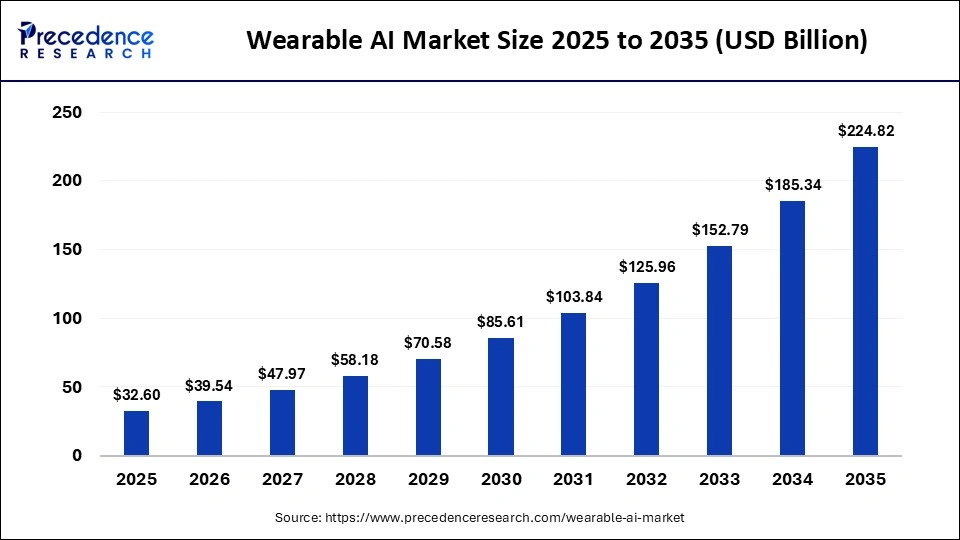
ICT industry specialist Shivani Zoting estimates the wearable ai market at USD 39.54 billion in 2026, with continued technology adoption expected to take the market to USD 224.82 billion by 2035 at a CAGR of 21.30%. Leading wearable ai market providers such as Apple Inc., Samsung Electronics Co., Ltd., Google LLC (Alphabet Inc.), Fitbit Inc. (now part of Google), Garmin Ltd are expanding their capabilities across segments including By Component, By Product Type, By Application, By End-Use.
Source: https://www.precedenceresearch.com/wearable-ai-market
 Get a Sample
 Table Of Content


What is the Wearable AI Market Size in 2026?
The global wearable AI market size accounted for USD 32.60 billion in 2025 and is predicted to increase from USD 39.54 billion in 2026 to approximately USD 224.82 billion by 2035, expanding at a CAGR of 21.30% from 2026 to 2035. The wearable AI market is driven by rising demand for real-time health monitoring and personalized smart devices.
Key Takeaways
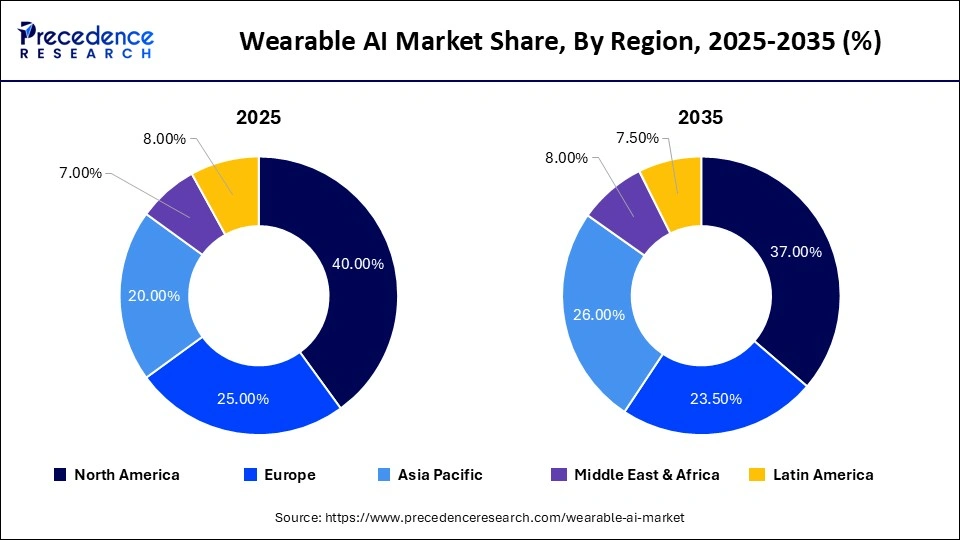
- North America dominated the wearable AI market with a 40% share in 2025.
- The Asia Pacific is expected to grow at the fastest rate during the forecast period.
- By component, the hardware segment held a dominant market share of 50% in 2025.
- By component, the software segment was the second-largest shareholder in 2025 and is expected to grow at the fastest rate between 2026 and 2035.
- By product type, the smartwatches segment led the global market, accounting for 50% of the market in 2025.
- By product type, the smart glasses segment is expected to grow at the fastest CAGR between 2026 and 2035.
- By application, the healthcare segment accounted for a 35% revenue share in the market in 2025.
- By application, the sports segment is expected to grow at the fastest rate between 2026 and 2035.
- By end-use, the healthcare providers segment led the global market in 2025.
- By end-use, the sports and fitness organizations segment is expected to grow at the fastest CAGR between 2026 and 2035.
Market Overview
The integration of artificial intelligence into wearables is making devices intelligent and autonomous, enabling them to provide real-time information about vital parameters, such as heart rate, oxygen levels, and sleep patterns. In the healthcare sector, AI wearables are highly used to continuously detect such vital signs, providing an early warning of possible health concerns and improving patient care. The wearable AI market is growing, driven by heightened consumer awareness of health & wellness and the growing demand for real-time physiological tracking. Moreover, the increasing number of enterprises implementing it and the rising use of augmented reality in industries, such as manufacturing and healthcare, drive the market.
Wearable AI Market Trends
- There is growing adoption of health-focused wearables, driven by increasing awareness of health and wellness.
- Innovations in continuous monitoring features such as heart rate, sleep patterns, and blood oxygen levels, supporting preventive healthcare and personalized wellness for both consumers and healthcare providers.
- Improvements in battery life and fast-charging technologies are enhancing device usability, enabling longer operation times with minimal downtime, which is critical for both personal and enterprise applications.
- Increasing use of wearable AI solutions in enterprises is transforming workforce management, enabling applications like remote assistance, safety monitoring, and training, ultimately improving operational efficiency, employee productivity, and workplace safety.
Market Scope
| Report Coverage | Details |
| Market Size in 2025 | USD 32.60 Billion |
| Market Size in 2026 | USD 39.54 Billion |
| Market Size by 2035 | USD 224.82 Billion |
| Market Growth Rate from 2026 to 2035 | CAGR of 21.30% |
| Dominating Region | North America |
| Fastest Growing Region | Asia Pacific |
| Base Year | 2025 |
| Forecast Period | 2026 to 2035 |
| Segments Covered | Component, Product Type, Application, End-Use, and Region |
| Regions Covered | North America, Europe, Asia-Pacific, Latin America, and Middle East & Africa |
Market Dynamics
Drivers
Rising Demand for Real-Time Health Monitoring
The wearable AI market is driven by the growing demand for real-time health monitoring and seamless user experiences, as consumers increasingly adopt smart wearables to track vital parameters and improve physical activity. AI-powered devices such as fitness bands and smartwatches enable continuous health insights, while advancements in on-device AI ensure faster data processing, lower latency, and enhanced privacy, making these devices more reliable and efficient. Additionally, the rising adoption of augmented reality and enterprise use cases across industries like manufacturing, logistics, and healthcare is further accelerating market growth.
Restraint
Data Privacy Concerns and High Costs
Concerns over data privacy and security are one of the major concerns since wearable devices collect sensitive personal and health-related information. Moreover, the high cost of advanced AI-enabled wearables limits accessibility, particularly in developing regions. The need to comply with stringent healthcare regulations and data protection laws adds complexity for developers, potentially slowing product development. These factors restrain the growth of the wearable AI market.
Opportunity
Expanding Healthcare Applications and Ongoing Technological Advances
The wearable AI market presents significant growth opportunities driven by rapid technological advancements and expanding application areas. In healthcare, AI-powered wearables are increasingly used for remote patient monitoring, early diagnosis, and chronic disease management, with further potential when integrated with telemedicine and digital health ecosystems. Emerging markets also offer strong growth prospects, supported by rising smartphone penetration, improving digital infrastructure, and growing health awareness among consumers.
Segment Insights
Component Insights
Wearable AI Market Share, By Component, 2025-2035 (%)
| Component | 2025 | 2035 | CAGR (%) |
| Hardware | 50.00% | 47.00% | 20.50% |
| Software | 35.00% | 38.00% | 22.00% |
| Services | 15.00% | 15.00% | 17.00% |
The Hardware Segment Held a 50% Market Share in 2025
The hardware segment dominated the wearable AI market with a major share of 50% in 2025, owing to the heightened adoption of gadgets such as smartwatches, fitness trackers, and AI-enabled glasses. Hardware solutions such as sensors, chipsets, and batteries are the backbone of these devices. Advancements in sensors have improved health, fitness, and activity monitoring, bolstering segmental growth.
The software segment held a 35% market share in 2025 and is expected to grow at the fastest CAGR during the projection period. This is because of the crucial role of AI-driven software in health & sleep tracking and data analytics. The need for comprehensive software platforms is rising due to the growing trend of digital wellness and demand for proactive health apps.
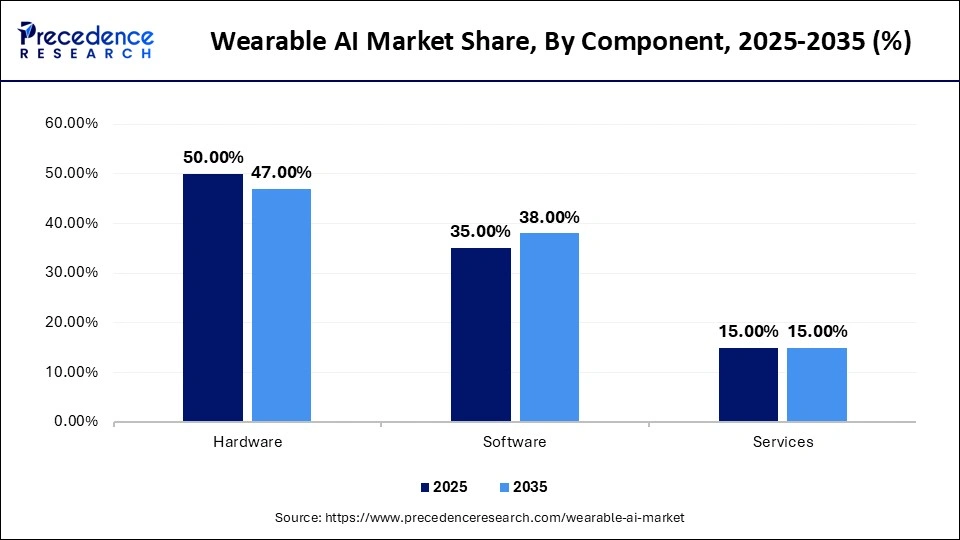
The services segment held a 15% share of the market in 2025 and is expected to grow at a significant CAGR during the projection period. This is mainly due to the increasing demand for AI integration, cloud-based data management, and ongoing technical support. As wearable devices generate large volumes of health and activity data, organizations rely on services such as data analytics, remote monitoring, and AI model optimization to derive meaningful insights. Additionally, enterprises and healthcare providers are adopting these services to enhance device performance, ensure seamless system integration, and support real-time decision-making.
Product Type Insights
Wearable AI Market Share, By Product Type, 2025-2035 (%)
| Product Type | 2025 | 2035 | CAGR (%) |
| Smartwatches | 50.00% | 47.00% | 20.50% |
| Fitness Bands | 20.00% | 19.00% | 18.00% |
| Smart Glasses (AR/VR) | 12.00% | 13.50% | 22.00% |
| Smart Rings | 8.00% | 9.50% | 23.00% |
| Smart Clothing | 7.00% | 8.00% | 21.50% |
| Medical Wearables | 3.00% | 3.00% | 15.00% |
Why Did the Smartwatches Segment Dominated the Wearable AI Market in 2025?
The smartwatches segment registered its dominance in the market by holding a share of 50% in 2025, driven by their increased adoption for health monitoring, fitness tracking, and communication. These devices offer multifunctionality, combining features such as heart rate monitoring, sleep tracking, activity tracking, and notifications in a single platform, making them highly valuable to consumers. The integration of AI-powered voice assistants and predictive analytics further enhances user experience and engagement, strengthening their market leadership.
The fitness bands segment was the second-largest shareholder in 2025, holding a 20% market share, driven by the increasing demand for advanced health and fitness monitoring products. Fitness bands track activity, calories burnt, sleep patterns, and heart rates to provide users with some actionable data to improve wellness. Fitness bands have become more popular as a part of corporate health programs and preventive healthcare efforts.
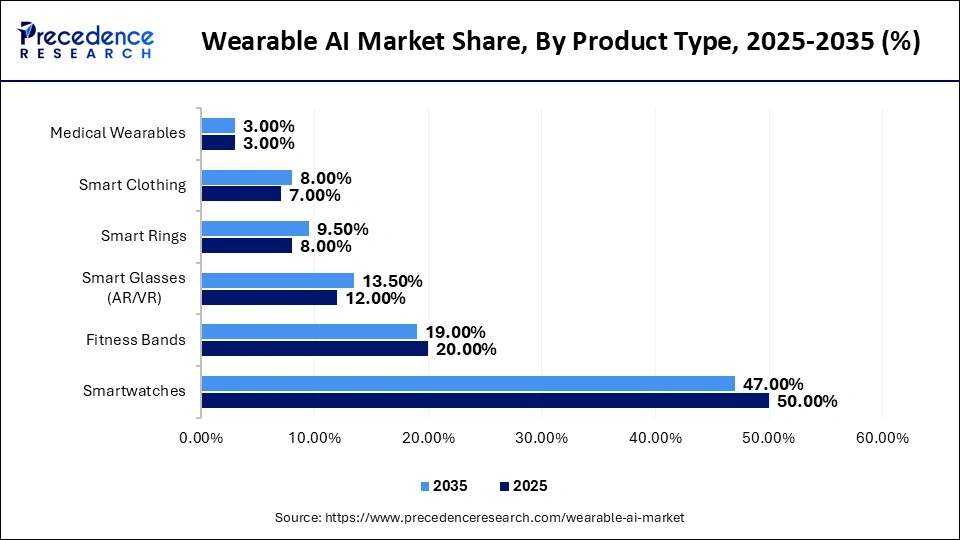
The smart glasses segment held a 12% market share in 2025 and is expected to grow at a significant rate during the projection period, due to their increasing applications in augmented reality (AR), voice-assistance, and health monitoring. The integration of AI in smart glasses provides real-time contextual information, recognition of gestures, and predictive data. In the enterprise sector, smart glasses are increasingly used for training, remote assistance, and hands-free operations.
The smart rings segment held a 8% share of the market in 2025 and is expected to grow at the highest CAGR during the forecast period, driven by the increasing demand for compact, AI-enabled devices for health and performance monitoring. Adoption is also rising in enterprise wellness programs and medical monitoring applications. Additionally, advancements in battery efficiency, miniaturized sensors, and sleek design aesthetics are further supporting segmental growth.
Application Insights
The Healthcare Segment Held a 35% Share in the Wearable AI Market in 2025
The healthcare segment dominated the market while holding a share of 35% in 2025 because of the increased use of AI technology in patient monitoring and management of chronic diseases. Devices like smartwatches, smart rings, and fitness bands enable continuous monitoring of vital health parameters, which further enhance patient care. The segment dominance is also reinforced due to the increasing focus to improve patient care and the demand for early diagnosis.
The fitness and wellness segment held the second-largest market share of 30% in 2025 and is expected to grow at a significant rate during the studied period due to the growing awareness of health & wellness. As a result, more people are using AI-driven wearables to track their physical activities. Gyms and fitness centers are beginning to employ smartwatches and fitness bands to improve training.
Wearable AI Market Share, By Application, 2025-2035 (%)
| Application | 2025 | 2035 | CAGR (%) |
| Healthcare | 35.00% | 33.00% | 18.00% |
| Fitness and Wellness | 30.00% | 28.00% | 19.50% |
| Consumer Electronics | 15.00% | 14.50% | 19.00% |
| Sports | 10.00% | 12.00% | 21.50% |
| Fashion and Lifestyle | 5.00% | 5.50% | 18.00% |
| Others | 5.00% | 7.00% | 16.00% |
The consumer electronics segment held a 15% market share in 2025 and is expected to grow at a notable CAGR during the forecast period. This is mainly due to the integration of AI features for entertainment, smart home control, and device management. Integrating AI features in consumer electronics enables hands-free interaction, contextual alerts, and seamless connectivity with other devices, while applications such as streaming media and smart assistants further enhance user convenience and engagement.
The sports segment held a 10% share of the market in 2025 and is expected to grow at the highest CAGR in the upcoming period, driven by rising adoption of AI-enabled wearables for performance tracking, injury prevention, and real-time analytics. These devices monitor key metrics such as speed, movement patterns, heart rate, and recovery, helping athletes optimize performance. The growing reliance on data-driven insights by athletes, coaches, and fitness enthusiasts is further accelerating demand for AI-driven wearables in this segment.
End-Use Insights
Why Did the Healthcare Providers Segment Hold a Dominant Position in 2025?
The healthcare providers segment held a dominant position in the wearable AI market in 2025, owing to the widespread adoption of AI-enabled solutions for patient monitoring and chronic disease management. Hospitals and clinics increasingly use devices such as smartwatches, fitness bands, smart rings, and medical-grade wearables to continuously track health parameters and improve patient outcomes. Strong regulatory support and growing trust in digital health technologies have further accelerated adoption.
The sports and fitness organizations segment is expected to grow at the fastest CAGR in the market between 2026 and 2035 due to the increasing focus on performance optimization, injury prevention, and real-time athlete monitoring. AI-powered wearables such as smartwatches, fitness bands, and biometric sensors help track key metrics like heart rate, movement patterns, and recovery levels, enabling data-driven training decisions. Additionally, the integration of advanced sensors, real-time analytics, and mobile connectivity is making these solutions more accessible and effective for gyms, professional sports teams, and fitness centers.
The individual consumers segment held a significant market share in 2025 due to rising health awareness and increasing demand for real-time fitness and wellness tracking. Consumers are widely adopting AI-enabled devices such as smartwatches, fitness bands, and smart rings to monitor vital signs, activity levels, sleep patterns, and overall health. Additionally, growing awareness of preventive healthcare, along with the affordability and convenience of smart wearable technologies, is further driving strong adoption among individual users.
The enterprises segment is anticipated to grow at a considerable rate in the market over the forecast period, driven by the increasing use of wearables to monitor employee health, productivity, and workplace safety. Companies are adopting smart devices such as smartwatches, AI-powered fitness trackers, and wearable sensors to track employee fitness and well-being in real time. In addition, AI-enabled predictive analytics is enhancing applications like workforce safety monitoring, location tracking, and fatigue detection, further supporting enterprise adoption.
Regional Insights
North America Wearable AI Market Size and Growth 2026 to 2035
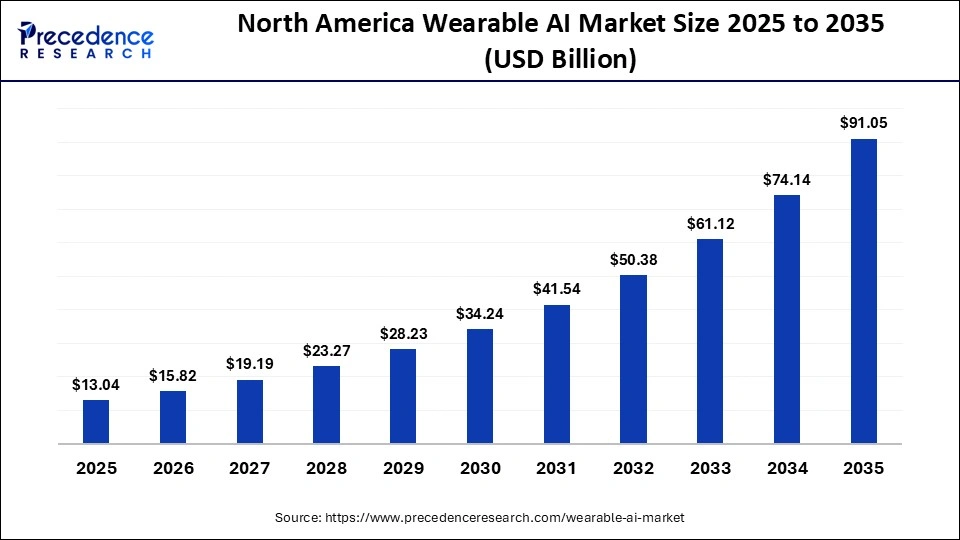
The North America wearable AI market size is estimated at USD 13.04 billion in 2025 and is projected to reach approximately USD 91.05 billion by 2035, with a 21.45% CAGR from 2026 to 2035.
Why Did North America Lead the Global Wearable AI Market in 2025?
North America dominated the wearable AI market with a share of 40% in 2025, driven by strong adoption of wearable technologies, advanced digital infrastructure, and a growing shift toward health-conscious lifestyles. The region benefits from significant R&D investment and technological advancement in AI and machine learning integration within wearable devices. Smartwatches, fitness bands, AI rings, and medical-grade wearables are in high demand across the region for real-time health monitoring, chronic disease management, and personalized wellness programs. Additionally, supportive government initiatives promoting AI research and digital healthcare adoption have further strengthened market growth in the region.
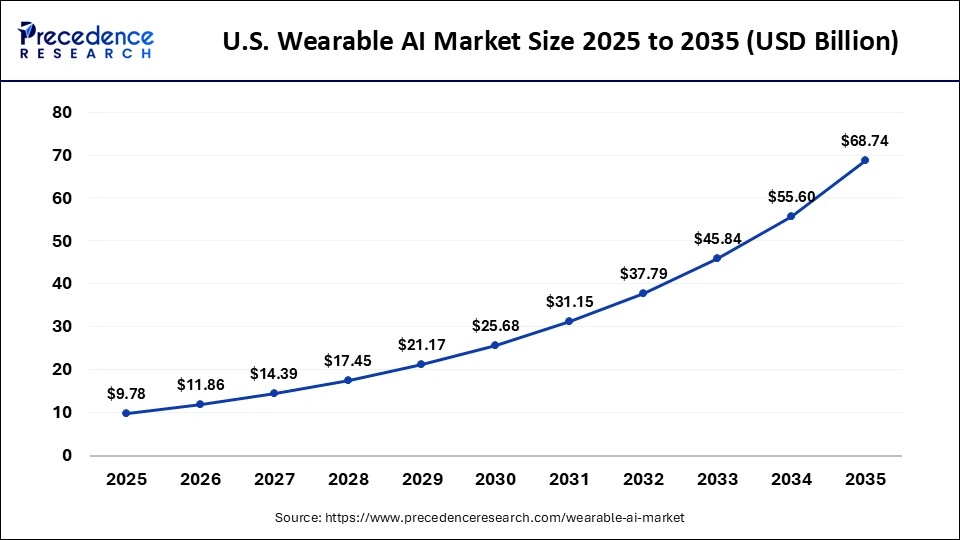
U.S. Wearable AI Market Size and Growth 2026 to 2035
The U.S. wearable AI market size is calculated at USD 9.78 billion in 2025 and is expected to reach nearly USD 68.74 billion in 2035, accelerating at a strong CAGR of 21.53% between 2026 and 2035.
U.S. Wearable AI Market Analysis
The U.S. is a major contributor to the North American market due to strong consumer awareness and a growing focus on preventive healthcare, chronic disease management, and personalized wellness programs. The country benefits from a highly advanced technological ecosystem, leading AI research centers, a well-established healthcare infrastructure, and widespread smartphone adoption. Additionally, healthcare providers in the country are integrating wearable AI data into telemedicine, remote patient monitoring, and clinical decision-making to improve patient outcomes.
Why is Asia Pacific Undergoing the Fastest Growth in the Wearable AI Market?
Asia Pacific held a 20% share of the market in 2025 and is expected to grow at the fastest CAGR during the projection period. This is because of the rising health and fitness awareness and increasing disposable incomes, which are driving demand for AI-enabled wearable devices across the region. The rollout of advanced technologies such as machine learning and 5G in countries like China, India, Japan, and South Korea is further supporting market expansion. Additionally, government and private investments in digital health infrastructure, combined with the mainstream adoption of telemedicine, health apps, and enterprise solutions, are accelerating growth in the region.
China Wearable AI Market Analysis
The market in China is growing because of its highly developed digital infrastructure and strong technology adoption. China is rapidly advancing its AI and semiconductor ecosystem, enabling the development of more sophisticated wearable devices with real-time processing and on-device AI capabilities. Meanwhile, rising interest in preventive healthcare and fitness, along with growing awareness of wearable health technologies, is further driving market expansion across the country.
Why Is Europe Experiencing Notable Growth in the Wearable AI Market?
Europe was the second-largest market in 2025, holding a 25% share, and is expected to grow at a notable rate during the projection period. This growth is supported by well-established healthcare systems, rising health awareness, and increasing demand for AI-powered wellness and fitness devices. The widespread adoption of smartwatches, AI-enabled fitness trackers, medical-grade wearables, and smart hearing devices is further driving market expansion. Additionally, technological innovation, supportive government policies, and rising investments in digital health are encouraging consumers across Europe to prioritize preventive care and digital wellness solutions.
Wearable AI Market Companies
- Apple Inc.
- Samsung Electronics Co., Ltd.
- Google LLC (Alphabet Inc.)
- Fitbit Inc. (now part of Google)
- Garmin Ltd.
- Huawei Technologies Co., Ltd.
- Xiaomi Corporation
- Sony Corporation
- Whoop, Inc.
- Oura Health Ltd.
- Biobeat Medical Ltd.
- Amazfit (Huami Corporation)
- Withings
- Jabra (GN Audio)
- Medtronic plc
Recent Developments
- In October 2025, Starkey released its latest line of hearing aids, Omega AI, which includes directionality based on a deep neural network, spatial awareness hyped by 8 dB, battery life of 51 hours, waterproofing, LED status/find-my-pages, and troubleshooting AI, TeleHear AI. New health features are also included in the devices.(Source: https://www.starkey.com)
- In September 2025, Meta introduced Ray-Ban Display AI Glasses, which featured an in- lens display with full-color, high-resolution, capable of performing tasks and visual Meta AI cues, messaging, video calling, navigation, live captions/translation, playing music, and taking pictures/videos, and responsive control by EMG. The glasses are available in Black or Sand, standard or large frames, and offer a battery life of up to 6 hours.(Source: https://about.fb.com)
- In September 2025, Xiaomi launched three international products, including OpenWear Stereo Pro wireless earbuds that have a five-unit acoustic system and Harman tuning, Xiaomi Watch S4, and the Smart Band 10 Glimmer Edition. These products are aimed at superior audio experiences, fitness tracking, and the convenience of smart wearables to consumers the world over.(Source: https://www.mi.com)
Segments Covered in the Report
By Component
- Hardware
- Software
- Services
By Product Type
- Smartwatches
- Fitness Bands
- Smart Glasses (AR/VR)
- Smart Rings
- Smart Clothing
- Medical Wearables (ECG, BP monitors, glucose monitors)
By Application
- Healthcare
- Fitness and Wellness
- Consumer Electronics
- Sports
- Fashion and Lifestyle
- Others
By End-Use
- Individual Consumers
- Healthcare Providers
- Enterprises
- Sports and Fitness Organizations
- Others
By Region
- North America
- Latin America
- Europe
- Asia-pacific
- Middle and East Africa
For inquiries regarding discounts, bulk purchases, or customization requests, please contact us at sales@precedenceresearch.com
Frequently Asked Questions
Tags





Ask For Sample
No cookie-cutter, only authentic analysis – take the 1st step to become a Precedence Research client
 Get a Sample




 sales@precedenceresearch.com
 Schedule a Meeting
