



Data Converter Market Trends, Companies, Revenue / Sales Performance, Manufacturing Yield, Fab Capacity, Export & Import Dynamics, Supply Chain Analysis, Competitive Landscape, and Growth Forecast
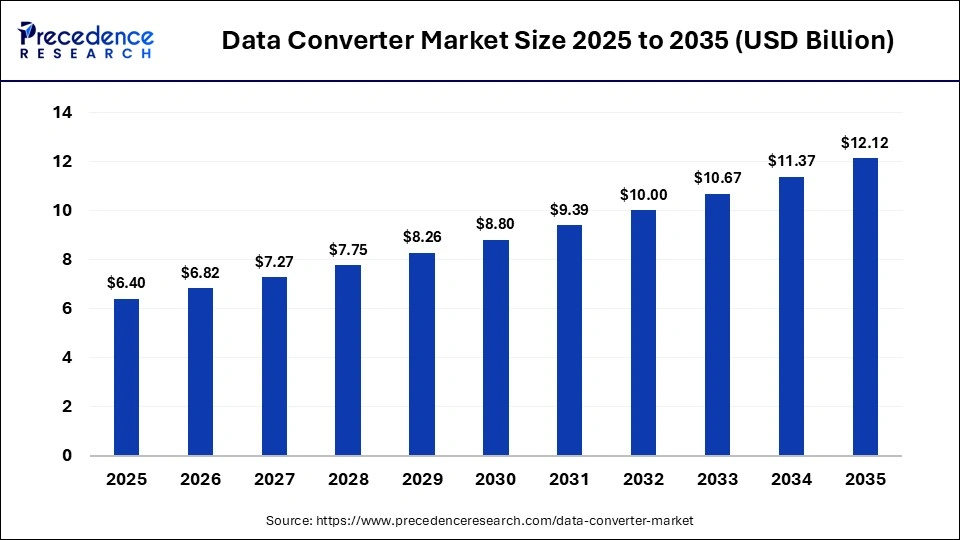
According to semiconductor and electronics specialist Laxmi Narayan, the data converter market is valued at USD 6.82 billion in 2026 and is forecast to reach USD 12.12 billion by 2035, reflecting a CAGR of 6.60%. Leading data converter market companies, including Analog Devices, Texas Instruments, STMicroelectronics, Infineon Technologies, NXP Semiconductors, Renesas Electronics, are strengthening their presence across key segments such as By Type, By Converter Architecture, By Sampling Rate, By Application, By End User.
Source: https://www.precedenceresearch.com/data-converter-market
 Get a Sample
 Table Of Content


What is the Data Converter Market Size in 2026?
The global data converter market size accounted for USD 6.40 billion in 2025 and is predicted to increase from USD 6.82 billion in 2026 to approximately USD 12.12 billion by 2035, expanding at a CAGR of 6.60% from 2026 to 2035. The market is driven by the increasing use of high-quality images in the healthcare sector for early diagnosis, as well as the rapid adoption of cloud computing in several industries.
Key Takeaways
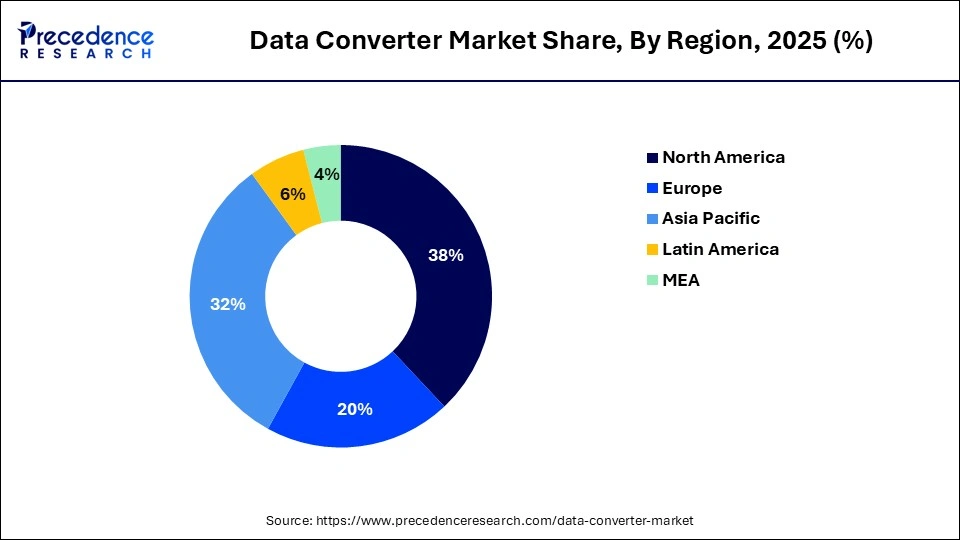
- North America led the market with a share of 38% in 2025.
- Asia Pacific is expected to grow at the highest CAGR of 7.0% during the forecast period.
- By type, the analog-to-digital converter (ADC) segment held the largest market share of 60% in 2025.
- By type, the digital-to-analog converter (DAC) segment is expected to expand with a robust CAGR of 5.5% during the forecast period.
- By converter architecture, the successive approximation register (SAR) segment dominated the market with a share of 35% in 2025.
- By converter architecture, the sigma-delta converter segment is expected to grow at a CAGR of 5.4% during the forecast period.
- By sampling rate, the high-speed data converters segment held the highest share of the market with 72% in 2025.
- By sampling rate, the general-purpose data converters segment is expected to grow at a CAGR of 5.7% during the forecast period.
- By application, the consumer electronics segment held the largest market share of 40% in 2025.
- By application, the automotive electronics segment is expected to expand at a healthy CAGR of 5.8% between 2026 and 2035.
- By end user, the industrial segment led the market with a share of 45% in 2025.
- By end user, the consumer segment is expected to expand with the fastest CAGR of 6% during the forecast period.
Market Overview
The data converter market includes a wide range of semiconductor devices that convert analog signals to digital form and digital signals back to analog form, enabling communication between real-world signals and digital systems. These components are essential in electronic systems, including smartphones, communication equipment, automotive electronics, industrial automation, and medical devices. The increasing adoption of IoT, expansion of the 5G infrastructure, and popularity of drones are significantly driving demand for high-quality data converter technologies.
How is AI Impacting the Data Converter Market?
AI plays an important role in transforming the data converter industry. Artificial Intelligence is used to analyze data from various sources to enhance speed and improve accuracy. AI helps in identifying outliers, anomalies, and inconsistencies in datasets through advanced imputation techniques, which ensure higher data reliability. Additionally, AI-enabled data converters are used in data centers for online/offline supervision through real-time monitoring and predictive maintenance.
- In March 2025, SMD Semiconductor launched ultra edge power converter. This is an AI-enabled converter designed for meeting the growing needs of next-gen computing.
Data Converter Market Trends
- Partnerships: Several data converter companies are partnering with ASIC solution providers to develop advanced data converters for the end-user industries. For instance, in September 2024, Omni Design Technologies partnered with EnSilica. This partnership aims to expand the Swift Data Converter IP portfolio.
- Innovations: Numerous market players are innovating a wide range of data converters for the aerospace sector. For instance, in March 2026, Micross Components, Inc launched the Class H+ AFLS28XX Series. Class H+ AFLS28XX Series is a DC-DC converter that finds application in space-related missions.
- Surging Use of DAC Converters in Data Centers: The application of DAC converters has grown significantly in data centers for handling a vast range of data. For instance, in June 2025, Imec launched a digital-to-analog converter (DAC). This DAC is designed for achieving 300 Gb/s data transmission speed in data centers.
- Miniaturization and Integration: Smaller and more efficient data converters are in demand as consumer electronics and mobile devices become increasingly compact. System-on-chip (SoC) designs that integrate ADCs/DACs with other processing elements are becoming more popular, particularly in mobile and portable devices.
- Growth of Automotive and Electric Vehicles (EVs): Data converters are playing an essential role in the development of electric vehicles, particularly in battery management systems (BMS) where precise voltage and current measurements are required. They also play a role in controlling electric motors and in powertrains.
Market Scope
| Report Coverage | Details |
| Market Size in 2025 | USD 6.40 Billion |
| Market Size in 2026 | USD 6.82 Billion |
| Market Size by 2035 | USD 12.12 Billion |
| Market Growth Rate from 2026 to 2035 | CAGR of 6.60% |
| Dominating Region | North America |
| Fastest Growing Region | Asia-Pacific |
| Base Year | 2025 |
| Forecast Period | 2026 to 2035 |
| Segments Covered | Type, Converter Architecture, Sampling Rate, Application, End User, and Region |
| Regions Covered | North America, Europe, Asia-Pacific, Latin America, and Middle East & Africa |
Segment Insights
Type Insights
Data Converter Market Share, By Type, 2025 (%)
| Type | 2025 |
| Analog-to-Digital Converter (ADC) | 60% |
| Digital-to-Analog Converter (DAC) | 40% |
Why Did the Analog-To-Digital Converter (ADC) Segment Dominate the Data Converter Market?
The analog-to-digital converter (ADC) segment dominated the market in 2025, accounting for a 60% share. This is mainly due to its prominent role in converting real-time analog signals into digital data that are processed by modern electronic equipment. These converters are used in a wide range of applications, including telecommunication, consumer electronics, automotive units, and industrial automation. ADCs help in enabling processors and microcontrollers to interpret and analyze analog signals.
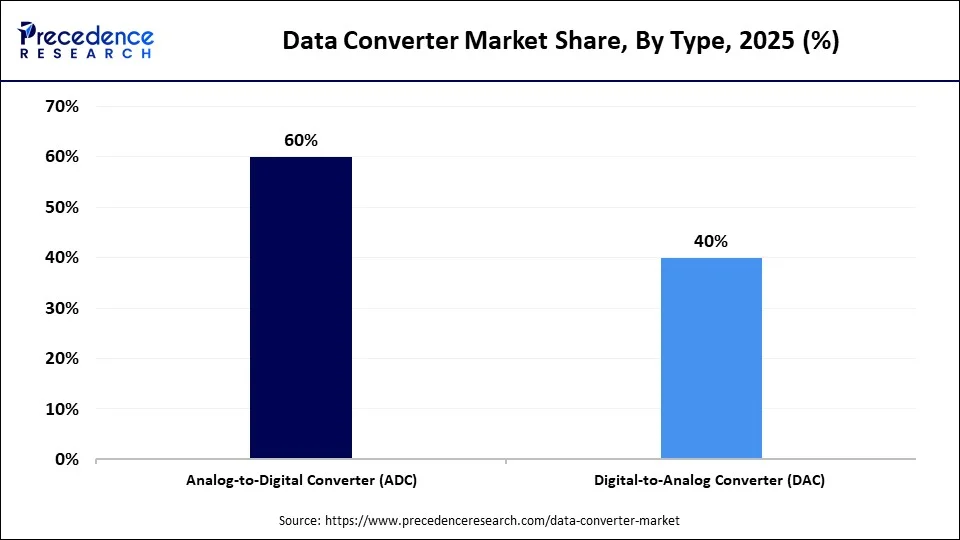
While holding 40% of market share in 2025, digital-to-analog converter (DAC) segment is expected to grow at a robust CAGR of 5.5% during the forecast period, owing to the surging demand for accurate signal reconstruction in advanced electronic systems. These converters help in converting digital signals into analog outputs that are required for numerous applications, including video displays, audio devices, and wireless communication systems. With the increasing use of infotainment systems in modern cars, the demand for advanced DACs is expected to rise significantly in the coming years.
Converter Architecture Insights
What Made Successive Approximation Register (SAR) the Leading Segment in the Market?
The successive approximation register (SAR) segment led the data converter market with a share of 35% in 2025. This dominance is attributed to its superior accuracy, high conversion speeds, and less power consumption. SAR converters are used in numerous applications, such as portable electronic systems and embedded electronic units. These devices are widely adopted in several industries, such as industrial automation, consumer electronics, medical devices, and automotive systems.
While holding 25% of market share in 2025, sigma-delta converter segment is expected to grow with a CAGR of 5.4% during the forecast period. This is owing to its ability to deliver high resolution and enhanced noise performance in precise applications. Sigma-delta converters use oversampling techniques to deliver an accurate digital representation of analog signals. These converters are used in high-end audio equipment, industrial measurement systems, and medical devices, which require precise data acquisition.
Data Converter Market Share, By Converter Architecture, 2025 (%)
| Converter Architecture | 2025 |
| Successive Approximation Register (SAR) | 35% |
| Sigma-Delta Converter | 25% |
| Pipeline Converter | 22% |
| Flash Converter | 18% |
The pipeline converter segment held 22% of market share in data converter market in 2025. This segment is gaining traction due to its ability to deliver high-speed performance while maintaining relatively low power consumption. Pipeline converters are widely used in applications such as wireless communication, medical imaging, and instrumentation, where a balance between speed and resolution is critical. Additionally, advancements in semiconductor technologies are further enhancing their efficiency and adoption across modern electronic systems.
The flash converter segment held 18% market share in 2025. Flash converters are known for their ultra-fast conversion speeds, making them ideal for applications requiring real-time data processing such as radar systems, high-frequency signal processing, and digital oscilloscopes. However, their higher power consumption and cost compared to other converter types can limit widespread adoption. Despite this, ongoing innovations aimed at reducing power usage and improving integration are supporting steady growth in this segment.
Sampling Rate Insights
Data Converter Market Share, By Sampling Rate, 2025 (%)
| Sampling Rate | 2025 |
| High-Speed Data Converters | 72% |
| General-Purpose Data Converters | 28% |
How Does the High-Speed Data Converters Segment Lead the Data Converter Market?
The high-speed data converters segment led the market with the largest share of 72% in 2025, driven by the rising demand for accurate signal processing in modern electronic systems. High-speed data converters are used in numerous applications that require fast sampling rates, including wireless communication systems, radar technologies, and advanced medical imaging equipment. The growing application of high-speed data converters in the aerospace and telecommunications sectors has driven the market expansion.
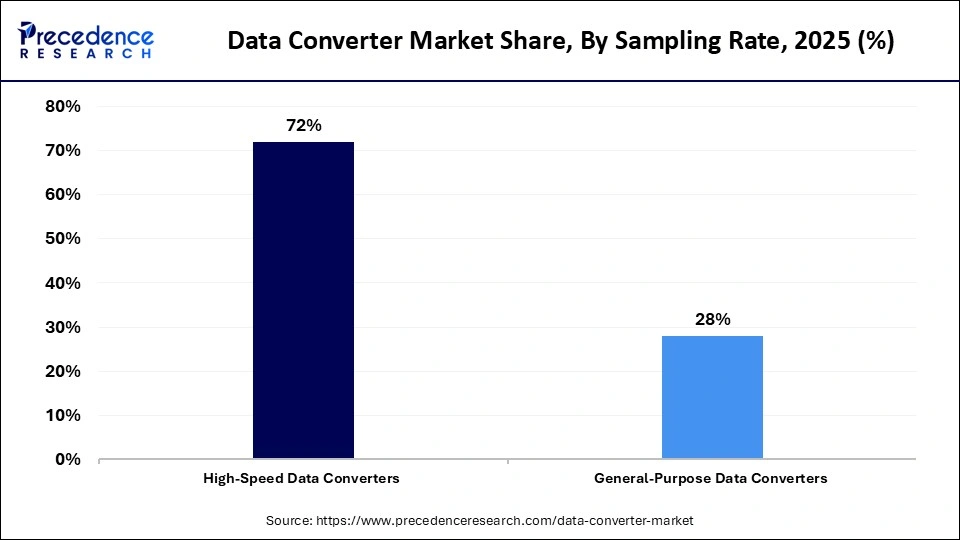
While holding 28% market share in 2025, the general-purpose data converters segment is expected to grow at a CAGR of 5.7% during the forecast period, owing to its ability to offer balanced performance in terms of resolution, speed, and power consumption. These converters are widely used in various sectors, including telecommunication devices, smartwatches, automotive infotainment systems, and industrial automation solutions.
Application Insights
Why Did the Consumer Electronics Segment Dominate the Data Converter Market?
The consumer electronics segment dominated the data converter market in 2025, holding a 40% share. This dominance is attributed to the surging adoption of smartphones in several countries, comprising China, India, and the U.S. Modern electronic devices, such as tablets, televisions, gaming devices, and wearables, use data converters to process analog signals into digital signals. DAC technology is essential in enabling numerous features, including touch sensing, video processing, and audio recording in electronic gadgets.
The automotive electronics segment is expected to grow at a CAGR of 5.8% between 2026 and 2035, due to the increasing use of high-quality electronics systems in autonomous vehicles. Automotive applications, including ADAS, autonomous driving, and infotainment units, are highly dependent on data converters to enhance accurate signal processing from numerous sensors and control units.
End User Insights
What Made Industrial the Leading Segment in the Data Converter Market?
The industrial segment led the data converter market with a share of 45% in 2025. This is due to the rapid deployment of advanced automation solutions in several industries, such as manufacturing, aerospace, and automotive. The industrial automation systems are highly dependent on the accurate monitoring of numerous parameters, including pressure, temperature, and vibration, which increases the demand for data converters.
Data Converter Market Share, By End User, 2025 (%)
| End User | 2025 |
| Industrial | 45% |
| Commercial | 30% |
| Consumer | 25% |
While holding 25% of market share in 2025, consumer segment is expected to expand with the highest CAGR of 6% during the forecast period. This is due to the surging proliferation of connected devices and the increasing popularity of smart homes in developed nations. The consumer electronics brands are collaborating with semiconductor companies to use DAC in modern devices for processing audio and sensor data.
The commercial segment held 30% of market share in 2025. This significant share is driven by the widespread adoption of advanced technologies across industries such as telecommunications, consumer electronics, and enterprise infrastructure. Businesses are increasingly investing in high-performance systems to enhance operational efficiency, scalability, and service delivery. Additionally, the growing demand for data processing, connectivity, and automation solutions is further contributing to the expansion of this segment.
Regional Insights
North America Data Converter Market Size and Growth 2026 to 2035
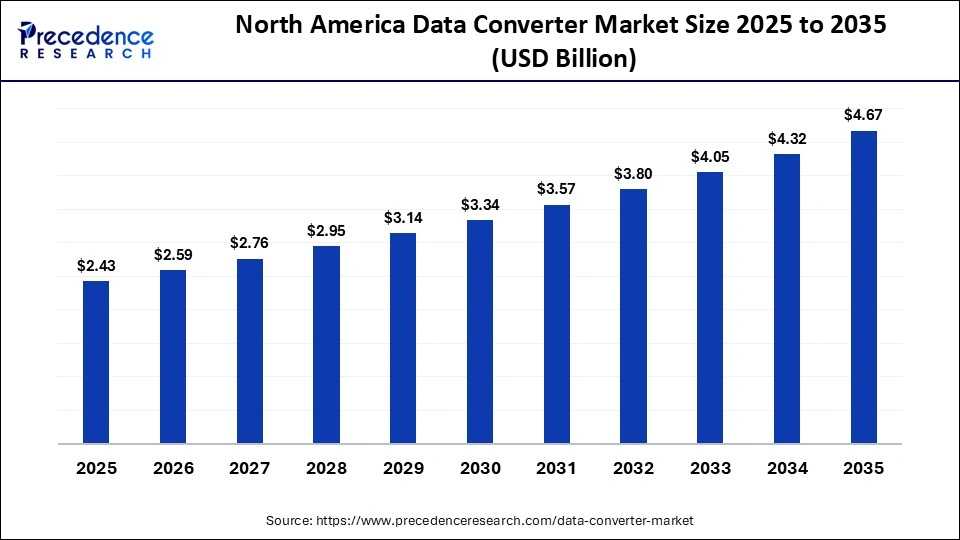
The North America data converter market size is estimated at USD 2.43 billion in 2025 and is projected to reach approximately USD 4.67 billion by 2035, with a 6.75% CAGR from 2026 to 2035.
How Does North America Dominate the Data Converter Market?
North America dominated the data converter market by holding a major share of 38% in 2025. The region's dominance is attributed to surging demand for high-quality consumer electronics, along with increasing consumer awareness of adopting energy-efficient solutions in the residential sector. The rising emphasis of the people in purchasing EVs for lowering emissions, as well as the rapid investment in the aerospace and defense sector, is accelerating market growth. This region is home to several market players, such as Texas Instruments, Analog Devices, and Maxim Integrated. These companies are adopting numerous strategies to maintain their prominent position in the industry.
The region's advanced infrastructure and substantial investments in sectors such as aerospace, defense, telecommunications, and automotive, especially electric vehicles and 5G, fuel the demand for high-speed and precision converters. Additionally, robust R&D capabilities and strategic collaborations with startups and research institutions enable North America to maintain its leadership in developing cutting-edge, application-specific data conversion solutions.
- In November 2025, Texas Instruments opened a new production unit in Sherman, U.S. This new manufacturing facility was inaugurated to develop semiconductor-based components that are widely used in smartphones, life-saving medical devices, industrial robots, smart home appliances, automotive systems, and data centers.
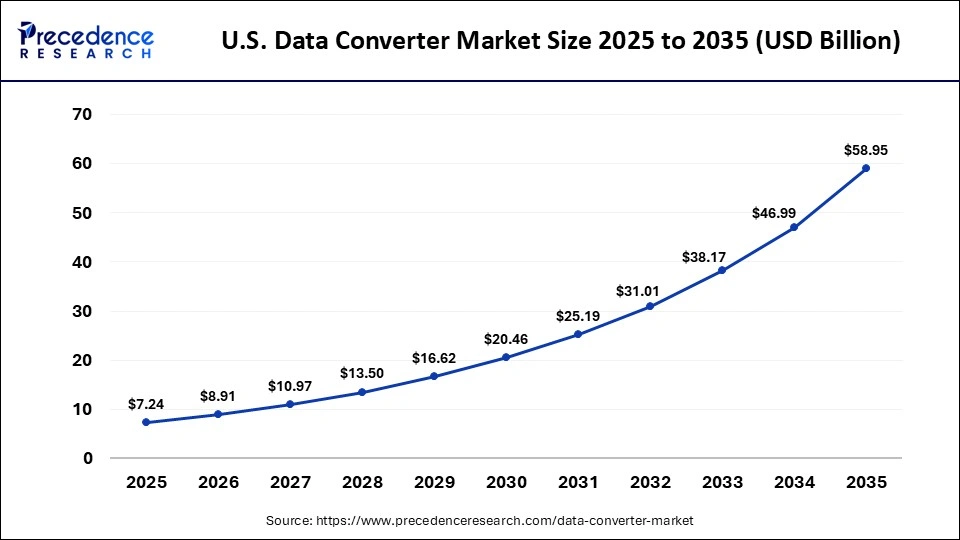
U.S. Data Converter Market Size and Growth 2026 to 2035
The U.S. data converter market size is calculated at USD 1.82 billion in 2025 and is expected to reach nearly USD 3.52 billion in 2035, accelerating at a strong CAGR of 6.82% between 2026 and 2035.
U.S. Data Converter Market Trends
The U.S. leads the data converter industry in North America due to the increasing demand for smart home solutions and the rapid deployment of advanced imaging systems in diagnostic centers. Also, the growing adoption of autonomous vehicles, as well as collaborations among tech developers and electronics companies, has accelerated the industry in a positive direction.
Why is Asia Pacific Expanding with the Highest CAGR in the Market?
While holding 32% of market share in 2025, Asia Pacific is expected to expand with the highest CAGR of 7.0% during the forecast period, owing to the expansion of AI data centers, along with technological advancements in the telecom industry. The rapid expansion of the automotive sector in China and Japan, due to the dominance of prominent companies such as Toyota, Honda, BYD, and Xpeng, has further increased the demand for advanced data converters. The manufacturing companies are widely adopting collaborative robots to enhance their operational efficiency and reduce manual errors, which in turn increases the application of DACs. Numerous government policies to strengthen the semiconductor sector, as well as the rise in the number of medical device manufacturers, are expected to propel industrial growth.
- In March 2026, Anant Raj Cloud collaborated with Submer. This collaboration aims to open an AI-enabled data center in India.
China Data Converter Market Analysis
China is the major contributor to the Asia Pacific data converter industry, due to the surging expansion of the 5G infrastructure, along with the presence of several smartphone manufacturing brands, such as Xiaomi, Huawei, and OnePlus. The availability of data converters in retail outlets and shopping malls, coupled with the rapid digitalization of the industrial sector, has bolstered the market expansion.
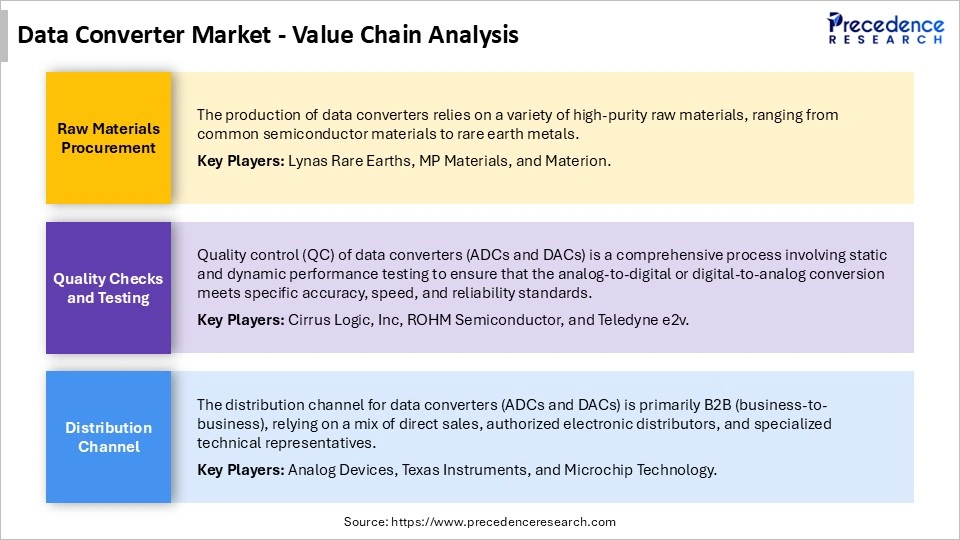
Data Converter Market Value Chain Analysis
Data Converter Market Companies
- Analog Devices
- Texas Instruments
- STMicroelectronics
- Infineon Technologies
- NXP Semiconductors
- Renesas Electronics
- Qualcomm
- Broadcom
- ROHM Semiconductor
- Maxim Integrated
- Cirrus Logic
- Asahi Kasei Microdevices
- Microchip Technology
- ON Semiconductor
- Skyworks Solutions
Recent Developments
- In November 2025, Consistent Infosystems launched an advanced Ethernet media converter. This converter is designed to deliver seamless data transmission in numerous types of media.(Source: https://www.expresscomputer.in)
- In November 2025, Sprout Social launched Trellis. Trellis is an AI-enabled agent that helps in transforming social media insights into business data through conversational queries.(Source: https://www.netinfluencer.com)
- In August 2025, AccuratePredict launched a free bet-slip converter. This converter is designed to enhance the experience of punters in the African region.
- In August 2025, Ferric launched Fe1766. Fe1766 is a high-quality 16-phase interleaved buck converter that reshapes power density and efficiency for the upcoming computing applications.(Source: https://www.everythingpe.com)
- In May 2025, Silanna Semiconductor launched Plural. Plural is a high-quality data converter designed for delivering high-performance conversion to the end-users.(Source: https://silannasemi.com)
- In March 2025, Omni Design launched a new range of high-speed data converters. These converters are designed for the satellite communication providers of Europe and the U.S.(Source: https://www.spacedaily.com)
Segments Covered in the Report
By Type
- Analog-to-Digital Converter (ADC)
- Digital-to-Analog Converter (DAC)
By Converter Architecture
- Successive Approximation Register (SAR)
- Sigma-Delta Converter
- Pipeline Converter
- Flash Converter
By Sampling Rate
- High-Speed Data Converters
- General-Purpose Data Converters
By Application
- Consumer Electronics
- Telecommunications
- Industrial Automation
- Automotive Electronics
- Healthcare Equipment
By End User
- Industrial
- Commercial
- Consumer
By Region
- North America
- Latin America
- Europe
- Asia-pacific
- Middle and East Africa
For inquiries regarding discounts, bulk purchases, or customization requests, please contact us at sales@precedenceresearch.com
Frequently Asked Questions
Tags





Ask For Sample
No cookie-cutter, only authentic analysis – take the 1st step to become a Precedence Research client
 Get a Sample




 sales@precedenceresearch.com
 Schedule a Meeting
