



Green AI Infrastructure Market Trends, Companies, Revenue / Sales Performance, Subscriber Growth, Pricing Strategies, Cloud Adoption, Infrastructure Expansion, Competitive Landscape, and Industry Outlook
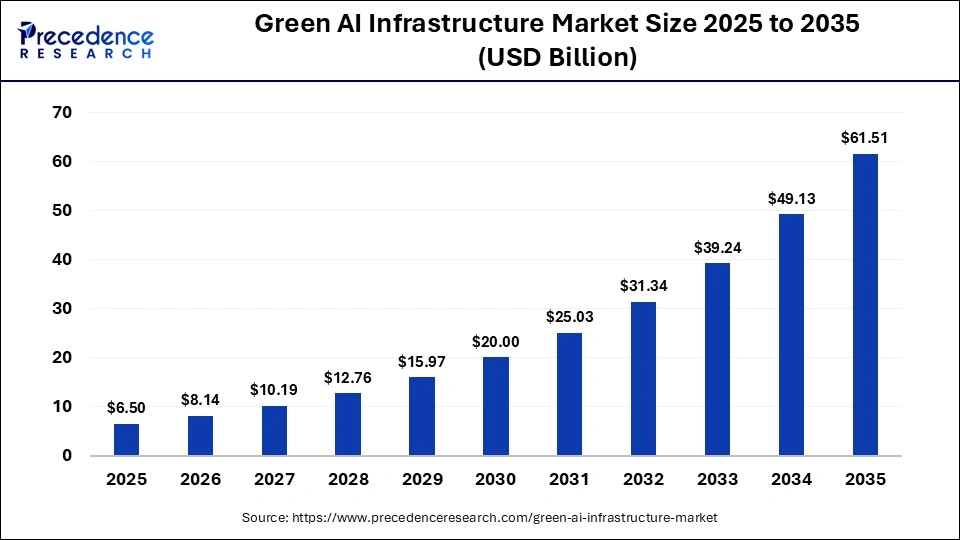
ICT industry specialist Gautam Mahajan estimates the green AI infrastructure market at USD 8.14 billion in 2026, with continued technology adoption expected to take the market to USD 61.51 billion by 2035 at a CAGR of 25.20%. Leading green AI infrastructure market providers such as NVIDIA Corporation, Google LLC (Alphabet Inc.), Microsoft Corporation, Intel Corporation are expanding their capabilities across segments including By Infrastructure Type, By Component, By AI Technology, By End-Use Industry.
Source: https://www.precedenceresearch.com/green-ai-infrastructure-market
 Get a Sample
 Table Of Content


What is the Green AI Infrastructure Market Size in 2026?
The global green AI infrastructure market size accounted for USD 6.50 billion in 2025 and is predicted to increase from USD 8.14 billion in 2026 to approximately USD 61.51 billion by 2035, expanding at a CAGR of 25.20% from 2026 to 2035. The green AI infrastructure market is driven by the increasing demand for energy-efficient, low-carbon AI infrastructure.
Key Takeaways
- North America dominated the green AI infrastructure market with a share of 35% in 2025.
- The Asia Pacific is expected to grow at the fastest CAGR of 27% during the forecast period.
- By infrastructure type, the data centers segment held a dominant position in the market, accounting for a 50% share in 2025.
- By infrastructure type, the cloud computing infrastructure segment is the second-largest shareholder and is expected to grow at a 21% CAGR between 2026 and 2035.
- By component, the hardware segment held a 45% share of the market in 2025.
- By component, the software segment is the second-largest shareholder and is expected to grow at a 25% CAGR between 2026 and 2035.
- By AI technology, the machine learning & deep learning segment led the global market with a share of 45% in 2025.
- By AI technology, the computer vision segment is the second-largest shareholder and is expected to grow at a 24.5% CAGR between 2026 and 2035.
- By end-use industry, the IT & telecommunications segment held a 30% market share in 2025.
- By end-use industry, the healthcare segment is the second-largest shareholder and is expected to grow at a 25% CAGR between 2026 and 2035.
Market Overview
The green AI infrastructure market is driven by the urgent need to balance high-performance computing with environmental sustainability in artificial intelligence workloads. The rapid expansion of AI-driven systems that generate massive volumes of data has significantly increased energy consumption in data centers, making both performance optimization and CO2 reduction critical priorities for organizations worldwide. The growing adoption of renewable energy sources, along with improvements in power usage efficiency, is enabling businesses to lower operational costs while meeting sustainability goals. At the same time, industries such as finance are increasingly transitioning to private, energy-efficient cloud environments. This shift supports advanced analytics while ensuring regulatory compliance and maintaining strong data security standards.
Green AI Infrastructure Market Trends
- There is a rising use of machine learning to dynamically adjust power consumption in data centers, reducing energy waste, improving efficiency, and lowering long-term operational costs.
- The rising demand for intelligent systems boosts the market. Intelligent systems can forecast energy demand and optimize the use of renewable sources such as solar and wind, improving reliability while minimizing carbon emissions.
- Increasing investments in AI-enabled cooling systems contribute to market growth. Advanced, data-driven cooling technologies use real-time inputs to adapt to changing thermal loads, significantly enhancing energy efficiency and reducing environmental impact.
- Organizations are leveraging AI to distribute computing workloads more efficiently across systems, minimizing idle resources, improving performance, and reducing energy consumption in large-scale AI operations.
Market Scope
| Report Coverage | Details |
| Market Size in 2025 | USD 6.50 Billion |
| Market Size in 2026 | USD 8.14 Billion |
| Market Size by 2035 | USD 61.51 Billion |
| Market Growth Rate from 2026 to 2035 | CAGR of 25.20% |
| Dominating Region | North America |
| Fastest Growing Region | Asia Pacific |
| Base Year | 2025 |
| Forecast Period | 2026 to 2035 |
| Segments Covered | Infrastructure Type, Component, AI Technology, End-Use Industry, and Region |
| Regions Covered | North America, Europe, Asia-Pacific, Latin America, and Middle East & Africa |
Market Dynamics
Drivers
Rising Demand for Sustainable and Energy-Efficient AI Infrastructure
The need for green and energy-efficient computing systems is rising across industries amid the growing digital transformation. As AI models become larger and more complex, their computational requirements and associated energy costs are rising exponentially, making low-carbon computing a strategic priority for businesses. As a result, organizations are realigning their technology investments to meet environmental, social, and governance (ESG) objectives. This shift is driving increased demand for sustainable data centers and energy-efficient infrastructure that can support advanced AI workloads while minimizing environmental impact.
Restraint
High Initial Capital Investment and Deployment Costs
The major challenge in the green AI infrastructure market is the high upfront cost of deploying energy-efficient and sustainable technologies. Advanced AI hardware, such as next-generation GPUs and compact, high-performance tensor processing units built on smaller process nodes, requires significant capital investment, often placing it out of reach for small and medium-sized enterprises. Additionally, implementing sustainable infrastructure solutions, such as direct-to-chip liquid cooling or retrofitting legacy data centers, involves complex engineering changes and substantial financial outlay. These barriers can slow adoption despite the long-term cost savings and environmental benefits.
Opportunity
Integration of Renewable Energy
A major opportunity in the green AI infrastructure market is the integration of AI workloads with renewable energy-powered data centers. As organizations seek to reduce carbon footprints, there is a growing demand for infrastructure that can intelligently align computing tasks with the availability of solar and wind energy. This enables companies to lower energy costs, meet sustainability targets, and build more resilient, future-ready AI operations.
Segment Insights
Infrastructure Type Insights
Green AI Infrastructure Market Share, By Infrastructure Type, 2025-2035 (%)
| Infrastructure Type | 2025 | 2035 | CAGR (%) |
| Data Centers | 50.00% | 48.00% | 24.00% |
| Edge Computing Infrastructure | 20.00% | 25.00% | 28.50% |
| Cloud Computing Infrastructure | 25.00% | 22.00% | 21.00% |
| Hybrid AI Infrastructure | 5.00% | 5.00% | 20.00% |
The Data Centers Segment Held a 50% Market Share in 2025
The data centers segment dominated the green AI infrastructure market with the largest share of 50% in 2025, owing to the intensive computational demands of large-scale AI workloads. These models require substantial processing power and energy, making efficiency a top priority. As a result, organizations are significantly increasing investments in green data centers, renewable energy integration, advanced cooling systems, and improved power usage effectiveness (PUE).
The edge computing infrastructure segment held a 20% share of the market in 2025 and is expected to grow at the highest CAGR of 28.5% during the projection period, driven by the increasing need for real-time processing of AI with minimum latency. Applications such as autonomous vehicles, smart cities, and industrial automation require localized data processing, reducing reliance on centralized data centers. This significantly encourages the shift toward edge computing.
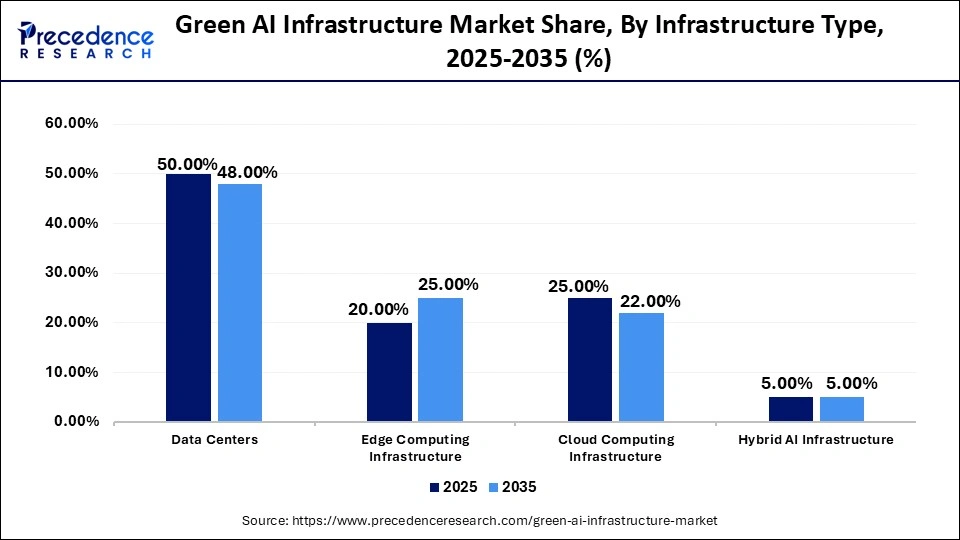
The cloud computing infrastructure segment held the second-largest market share of 25% in 2025 and is expected to grow at a CAGR of 21% during the forecast period. This is mainly due to the rapid adoption of scalable and flexible cloud solutions that enable businesses to handle large AI workloads without heavy upfront infrastructure investments. Cloud providers are also advancing sustainability efforts through renewable energy usage, higher server utilization, and improved data center efficiency.
The hybrid AI infrastructure segment held a 5% market share in 2025 and is expected to grow at a CAGR of 20% during the projection period, as it combines the benefits of cloud and on-premises systems for optimal AI performance and flexibility. Companies are moving toward on-premises systems and cloud environments to balance regulatory compliance and security needs while optimizing costs and energy consumption through efficient workload distribution.
Component Insights
Green AI Infrastructure Market Share, By Component, 2025-2035 (%)
| Component | 2025 | 2035 | CAGR (%) |
| Hardware (GPUs, CPUs, TPUs, Servers) | 45.00% | 42.00% | 23.50% |
| Software (AI Models, Data Management Software) | 25.00% | 28.00% | 26.00% |
| Networking Equipment | 15.00% | 14.00% | 19.00% |
| Energy Management Solutions | 15.00% | 16.00% | 30.00% |
The Hardware Segment Led the Market With a 45% Share in 2025
The hardware (GPUs, CPUs, TPUs, servers) segment led the green AI infrastructure market with a major share of 45% in 2025, owing to the heightened demand for high-performance computing in AI workloads. Components like GPUs, CPUs, TPUs, and high-power servers are crucial for AI computation and large-scale model training and inference. Continued innovations in semiconductor design and low-power architecture are also reinforcing the segment's dominance.
The software (AI models, data management software) segment held the second-largest market share of 25% in 2025 and is expected to grow at a CAGR of 26% during the projection period. This is mainly due to the expanding adoption of AI applications and the increasing need for efficient data handling. As organizations prioritize sustainable AI, the demand for software is rising that optimizes workloads, improves resource allocation, and enables real-time processing while reducing energy consumption.
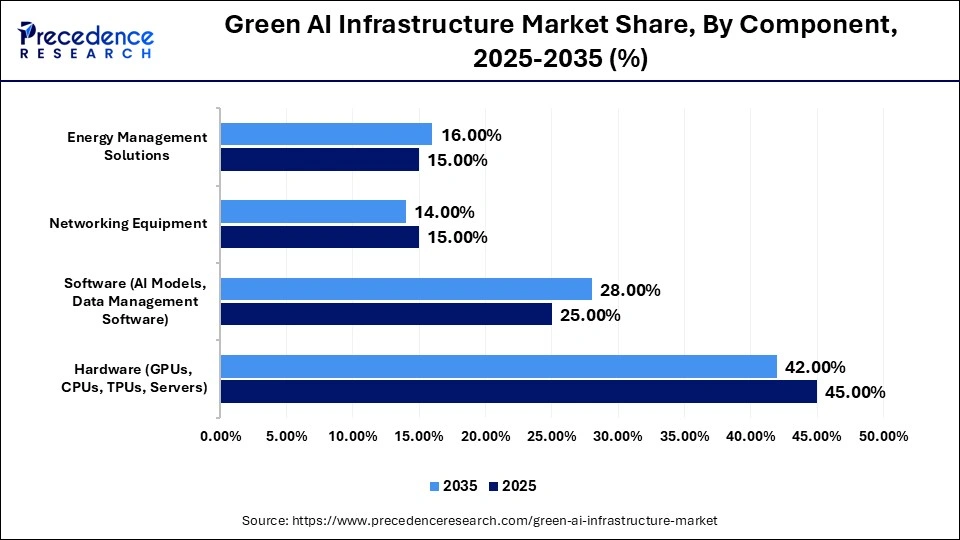
The networking equipment segment held a 15% share of the market in 2025 and is expected to grow at a 19% CAGR during the projection period, driven by the need for high-speed, reliable data transmission across AI ecosystems. Advanced networking technologies, including high-bandwidth switches, routers, and optical communication systems, are essential for ensuring seamless data flow across data centers and edge environments.
The energy management solutions segment held a 15% share of the market in 2025 and is expected to grow at the highest CAGR of 30% during the projection period. The growth of the segment is attributed to the increasing pressure to reduce the carbon footprint of AI infrastructure. These solutions provide real-time monitoring and optimization of energy consumption, while AI-powered analytics help organizations improve efficiency, minimize waste, and achieve sustainability targets.
AI Technology Insights
Why Did the Machine Learning & Deep Learning Segment Dominated the Market in 2025?
The machine learning & deep learning segment dominated the green AI infrastructure market with a share of 45% in 2025. This is mainly because these technologies are the core elements of modern AI applications. These technologies enable massive model training, predictive analytics, and improved decision-making. The segment's dominance is also driven by the rising demand for high-performance computing and energy-efficient infrastructures.
The natural language processing (NLP) segment held a 15% market share in 2025 and is expected to grow at a CAGR of 22% during the projection period. This is mainly due to the rapid adoption of conversational AI applications such as chatbots, virtual assistants, and automated customer service across industries. These applications require real-time processing of large volumes of text and voice data, driving demand for energy-efficient infrastructure that can deliver high performance while minimizing power consumption and environmental impact.
Green AI Infrastructure Market Share, By AI Technology, 2025-2035 (%)
| AI Technology | 2025 | 2035 | CAGR (%) |
| Machine Learning & Deep Learning | 45.00% | 50.00% | 26.00% |
| Natural Language Processing (NLP) | 15.00% | 13.50% | 22.00% |
| Computer Vision | 20.00% | 18.50% | 24.50% |
| Reinforcement Learning | 10.00% | 9.50% | 23.00% |
| Generative AI | 10.00% | 9.00% | 28.00% |
The computer vision segment held a 20% share of the market in 2025 and is expected to grow at a CAGR of 24.5% during the projection period due to its expanding use in applications such as autonomous vehicles, medical imaging, and industrial automation. These use cases require intensive image and video processing, driving demand for high-performance yet energy-efficient infrastructure to handle large data volumes while minimizing power consumption and environmental impact.
The reinforcement learning segment held a 10% market share in 2025 and is expected to grow at a CAGR of 23% during the projection period due to its increasing use in robotics, automation, and intelligent decision-making systems. Since reinforcement learning relies on continuous training through simulations and repeated environment interactions, it requires substantial computational resources, driving demand for more energy-efficient and optimized AI infrastructure.
The generative AI segment held a 10% market share in 2025 and is expected to grow at the highest CAGR of 28% in the upcoming period. This is primarily due to the rapid adoption of large-scale models for content creation, coding, design, and synthetic data generation across industries. These models are highly compute-intensive, which is increasing the need for energy-efficient infrastructure that can support heavy training and inference workloads while reducing overall power consumption and carbon emissions.
End-Use Industry Insights
The IT & Telecommunications Segment Held a 30% Market Share in 2025
The IT & telecommunications segment registered its dominance in the green AI infrastructure market with a share of 30% in 2025, driven by the massive investment in cloud computing and artificial intelligence (AI) apps and supercomputer systems. Telecom providers and IT service companies are increasingly adopting green data centers in an effort to reduce their rates of operation and minimize the emission of carbon in the environment.
The healthcare segment held a 25% market share in 2025 and is expected to grow at a CAGR of 25% during the projection period. This is mainly due to the increasing adoption of AI-powered diagnostic tools, predictive analytics, and personalized medicine. These applications require powerful, energy-efficient AI infrastructures.
Green AI Infrastructure Market Share, By End-Use Industry, 2025-2035 (%)
| End-Use Industry | 2025 | 2035 | CAGR (%) |
| IT & Telecommunications | 30.00% | 28.00% | 24.00% |
| Healthcare | 25.00% | 27.00% | 25.00% |
| Automotive & Mobility | 15.00% | 16.00% | 28.00% |
| Financial Services (BFSI) | 10.00% | 9.50% | 23.50% |
| Retail & E-commerce | 10.00% | 9.00% | 21.50% |
| Government & Defense | 5.00% | 6.00% | 25.00% |
| Others | 5.00% | 4.50% | 22.00% |
The automotive & mobility segment held a 15% share of the market in 2025 and is expected to grow at the highest CAGR of 28% during the projection period. This growth is driven by the increasing integration of AI in autonomous vehicles, electric mobility systems, and vehicle-to-vehicle communication technologies. These applications require real-time data processing, sensor fusion, and intelligent decision-making capabilities supported by advanced, high-performance AI infrastructure.
The financial services segment held a 10% market share in 2025 and is expected to grow at a CAGR of 23.5% during the projection period. This is primarily due to the rising adoption of AI for fraud detection, risk assessment, algorithmic trading, and customer service automation. Financial institutions such as banks and fintech companies require secure, reliable, and energy-efficient computing infrastructure capable of processing large volumes of transactional and behavioral data in real time.
Regional Insights
North America Green AI Infrastructure Market Size and Growth 2026 to 2035
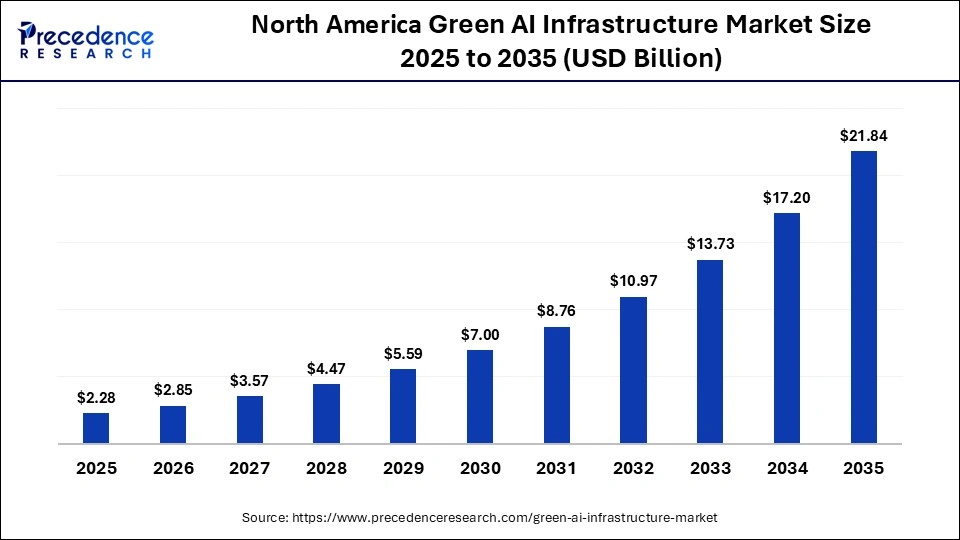
The North America green AI infrastructure market size is estimated at USD 2.28 billion in 2025 and is projected to reach approximately USD 21.84 billion by 2035, with a 25.35% CAGR from 2026 to 2035.
North America Led the Global Green AI Infrastructure Market in 2025
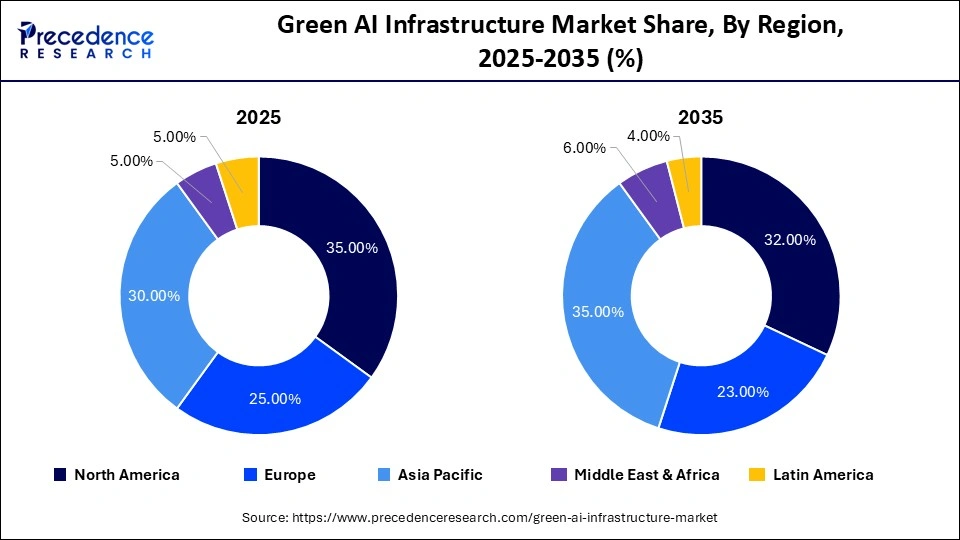
North America led the green AI infrastructure market while holding a major share of 35% in 2025, driven by its advanced technology ecosystem, strong digital infrastructure, and widespread adoption of AI-based solutions. The region is home to major technology companies, hyperscale cloud providers, and AI startups that are consistently investing in sustainable computing technologies. Government initiatives supporting AI innovation, clean energy adoption, and data center efficiency further strengthen market growth. Additionally, rising demand from 5G networks, IoT, and industrial automation continues to expand infrastructure requirements.
U.S. Green AI Infrastructure Market Size and Growth 2026 to 2035
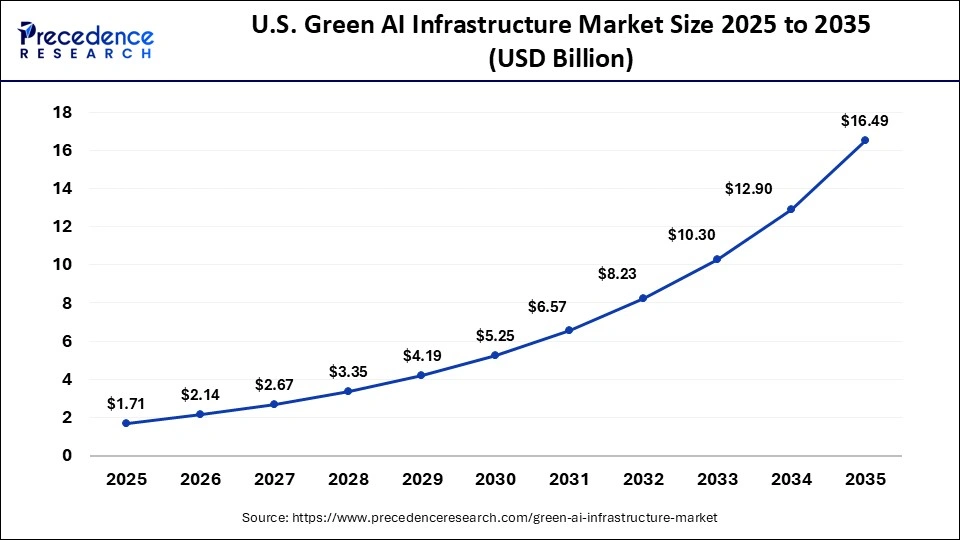
The U.S. green AI infrastructure market size is calculated at USD 1.71 billion in 2025 and is expected to reach nearly USD 16.49 billion in 2035, accelerating at a strong CAGR of 25.44% between 2026 and 2035.
U.S. Market Analysis
The U.S. is a major player in the North American green AI infrastructure market, owing to its leadership in AI development, cloud computing, and semiconductor innovation. Significant investments from major technology firms are accelerating the deployment of energy-efficient data centers powered by renewable sources such as wind and solar. Growing demand for large-scale AI models across healthcare, finance, and defense sectors is further driving the need for high-performance yet energy-efficient infrastructure.
Asia Pacific: The Fastest-Growing Region
Asia Pacific held a 30% share of the market in 2025 and is expected to grow at the fastest CAGR of 27% during the projection period, supported by rapid digital transformation and increasing AI investments. Countries such as China, India, and Japan are expanding their data center and IT infrastructure capabilities to support growing AI workloads. Industrialization, urbanization, and rising internet penetration are further accelerating demand for scalable and energy-efficient computing systems. The region is also advancing smart city initiatives, digital economy programs, and AI research projects that support sustainable infrastructure development.
China Market Analysis
China is a dominant force in the Asia Pacific green AI infrastructure market, supported by its large digital ecosystem and strong government-backed AI investments. Strategic focus on manufacturing, surveillance, and cloud computing, led by major domestic technology companies, is accelerating infrastructure development. In parallel, India is witnessing rapid growth in digital services, fintech, and AI-enabled public services, increasing demand for scalable and cost-efficient computing infrastructure.
How is the Opportunistic Rise of Europe in the Green AI Infrastructure Market?
The Europe segment held a 25% of the market in 2025 and is expected to grow at a notable CAGR of 22.5% during the projection period, supported by strong regulatory frameworks and increasing adoption of AI across industries. The region's sustainability-driven policies encourage the deployment of energy-efficient computing systems and renewable-powered data centers. AI applications are expanding across industrial automation, healthcare, and smart city initiatives, while government funding continues to support green technology development aligned with carbon neutrality goals and operational efficiency improvements.
UK Market Analysis
The UK plays a significant role in the European market, supported by a strong digital economy and an active research ecosystem. The country is investing heavily in AI innovation, cloud infrastructure, and sustainable data center development. Government policies promoting carbon neutrality and digital transformation are encouraging businesses to adopt energy-efficient AI infrastructure. Collaboration between public institutions and technology companies is further accelerating the development of green AI solutions.
Green AI Infrastructure Market Companies
- NVIDIA Corporation
- Google LLC (Alphabet Inc.)
- Microsoft Corporation
- Intel Corporation
- Amazon Web Services, Inc. (AWS)
- IBM Corporation
- Siemens AG
- Hewlett Packard Enterprise (HPE)
- AMD (Advanced Micro Devices, Inc.)
- Cohesity, Inc.
- Alibaba Cloud
- Databricks, Inc.
- Arista Networks, Inc.
- Red Hat, Inc.
- SAP SE
Recent Developments
- In March 2026, Schroders Greencoat reported an updated green digital infrastructure framework, which focused on investing in an energy-efficient and renewable energy park in the form of a data center. The project will help meet the increased energy requirements of AI applications and promote the progress of sustainable infrastructural development.(Source: https://www.esgtoday.com)
- In March 2026, at the Global Digital Power Forum during MWC Barcelona 2026, Huawei Digital Power launched the AIDC Ecosystem Co-construction Initiative with Global Computing Consortium (GCC) and unveiled the New-Gen AI-Powered Green Site to empower the ICT industry in the AI era.(Source: https://www.engineering.com)
- In February 2026, Adani Group announced a proposal for a 100-billion-dollar building of a renewable-powered hyperscale AI-based data center platform in India by 2035. The project will bring an Indian national AI ecosystem with a value of 250 billion dollars and develop the nation into an AI infrastructure hub.(Source: https://oilprice.com)
Segments Covered in the Report
By Infrastructure Type
- Data Centers
- Edge Computing Infrastructure
- Cloud Computing Infrastructure
- Hybrid AI Infrastructure
By Component
- Hardware (GPUs, CPUs, TPUs, Servers)
- Software (AI Models, Data Management Software)
- Networking Equipment
- Energy Management Solutions
By AI Technology
- Machine Learning & Deep Learning
- Natural Language Processing (NLP)
- Computer Vision
- Reinforcement Learning
- Generative AI
By End-Use Industry
- IT & Telecommunications
- Healthcare
- Automotive & Mobility
- Financial Services (BFSI)
- Retail & E-commerce
- Government & Defense
- Others
By Region
- North America
- Latin America
- Europe
- Asia-pacific
- Middle and East Africa
For inquiries regarding discounts, bulk purchases, or customization requests, please contact us at sales@precedenceresearch.com
Frequently Asked Questions





Ask For Sample
No cookie-cutter, only authentic analysis – take the 1st step to become a Precedence Research client
 Get a Sample




 sales@precedenceresearch.com
 Schedule a Meeting
