



Medical Ceramics Market Size, Key Companies, Company Production Capacity, Healthcare Infrastructure Growth, Product Utilization, Regulatory Compliance, Company Expansion Strategies, Company Investment Strategies, and Market Outlook
Medical Ceramics Market (By Material Type: Bioinert Ceramics, Zirconia, Aluminium Oxide, Other Bioinert Ceramics, Bioactive Ceramics, Hydroxyapatite, Glass Ceramics, Bioresorbable Ceramics; By Application: Dental Applications, Dental Implants, Dental Crowns & Bridges, Braces, Inlays and Onlays, Dental Bone Grafts & Substitutes, Orthopedic Applications, Joint Replacement, Fracture Fixation, Synthetic Bone Grafts, Surgical Instruments, Plastic Surgery, Craniomaxillofacial Implants, Orbital/Ocular Implants, Dermal Fillers) - Global Industry Analysis, Size, Trends, Leading Companies, Regional Outlook, and Forecast 2026 to 2035
Source: https://www.precedenceresearch.com/medical-ceramics-market
 Get a Sample
 Table Of Content


What is the Medical Ceramics Market Size?
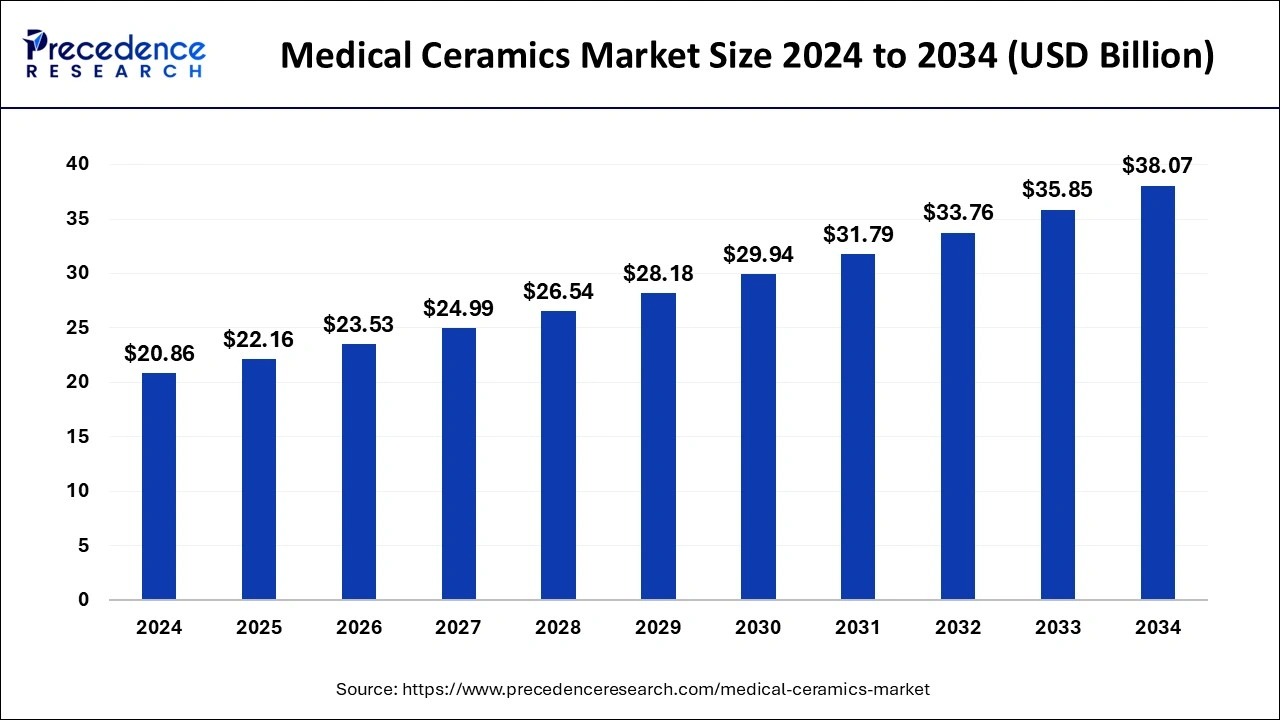
The global medical ceramics market size is calculated at USD 22.16 billion in 2025 and is predicted to increase from USD 23.53 billion in 2026 to approximately USD 40.20 billion by 2035, expanding at a CAGR of 6.14% from 2026 to 2035. The rising demand for medical ceramics is observed due to their unique properties that are suitable for a wide range of medical applications.
Medical Ceramics Market Key Takeaways
- North America dominated the global medical ceramics market with the largest share of 33% in 2025.
- Asia Pacific is projected to expand at a notable CAGR of 8.2% during the forecast period.
- By material type, the bioinert ceramics segment contributed the highest market share in 2025.
- By material type, the bioactive ceramics segment is estimated to grow rapidly during the forecast period.
- By application, dental application captured the biggest market share in 2025.
- By application, the orthopedic application segment is expected to grow at a significant CAGR during the forecast period.
Market Overview
The medical ceramics market has become an essential component in the healthcare sector. The strength, durability, and custom-design properties of medical ceramics used in mold casting make them useful for various applications. The healthcare industry is constantly advancing towards prosthetic aids, which is raising the demand for medical ceramics to create artificial bones and joints for dental material. They are extensively used to repair or replace damaged bone tissue. It offers various benefits, including biocompatibility, non-toxicity, dimensional stability, and bioinertness in endodontic applications.
How is Artificial Intelligence (AI) Changing the Medical Ceramics Market?
Integration of artificial intelligence into medical ceramics brings revolutionary changes to the medical ceramics market by enhancing the manufacturing process with efficiency and precision. AI technology assists in the design, creation, and development of new medical ceramic products, resulting in optimizing material properties as desired and specific to medical applications. Moreover, the incorporation of automation helps in the production process, reducing time and improving consistency, which ultimately increases efficiency and lowers manufacturing costs.
Medical Ceramics Market Growth Factors
- Medical ceramics are in increasing demand due to their broad application in the medical field, including orthopedics, tissue engineering, and restorative dentistry.
- The utilization of nanotechnology in medical ceramics is a novel advancement used in tissue engineering and biomedical applications. It entirely mimics the natural tissue which helps in regeneration and improving the longevity of implants.
- 3D printing is an innovative material processing technique that is extensively used to produce medical ceramics parts and scaffolds, contributing to the growth of the medical ceramics market.
Market Scope
| Report Coverage | Details |
| Market Size by 2025 | USD 22.16 Billion |
| Market Size in 2026 | USD 23.53 Billion |
| Market Size in 2035 | USD 40.20 Billion |
| Market Growth Rate from 2026 to 2035 | CAGR of 6.14% |
| Dominating Region | North America |
| Fastest Growing Region | Asia Pacific |
| Base Year | 2025 |
| Forecast Period | 2026 to 2035 |
| Segments Covered | Material Type, Application, and Regions. |
| Regions Covered | North America, Europe, Asia-Pacific, Latin America, and Middle East & Africa. |
Market Dynamics
Drivers
Prevalence of hip and knee replacement
The rising number of knee and hip replacement surgeries is propelling the medical ceramics market. It is estimated that by 2030, there will be more than 60% percent of total knee replacement procedures compared to the last decade. The predominant reason for knee and hip replacement is high patient satisfaction, which encourages people to experience pain relief and significantly improve joint function soon after surgery.
There is a 90-95% success rate received after total hip replacement and almost total pain relief followed by surgery; knee replacement has a success rate of 80-85%. Ceramic is the most preferred material when it comes to knee and hip replacement compared to metal due to its ceramic strength, hardness, and resistance properties. Along with that, less physical and chemical wear and tear was observed with ceramic than with polyethylene and metal.
Restraint
Regulatory framework
The strict regulations associated with medical ceramics are creating a hindrance to market expansion. The biomaterial and medical devices are subjected to strict testing protocols including in vitro and animal-based testing. There must be a high-standard material capable of integrating into biological environments such as the oral cavity and other anatomical regions of the human body.
Opportunity
Biocompatible ceramic
The future of the medical ceramics market is revolutionizing with the incorporation of advanced materials with strong and lightweight properties. Consumer preferences and medical professionals' recommendations are increasingly growing towards all ceramic biomaterial use for implants, prosthetics, and many more. The incorporation of zirconium oxide makes the ceramic tougher in terms of physical features and more resistant to fractures. It is a strong, hard, and biocompatible material with good thermal and mechanical properties.
Segment Insights
Material Type Insights
The bioinert ceramics segment contributed the highest share of the medical ceramics market in 2025. The dominance of this segment is observed due to its stable and completely safe properties. Bioinert ceramic is utilized in the medical sector for implanting or re-establishing the function of degenerated or traumatized organs in the human body. It possesses excellent chemical stability, biocompatibility, corrosion and water resistance behaviors, and mechanical strength. It is widely used for hip/knee replacement and dental implants due to its great characteristic of being tensile, compressive, hard, and tough. Bioinert ceramic comprises three metal types, including alumina, zirconia, and titania, which are commonly used in musculoskeletal applications.
The bioactive ceramics segment is estimated to grow rapidly during the forecast period. The growth of this segment is expected to continue with the help of its design, which is used to induce specific biological activity for repairing damaged organs. It is still not widely popular due to its low mechanical strength and fracture toughness, as this characteristic restricts its use in non-bearing applications. However, recent studies have resolved the issue of mechanical and biological properties by incorporating bioactive ions, polymers, bioactive proteins, and other chemicals in bioactive ceramics. This is more suitable for tissue engineering scaffolds.
Application Insights
The dental application segment captured the biggest medical ceramics market share in 2025. The popularity of ceramic material in dentistry is due to its biocompatible properties, which are aesthetically pleasing. Ceramics have a hypoallergenic characteristic, which ultimately makes them a great, suitable alternative for people allergic to titanium. Ceramics is in the dentistry field and is commonly used for prostheses such as crowns and bridges, orthodontic devices- dental braces, and dental implants, which include root implants. They are highly preferred by consumers as they match the color of any individual's teeth, and along with that, they reduce the risk of infection and deterioration.
- In October 2024, Barings, the world's leading investment manager, revealed that it has served as a sole lender and minority equity to the Zabel companies to provide financial support in Golden Ceramic Dental Lab.
The orthopedic application segment is expected to grow at a significant CAGR from 2026 to 2035. The expansion of this segment is observed due to the extensive use of ceramic to replace or reconstruct bones and joints. These are used to treat bone non-union and feature healing. The addition of some elements to the ceramic, such as magnesium, zinc, strontium, and boron, enhances the osteoconductive property of the ceramic.
Regional Insights
What is the U.S. Medical Ceramics Market Size?
The U.S. medical ceramics market size was exhibited at USD 5.82 billion in 2026 and is projected to be worth around USD 10.22 billion by 2035, growing at a CAGR of 6.43% from 2026 to 2035.
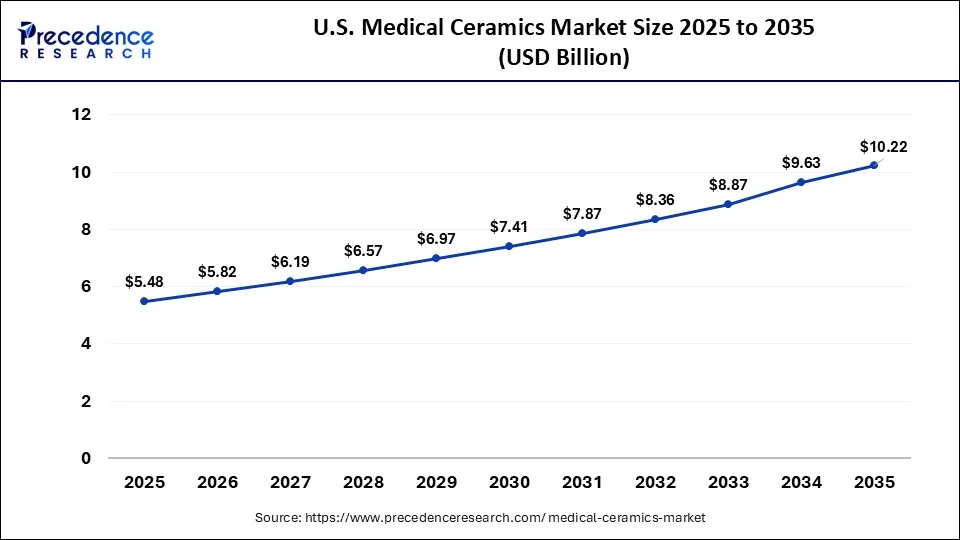
North America dominated the global medical ceramics market with the largest share in 2025. North America has a high usage rate of implantable medical devices and diagnostics imaging equipment. According to the AMA (American Medical Association), about 10% of Americans will have an implanted device for their entire lifetimes. There is a rising demand for implant medical devices as they deliver medicines, replace damaged body parts, monitor physiological activities, and support specific organs or tissues, improving quality of life. According to the Orthopaedic Surgeons, more than 700,000 knee replacement surgeries are performed annually in the United States. Over 3 million Americans live with cardiac pacemakers, and 70% of people have their pacemakers under the age of 65.
U.S. Market Trends
There is a significant change toward advanced materials like Zirconium Oxide due to its high durability along with superior aesthetic properties compared to metals, decreasing the risk of implant failure. Ceramics are being utilized in tissue engineering and even as scaffolds to support stem cell therapies.
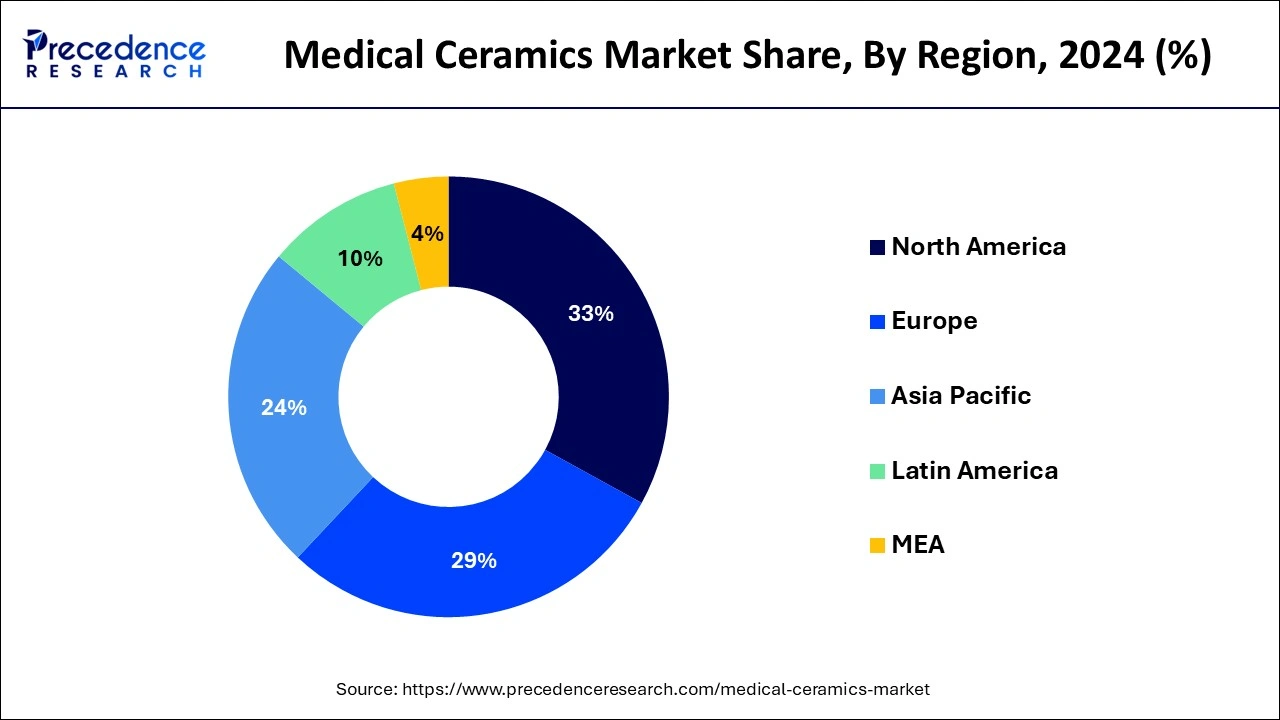
Asia Pacific is projected to expand at a notable CAGR in the medical ceramics market during the forecast period. The expansion in the region is noticed due to the increase in infrastructural advancement of healthcare. A significant growth in the region is noted in countries such as China, Japan, and South Korea due to the surging number of patients opting for knee and hip replacement surgeries, an increasing number of research facilities, and easy accessibility of treatment. Additionally, China offers cost-effective medical devices for patients with lower disposable incomes.
China Market Trends
The aging population and higher prevalence of chronic diseases in China are increasing the demand for hip or knee replacements and even restorative dental procedures, boosting the need for bioinert and bioactive ceramics. The industry is moving toward custom-engineered implants using advanced processing technologies such as 3D printing and enhanced ceramic coatings, improving the fit and longevity of implants.
How is the Medical Ceramics Market Evolving in Europe?
Europe is expected to show significant growth during the forecast period. Advancements in technology, mainly in additive manufacturing, 3D printing, and bioactive materials, are changing the landscape from traditional passive implants toward smart, regenerative, and even customized solutions, with Germany serving as a major centre for innovation and adoption.
Italy Market Trends
The Italian market is driven by rising orthopedic, an aging population, and dental procedures, and a high need for biocompatible materials. An increasing prevalence of osteoarthritis along with dental issues drives the need for advanced implants, mainly in Italy's strong healthcare sector. Growing usage of specialized, small-sized ceramic components for minimally invasive orthopedic and even dental surgeries propels the market.
Why is Demand for Medical Ceramics Increasing Across the Global Healthcare Sector in Latin America?
Latin America is expected to show notable growth during the forecast period. As the population over 60 increases in Latin America, there is a higher prevalence of diseases like osteoarthritis and orthopedic disorders. This surge drives the need for joint replacements, bone repairs, and spinal surgeries that utilize ceramic materials.
Brazil Market Trends
Growing knowledge of dental health is fueling the need for ceramic crowns, veneers, and implants that provide better aesthetics and strength. The market is shifting towards advanced manufacturing techniques, like 3D printing and nanotechnology, to manufacture customized ceramic implants with superior fit and biocompatibility.
How are Bioceramics Transforming the Medical Ceramics Market in the Middle East and Africa?
The Middle East and Africa are expected to show lucrative growth during the forecast period. The growing need for hydroxyapatite and even zirconia in joint replacements and dental implants is fueled by an aging population and the rising prevalence of musculoskeletal disorders. Countries such as the UAE are prioritizing high-quality, advanced dental and orthopedic procedures, increasing the need for premium bioceramic solutions.
Saudi Arabia Market Trends
The Saudi Arabian market is driven by rising orthopedic and dental procedures, an aging population, and even increased healthcare investment under Vision 2030. It includes a high need for bioinert zirconia or alumina in implants, acceptance of CAD or CAM technology, and a change toward personalized regenerative medicine.
Medical Ceramics Market Companies
- Institute Straumann AG: Institut Straumann AG provides a robust portfolio aimed at high-performance zirconium oxide ceramic materials for dental applications. Their offerings are targeted at providing metal-free, highly aesthetic, and reliable solutions for dental restorations.
- Stryker: Stryker primarily provides advanced material solutions for orthopedics and spine applications, aiming on biocompatibility, wear resistance, and even bone regeneration. Their offerings involve specialized ceramic joint replacements and even bioactive synthetic bone grafts.
- Kyocera Corporation: Kyocera Corporation provides high-performance alumina and zirconia components, thus specializing in 3D printing for customized implants, and ceramic-to-metal bonding for medical devices such as surgical tools and diagnostic equipment.
- Nobel Biocare: Nobel Biocare provides specialized dental solutions in the medical ceramics industry, focusing on metal-free aesthetics and high-precision CAD or CAM restorations.
Other Major Key Players
- 3M ESPE AG
- Rockwood Holdings
- Morgan Advanced Materials PLC
- Noritake
- Tosoh Corporation
- CoorsTek, Inc.
- Zimmer Biomet Holdings, Inc.
- DePuy Synthes
- CeramTec
- Rauschert Group
Recent updates on medical ceramics-2025
Advanced materials enhance biocompatibility and durability
On 10 March 2025, next-generation zirconia and alumina composites were developed, marking a significant milestone for the medical ceramics industry. Orthopedic implants and dental applications benefit greatly from these materials' exceptional strength, fracture resistance, and biocompatibility. Innovation in this field is being driven by the rising need for minimally invasive procedures and durable implant solutions.
Global demand rises with an aging population and dental tourism
In April 2025, the use of medical ceramics has increased dramatically as a result of growing joint and bone disorders and increased global awareness of dental health. Countries like India, Mexico, and Hungary saw a boom in dental tourism with ceramic-based crowns, bridges, and implants gaining popularity for their aesthetics and longevity. Diversification of products and market expansion are anticipated outcomes of this trend.
Recent developments
- On 19 Feb 2025, Straumann projected strong sales growth in 2025, driven by China's surge in dental implant demand after a government-led price drop. In 2024, the Asia-Pacific region contributed a 33% sales boost. The company is expanding its ceramic dental implant lines to meet aesthetic and biocompatibility needs. It also plans to invest in digital dentistry to streamline procedures and increase global market share.
- On 26 February 2025, CeramTec introduced a new range of lead-free piezoceramics designed for use in medical sensors and diagnostic equipment. These materials are safer for both patients and the environment. The innovation supports compliance with evolving EU and U.S. regulations on hazardous substances. It also strengthens CeramTec's position as a leader in sustainable medical material solutions.
- On 18 September 2024, Kyocera unveiled a new zirconia-toughened alumina ceramic specifically for use in artificial joints and dental bridges. The material delivers improved fracture toughness and load-bearing strength. With rising global demand for joint replacements, Kyocera is ramping up production capacity. This innovation reflects the growing trend toward high-performance ceramics in load-bearing biomedical applications.
- In November 2024, C5 Medical Werks, a manufacturer of medical implant components, revealed the addition of a new material to its ceramic injection model portfolio. This innovative material is designed to meet the needs of next-generation devices.
- In May 2024, Himed, a leading manufacturer of bioceramic materials, and Lithoz, a pioneer in ceramic 3D printing equipment, declared the launch of a new Bioceramics Center of Excellence™ (BCoE). The BCoE will offer a holistic approach to R&D using bioceramics for medical device manufacturers, integrating various analytical services to support the rapid prototyping process.
Segments Covered in the Report
By Material Type
- Bioinert Ceramics
- Zirconia
- Aluminium Oxide
- Other Bioinert Ceramics
- Bioactive Ceramics
- Hydroxyapatite
- Glass Ceramics
- Bioresorbable Ceramics
By Application
- Dental Applications
- Dental Implants
- Dental Crowns & Bridges
- Braces
- Inlays and Onlays
- Dental Bone Grafts & Substitutes
- Orthopedic Applications
- Joint Replacement
- Knee Replacement
- Hip Replacement
- Shoulder Replacement
- Others
- Fracture Fixation
- Synthetic Bone Grafts
- Surgical Instruments
- Plastic Surgery
- Craniomaxillofacial Implants
- Orbital/Ocular Implants
- Dermal Fillers
By Geography
- North America
- Europe
- Asia Pacific
- Latin America
- Middle East and Africa
For inquiries regarding discounts, bulk purchases, or customization requests, please contact us at sales@precedenceresearch.com
Frequently Asked Questions
Tags





Ask For Sample
No cookie-cutter, only authentic analysis – take the 1st step to become a Precedence Research client
 Get a Sample
.webp)



 sales@precedenceresearch.com
 Schedule a Meeting
