



AI in CGT Manufacturing Market Revenue to Attain USD 5,217.07 Mn by 2035
Published: 09 Jul 2026
Author: Precedence Research



AI in CGT Manufacturing Market Revenue and Trends 2026 to 2035
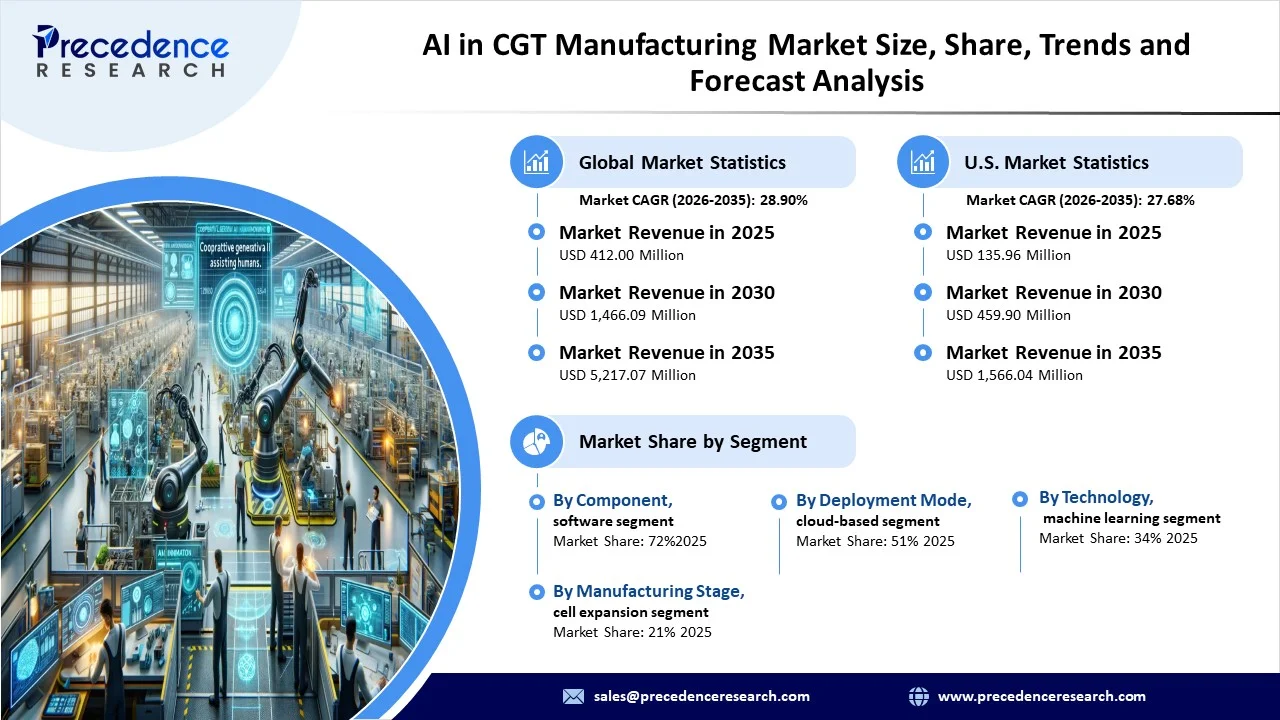
The global AI in CGT manufacturing market revenue surpassed USD 412.00 million in 2025 and is predicted to attain around USD 5,217.07 million by 2035, growing at a CAGR of 28.90%. The market is driven by the pressing need to counter the high levels of complexity, cost, and batch failures associated with the process of producing cell and gene therapies using AI-based optimization of process parameters and quality control.
Smart Manufacturing for Modern Therapies
The AI in CGT manufacturing market includes AI and machine learning (ML) solutions used in the manufacturing process of cell and gene therapies (CGTs), such as CAR-T cells, stem cell therapies, gene-edited therapies, and oncolytic viruses. These therapies are facilitated by software platforms that offer process development, manufacturing execution, quality control, supply chain optimization, and regulatory compliance services. Hardware-based AI solutions enable real-time monitoring and control of bioreactors, cell culture, and analytical instrumentation.
This market has adopted predictive analytics for critical process parameters, computer vision for morphological analysis, natural language processing for regulatory documentation, and reinforcement learning for batch-to-batch optimization. Applications of this technology include process development and scale-up, manufacturing (upstream and downstream), quality optimization (batch release and contamination detection), and logistics (cold chain and chain of identity). This market has been adopted by pharmaceutical and biotechnology firms, contract development and manufacturing organizations (CDMOs), and academic research institutes.
Optimization of Manufacturing Operations by AI Platforms
The market is growing rapidly with the development of end-to-end platforms that utilize AI to process thousands of constructs before manufacture. The process development, quality control, and compliance information data are integrated within such platforms in order to optimize the manufacturing parameters and accelerate the process. In 2026, Form Bio introduced its end-to-end AI platform for manufacturing, which checks a large number of constructs for manufacturing risks before manufacture. This technology provides an 8-times improvement in genome integrity and a 2- to 3-times increase in manufacturing yield.
Manufacturing Platform for Personalized Medicine Uses AI-based Technology
The AI in CGT manufacturing market is witnessing a shift from pilot applications to actual implementation through the use of enterprise AI platforms to improve the process of manufacturing. Biotechnology companies are developing manufacturing data lakes on a large-scale in order to correlate process parameters with yield and quality. The use of such platforms results in an increase in efficiency of production processes and a decrease in batch failures through the identification of constructs that have better manufacturability. At BIO 2026, Kriya Therapeutics announced that it has created a manufacturing data lake consisting of about 100 million data points in engineering and GMP runs. This is used with enterprise-level AI to identify constructs with better manufacturability.
Expansion of Government-Funded Manufacturing of Cell and Gene Therapy
Government institutions across the globe are directly financing the development of CGT manufacturing capacities with an emphasis on incorporating AI and robotics in order to address production constraints. Such initiatives help to provide financial and strategic assistance in building intelligent factories using AI that will be able to decrease costs, increase efficiency, and ensure a regional supply chain for the advanced therapies. In 2025, the Canadian government provided financial support to OmniaBio’s expansion of facilities in Hamilton, Ontario. Within the framework of the Biomanufacturing and Life Sciences Strategy of the country. This initiative is aimed at creating the first cell therapy “Intelligent Factory” by incorporating AI and robotics in the process of manufacturing.
Cellular Origins Secures USD 40 Million Financing for Robotic CGT Automation
Cellular Origins in Cambridge raised a highly oversubscribed Series A funding round of USD 40 million from Johnson and Johnson Innovation to scale up its technology platform for automated manufacturing of cell and gene therapies. The funding seeks to overcome the bottleneck created by existing systems that are used by less than 7% of patients. The system automates labor-intensive tasks, minimizing contamination risks and batch variability.
Market Segmentation Overview
- By deployment mode, the cloud-based segment led the AI in CGT manufacturing market with a 51% share in 2025, and is expected to expand at the highest CAGR of 31.8% during the forecast period, since it offers the needed scalability and computing power for analyzing huge manufacturing datasets without needing costly on-premise infrastructure. Cloud solutions offer collaborative capabilities for remote workers and centralized access to the databases.
- By deployment mode, the on-premises segment held the second-largest market share of 34% in 2025 because large drug manufacturers and CDMOs do not want to transfer their manufacturing data, such as cell line behavior, processing parameters, and batch data, into the cloud environment for concerns about intellectual property security.
- By technology, the machine learning (ML) segment dominated the AI in CGT manufacturing market with a 34% share in 2025, as it forms the basis of all key applications, including predictive modeling for process parameters, quality control, yield optimization, and manufacturing data analysis. This technology has broad application across the entire spectrum of CGT manufacturing, from research and development to clinical production.
- By technology, the generative AI segment is expected to grow at the fastest CAGR of 35.8% from 2026 to 2035, since it tackles the most cost- and time-intensive bottlenecks in CGT development- the creation of new viral vectors and cells, production of synthetic training data for quality control, and preparation of regulatory documents.
- By manufacturing stage, the cell expansion segment led the market with a 21% share in 2025 because it is the most complicated and expensive stage in cell therapy production, since there are many different types of bioreactors used, different methods of feeding, and environmental conditions that influence the cell yield, quality, and viability.
- By manufacturing stage, the gene editing and vector production segment is expected to expand at the highest CAGR of 31.5% during the forecast period, because the use of gene-editing technologies such as CRISPR presents an additional set of problems relating to delivery, accuracy, and off-target effects management. This increases the demand for AI to help in predicting editing efficiency, designing novel viral capsids, and improving transfection and packaging conditions.
- By therapy type, the cell therapy segment dominated the AI in CGT manufacturing market with a 62% share in 2025, as autologous cell therapies, especially CAR-T, are highly complicated manufacturing processes that exhibit great variability in batches. This creates a pressing need for AI for optimization of cell expansion, quality control, and logistics of manufacturing.
- By therapy type, the gene therapy segment is expected to grow at the fastest CAGR of 30.1% from 2026 to 2035, due to the difficulties in scaling up viral vector production, which forms the basis of most gene therapies. As more and more gene therapies are reaching late-stage development with a bigger pipeline, there is an impetus for adopting AI technology to solve the problem of high costs and capacity bottlenecks.
- By end user, the biopharmaceutical companies segment led the AI in CGT manufacturing market with a 46% share in 2025, as they control the intellectual property as well as the commercial pipelines of cell and gene therapies. They are the biggest beneficiaries of cost reductions in manufacturing enabled by AI and failures of batches, as these affect their bottom lines.
- By end user, the contract development and manufacturing organizations (CDMOs) segment is expected to expand at the highest CAGR of 32.4% during the forecast period, since they serve as manufacturing partners to various biopharmaceutical clients, providing them with access to wide-ranging and large volumes of process data, which is vital for training and validation of AI models.
Regional Analysis
North America dominated the AI in CGT manufacturing market with a 44% share in 2025, due to the presence of many cell and gene therapy companies, research facilities, and manufacturing plants forming a rich network of places where AI-based manufacturing solutions could be designed and implemented. The U.S. led the market in North America because of extensive government funding by ARPA-H and NIH, the availability of significant venture capital, which supported AI-based manufacturing firms, and the significant presence of CDMOs and pharmaceutical companies that have made efforts in incorporating AI in medical research. Canada is a significant contributor to the market as it has made significant investments in AI-based manufacturing infrastructure, the emergence of CGT firms and CDMOs, and partnerships between academia and industry in the field of research.
Asia Pacific is expected to grow at the fastest CAGR of 34.6% from 2026 to 2035, due to the fast-paced increase in the number of cell and gene therapy clinical trials, thereby creating an immediate need for AI-powered manufacturing technologies for increased scalability and reduced manufacturing costs. China dominated the market in Asia Pacific owing to immense governmental investments in biomanufacturing technology infrastructure, an efficient domestic pipeline of cell and gene therapy, and fast implementation of AI and automation by Chinese CDMOs and biopharmaceutical companies. India witnessed notable market growth because of its big biopharmaceutical industry, cost-competitive manufacturing infrastructure, and governmental efforts aimed at making India a global center of affordable innovative therapies.
Europe held the second-largest market share of 28% in 2025, owing to its highly stringent regulatory landscape, which favors advanced therapies, and large investments from the government in the development of novel approaches to biomanufacturing through initiatives such as Horizon Europe and Innovate UK. Germany led the market in Europe due to the presence of a thriving CDMO sector, a high level of government support for digitizing manufacturing processes, and the presence of highly reputed research institutions, which are pioneers of AI and automation in cell and gene therapy. The U.K. is a significant contributor to the market due to its world-class cell and gene therapy ecosystem, which includes the Cell and Gene Therapy Catapult, government support for manufacturing advancement, and an AI-focused biotechnology startup cluster.
AI in CGT Manufacturing Market Coverage
| Report Attribute | Key Statistics |
| Market Revenue in 2025 | USD 412.00 Million |
| Market Revenue by 2035 | USD 5,217.07 Million |
| CAGR from 2026 to 2035 | 28.90% |
| Quantitative Units | Revenue in USD million/billion, Volume in units |
| Largest Market | North America |
| Base Year | 2025 |
| Regions Covered | North America, Europe, Asia-Pacific, Latin America, and the Middle East & Africa |
Top Companies in the AI in CGT Manufacturing Market
Thermo Fisher Scientific, Danaher Corporation, and Sartorius AG are some of the key players that manufacture instruments, consumables, and digital systems for the CGT production process. Lonza Group, Catalent, and Samsung Biologics use AI for CGT manufacturing enhancement and scaling. Siemens AG, SAP SE, and Dassault Systèmes offer industrial platforms and digital twin products for automating the CGT workflows. Form Bio, BioCurie, and Streamline Bio are developing solutions for manufacturability prediction and designing genetic medicines.
Segments Covered in This Report
By Component
- Software
- Machine Learning Platforms
- Predictive Analytics Software
- Digital Twin Software
- Process Control & Optimization Software
- Computer Vision Software
- Services
- Consulting Services
- Implementation & Integration Services
- Support & Maintenance Services
By Deployment Mode
- Cloud-based
- On-premises
- Hybrid
By Technology
- Machine Learning (ML)
- Deep Learning
- Computer Vision
- Natural Language Processing (NLP)
- Reinforcement Learning
- Generative AI
By Manufacturing Stage
- Upstream Processing
- Cell Expansion
- Gene Editing and Vector Production
- Downstream Processing
- Fill and Finish
- Quality Control and Release Testing
By Therapy Type
- Cell Therapy
- CAR-T Cell Therapy
- Stem Cell Therapy
- TCR-T Cell Therapy
- NK Cell Therapy
- Gene Therapy
- In Vivo Gene Therapy
- Ex Vivo Gene Therapy
By Application
- Process Optimization
- Predictive Maintenance
- Quality Assurance and Quality Control
- Process Monitoring
- Batch Release Optimization
- Supply Chain and Inventory Management
- Regulatory Compliance
- Digital Twin Simulation
By End User
- Biopharmaceutical Companies
- Contract Development and Manufacturing Organizations (CDMOs)
- Research Institutes
- Academic Institutions
- Hospitals and Cell Therapy Centers
By Organization Size
- Large Enterprises
- Small and Medium-sized Enterprises (SMEs)
By Region
- North America
- Latin America
- Europe
- Asia-pacific
- Middle and East Africa
Get this report to explore global market size, share, CAGR, and trends, featuring detailed segmental analysis and an insightful competitive landscape overview @ https://www.precedenceresearch.com/sample/8541
You can place an order or ask any questions. Please feel free to contact us at sales@precedenceresearch.com |+1 804 441 9344