



Wireless Brain Sensors Market Size, Share and Trends 2026 to 2035
Wireless Brain Sensors Market (By Sensor Type: Wireless EEG Sensors, Dry electrode EEG sensors, Wet electrode EEG sensors, Wireless fNIRS Sensors, Other Brain Sensing Technologies; By Product Type: Wearable Headbands/Headsets, Portable Wireless Brain Monitoring Systems; By Connectivity Type: Bluetooth/BLE-based Sensors, NFC/Near-field Communication Sensors; By Application: Neurological Disorder Diagnosis & Monitoring, Sleep Monitoring & Sleep Medicine, Other Applications; By End-User: Hospitals & Neurology Centers, Consumer, Defense & Sports Organizations; By Use Setting: Clinical/Hospital-based Monitoring, Home-based Monitoring, Research/Lab-based Use; By Technology/Platform: Standalone Wireless Sensor, Integrated Neuro-monitoring Ecosystems; By Channel: Direct Sales to Hospitals & Research Centers, Online/DTC Sales) - Global Industry Analysis, Size, Trends, Leading Companies, Regional Outlook, and Forecast 2026 to 2035
Source: https://www.precedenceresearch.com/wireless-brain-sensors-market
 Get a Sample
 Table Of Content


What is the Wireless Brain Sensors Market Size?
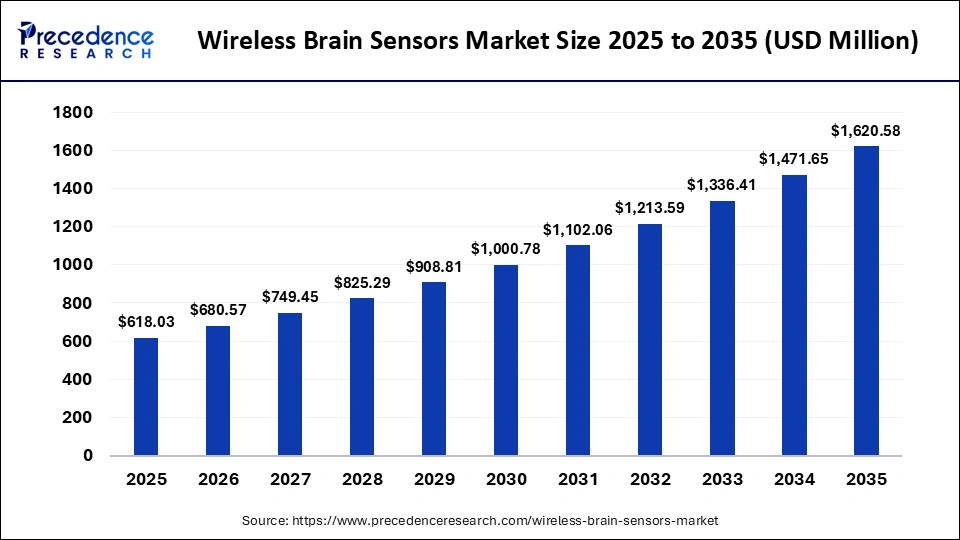
The global wireless brain sensors market size was calculated at USD 618.03 million in 2025 and is predicted to increase from USD 680.57 million in 2026 to approximately USD 1,620.58 million by 2035, expanding at a CAGR of 10.12% from 2026 to 2035. The market is driven by the rising prevalence of neurological disorders and the growing demand for non-invasive, real-time brain monitoring solutions.
Market Highlights
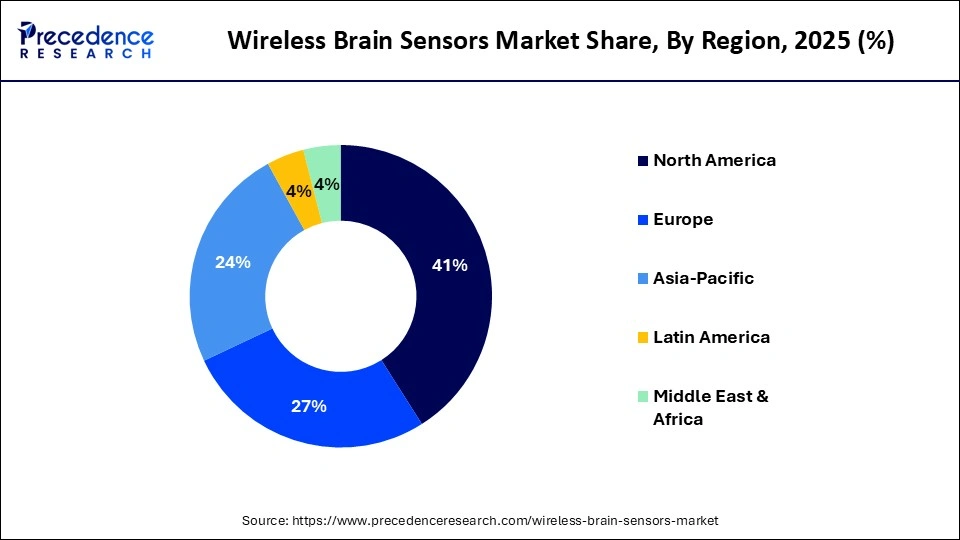
- North America dominated the market by holding more than 41% of market share in 2025.
- Asia-Pacific is expected to grow at the fastest CAGR in the market during the forecast period.
- By sensor type, the wireless EEG sensors segment held a dominant position in the wireless brain sensors market with a share of approximately 62% in 2025.
- By sensor type, the wireless fNIRS sensors segment is expected to grow at the fastest CAGR in the market between 2026 and 2035.
- By product type, the wearable headbands/headsets segment accounted for a considerable revenue share of approximately 44% in the market in 2025.
- By product type, the wireless sensor patches & modular nodes segment is expected to grow with the highest CAGR in the market during the studied years.
- By connectivity type, the Bluetooth/BLE-based sensors segment led the global market with a share of approximately 48% in 2025.
- By connectivity type, the Wi-Fi-enabled sensors segment is expected to expand rapidly in the wireless brain sensors market with a CAGR in the coming years.
- By application, the neurological disorder diagnosis & monitoring segment registered its dominance over the global market with a share of approximately 31% in 2025.
- By application, the brain-computer interface (BCI) & assistive tech segment is expected to witness the fastest growth in the market over the forecast period.
- By end-user, the hospitals & neurology centers segment dominated the global market with a share of approximately 34% in 2025.
- By end-user, the homecare/remote patient monitoring users segment is expected to gain the highest share of the market between 2026 and 2035.
- By use setting, the clinical/hospital-based monitoring segment held the largest revenue share of approximately 43% in the wireless brain sensors market in 2025.
- By use setting, the home-based monitoring segment is expected to show the fastest growth with a CAGR over the forecast period.
- By technology/platform, the wireless sensors with AI analytics software segment contributed the biggest revenue share of approximately 44% in the market in 2025.
- By technology/platform, the integrated neuro-monitoring ecosystems segment is expected to account for the highest growth in the coming years.
- By channel, the direct sales to hospitals & research centers segment held a major revenue share of approximately 46% in the market in 2025.
- By channel, the online/DTC sales (consumer-grade) segment is expected to grow with the highest CAGR in the market during the studied years.
Untethering the Mind: How Wireless Brain Sensors are Redefining Neuro-Monitoring
The wireless brain sensors market companies have advanced neuro-monitoring devices designed to record, transmit, and analyze brain activity without constraints of wired connections. These systems are increasingly adopted across clinical diagnostics and neuroscience research, neurorehabilitation, and continuous brain monitoring. Rising incidence of neurological disorders, mental health conditions, and cognitive impairments, along with the global shift toward remote and home-based care, is accelerating market growth.
Key Technological Advancements in the Market
The market is currently undergoing a major technological transformation, driven by the development of tiny, lightweight sensors that require minimal power and provide better comfort to patients while their health status is under observation. Dry and semi-dry electrode technology enables faster device setup by eliminating the need for conductive gels, making devices easier to operate. Machine learning algorithms and artificial intelligence become integrated into sensor technology platforms, which provide capabilities for real-time signal processing, pattern detection, and early identification of neurological disorders.
Wireless Brain Sensors Market Trends
- Healthcare providers increasingly adopt neuro-monitoring devices that patients can use at home to manage their chronic illnesses and assess their mental health conditions.
- Research institutions and pharmaceutical companies show increased demand for portable EEG systems, which they need during their clinical trial processes.
- The consumer neurotechnology field is growing through the development of products that enable users to track their sleep patterns and manage their stress levels while improving their cognitive abilities.
- Healthcare systems show strong interest in remote tele-neurology solutions, which gained popularity after the outbreak of the COVID-19 pandemic.
Market Scope
| Report Coverage | Details |
| Market Size in 2025 | USD 618.03 Million |
| Market Size in 2026 | USD 680.57 Million |
| Market Size by 2035 | USD 1,620.58 Million |
| Market Growth Rate from 2026 to 2035 | CAGR of 10.12% |
| Dominating Region | North America |
| Fastest Growing Region | Asia Pacific |
| Base Year | 2025 |
| Forecast Period | 2026 to 2035 |
| Segments Covered | Sensor Type, Product Type, Connectivity Type, Application, End-User, Use Setting, Technology/Platform, Channel, and Region |
| Regions Covered | North America, Europe, Asia-Pacific, Latin America, and Middle East & Africa |
Segmental Insights
Sensor Type Insights
Why the Wireless EEG Sensors Segment Dominated the Wireless Brain Sensors Market?
The wireless EEG sensors dominated the market, holding approximately 62% share in 2025, driven by their clinical reliability, broad diagnostic scope, and generalizability across various fields of neurology. These sensors enable tracking of electrical activity in the brain through continuous observation at a high level of temporal resolution, which makes them essential in the diagnosis of epilepsy, sleep disorders, brain injuries, and cognitive dysfunctions.
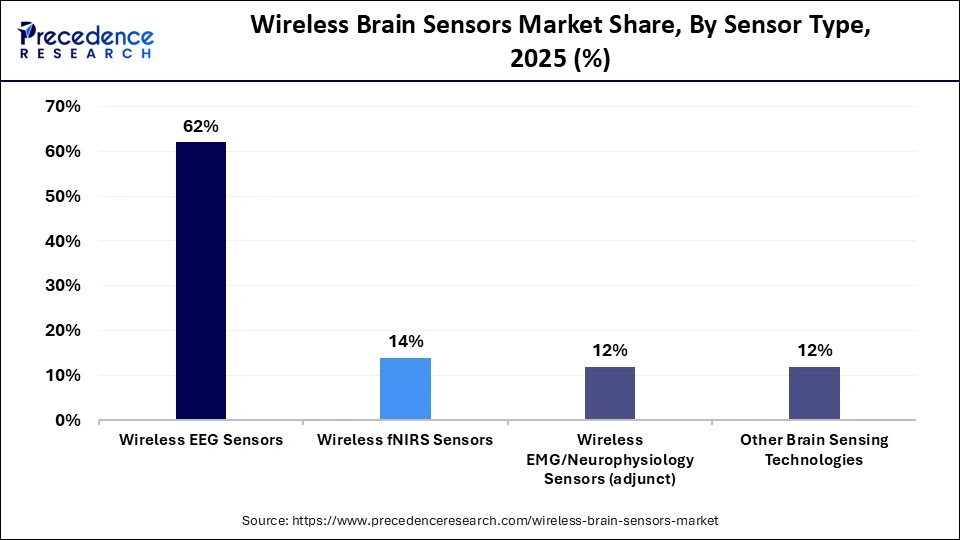
The wireless fNIRS sensors segment is expected to be the fastest-growing in the market, due to the ability to monitor cerebral blood flow and oxygenation, particularly in the prefrontal cortex. These instruments have great benefits in cognitive studies, mental health evaluation, and neurorehabilitation, as they allow insights into the functioning of the brain in naturalistic settings. They are tolerant to movement artefacts and therefore can be used in ambulatory and behavioral studies. The growth rate is accelerated by rising adoption in cognitive neuroscience, human-computer interaction, and brain-computer interface studies.
Product Type Insights
How the Wearable Headbands/Headsets Segment Dominated the Wireless Brain Sensors Market?
The wearable headbands/headsets held the largest revenue share of approximately 44% in the market in 2025, due to their ease of use, comfort, and applicability in monitoring the brain in the frontal position. The latter is commonly used in EEG and fNIRS-based applications to determine attention, stress, sleep, and mental workload. Their ergonomic construction allows for fast and long-term wear, offering suitability for clinical, research, and consumer neurotechnological use.
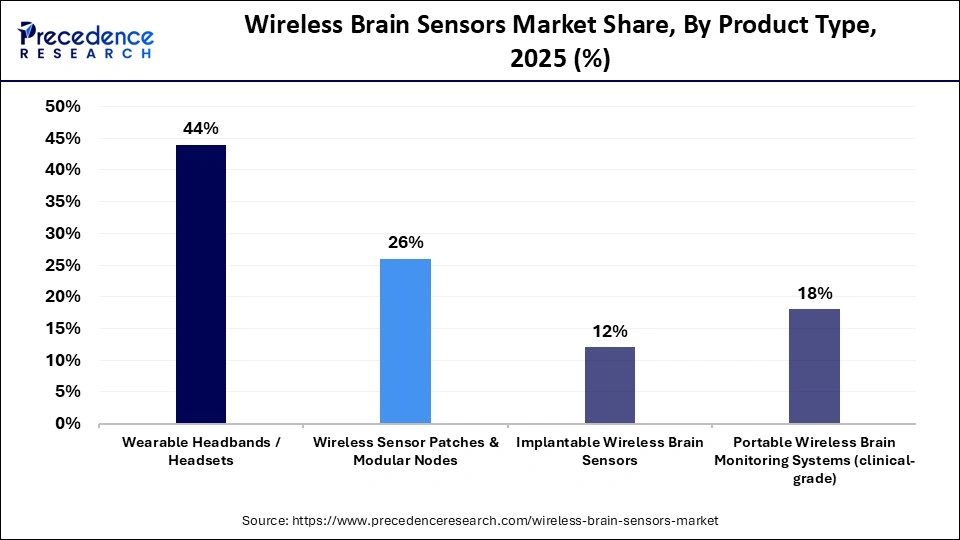
The wireless sensor patches and modular nodes segment is expected to grow the fastest CAGR during the forecast period, driven by their flexibility and scalability. These instruments enable the customization of sensor locations across multiple brain areas, which is useful in high-level neurological research and multimodal monitoring. Their small size and portability allow them to be kept on all the time, and they do not confine patients to a specific area.
Connectivity Type Insights
Which Connectivity Type Segment Led the Wireless Brain Sensors Market?
The Bluetooth/BLE-based sensors segment led the global market with a share of approximately 48% in 2025, due to their low power consumption, stable connectivity, and compatibility with smartphones and wearable ecosystems. These technologies are well-suited for continuous brain monitoring, enabling long battery life and seamless data transmission in both clinical and home settings. The aspect of dominance is reinforced by a wide range of infrastructure and familiarity with regulations. The BLE connectivity enables it to be integrated with mobile health systems, cloud analytics, and AI-based applications.
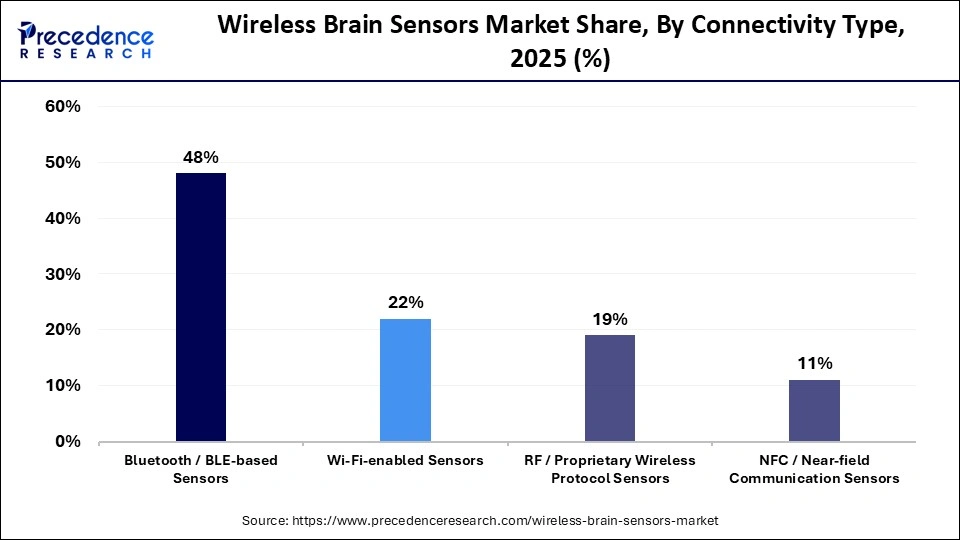
The Wi-Fi-enabled sensors segment is expected to grow at the highest CAGR between 2026 and 2035, due to the need to send high-bandwidth and real-time data to the cloud. These sensors are useful in hospital-based monitoring and research-intensive settings, as they can support advanced analytics, high-resolution data streaming, and multi-user access. The development of tele-neurology programs and smart healthcare infrastructure facilitates growth. Wi-Fi connectivity enables the seamless integration of electronic health records and centralized monitoring systems.
Application Insights
Which Application Segment Dominated the Wireless Brain Sensors Market?
The neurological disorder diagnosis & monitoring held a major revenue share of approximately 31% in 2025, driven by the increasing number of epilepsy, stroke, dementia, and sleep disorders. Wireless brain sensors can be used to continuously monitor in the real world, facilitating more suitable diagnostics and customized treatment. Their capacity to record long-term brain activity patterns promotes clinical decision-making process.
The brain-computer interface (BCI) & assistive tech segment is expected to expand rapidly in the market in the coming years, because of the rapid progress of neurotechnology and human-machine interactions. The importance of wireless brain sensors is that they can be used to convert the neural signal to an actionable form to be used in assistive devices, rehabilitation, and cognitive enhancement systems.
End-User Insights
Why Did the Hospitals & Neurology Centers Segment Dominate the Wireless Brain Sensors Market?
The hospitals & neurology centers segment dominated the market by holding a share of approximately 34% in 2025, where there is a high clinical need for accurate and validated brain monitoring solutions. Wireless brain sensors have high applications in diagnosis, treatment planning, and post-treatment monitoring of controlled healthcare settings. They dominate them due to the availability of trained professionals, regulatory compliance, and connectivity with hospital IT systems.
The homecare/remote patient monitoring users segment is expected to witness the fastest growth in the market over the forecast period, due to the move towards remote patient monitoring and decentralized healthcare. Neural wireless sensors enable continuous neurological evaluation at home, lowering hospitalization and enhancing patient adherence. The increase in the adoption of wearable technologies, telemedicine software, and AI-based health apps supports growth. This segment is one of the areas of focus because home-based monitoring is particularly growing in chronic neurological care, mental health care, and post-stroke rehabilitation.
Use Setting Insights
How the Clinical/Hospital-based Monitoring Segment Dominated the Wireless Brain Sensors Market?
The clinical/hospital-based monitoring segment contributed the biggest revenue share of approximately 43% in the market in 2025, driven by clinical and hospital-based monitoring, as the use of high-quality real-time brain-based information is of paramount importance during diagnosis and treatment. The wireless brain sensors are used to boost the efficiency of the workflow because they allow mobility and provide clinical-grade precision. This market is also growing well because hospitals are implementing superior wireless systems that allow them to perform continuous monitoring and tele-neurology services.
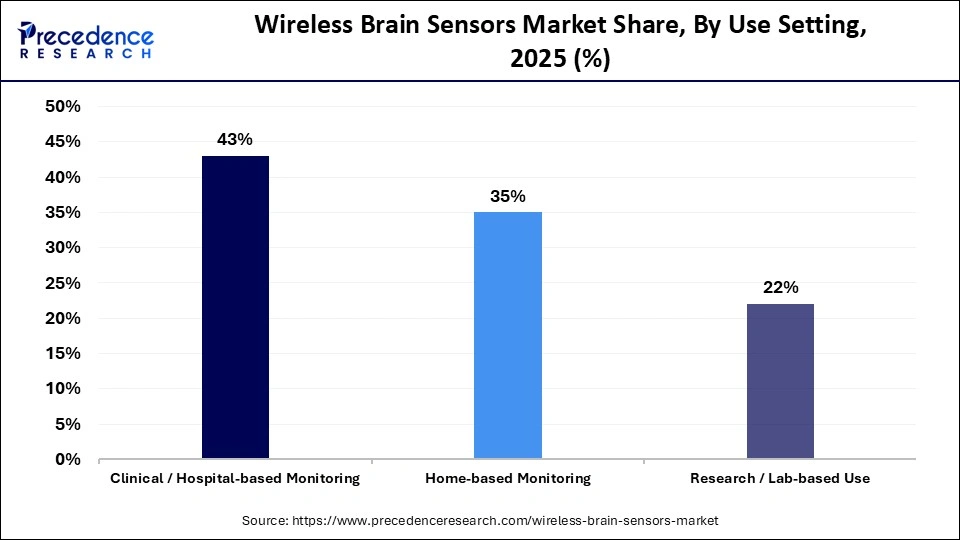
The home-based monitoring segment is expected to witness the fastest growth in the market over the forecast period, due to the growing geriatric population and the shifting trend toward home-based monitoring. Home-based monitoring eliminates the need for patients to visit any healthcare organization, saving time and costs. It enhances patient convenience and increases treatment accessibility, especially for patients living in remote areas.
Technology/Platform Insights
Which Technology/Platform Segment Dominated the Wireless Brain Sensors Market?
The wireless sensors with AI analytics software segment accounted for the highest revenue share of approximately 44% in the market in 2025, because they can convert raw brain signals into usable clinical information. With AI, pattern recognition, anomaly detection, and predictive analytics can be recognized in real-time to enhance the speed and accuracy in diagnosis. Professionals in the healthcare sector are becoming more attracted to AI-based solutions in their personal treatment planning and automated reporting.
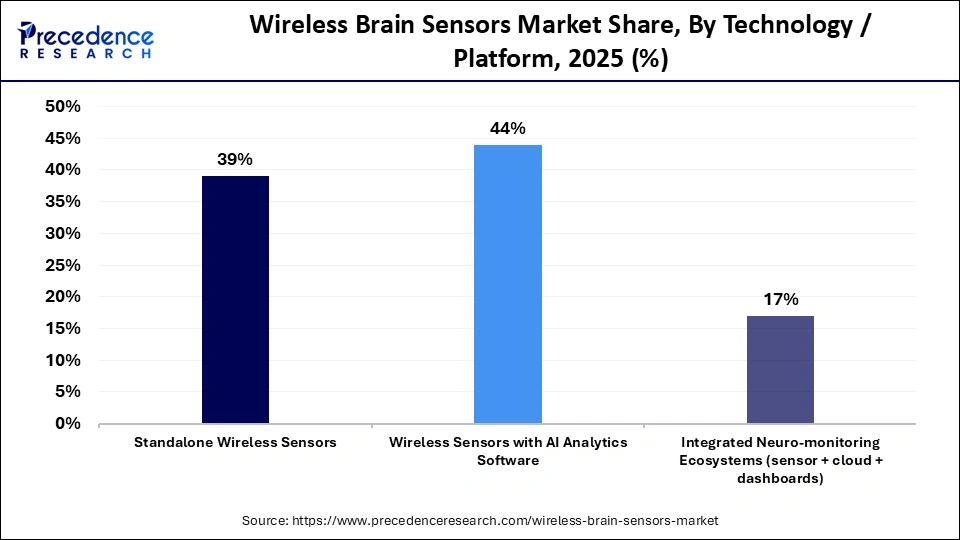
The integrated neuro-monitoring ecosystems segment is expected to show the fastest growth over the forecast period, which is a combination of brain sensors and peripheral nervous system monitoring, cloud platforms, and digital health tools. These ecosystems allow the holistic evaluation of the brain-body interactions. The demand is fuelled by the development in the need for holistic neurological information in rehabilitation, mental health, and performance monitoring. The smooth connection between wearables, mobile applications, and healthcare information systems is making the adoption faster and increasing the functional level of wireless brain sensor platforms.
Channel Insights
Which Channel Segment Dominated the Wireless Brain Sensors Market?
The direct sales to hospitals & research centers segment dominated the market with a share of approximately 46% in 2025, as wireless brain sensor systems are complex in nature. Producers also depend on personal contact to offer personalization, training, and technical assistance. The channel guarantees regulatory compliance, long-term customer contracts, and good customer relationships. The models of direct sales are still supported by high-value procurement and research-based demand.
The online/DTC sales (consumer-grade) segment is expected to grow at the fastest CAGR in the market between 2026 and 2035, due to the increasing consumer interest in brain health, wellness, and cognitive performance monitoring. E-commerce services allow expanding the market and implementing the products more quickly. Increased access to wearable brain sensors and digital health applications helps with growth. With the introduction of consumer neurotechnological acceptance, online distribution is becoming another important growth channel.
Regional Insights
How Big is the North America Wireless Brain Sensors Market Size?
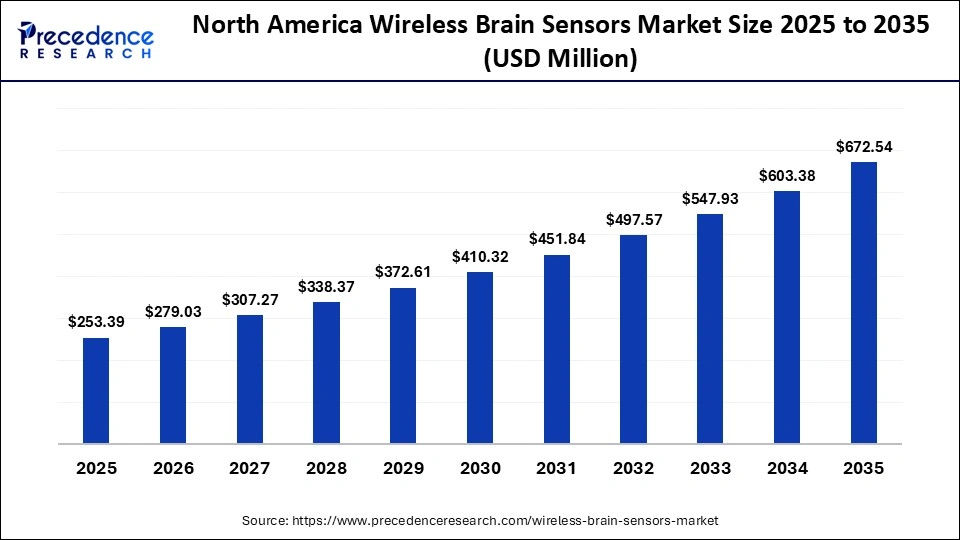
The North America wireless brain sensors market size is estimated at USD 253.39 million in 2025 and is projected to reach approximately USD 672.54 million by 2035, with a 10.25% CAGR from 2026 to 2035.
Why North America Dominated the Wireless Brain Sensors Market?
North America dominated the market with a share of approximately 41% in 2025, due to advanced healthcare infrastructure, high adoption of digital health technologies, and the strong presence of leading neurotechnology companies. The region benefits from early integration of AI-driven brain monitoring solutions across hospitals, research institutions, and homecare settings. High prevalence of neurological disorders and strong reimbursement frameworks further support widespread adoption. Continuous investments in neuroscience research and brain-computer interface development reinforce regional leadership.
What is the Size of the U.S. Wireless Brain Sensors Market?
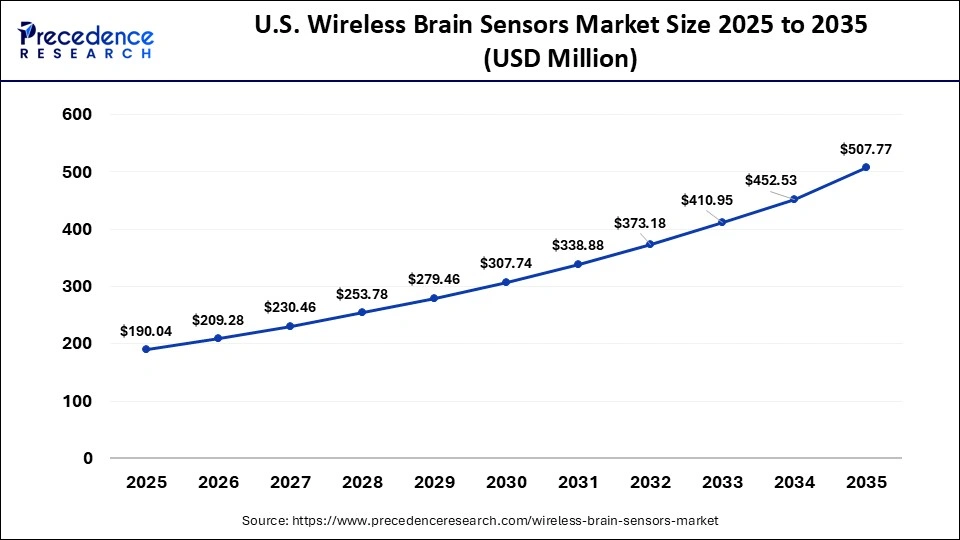
The U.S. wireless brain sensors market size is calculated at USD 190.04 million in 2025 and is expected to reach nearly USD 507.77 million in 2035, accelerating at a strong CAGR of 10.33% between 2026 and 2035.
Country Level Analysis
The U.S. accounts for the largest share, driven by extensive clinical research activity, rapid commercialization of wearable neurotechnology, and strong FDA regulatory pathways for innovative devices. Canada contributes steadily through academic research collaborations and the growing adoption of remote neurological monitoring in public healthcare systems. The presence of major universities and research labs accelerates technology validation and deployment. Together, these factors sustain North America's dominant market position.
How is Asia-Pacific Growing in the Wireless Brain Sensors Market?
Asia-Pacific is expected to host the fastest-growing market in the coming years, driven by expanding healthcare access, rising neurological disease burden, and increasing awareness of mental health. Rapid adoption of wearable medical devices and growing investments in digital health infrastructure are accelerating market expansion. Governments across the region are supporting innovation through healthcare modernization initiatives. The large population base further amplifies demand for scalable, cost-effective brain monitoring solutions.
Country Level Analysis
China leads growth due to strong manufacturing capabilities, rising neurotechnology research, and increasing hospital adoption of wireless monitoring systems. Japan plays a key role in advanced neuroscience research, the aging population needs, and the early adoption of brain-computer interface technologies. India is emerging rapidly, supported by expanding telemedicine networks and growing use of wearable health technologies. Collectively, these countries position Asia Pacific as the primary growth engine for the global market.
Wireless Brain Sensors Market Value Chain Analysis
R&D
R&D activities of the company study reduced sensor size, improved signal processing accuracy, enhanced battery performance, and developed new methods to interpret brain signals through advanced algorithms. The ongoing development of materials science, electrode design, and AI-based analytics is producing unique products that improve clinical outcomes.
Key players: Virbac, Advanced Brain Monitoring, Inc., and NeuroTech Solutions.
Clinical Trials and Regulatory Approvals
The process of clinical validation requires testing to establish that wireless brain sensors can safely operate and correctly detect neurological and cognitive conditions. The regulatory approval process requires organizations to meet medical device regulations, data protection requirements, and operational testing standards, resulting in extended product development time but enhancing the trustworthiness of their offerings.
Key players: HIPRA, Medtronic plc, and EMOTIV, Inc.
Assembly and Installation
The wireless brain sensor system needs this stage of development, which requires system integration device assembly, firmware installation, and calibration to achieve proper signal acquisition. The final preparation process includes usability testing, which ensures that different user groups, including clinicians, researchers, and patients, can use the system effectively.
Key players: Indian Immunological Ltd., Brain Products GmbH.
Packaging and Serialization
The packaging system protects delicate electronic parts during transport while maintaining simple handling procedures. The sterilization process and contamination control methods work as essential protection measures for medical devices used in hospitals and clinics when their products need to contact human skin or scalp.
Key players: AbbVie
Distribution to Hospitals, Pharmacies
Distribution channels usually operate through medical device distributors who deliver products to hospitals, specialized medical facilities, and diagnostic testing centers. The delivery system and training support for medical staff create essential value by delivering products on schedule and handling device repairs.
Key players: Ceva, NeuroSky, and Neuroelectrics.
Who are the Major Players in the Global Wireless Brain Sensors Market?
The major players in the wireless brain sensors market include EMOTIV, Advanced Brain Monitoring, Inc., NeuroSky, Neuroelectrics, and Neuronetrix Solutions, LLC.
Recent Developments
- In January 2026, the CES 2026 preview showcased a broad range of next-generation consumer technologies, including AI-powered devices, robotics, and advanced health and brain-monitoring solutions. The event underscores a strong shift toward practical, everyday applications of emerging technologies, with innovations spanning smart electronics, wellness devices, and experiential consumer tech.(Source: https://spectrum.ieee.org)
- In November 2025, Next Sense raised USD 16 million in an oversubscribed Series A funding round to support the launch of the world's first truly wireless earbuds integrated with EEG sensors. The funding was raised to accelerate the commercialization of its in-ear brain monitoring technology, enabling clinically accurate tracking of brain activity to enhance sleep, focus, and overall brain health.(Source: https://www.businesswire.com)
Segments Covered in the Report
By Sensor Type
- Wireless EEG Sensors
- Dry electrode EEG sensors
- Wet electrode EEG sensors
- Wireless fNIRS Sensors
- Wireless EMG/Neurophysiology Sensors (adjunct)
- Other Brain Sensing Technologies
By Product Type
- Wearable Headbands/Headsets
- Wireless Sensor Patches & Modular Nodes
- Implantable Wireless Brain Sensors
- Portable Wireless Brain Monitoring Systems (clinical-grade)
By Connectivity Type
- Bluetooth/BLE-based Sensors
- Wi-Fi-enabled Sensors
- RF/Proprietary Wireless Protocol Sensors
- NFC/Near-field Communication Sensors
By Application
- Neurological Disorder Diagnosis & Monitoring
- Epilepsy monitoring
- Parkinson's/dementia support
- Sleep Monitoring & Sleep Medicine
- Brain-Computer Interface (BCI) & Assistive Tech
- Cognitive Performance & Neuro-wellness Tracking
- Concussion/TBI Monitoring
- Other Applications
By End-User
- Hospitals & Neurology Centers
- Research Institutes & Universities
- Homecare/Remote Patient Monitoring Users
- Consumer Neuro-wellness User
- Defense & Sports Organizations
By Use Setting
- Clinical/Hospital-based Monitoring
- Home-based Monitoring
- Research/Lab-based Use
By Technology/Platform
- Standalone Wireless Sensors
- Wireless Sensors with AI Analytics Software
- Integrated Neuro-monitoring Ecosystems (sensor + cloud + dashboards)
By Channel
- Direct Sales to Hospitals & Research Centers
- Distributors/Medical Device Suppliers
- Online/DTC Sales (consumer-grade)
By Region
- North America
- Europe
- Asia-Pacific
- Latin America
- Middle East & Africa
For inquiries regarding discounts, bulk purchases, or customization requests, please contact us at sales@precedenceresearch.com
Frequently Asked Questions





Ask For Sample
No cookie-cutter, only authentic analysis – take the 1st step to become a Precedence Research client
 Get a Sample




 sales@precedenceresearch.com
 Schedule a Meeting
