



AI IP and Licensing Market Trends, Companies, Revenue / Sales Performance, Subscriber Growth, Pricing Strategies, Cloud Adoption, Infrastructure Expansion, Competitive Landscape, and Industry Outlook
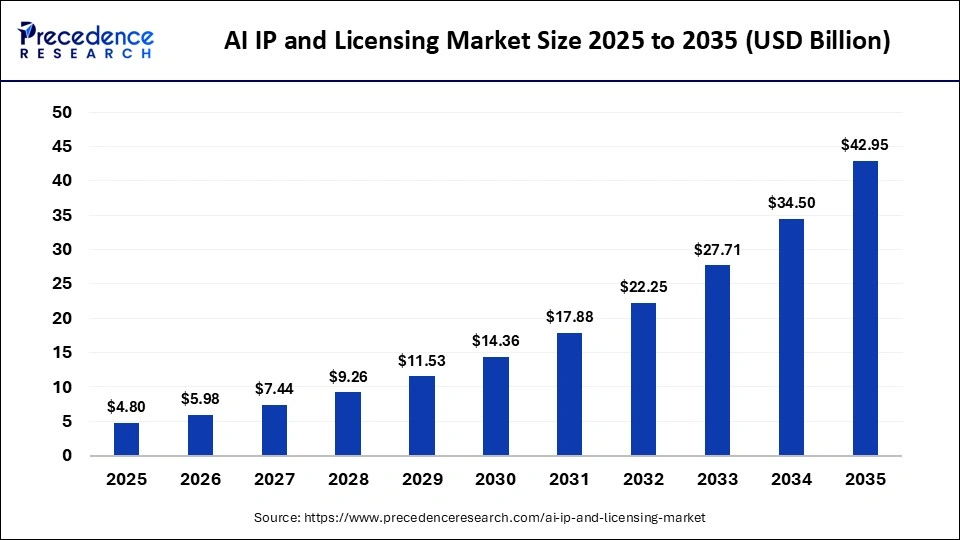
ICT industry specialist Shivani Zoting estimates the ai ip and licensing market at USD 5.98 billion in 2026, with continued technology adoption expected to take the market to USD 42.95 billion by 2035 at a CAGR of 24.50%. Leading ai ip and licensing market providers such as Alphabet Inc. (Google DeepMind), ARM Holdings plc, Cadence Design Systems, Inc., CEVA, Inc., Graphcore Ltd. are expanding their capabilities across segments including By IP Type, By Deployment Model, By Application, By End-Use Industry.
Source: https://www.precedenceresearch.com/ai-ip-and-licensing-market
 Get a Sample
 Table Of Content


What is the AI IP and Licensing Market Size in 2026?
The global AI IP and licensing market size accounted for USD 4.80 billion in 2025 and is predicted to increase from USD 5.98 billion in 2026 to approximately USD 42.95 billion by 2035, expanding at a CAGR of 24.50% from 2026 to 2035. The market growth is attributed to increasing enterprise demand for proprietary AI model licensing frameworks and scalable monetization of digital intellectual property assets.
Key Takeaways
- North America dominated the market with a 42% share in 2025.
- Asia Pacific is expected to grow at the highest CAGR between 2026 and 2035.
- By IP type, the processor IP (AI Accelerators, NPUs, GPUs) segment contributed a major market share of 45% in 2025.
- By IP type, the AI algorithm & model licensing segment held a 25% share of the market in 2025 and is expected to grow at the highest CAGR between 2026 and 2035.
- By deployment model, the cloud-based AI model licensing segment held a major market share of 45% in 2025.
- By deployment model, the on-device AI IP licensing segment held a 40% market share in 2025 and is expected to grow at a robust CAGR during the projection period.
- By application, the data centers & cloud AI segment held a market share of 30% in 2025.
- By application, the smart consumer electronics segment contributed a 25% market share in 2025 and is estimated to grow at a strong CAGR over the projected period.
- By end-use industry, the semiconductor & electronics segment contributed the largest market share of 35% in 2025.
- By end-use industry, the automotive segment held a 20% share of the market in 2025 and is expected to grow at the fastest CAGR between 2026 and 2035.
Market Overview
The AI IP and licensing market is primarily driven by rising enterprise investment in generative AI technologies, which require structured intellectual property protection and monetization frameworks. AI IP and licensing is the proprietary protection and commercialization of algorithms, models, data, and AI software by patent, copyright, and licensing agreements. These play a monetizing role based on subscription access, API licensing, royalty strategies, and cross-industry collaborations in various industries.
The total investment in generative AI-based companies exceeded USD 35.3 billion by the year 2025. This further shows a high level of interest in owning unique AI models and licensing. Furthermore, the trend toward a more commercial AI model and business dependence on licensed solutions keeps gaining momentum, necessitating a solid intellectual property approach to AI.
Major Market Trends
- Rising AI Use Across Sectors: The adoption of AI is rising beyond the technology industry to government services and regulated sectors. This significantly drives the need to have sector-specific licensing agreements based on the needs of the regulators and ethical and operational demands.
- Rising Importance of Data Ownership Rights: Increasing focus on data governance is boosting structured licensing of datasets and training resources.
- Growth in API-Based AI Monetization: Expanding use of AI APIs is fuelling recurring revenue models and broader commercialization of proprietary technologies.
Market Scope
| Report Coverage | Details |
| Market Size in 2025 | USD 4.80 Billion |
| Market Size in 2026 | USD 5.98 Billion |
| Market Size by 2035 | USD 42.95 Billion |
| Market Growth Rate from 2026 to 2035 | CAGR of 24.50% |
| Dominating Region | North America |
| Fastest Growing Region | Asia Pacific |
| Base Year | 2025 |
| Forecast Period | 2026 to 2035 |
| Segments Covered | IP Type, Deployment Model, Application, End-Use Industry, and Region |
| Regions Covered | North America, Europe, Asia-Pacific, Latin America, and Middle East & Africa |
Market Dynamics
Drivers
Increasing Adoption of AI Among Enterprises
Increasing enterprise adoption of intelligent technologies, including AI, across industries is expected to drive the growth of the AI IP and licensing market. Ownership of trained models and datasets is a priority among enterprises to enable long-term competitive positioning and differentiation. Furthermore, the expansion of enterprise-led deployments is increasing the need for robust IP protection and effective monetization strategies to safeguard innovations and maximize their commercial value.
Restraint
Complex Intellectual Property Ownership Disputes
Rising complexity in intellectual property ownership disputes is expected to hinder the AI IP and licensing market in the coming years. There is often a conflict in ownership between organizations. Businesses are also apprehensive about the implementation of externally licensed models without the establishment of ownership rights.
Opportunity
Growing Adoption of API-Based AI Monetization
The growing reliance on API-based delivery models is expected to expand monetization opportunities for proprietary algorithms and intelligent systems. Organizations are increasingly leveraging APIs to power applications such as automation, analytics, and customer engagement solutions. This approach enables continuous revenue generation while maintaining control over the underlying intellectual property. Additionally, rapid advancements in high-performance computing and cloud infrastructure are anticipated to further support the development, deployment, and licensing of complex intelligent systems at scale.
Segment Insights
IP Type Insights
The Processor IP Segment Dominated the Market With a 45% Share in 2025
In 2025, the processor IP (AI accelerators, NPUs, GPUs) segment dominated the AI IP and licensing market with the largest share of 45%. This is mainly due to innovations in chip architecture and the growing use of heterogeneous computing systems. The initiation of edge intelligence is driving the demand for compact and power-efficient IP processor solutions. The segment's dominance is also reinforced by the rising demand for AI chips, NPUs, and accelerators across edge devices, autonomous systems, and data centers requiring high-performance computing.
AI IP and Licensing Market Share, By IP Type, 2025-2035 (%)
| IP Type | 2025 | 2035 | CAGR (%) |
| Processor IP (AI Accelerators, NPUs, GPUs) | 45.00% | 47.00% | 23.50% |
| Memory IP for AI Workloads | 15.00% | 16.00% | 22.00% |
| Interface & Connectivity IP | 15.00% | 14.50% | 21.00% |
| AI Algorithm & Model Licensing | 25.00% | 22.50% | 28.00% |
The memory IP for AI workloads segment held a 15% share of the market in 2025 and is expected to grow at a significant CAGR between 2026 and 2035, owing to the growing demand for high-bandwidth and low-latency memory architectures in data-intensive applications. However, memory IP is critical for high-bandwidth and low-latency AI processing, especially in data-intensive applications. Firms are also investing in new-generation memory technologies, such as HBM and DDR models, to enable high-scale model execution. The increase in demand for real-time analytics and edge computing is creating a high need for memory IP.
The interface & connectivity IP segment held a 15% share of the market in 2025 and is expected to grow at a notable CAGR during the projection period. The growth of the segment is driven by the need for high-speed interconnect IP, which is essential for efficient data transfer between AI components, especially in large-scale data centers and HPC environments. Quick interconnects, including PCIe, CXL, and modern networking protocols, facilitate effective communication between processors, memory, and storage devices.
The AI algorithm & model licensing segment held the second-largest market share of 25% in 2025 and is estimated to grow at the highest CAGR over the projected period. This is mainly due to the increasing demand for customized and domain-specific solutions. The rising demand for pre-trained AI models, foundation models, and API-based AI services across industries is expected to drive segmental growth.
Deployment Model Insights
AI IP and Licensing Market Share, By Deployment Model, 2025-2035 (%)
| Deployment Model | 2025 | 2035 | CAGR (%) |
| On-device AI IP Licensing | 40.00% | 38.00% | 22.00% |
| Cloud-based AI Model Licensing | 45.00% | 48.00% | 27.50% |
| Hybrid Licensing Models | 15.00% | 14.00% | 25.00% |
The Cloud-based AI Model Licensing Segment Held a 45% Market Share in 2025
The cloud-based AI model licensing segment dominated the AI IP and licensing market with the largest share of 45% in 2025. This is mainly due to the increased need to have scalable and centrally controlled intelligent systems within enterprises. The ease of deployment of cloud-based models and increasing enterprise reliance on AI-as-a-service platforms also reinforced the segment's dominance.
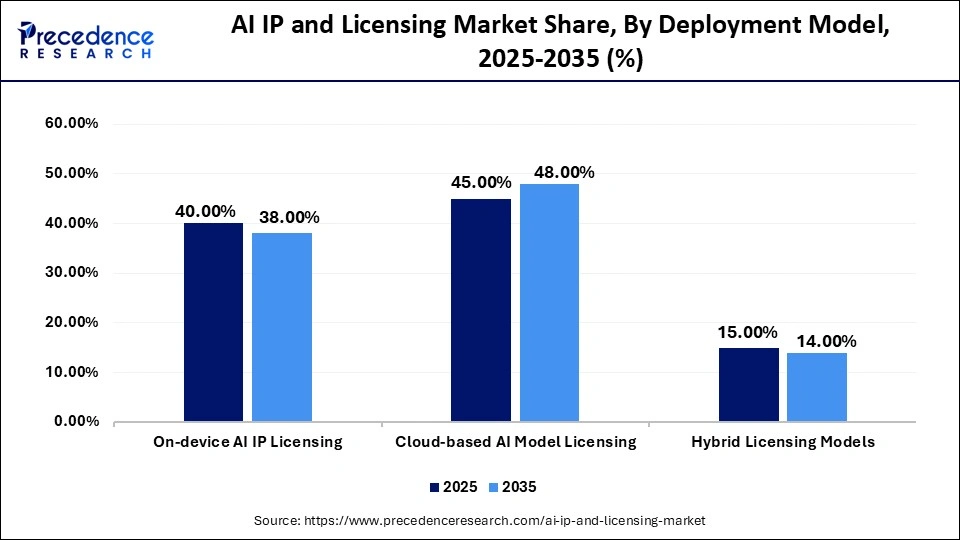
The on-device AI IP licensing segment held the second-largest share of 40% in the market in 2025 and is expected to grow at a significant CAGR between 2026 and 2035. The growth of the segment is attributed to the increasing demand for low-latency, real-time processing and enhanced data privacy, which are critical for applications such as smartphones, wearables, and edge devices. Additionally, enterprises prefer on-device deployment to reduce cloud dependency and operational costs while ensuring secure execution of proprietary AI models directly on end-user hardware.
The hybrid licensing models segment held a 15% share of the market in 2025 and is expected to grow at the fastest CAGR during the projection period, the increasing need for flexibility in deploying AI workloads across both cloud and on-device environments. This approach allows organizations to balance performance, cost efficiency, scalability, and data security while optimizing AI usage based on specific application requirements.
Application Insights
Why Did the Data Centers & Cloud AI Segment Dominated the Market in 2025?
The data centers & cloud AI segment dominated the AI IP and licensing market with a major share of 30% in 2025. This is mainly due to the rapid growth of AI-based digital services and enterprise cloud transformation projects. Organizations are increasingly investing in specialized computing accelerators and high-speed interconnect technologies to improve processing efficiency and optimize AI workloads. Additionally, the growing adoption of generative AI systems and real-time analytics applications is further accelerating demand within the segment.
The autonomous vehicles segment held a 20% share of the market in 2025 and is expected to grow at a significant CAGR over the projected period. This is because autonomous driving systems require advanced AI IP for perception, decision-making, and safety-critical operations, driving strong adoption.
As vehicles progress toward higher levels of autonomy, the demand for sophisticated intellectual property and advanced AI capabilities continues to rise. Companies such as Qualcomm Inc. and NVIDIA Corporation are advancing automotive AI solutions that enable real-time perception and autonomous decision-making. These developments are further accelerating the need for licensed technologies within autonomous mobility ecosystems.
AI IP and Licensing Market Share, By Application, 2025-2035 (%)
| Application | 2025 | 2035 | CAGR (%) |
| Autonomous Vehicles | 20.00% | 22.00% | 26.00% |
| Smart Consumer Electronics | 25.00% | 23.00% | 22.00% |
| Data Centers & Cloud AI | 30.00% | 32.00% | 27.00% |
| Healthcare AI Systems | 10.00% | 10.50% | 24.00% |
| Industrial Automation & Robotics | 10.00% | 9.50% | 23.00% |
| Financial Services & Risk Modeling | 5.00% | 3.00% | 21.50% |
The smart consumer electronics segment held the second-largest market share of 25% in 2025 and is expected to grow at a notable rate between 2026 and 2035. This growth is driven by the increasing integration of intelligent functionalities across smartphones, wearables, and smart home devices. Manufacturers are embedding licensed AI technologies such as voice recognition models, personalization engines, and real-time user interaction systems into their products. These advancements are accelerating the adoption and integration of licensed AI IP within the consumer electronics ecosystem.
The healthcare AI systems segment held a 10% share of the market in 2025 and is expected to grow at the fastest CAGR between 2026 and 2035. This is mainly due to the increasing adoption of intelligent systems in diagnostics, medical imaging, and clinical decision support applications. The expansion of telemedicine and remote diagnostic services is further accelerating the integration of AI technologies in healthcare workflows. These developments are strengthening the role of healthcare as a key contributor within the AI IP and licensing ecosystem.
The industrial automation & robotics segment held a 10% share in 2025, driven by the growing emphasis on precision, operational efficiency, and cost optimization in industrial processes. Industries are increasingly integrating advanced AI algorithms into robotic systems to enable autonomous operations and adaptive functionality. As a result, licensing strategies are evolving toward scalable solutions capable of supporting diverse industrial environments.
The financial services & risk modeling segment held a 5% market share in 2025 and is estimated to grow at a notable rate over the projected period. This growth is supported by the increasing adoption of AI-powered solutions for fraud detection, risk assessment, and automated trading. Financial institutions are leveraging licensed AI models to efficiently process large volumes of transactional and behavioral data, enhancing decision-making and operational accuracy.
End-Use Industry Insights
The Semiconductor & Electronics Segment Led the Market With a 35% Share in 2025
The semiconductor & electronics segment dominated the AI IP and licensing market while holding a major share of 35% in 2025. This dominance is primarily driven by the rising production of edge computing and intelligent devices. Semiconductor companies are increasingly integrating AI intellectual property into chipsets to enable edge AI capabilities and high-performance computing solutions.
The automotive segment held the second-largest market share of 20% in 2025 and is expected to grow at the fastest CAGR between 2026 and 2035. This is mainly due to the increasing integration of smart features within modern vehicles. Licensed algorithms for perception, navigation, and decision-making are being embedded into vehicle architectures by manufacturers. As the industry continues to shift toward higher levels of automation, demand for specialized AI intellectual property is rising significantly.
AI IP and Licensing Market Share, By End-Use Industry, 2025-2035 (%)
| End-Use Industry | 2025 | 2035 | CAGR (%) |
| Semiconductor & Electronics | 35.00% | 37.00% | 24.00% |
| Automotive | 20.00% | 22.00% | 25.50% |
| Healthcare | 10.00% | 10.50% | 23.00% |
| BFSI | 10.00% | 9.00% | 21.00% |
| Manufacturing | 15.00% | 13.50% | 22.50% |
| IT & Telecommunications | 10.00% | 8.00% | 23.00% |
The manufacturing segment held a 15% share of the market in 2025 and is expected to grow at a significant rate during the projection period. This growth is driven by the increasing adoption of intelligent systems for automation, predictive maintenance, and process optimization. Licensing strategies are increasingly focused on scalable AI solutions that can be deployed across diverse industrial environments, further supporting the expansion of the market.
The healthcare segment held around 10% of the market share in 2025, supported by the growing integration of intelligent systems in diagnostics, medical imaging, and clinical workflows. Healthcare providers are increasingly adopting licensed AI models to enhance diagnostic accuracy and improve treatment planning. The market is further driven by the rising demand for personalized medicine and data-driven healthcare solutions.
The BFSI segment held a 10% share of the market in 2025, driven by the increasing adoption of intelligent systems for fraud detection, credit scoring, and risk assessment. Financial institutions are leveraging licensed AI models to process large volumes of transactional and behavioral data more efficiently. The segment growth is further supported by growing emphasis on regulatory compliance and enhanced data security requirements.
The IT & telecommunications segment held a 10% market share in 2025, supported by the expanding deployment of 5G infrastructure and advanced connectivity solutions. Intelligent automation is increasingly being integrated to improve the efficiency of large-scale network operations. Licensing frameworks are further enabling interoperability and scalability across diverse platforms.
Regional Insights
North America AI IP and licensing Market Size and Growth 2026 to 2035
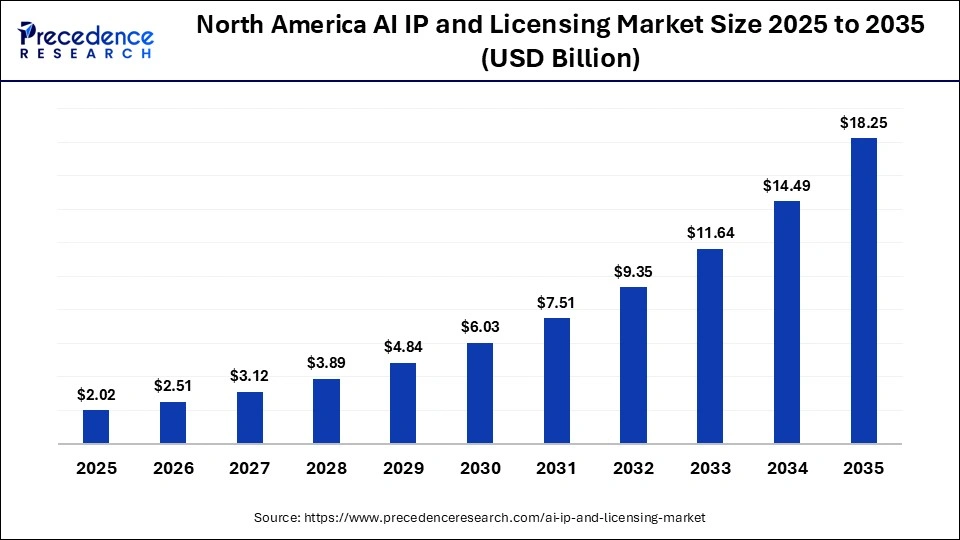
The North America AI IP and licensing market size is estimated at USD 2.02 billion in 2025 and is projected to reach approximately USD18.25 billion by 2035, with a 24.62% CAGR from 2026 to 2035.
North America Dominated the Market With a 42% Share in 2025
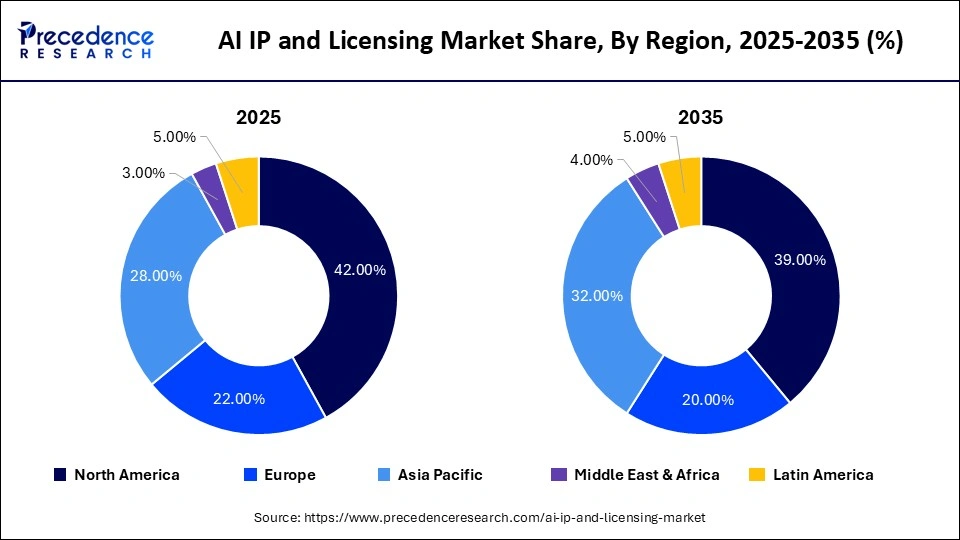
North America led the AI IP and licensing market, capturing the largest revenue share of 42% in 2025. The region's dominance is driven by the concentration of leading technology firms, advanced research institutions, and strong intellectual property frameworks. Firms like Microsoft, Alphabet Inc., and NVIDIA are in the process of developing their own models, chip architecture, and licensing platforms. The United States Patent and Trademark Office reports that the number of patent applications related to AI in 2025 has increased, especially in machine learning and semiconductor innovations. These innovations are strengthening the intellectual property-based ecosystems in the region.
U.S. AI IP and licensing Market Size and Growth 2026 to 2035
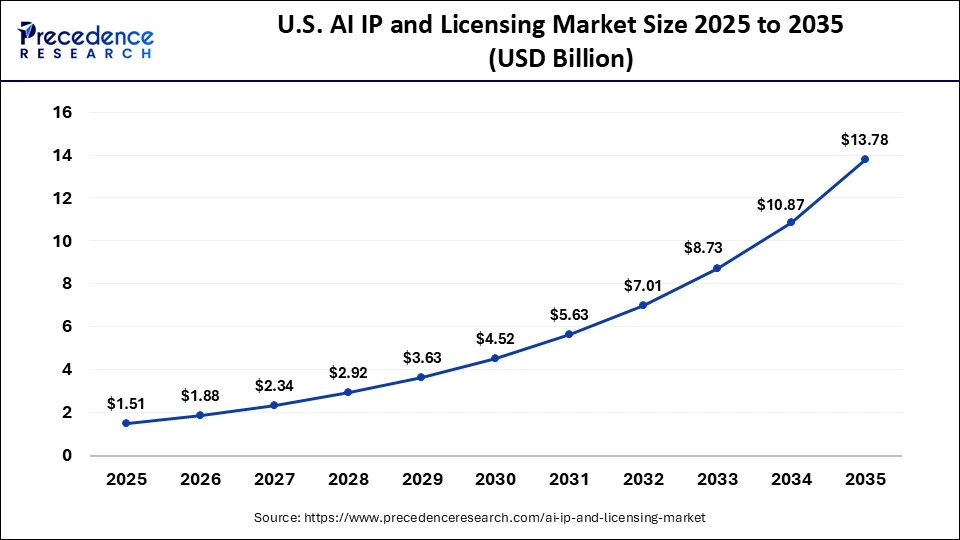
The U.S. AI IP and licensing market size is calculated at USD 1.51 billion in 2025 and is expected to reach nearly USD 13.78 billion in 2035, accelerating at a strong CAGR of 24.75% between 2026 and 2035.
U.S. AI IP and Licensing Market Analysis
The U.S. leads the market within North America, owing to the presence of a large number of AI technology leaders and increasing investments in AI research. The growth in proprietary model development and licensing systems is being seen in companies like Microsoft, Google, and IBM, among others, across industries. These factors are positioning the United States as a central hub for intellectual property creation and monetization.
What Makes Asia Pacific the Fastest-Growing Region in the AI IP and Licensing Market?
Asia Pacific held a 28% share of the market in 2025 and is expected to grow at the highest CAGR between 2026 and 2035. This growth is primarily driven by rapid expansion in semiconductor manufacturing, digital infrastructure development, and a thriving startup ecosystem focused on advanced technologies. Countries such as China, South Korea, and Japan are making significant investments in chip fabrication and intelligent computing systems. Additionally, the Korean Intellectual Property Office has reported a rise in patent filings related to advanced computing technologies in 2025, further indicating strong innovation activity.
China AI IP and Licensing Market Analysis
China is a major contributor to the market in Asia Pacific, supported by substantial investments in artificial intelligence and semiconductor manufacturing. The adoption of intelligent technologies is accelerating through government-backed initiatives focused on enterprise digitization, smart cities, and advanced digital services. Additionally, the rapid expansion of cloud infrastructure and data ecosystems is strengthening the commercialization of intellectual property, enabling broader deployment and monetization of AI-driven innovations across industries.
What Drives the AI IP and Licensing Market in Europe?
Europe held a 22% share of the market in 2025 and is estimated to grow at a robust CAGR over the projected period. This is mainly due to its well-established regulatory frameworks, strong industrial innovation, and a growing emphasis on the ethical development and deployment of intelligent technologies. The region is placing significant focus on the responsible use of AI through structured policies and compliance guidelines across various countries. Additionally, the prioritization of data privacy and robust data governance practices is further driving the adoption of AI IP licensing among businesses in Europe.
Germany AI IP and Licensing Market Analysis
In Germany, the market is driven by its strong industrial base and focus on advanced manufacturing technologies. The German Patent and Trade Mark Office reported an increase in patent applications related to AI in 2025, reflecting growing innovation in the field. Additionally, industries and research institutions in Germany are accelerating developments in robotics and smart manufacturing, further increasing the demand for AI intellectual property and licensing solutions across the industrial ecosystem.
AI IP and Licensing Market Companies
- Alphabet Inc. (Google DeepMind)
- ARM Holdings plc
- Cadence Design Systems, Inc.
- CEVA, Inc.
- Graphcore Ltd.
- IBM Corporation
- Imagination Technologies Group plc
- Intel Corporation
- Microsoft Corporation
- Mythic AI, Inc.
- NVIDIA Corporation
- Qualcomm Incorporated
- SambaNova Systems, Inc.
- Synopsys, Inc.
- Tenstorrent Inc.
Recent Developments
- In April 2026, BluWave-ai expanded its intellectual property strategy by launching a dedicated Partners IP and Patent Licensing unit following growth in its global patent portfolio. The company reported over 60 international filings and 14 granted or allowed patents, strengthening its global licensing capabilities.(Source: https://www.morningstar.com)
- In April 2026, Datavault AI Inc. secured USD750 million in tokenization contracts in Q1 2026, generating about USD77 million in fees across banking, IP licensing, and related services. These developments support its projected full-year 2026 revenue target of at least USD200 million.(Source: https://ir.datavaultsite.com)
- In March 2026, Panasonic Holdings Corporation launched global licensing for its AI-based visual inspection platform developed in Singapore to enhance infrastructure and industrial operations. This initiative marks its first global licensing effort for technologies originating from its Singapore R&D center.(Source: https://news.panasonic.com)
Segments Covered in the Report
By IP Type
- Processor IP (AI Accelerators, NPUs, GPUs)
- Memory IP for AI Workloads
- Interface & Connectivity IP (PCIe, CXL, High-speed Interconnects)
- AI Algorithm & Model Licensing (Foundation Models, CV/NLP Models)
By Deployment Model
- On-device AI IP Licensing (Edge AI, Embedded Systems)
- Cloud-based AI Model Licensing (API-based AI Services)
- Hybrid Licensing Models (Edge + Cloud Integration)
By Application
- Autonomous Vehicles
- Smart Consumer Electronics
- Data Centers & Cloud AI
- Healthcare AI Systems
- Industrial Automation & Robotics
- Financial Services & Risk Modeling
By End-Use Industry
- Semiconductor & Electronics
- Automotive
- Healthcare
- BFSI
- Manufacturing
- IT & Telecommunications
By Region
- North America
- Latin America
- Europe
- Asia-pacific
- Middle and East Africa
For inquiries regarding discounts, bulk purchases, or customization requests, please contact us at sales@precedenceresearch.com
Frequently Asked Questions
Tags





Ask For Sample
No cookie-cutter, only authentic analysis – take the 1st step to become a Precedence Research client
 Get a Sample




 sales@precedenceresearch.com
 Schedule a Meeting
