



U.S. Healthcare Cloud Computing Market Size, Companies, Share, Patient Volume, Treatment Adoption Rates, Pricing Analysis, Regulatory Landscape, Competitive Positioning, and Demand Forecast
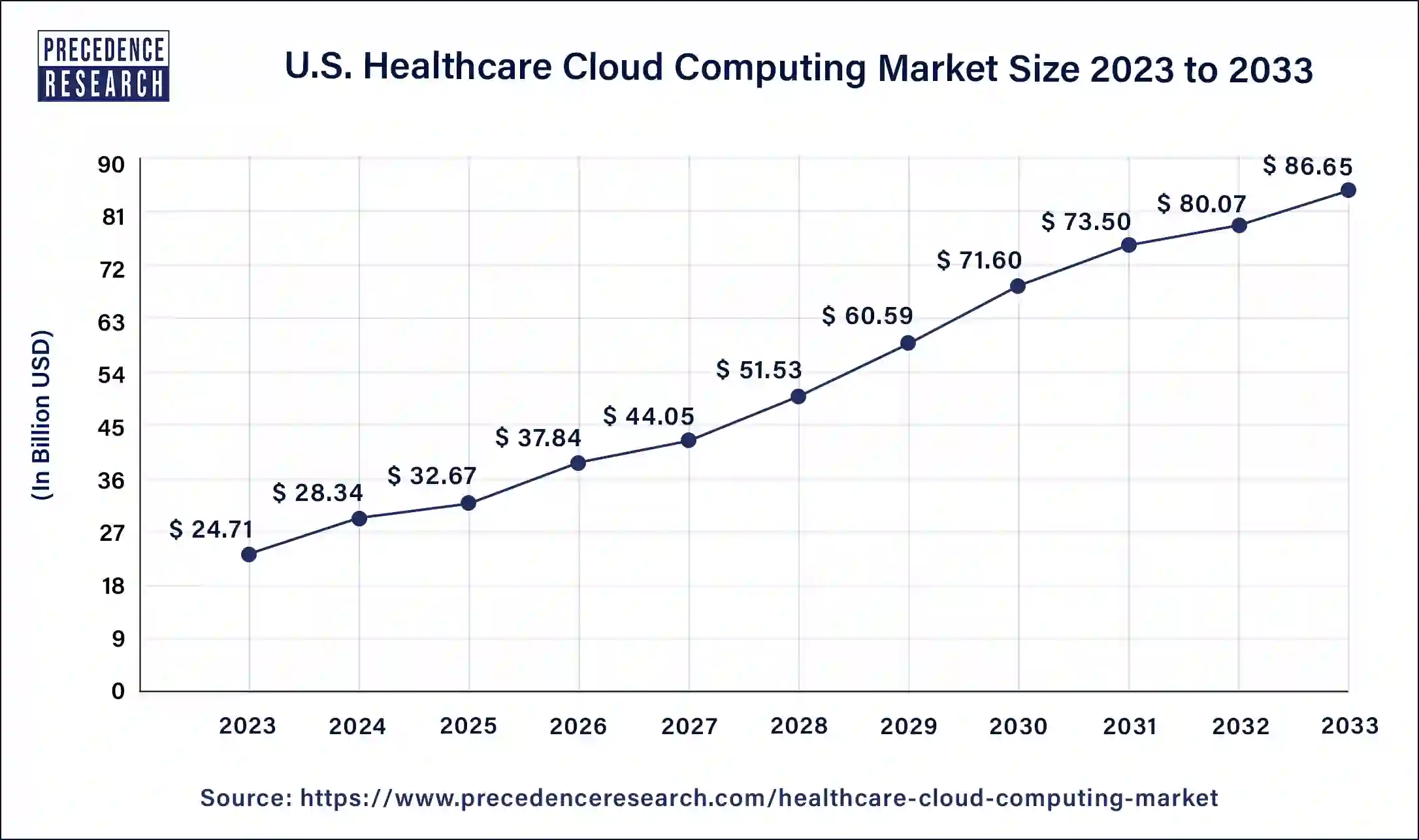
Rohan Patil, a Healthcare Industry Expert, highlights that the U.S. healthcare cloud computing market has reached USD 27.74 billion in 2026 and is on track to reach USD 117.90 billion by 2035, advancing at a CAGR of 17.46%. Key U.S. healthcare cloud computing market companies shaping the market include Amazon Web Services (AWS), Microsoft, Google, while major growth segments span By Product, By Application, By Service, By End Users.
Source: https://www.precedenceresearch.com/us-healthcare-cloud-computing-market
 Get a Sample
 Table Of Content


U.S. Healthcare Cloud Computing Market Size and Forecast 2026 to 2035
The U.S. healthcare cloud computing market size accounted for USD 23.58 billion in 2025 and is predicted to increase from USD 27.74 billion in 2026 to approximately USD 117.90 billion by 2035, expanding at a CAGR of 17.46% from 2026 to 2035. The market is witnessing substantial growth due to the rapid digital transformation in healthcare systems, increasing adoption of electronic health records (EHRs), rising demand for scalable data storage, and growing use of AI-enabled analytics to improve patient care, operational efficiency, and data security compliance.
Key Takeaways
- By product, the healthcare provider solutions segment led the market in 2025.
- By product, the healthcare payer solutions segment is expected to grow at a significant rate in the coming years.
- By deployment, the private cloud segment held a major market share in 2025.
- By deployment, the hybrid cloud segment is expected to expand at a notable CAGR from 2026 to 2035.
- By application, the non-clinical information systems segment contributed the highest market share in 2025.
- By application, the clinical information systems segment is expected to grow at a strong CAGR between 2026 and 2035.
- By services, the software as a service (SaaS) segment captured the highest market share in 2025.
- By services, the platform as a service (PaaS) segment is poised to grow at a healthy CAGR between 2026 and 2035.
- By end user, the healthcare providers segment generated the biggest market share in 2025.
- By end user, the healthcare payers segment is expected to expand at the fastest CAGR between 2026 and 2035.
Market Overview
The U.S. healthcare cloud computing market includes the provision of remote healthcare services, management of medical data, and deployment of software through internet-hosted servers. It allows healthcare facilities to store EHRs, analyze large datasets, and power telemedicine applications without the need for extensive on-site IT infrastructure. The market growth is driven by the increasing need to manage large volumes of healthcare data, the rapid adoption of telehealth services, and the necessity to reduce operational costs to enhance clinical decision-making and provide personalized patient care.
How is AI Transforming the U.S. Healthcare Cloud Computing Market?
Artificial intelligence (AI) is transforming this market by delivering the scalable computational power required to process vast datasets, automate workflows, and drive predictive analytics. AI automates routine administrative tasks, such as scheduling, claims processing, and supply chain management, reducing the burden on clinicians. It integrates seamlessly with IoT sensors and wearable technology to monitor patient vitals in real-time, predicting patient deterioration and enabling proactive interventions with summarized EHRs, improving diagnostic accuracy, and supporting clinical decisions.
Market Report Coverage and Key Metrics
| Report Coverage | Details |
| Market Size in 2025 | USD 23.58 Billion |
| Market Size in 2026 | USD 27.74 Billion |
| Market Size by 2035 | USD 117.90 Billion |
| Market Growth Rate from 2026 to 2035 | CAGR of 17.46% |
| Base Year | 2025 |
| Forecast Period | 2026 to 2035 |
| Segments Covered | Product, Deployment, Application, Service, and End User |
Market Dynamics
Drivers
The Shift Toward AI and Agentic Cloud Workflows
Next-generation cloud computing is transforming healthcare by enabling AI and machine learning workloads to run in secure, scalable environments without the high cost of on-premises infrastructure. This shift supports applications such as drug discovery, genomic analysis, and predictive diagnostics, improving speed and collaboration across healthcare systems. As a result, healthcare organizations are increasingly adopting flexible multi-cloud and AI-driven architectures to enable real-time, patient-centric care delivery.
Restraint
Regulatory Stringency and Cyber Vulnerability
Cloud computing adoption faces challenges due to a high incidence of data breaches, complex integration with legacy systems, and stringent regulatory compliance standards, such as HIPAA. Technology contends with obstacles, including intense intellectual property disputes concerning AI models, legal ambiguities regarding data sovereignty, and a shortage of skilled cloud-security personnel in healthcare, hindering digital commercialization.
Opportunity
Growth of Precision and Value-Based Care
Beyond basic data storage, cloud platforms present significant opportunities for advancing precision medicine and value-based care. By securely connecting disparate EHRs and Internet of Medical Things devices, cloud environments empower clinicians to leverage real-time data insights, leading to improved patient outcomes. Also, the push for Fast Healthcare Interoperability Resources (FHIR) and the integration of automated administrative agents create an ideal scenario for operational efficiency, addressing workforce shortages through AI automation.
How Are Government Initiatives Supporting the U.S. Healthcare Cloud Computing Market?
Federal mandates and interoperability initiatives support the market by enforcing policies that promote healthcare data interoperability. Initiatives such as the CMS Interoperability and Patient Access rules and the Trusted Exchange Framework and Common Agreement, spearheaded by the Office of the National Coordinator for Health Information Technology, drive providers to transition to interoperable cloud architectures. Regulatory frameworks and financial incentives under the Medicare and CHIP Reauthorization Act encourage hospitals to adopt cloud-based EHRs.
- For instance, the Centers for Medicare and Medicaid Services (CMS) advocate for seamless data exchange, which necessitates scalable and accessible cloud infrastructures provided by major vendors.
Market Segmentation Analysis
Product Insights
The healthcare provider solutions segment dominated the U.S. healthcare cloud computing market in 2025 due to the widespread adoption of electronic health records (EHR/EMR), telehealth platforms, and clinical information systems across hospitals and healthcare facilities. Increasing digitization of clinical workflows, regulatory requirements for patient data management, and the growing need for interoperable healthcare systems further strengthened demand for provider-focused cloud solutions.
The healthcare payer solutions segment is expected to grow at the fastest rate in the coming years, driven by rising adoption of cloud-based claims processing, fraud detection systems, and automated payment management platforms. Health insurers are increasingly leveraging cloud technologies to improve operational efficiency, reduce administrative costs, enhance data analytics capabilities, and support value-based care models.
Application Insights
The non-clinical information systems segment led the U.S. healthcare cloud computing market with a major share in 2025. This dominance is driven by strong adoption of cloud-based revenue cycle management (RCM), financial management, supply chain management (SCM), and billing and administrative solutions. Healthcare organizations are increasingly prioritizing operational efficiency and cost reduction, which is accelerating the shift toward cloud-enabled back-office automation. Additionally, growing demand for data-driven financial planning, interoperability, and streamlined administrative workflows has further strengthened the dominance of non-clinical cloud solutions.
The clinical information systems segment is expected to grow at the fastest rate during the forecast period. This is mainly due to increasing adoption of EHR/EMR platforms, telehealth solutions, and advanced diagnostic systems across healthcare facilities. Rising demand for real-time patient data access, improved care coordination, and interoperability between healthcare providers is accelerating cloud migration of clinical workflows.
Deployment Insights
The private cloud segment held the largest share of the market in 2025, primarily due to its provision of unparalleled data control and strict adherence to regulatory standards. Private clouds offer dedicated environments that mitigate the security risks associated with shared computing resources, facilitating compliance with audits and regulatory mandates. Dedicated infrastructure ensures predictable bandwidth and high uptime for continuous patient monitoring and life-critical hospital operations while securely managing protected health information.
The hybrid cloud segment is expected to grow at the fastest CAGR during the forecast period, as it optimally balances strict data security with high-performance scalability. Hybrid clouds allow providers to comply with rigorous privacy standards, such as HIPAA, by storing confidential patient information in secure on-premises environments and private data centers. By offloading non-core operations to cost-effective public clouds, healthcare facilities minimize the need for expensive hardware and reduce overall expenditure.
Services Insights
The software as a service (SaaS) segment dominated the U.S. healthcare cloud computing market in 2025. This is due to its low capital requirements, rapid remote deployment, and reduced dependence on internal IT infrastructure. SaaS models encompass most non-clinical software, including RCM, scheduling, and billing platforms. By utilizing cloud-delivered RCM, health systems significantly decreased payment realization times. SaaS also supports digital front doors for securely booking appointments, reviewing medical records, and consulting with doctors remotely.
The platform as a service (PaaS) segment is projected to expand at the fastest rate during the forecast period. This is due to the expansion of Integration PaaS and Database PaaS. The PaaS segment is instrumental in this growth as healthcare providers and IT teams use it to quickly build, deploy, and manage custom patient portals, telehealth platforms, and digital healthcare solutions. PaaS provides the necessary runtime environments and toolkits for the integration of Generative AI, ML, and analytics, ensuring regulatory compliance.
End-User Insights
The healthcare providers segment dominated the market in 2025, mainly due to their essential role in direct patient care, data generation, and rapid clinical digitization. Healthcare providers generate the largest volume of real-world patient data. Storing, managing, and securing millions of EHRs, high-resolution medical imaging files, and genomic datasets necessitate flexible, high-capacity storage. Providers are increasingly migrating their core ecosystems to SaaS platforms for healthcare applications to access real-time medical updates.
The healthcare payers segment is projected to grow at the fastest rate during the forecast period, largely due to the rising demand for automated claims processing, improved fraud detection, and population health management. Cloud platforms enable payers to automate and streamline manual processes, including insurance claims adjudication, member enrollment, and eligibility verification, with reduced administrative costs. The shift toward value-based care necessitates the management and tracking of high-risk, high-usage patient populations.
US Healthcare Cloud Computing Market: Country-Level Analysis
- Surging EHR and Telehealth Adoption: As virtual medicine grows, health systems are moving from legacy servers to elastic cloud networks. States such as California, New York, and Texas lead the nation in telemedicine and remote patient monitoring infrastructure.
- Business Expansions and AI Innovation: Market leaders such as Amazon Web Services, Microsoft Azure, and Google Cloud are continuously expanding their digital healthcare service offerings. Key tech hubs in Washington and Massachusetts are pioneering AI-enabled predictive analytics and genomics workloads in the cloud.
- Joint Ventures and Data Interoperability: Major medical and biotech companies are partnering with cloud providers to scale clinical trials. Pharmaceutical giants headquartered in New Jersey and Pennsylvania rely heavily on cloud solutions to address complex data interoperability challenges.
- Opening of New Hospitals: Hospital chains are investing heavily in network expansions. Emerging medical centers in rapidly growing states such as Florida and Arizona are using the cloud to manage massive influxes of patient data efficiently.
- Government Initiatives and Security Compliance: The U.S. government has launched major initiatives to strengthen the healthcare industry and advance unified digital health records. Healthcare IT providers in Virginia offer robust cloud security compliant with HIPAA and HITECH governance standards to protect patient information.
Competitive Landscape
The U.S. healthcare cloud computing market is highly consolidated, primarily led by Amazon Web Services, Microsoft Azure, and Google Cloud, which heavily focus on AI-driven diagnostics, big data analytics, and secure EHR management. Key players are driving market growth through infrastructure expansion to manage the surge in patient data. For instance, Google Cloud is enhancing its capabilities by incorporating ML into clinical decision-making tools to improve therapeutic efficacy.
Emerging providers like Cohere Health, CloudMedx, and Athelas are targeting future opportunities in telehealth and AI-driven diagnostics to facilitate rapid decision-making in remote patient care. However, these emerging players face significant barriers, including the high costs of establishing HIPAA-compliant infrastructures and strict regulatory constraints that limit data mobility and necessitate substantial security investments.
Top Companies in the US Healthcare Cloud Computing Market
- Amazon Web Services (AWS)
- Microsoft
- IBM
- Oracle
Recent Development US Healthcare Cloud Computing Market (2025-2026)
- In March 2025, GE HealthCare, a U.S.-based company, launched its Genesis portfolio, a cloud-based enterprise imaging SaaS suite. The solutions include edge computing, storage, vendor-neutral archive, and data migration capabilities. Designed to improve efficiency, streamline workflows, and optimize IT and capital resources, the platform supports enhanced precision in healthcare operations.
Segments Covered in the Report
By Product
- Healthcare Provider Solutions
- Clinical Information Systems
- EHR/EMR
- Telehealth Solutions
- PACS/VNA
- PHM Solutions
- LIS
- PIS
- RIS
- Non-clinical Information Systems
- RCM Solutions
- HIE Solutions
- Financial Management Solutions
- SCM Solutions
- Billings and Account Management Solutions
- Clinical Information Systems
- Healthcare Payer Solutions
- Claims Management Solutions
- Payment Management Solutions
- Provider Network Management Solutions
- Fraud Management Solutions
- CMR Solutions
By Deployment
- Public
- Private
- Hybrid
By Application
- Clinical Information System
- Telehealth Solutions
- Computerized Physician Order Entry
- Population Health Management (PHM) Solutions
- Electronic Medical Records
- Pharmacy Information System
- Radiology Information System
- Others
- Non-clinical Information System
- Revenue Cycle Management (RCM)
- Billing & Accounts Management Solutions
- Claims Management
- Others
By Service
- Platform as a service (Paas)
- Infrastructure as a service (Iaas)
- Software as a service (Saas)
By End Users
- Healthcare Providers
- Healthcare Payers
For inquiries regarding discounts, bulk purchases, or customization requests, please contact us at sales@precedenceresearch.com
Frequently Asked Questions





Ask For Sample
No cookie-cutter, only authentic analysis – take the 1st step to become a Precedence Research client
 Get a Sample




 sales@precedenceresearch.com
 Schedule a Meeting
