Automotive Blockchain Market Size, Share and Trends 2026 to 2035
Automotive Blockchain Market (By Provider: Middleware Providers, Infrastructure and Protocol Providers, Application and Solution Providers; By Application: Supply Chain Management, Smart Contracts, Vehicle Data Security, Mobility-as-a-Service (MaaS), Vehicle Financing and Leasing, Usage-based Insurance, Electric Vehicle (EV) Charging and Payments, Fleet Management; By Blockchain Type: Public Blockchain, Private Blockchain, Consortium Blockchain, Hybrid Blockchain; By Vehicle Type: Passenger Vehicles, Commercial Vehicles, Electric Vehicles (EVs), Autonomous Vehicles; By Deployment Mode: Cloud-based, On-premise; By End-User: Automotive OEMs, Fleet Operators, Insurance Companies, Mobility Service Providers, Automotive Dealers) - Global Industry Analysis, Size, Trends, Leading Companies, Regional Outlook, and Forecast 2026 to 2035
 Get a Sample
 Table Of Content


What is the Automotive Blockchain Market Size in 2026?
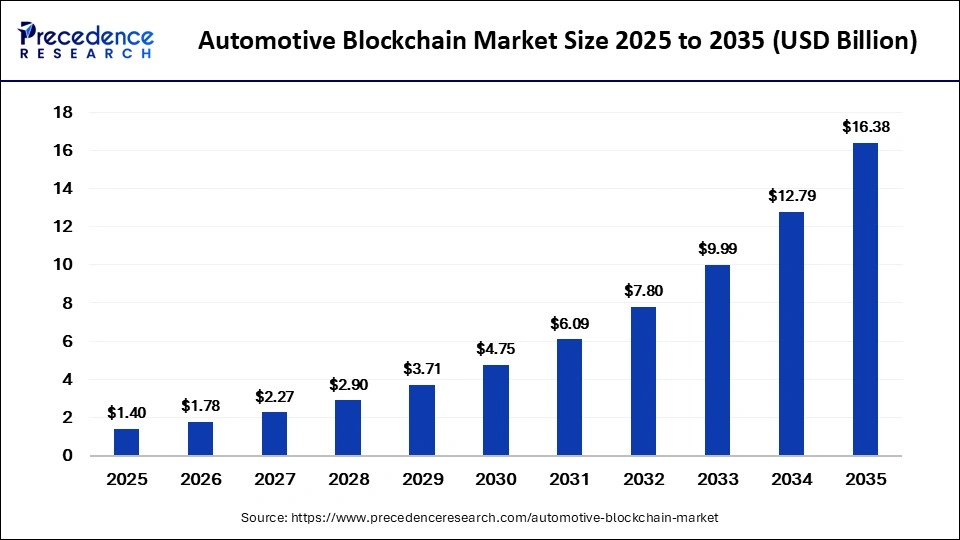
The global automotive blockchain market size was calculated at USD 1.40 billion in 2025 and is predicted to increase from USD 1.78 billion in 2026 to approximately USD 16.38 billion by 2035, expanding at a CAGR of 27.50% from 2026 to 2035. The market growth is attributed to expanding EV charging ecosystems, rising automotive cybersecurity investments, and growing adoption of decentralized mobility platforms
Key Takeaways
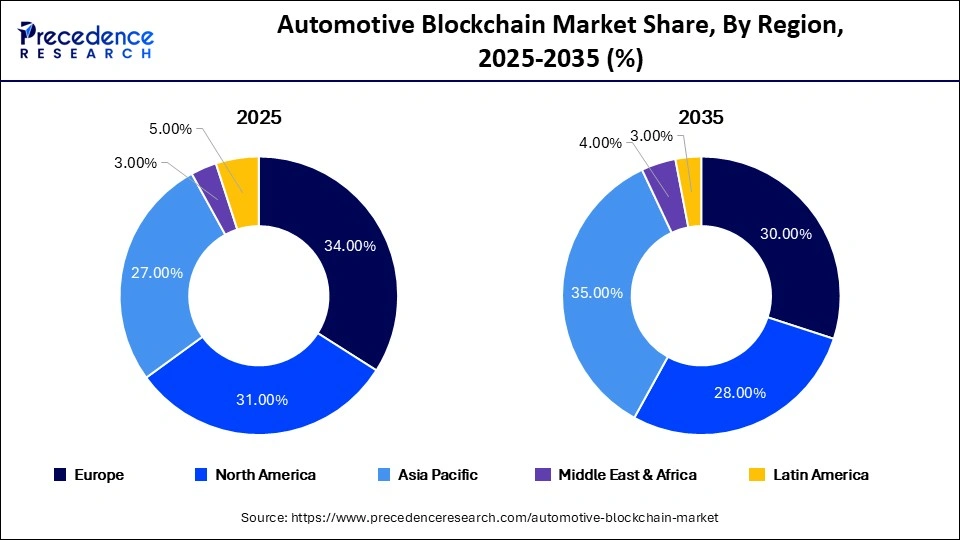
- Europe dominated the market with 34% of the automotive blockchain market share in 2025.
- Asia-Pacific held a market share of 27% in 2025 and is expected to register the fastest growth of 33.5% CAGR during 2026 and 2035.
- By provider, the application and solutions providers segment contributed the highest market share of 44% in 2025 and is expected to grow at the fastest CAGR of 31% during the forecast period.
- By provider, the infrastructure and protocol providers segment held a 32% share of the market in 2025 and is expected to grow at a significant CAGR of 25.5% between 2026 and 2035.
- By application, the supply chain management segment held a major market share of 24% in 2025.
- By application, the smart contracts segment held the second-largest automotive blockchain market share of 14% in 2025 and is expected to register a significant growth of 30.5% CAGR during 2026 and 2035.
- By blockchain type, the private blockchain segment contributed the highest market share of 38% in 2025.
- By blockchain type, the consortium blockchain segment contributed the second-largest market share of 30% in 2025 and is expected to grow at a CAGR of 31.5% over the projected period.
- By vehicle type, the passenger vehicles segment contributed the highest market share of 46% in 2025.
- By vehicle type, the commercial vehicles segment held 22% of the market share in 2025 and is expected to grow at a CAGR of 22% in the coming years.
Market Overview
Rising electric vehicle adoption and expanding connected mobility ecosystems are strongly driving growth in the automotive blockchain market globally. Vehicle identity, EV charging payments, battery tracking, mobility transactions, and automotive blockchain technology are solutions leveraging decentralized digital ledgers to safely handle all of these. The technology also enhances transparency, cybersecurity, and traceability throughout the automotive industry, its supply chains, and connected vehicle environments.
The IEA projects that EV sales surpassed 17 million vehicles globally in 2024, accounting for over 20% of worldwide vehicle sales. Other large industry initiatives, such as Mobility Open Blockchain Initiative (MOBI), are scaling their blockchain-enabled vehicle identity and connected mobility standards globally. Increase in SDV deployment, autonomous mobility testing programs, and investment in smart electric vehicle charging infrastructure remain driving long-term growth in the market globally.
Impact of Artificial Intelligence on the Automotive Blockchain Market
Artificial intelligence is significantly accelerating innovations and commercial adoption within the automotive blockchain industry by improving automation and real-time mobility intelligence. AI-enabled systems provide the analysis that delivers fraud detection and verification capabilities for transactions and enhances digital vehicle identity management within the automotive system. AI and blockchain are also making Automotive authentication faster, Predictive Maintenance, secure Vehicle-to-Everything (V2X) communications of Autonomous and Software-Defined Vehicles more possible.
Market Trends
Blockchain-Verified AI Training Data for Autonomous Vehicles
Connected cars will be more equipped with built-in wallets attached to the blockchain for toll payment, e-mobility subsidies, payments for parking, and e-mobility subscriptions. Automakers are making cars with independent transaction platforms that can process real-time, decentralized payments in the automobile sector. These connected payment ecosystems are growing rapidly across the world, with premium EV brands.
Growth Factors
- Increasing Adoption of Software-Defined Vehicles: Growing deployment of software centric automotive architectures is accelerating blockchain integration across connected mobility ecosystems.
- Rising Expansion of Vehicle-to-Everything (V2X) Networks: Increasing investments in intelligent transportation communication systems are boosting demand for decentralized automotive data exchange platforms.
Global Automakers Race Toward Blockchain-Powered Mobility Ecosystems
- In 2025 and 2026, Germany will become a major key player in the blockchain adoption of electric vehicle battery passports, facilitated by companies such as BMW Group, BASF, Siemens, CATL, and Henkel via Path.Now developed by the Era consortium for digital battery passport infrastructure for lifecycle traceability and regulatory compliance.
- In 2027, the OEMs in Europe have mandated that their EVs be equipped with battery passports, and in 2024, Volvo Cars was among the first OEMs worldwide to start deploying a blockchain-supported electric vehicle passenger.
- From 2024 to 2026, Toyota Blockchain Lab continued to develop blockchain-based vehicle transaction and mobility payment applications, facilitating secure peer-to-peer services for vehicles, such as automatic insurance verification and connected mobility infrastructure using smart vehicles.
Market Scope
| Report Coverage | Details |
| Market Size in 2025 | USD 1.40 Billion |
| Market Size in 2026 | USD 1.78 Billion |
| Market Size by 2035 | USD 16.38 Billion |
| Market Growth Rate from 2026 to 2035 | CAGR of 27.50% |
| Dominating Region | Europe |
| Fastest Growing Region | Asia Paific |
| Base Year | 2025 |
| Forecast Period | 2026 to 2035 |
| Segments Covered | Provider, Application, Blockchain Type, Vehicle Type, Deployment Mode, End-User, and Region |
| Regions Covered | North America, Europe, Asia-Pacific, Latin America, and Middle East & Africa |
Market Dynamics
Drivers
Increasing Demand for Secure Vehicle Data Management and Cybersecurity Solutions
Increasing cybersecurity concerns surrounding connected vehicles are anticipated to drive the automotive blockchain market globally. In the era of connected mobility, networks generate massive amounts of telematics, sensor, navigation, and driver behaviour data.
With the decentralized blockchain network, automotive manufacturers are trying to enhance vehicle identity verification and apply better software authentication. Furthermore, the growing adoption of smart contracts in mobility transactions is projected to strengthen market growth in the coming years.
Restraint
High Integration Costs and Complex Infrastructure Requirements
High deployment costs and complex integration requirements are expected to hamper the adoption of blockchain platforms across automotive ecosystems. Before companies can scale the implementation of their blockchain solutions.
Automotive manufacturers need to make substantial investments in the infrastructure that powers the cybersecurity systems, decentralized data network, and software-defined vehicle architectures. The increasing complexity of mobility ecosystems in various vendors is hampering the widespread adoption of their solutions in the emerging markets of the automotive industry.
Opportunity
Growing Adoption of Smart Contracts in Mobility Transactions
Growing integration of smart contract technologies into mobility ecosystems is projected to create immense market opportunities in the coming years. Vehicles have an increasing number of intelligent digital contracts that use blockchain to facilitate the automation of car rental, EV charging payments, toll collection, parking services, and mobility subscriptions.
Smart contract systems enhance trust, transparency, and reduce administrative inefficiencies between mobility providers and consumers of data. Furthermore, the mobility technology field is seeing companies such as Toyota Motor Corporation, Renault Group, and Ford Motor Company increasing their investments in blockchain-based mobility payment infrastructure and connected transaction ecosystems.
Segmental Insights
Provider Insights
The Application and Solution Providers Segment Dominated the Market with 44% of Market Share in 2025
The application & solution providers segment generated approximately USD 0.62 billion in 2025 and is projected to reach nearly USD 7.86 billion by 2035, growing at a CAGR of 31.0% during the forecast period. The application & solution providers segment dominated the automotive blockchain market with a share of 44% in 2025. Automotive organizations quickly started to put in place blockchain-based solutions for EV charging authentication, vehicle identity management, and battery life monitoring.
The number of blockchain platforms that have integrated with predictive maintenance, fleet management, and software-defined vehicle platforms has increased. The growing popularity of self-driving vehicles and connected vehicle services, particularly regarding the truck business model, boosted the demand for blockchain-based applications in the automotive industry on a massive scale.
Automotive Blockchain Market Share, By Provider, 2025-2035 (%)
| Provider | 2025 | 2035 | CAGR (%) |
| Middleware Providers | 24.00% | 22.00% | 24.00% |
| Infrastructure & Protocol Providers | 32.00% | 30.00% | 25.50% |
| Application & Solution Providers | 44.00% | 48.00% | 31.00% |
The infrastructure & protocol providers segment generated approximately USD 0.45 billion in 2025 and is expected to reach around USD 4.91 billion by 2035, expanding at a CAGR of 25.5%. The segment accounted for 32% of the market share in 2025 supported by growing investment by automotive firms in scalable blockchain infrastructure. This facilitates connected vehicle communication, mobility authentication, and decentralized EV charging.
Many infrastructure providers paid special attention to enhancing the transaction throughput, interoperability, and cybersecurity properties of high-volume automotive applications. The uptake of vehicle-to-everything communication systems significantly boosted the demand for safe decentralized automotive infrastructure.
The middleware providers segment generated approximately USD 0.34 billion in 2025 and is projected to reach nearly USD 3.60 billion by 2035, growing at a CAGR of 24.0%. The segment represented 24% of the market share in 2025, owing to the increasing deployment of multi-cloud mobility ecosystems and connected transportation platforms. Middleware software gets built into intelligent manufacturing and blockchain systems to enhance data flow synchronization and information insight.
Application Insights
The Supply Chain Management Segment Dominated the Market with 24% of Market Share in 2025
The supply chain management segment generated approximately USD 0.34 billion in 2025 and is projected to reach nearly USD 3.28 billion by 2035, growing at a CAGR of 22.0% during the forecast period. The segment dominated the automotive blockchain market with a share of 24% in 2025, driven by increasing regulatory focus on sustainability reporting and critical mineral traceability across EV production ecosystems. Automotive manufacturers quickly introduced a large number of decentralized traceability systems.
This enhances visibility over semiconductor sourcing, material sourcing for batteries, and from multi-tier suppliers. The Mobility Open Blockchain Initiative (MOBI) continued its efforts in collaboration with over 70 automotive and mobility participants during 2025, helping to establish a more solid ground for blockchain standardized usage in global vehicle supply chains.
The smart contracts segment generated approximately USD 0.20 billion in 2025 and is expected to reach around USD 2.62 billion by 2035, registering a CAGR of 30.5%. The segment accounted for 14% of the market share in 2025, due to its growing use in vehicle leasing, insurance automation, and settlement of EV charging. Blockchain smart contract deployment capabilities are growing within the connected car ecosystem, as seen in the range of companies such as IBM, Oracle, SAP, Accenture, and Consensys.
Automotive Blockchain Market Share, By Application, 2025-2035 (%)
| Application | 2025 | 2035 | CAGR (%) |
| Supply Chain Management | 24.00% | 20.00% | 22.00% |
| Smart Contracts | 14.00% | 16.00% | 30.50% |
| Vehicle Data Security | 18.00% | 17.00% | 25.00% |
| Mobility-as-a-Service (MaaS) | 12.00% | 14.00% | 32.00% |
| Vehicle Financing & Leasing | 10.00% | 9.00% | 23.50% |
| Usage-based Insurance | 8.00% | 9.00% | 29.00% |
| Electric Vehicle (EV) Charging & Payments | 8.00% | 11.00% | 38.50% |
| Fleet Management | 6.00% | 4.00% | 20.50% |
The vehicle data security segment generated approximately USD 0.25 billion in 2025 and is projected to reach nearly USD 2.78 billion by 2035, expanding at a CAGR of 25.0%. The segment represented 18% of the market share in 2025, owing to its increasing deployment of AI-powered connected transportation platforms and edge computing environments. Car manufacturers are increasingly using Blockchain-based encryption systems to secure navigation data, driver profiles, fleet analytics, and autonomous drive data.
The mobility-as-a-service (MaaS) segment generated approximately USD 0.17 billion in 2025 and is expected to reach around USD 2.29 billion by 2035, growing at a CAGR of 32.0%. The segment held 12% of the market share in 2025, as it increasingly integrates blockchain technologies into autonomous ride-hailing ecosystems and AI-driven transportation coordination systems. The market for decentralized mobility orchestration platforms started to grow at an accelerated pace as the use of shared electric mobility increased rapidly, and intelligent transportation was integrated.
The EV charging & payments segment generated approximately USD 0.11 billion in 2025 and is projected to reach nearly USD 1.80 billion by 2035, expanding at the fastest CAGR of 38.5%. The segment accounted for 8% of the market share in 2025. The segmental growth is attributed to the rapid expansion of EV charging infrastructure and the increasing demand for secure decentralized payment systems.
Blockchain Type Insights
Automotive Blockchain Market Share, By Blockchain Type, 2025-2035 (%)
| Blockchain Type | 2025 | 2035 | CAGR (%) |
| Public Blockchain | 18.00% | 16.00% | 23.00% |
| Private Blockchain | 38.00% | 34.00% | 24.80% |
| Consortium Blockchain | 30.00% | 34.00% | 31.50% |
| Hybrid Blockchain | 14.00% | 16.00% | 33.00% |
The Private Blockchain Segment Dominated the Market with 38% of Market Share in 2025
The private blockchain segment generated approximately USD 0.53 billion in 2025 and is projected to reach nearly USD 5.57 billion by 2035, growing at a CAGR of 24.8%. The segment dominated the automotive blockchain market with a share of 38% in 2025, due to growing cybersecurity concerns and the greater need for controlled blockchain governance. The increasing emphasis of automotive original equipment manufacturers (OEMs) on building private blockchain environments to enhance connectivity for cybersecurity within enterprise-class connected mobility infrastructure sustained such focus.
The consortium blockchain segment generated approximately USD 0.42 billion in 2025 and is expected to reach around USD 5.57 billion by 2035, expanding at a CAGR of 31.5%. The segment accounted for 30% of the market share in 2025, driven by the high number of automotive companies that began using consortium blockchains to boost interoperability and data ownership. Cross-industry transportation ecosystems have increasingly strengthened investment across consortium blockchain infrastructure during recent years.
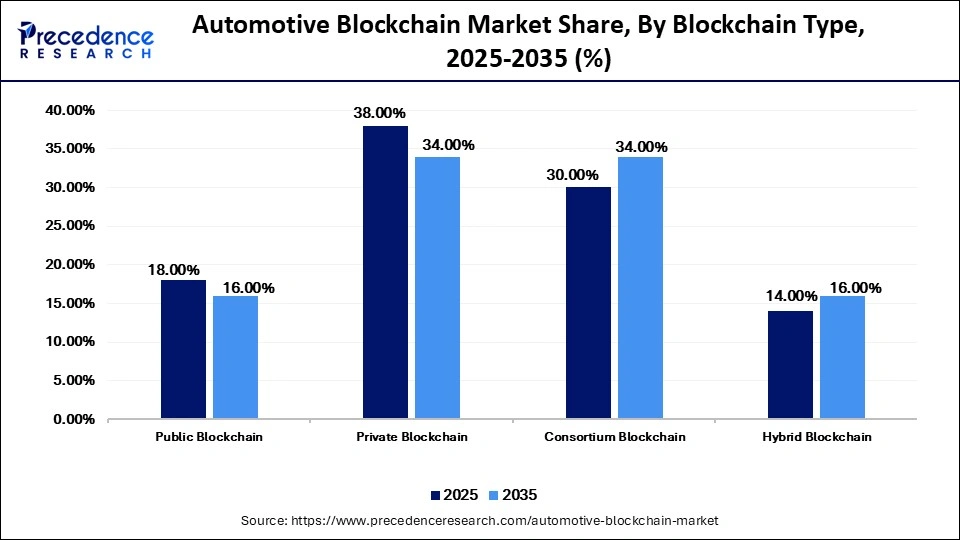
The public blockchain segment generated approximately USD 0.25 billion in 2025 and is projected to reach nearly USD 2.62 billion by 2035, growing at a CAGR of 23.0%. The segment represented 18% of the market share in 2025, owing to the increase in decentralized automotive transactions and peer-to-peer mobility services. OEMs are increasingly using public blockchain integration for their EV charging settlement systems, decentralized ride-sharing programmes, and tokenized payment mobility.
The hybrid blockchain segment generated approximately USD 0.20 billion in 2025 and is expected to reach around USD 2.62 billion by 2035, registering a CAGR of 33.0%. The segment held 14% of the market share in 2025, supported by rising demand for scalable and interoperable mobility ecosystems and hybrid blockchain infrastructure. A hybrid structure of public-facing blockchain with private enterprise security was adopted by various automotive companies across the intelligent transportation infrastructure.
Vehicle Type Insights
Automotive Blockchain Market Share, By Vehicle Type, 2025-2035 (%)
| Vehicle Type | 2025 | 2035 | CAGR (%) |
| Passenger Vehicles | 46.00% | 42.00% | 24.50% |
| Commercial Vehicles | 22.00% | 20.00% | 22.00% |
| Electric Vehicles (EVs) | 20.00% | 26.00% | 36.50% |
| Autonomous Vehicles | 12.00% | 12.00% | 31.00% |
The Passenger Vehicles Segment Dominated the Market with 46% of Market Share in 2025
The passenger vehicles segment generated approximately USD 0.64 billion in 2025 and is projected to reach nearly USD 6.88 billion by 2035, growing at a CAGR of 24.5% during the forecast period. The passenger vehicles segment dominated the automotive blockchain market with a share of 46% in 2025, as automotive manufacturers have quickly scaled the deployment of blockchain-powered infotainment ecosystems.
In 2025, worldwide car production of passenger cars grew to more than 67 million vehicles, boosting the need for a secure digital car identity and decentralized car authentication and logon systems, said the European Automobile Manufacturers Association (EAMA). Smart city transportation systems also enhanced coordination for the passengers' mobility with blockchain and the global linkage of the Parking Authentication Infrastructure.
The commercial vehicles segment generated approximately USD 0.31 billion in 2025 and is expected to reach around USD 3.28 billion by 2035, expanding at a CAGR of 22.0%. The segment accounted for 22% of the market share in 2025, driven by increasing digitization across global logistics ecosystems and rising demand for connected fleet management.
Companies like Daimler Truck, Volvo Trucks, and Tata Motors enhanced blockchain-based fleet management systems with secure maintenance monitoring and optimization of connected logistics. There was also a growing number of deployments of decentralized tracking and authentication technologies for cargo flows along international transportation corridors.
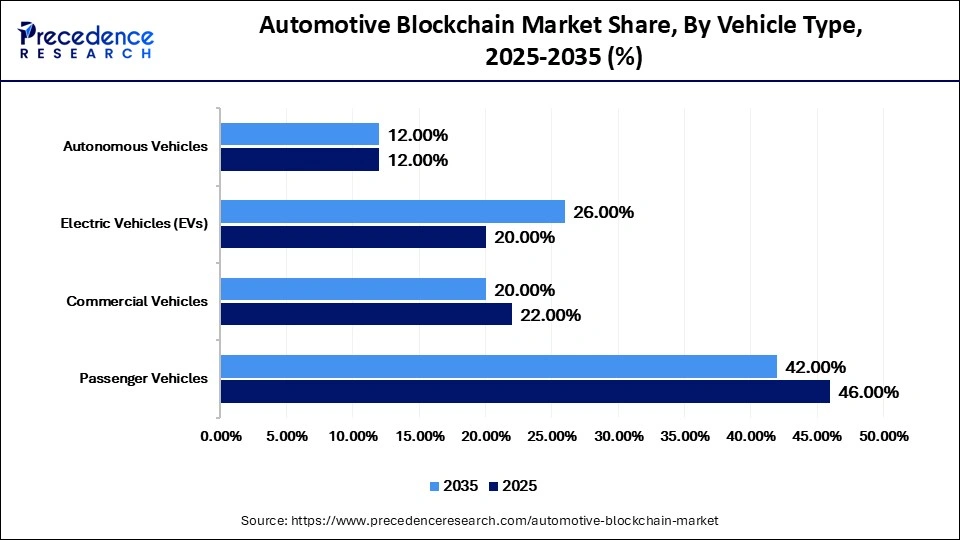
The electric vehicles (EVs) segment generated approximately USD 0.28 billion in 2025 and is projected to reach nearly USD 4.26 billion by 2035, registering the fastest CAGR of 36.5%. The segment represented 20% of the market share in 2025, owing to the rapid expansion of intelligent charging infrastructure and connected electric mobility services. In 2025, global EVA sales reached over 20 million vehicles which highlighted the growing need for charging coordination and battery tracking systems that utilize blockchain technology, according to IEA. Carbon tracking and recycled battery material verification systems using blockchain also took off in growing EV value chains within the automotive sector.
The autonomous vehicles segment generated approximately USD 0.17 billion in 2025 and is expected to reach around USD 1.97 billion by 2035, growing at a CAGR of 31.0%. The segment held 12% of the market share in 2025, due to continued expansion of blockchain integration across connected autonomous mobility ecosystems. Autonomous transportation developers tended to use decentralized communication systems.
This enables secure vehicle-to-vehicle coordination, encrypted telemetry exchange, and tamper-resistant mobility authentication infrastructure. Waymo had more than 14 million passenger trips powered by fully autonomous driving systems in 2025, raising more demand for safe blockchain-enabled mobility coordination systems.
Regional Insights
Europe Automotive Blockchain Market Size and Growth 2026 to 2035
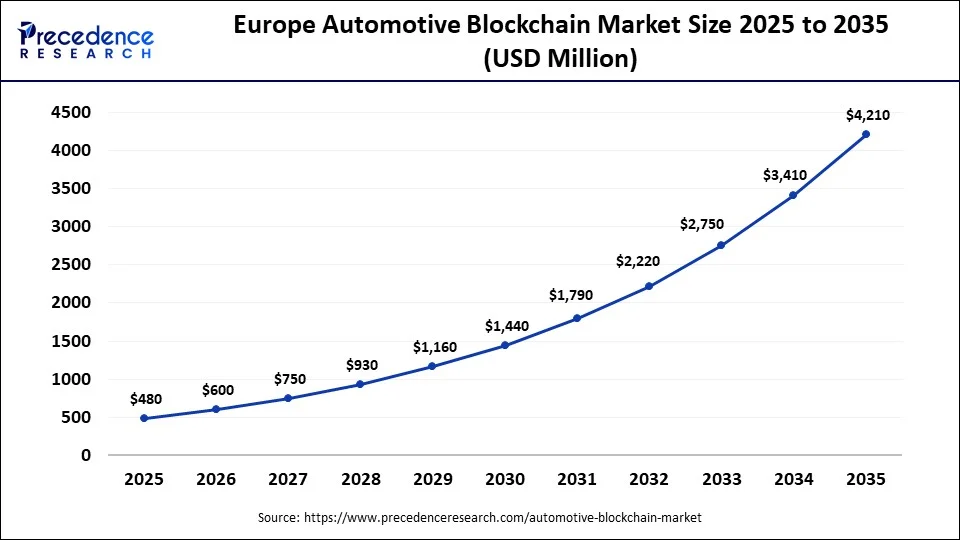
The Europe automotive blockchain market size was exhibited at USD 480 million in 2025 and is projected to be worth around USD 4,210 million by 2035, growing at a CAGR of 24.25% from 2026 to 2035.
Europe Dominated the Market with a 34% Share in 2025
Europe registered dominance in the automotive blockchain market by holding a major share of 34% in 2025. This is due to the presence of advanced automotive engineering networks and highly digitalized manufacturing environments. Germany, France, and the Netherlands actively pioneered the application of blockchain for EV battery traceability and vehicle lifecycle authentication.
The European Union Battery Regulation also helped speed up the introduction of blockchain and the adoption of battery passports and sustainability tracking systems in the EV supply chain. The expansion of local innovation capacity in mobility ecosystems was fostered by strengthening partnerships between automotive OEMs, cloud infrastructure companies, and blockchain software companies.
Germany Emerging as Europe's Strongest Automotive Blockchain Innovation Hub
Germany leads the market due to its dominant role in blockchain innovations for the European automotive industry, with intense investments in connected mobility and digital vehicle ecosystems. The country's EV charging infrastructure was made up of 161,150 publicly available charging stations as of 2025.
This is prompting a surge in the demand for blockchain authentication of charging stations and blockchain-based decentralized energy settlement systems. Furthermore, the increasing use of industrial AI, connected factories with 5G and digital twin technologies, continues to reinforce blockchain applications in the automotive value chain in Germany.
North America: The Second-Largest Market
North America is considered the second-largest market for automotive blockchain, holding a 31% share in 2025 and is expected to grow at a 25.8% CAGR between 2026 and 2035, driven by its strong grip within the connected mobility and automotive cybersecurity solutions value chain. Automotive OEMs in the region are partnering with the major cloud computing service providers and enterprise blockchain developers to rapidly realize their digital mobility transformation projects.
U.S. Continues Expanding Automotive Blockchain Infrastructure in North America
In the U.S., the market is witnessing strong growth driven by increasing investments in autonomous mobility, cybersecurity, and connected transportation technologies. Expanding venture capital funding and rapid development of enterprise cloud infrastructure, particularly for blockchain applications, are further accelerating innovation across the mobility ecosystem. These advancements are enabling the evolution of electric and autonomous vehicle solutions, including autonomous driving systems and vehicle data monetization platforms, thereby strengthening the overall mobility and transportation technology landscape.
Which Factors Drive the Automotive Blockchain Market in Asia-Pacific?
Asia-Pacific held a 27% market share in 2025 and is expected to host the fastest-growing market with a CAGR of 33.5% in the coming years, supported by automotive semiconductor production, EV manufacturing, and intelligent logistics infrastructure linked with blockchain-powered traceability systems.
China, Japan, South Korea, and India are aggressively pushing their blockchain solutions into the area of connected vehicle systems, EV battery systems, and intelligent transportation systems. Furthermore, the region is witnessing rapid urbanisation and smart city expansion in line with decentralized transportation and mobility authentication platform demands.
China Accelerating Automotive Blockchain Deployment Across Asia Pacific
China is a major contributor to the market due to expanding EV ecosystems, intelligent transportation infrastructure, and software-defined vehicle manufacturing. In 2025, sales of electric vehicles in the country increased to more than 11,863,700 vehicles, representing almost 60% of the world market. Automotive giants such as BYD, NIO, XPENG, Li Auto, and CATL are incorporating blockchain solutions into battery swapping solutions, connected mobility solutions, and EV lifecycle management infrastructure
What Factors Influence the Automotive Blockchain Market in Latin America?
Latin America held a 5% share of the market in 2025 and is expected to grow at a 21.5% CAGR in the coming years, influenced by the increasing adoption of digital technologies in the automotive sector and rising penetration of smart and connected vehicles across the region. Automotive manufacturers and mobility service providers are increasingly leveraging blockchain technology to enhance supply chain transparency, enable secure digital transactions, and strengthen cybersecurity within connected mobility ecosystems.
Brazil Market Trends
Brazil is emerging as a key contributor to the Latin American market, supported by rising investments in digital transformation across the automotive industry and rapid advancements in connected mobility technologies. The adoption of blockchain solutions is accelerating as automakers aim to improve supply chain traceability and operational transparency. Additionally, the growing presence of electric vehicles (EVs) and smart mobility solutions is boosting demand for blockchain-enabled payment systems and charging infrastructure management platforms.
How is the Opportunistic Rise of the Middle East & Africa in the Automotive Blockchain Market?
The Middle East & Africa held a 3% market share in 2025 and is expected to grow at a 26% CAGR in the upcoming years. This growth is fueled by significant investments in smart mobility infrastructure, digital transformation initiatives, and the development of smart cities across the region. Automakers are increasingly exploring blockchain applications to enhance vehicle cybersecurity, improve supply chain tracking, and deliver faster and more secure digital mobility experiences.
Saudi Arabia Market Trends
Saudi Arabia is witnessing strong growth due to rising investments in smart mobility projects and infrastructure automation. The country's focus on expanding electric vehicle adoption, connected transportation systems, and advanced logistics networks is creating a favorable environment for blockchain integration. As a result, automotive stakeholders and technology providers are increasingly adopting blockchain solutions to ensure secure vehicle data management and improved supply chain visibility.
Automotive Blockchain Market Value Chain Analysis
- Blockchain Infrastructure Development
The foundation of automotive blockchain ecosystems lies in the development of decentralized ledger protocols, cloud infrastructure, and secure node management systems for mobility applications.
Key Players: IBM, Microsoft, Amazon Web Services, Oracle.
- Middleware & Integration Services
Blockchain middleware platforms integrate automotive systems, connected vehicle networks, telematics platforms, and enterprise mobility applications through APIs and interoperability frameworks.
Key Players: Accenture, Infosys, Tech Mahindra, TCS.
- Vehicle & Mobility Platform Integration
Automotive OEMs integrate blockchain technologies into connected vehicles, autonomous mobility systems, EV ecosystems, and software-defined vehicle architectures.
Key Players: BMW Group, Mercedes-Benz Group, Toyota Motor Corporation, Tesla.
- Data Security & Compliance Management
Automotive enterprises deploy blockchain frameworks for cybersecurity, vehicle authentication, regulatory compliance, and secure automotive data exchange across connected ecosystems.
Key Players: Qualcomm, NVIDIA, BlackBerry QNX, Bosch
Competitive Landscape
The automotive blockchain technology market is moderately competitive and rapidly evolving, with a mix of global technology providers, automotive OEMs, and emerging blockchain startups competing to build secure and scalable mobility ecosystems. Leading players such as IBM, Microsoft, Oracle, Toyota Motor Corporation, and Mercedes-Benz Group are strengthening their positions through blockchain-enabled mobility platforms, connected vehicle solutions, and enterprise-grade digital infrastructure. These companies are increasingly focusing on partnerships, ecosystem development, and long-term infrastructure deployments to enhance scalability, interoperability, and global adoption of blockchain in automotive applications.
Competition in the market is being shaped by rapid technological convergence, particularly the integration of artificial intelligence, IoT connectivity, smart contracts, decentralized identity systems, and cloud-based blockchain platforms. Key players are investing heavily in solutions that support vehicle financing, EV charging infrastructure, autonomous mobility, and connected vehicle data management. As the ecosystem matures, differentiation is increasingly driven by cybersecurity strength, data transparency capabilities, and the ability to deliver secure, real-time, and interoperable mobility solutions across complex automotive networks.
Automotive Blockchain Market Companies
- IBM Corporation
- Microsoft Corporation
- Oracle Corporation
- Amazon Web Services (AWS)
- SAP SE
- Accenture plc
- BigchainDB GmbH
- Bitfury Group Limited
- XAIN AG
- ConsenSys Software Inc.
- ShiftMobility Inc.
- Helbiz Inc.
- Toyota Motor Corporation
- BMW Group
- Mercedes-Benz Group AG
Recent Developments
- In April 2026, Lotus Cars announced plans at the Hong Kong Web3 Festival to integrate AI and blockchain technologies across connected mobility, personalized driving, and automotive supply chain ecosystems. The company strengthened its focus on decentralized digital infrastructure, positioning blockchain-enabled mobility platforms as a core part of future automotive innovation strategies.(Source: https://cryptonews.net)
- In April 2026, Karma Automotive showcased its Kaveya supercar at the Hong Kong Web3 Festival while highlighting the growing influence of blockchain and digital asset ecosystems across luxury automotive markets. The company emphasized rising consumer engagement with tokenized value systems and blockchain-powered collectability models amid the expanding global digital asset economy. (Source: https://www.prnewswire.com)
Segments Covered in the Report
By Provider
- Middleware Providers
- Infrastructure and Protocol Providers
- Application and Solution Providers
By Application
- Supply Chain Management
- Smart Contracts
- Vehicle Data Security
- Mobility-as-a-Service (MaaS)
- Vehicle Financing and Leasing
- Usage-based Insurance
- Electric Vehicle (EV) Charging and Payments
- Fleet Management
By Blockchain Type
- Public Blockchain
- Private Blockchain
- Consortium Blockchain
- Hybrid Blockchain
By Vehicle Type
- Passenger Vehicles
- Commercial Vehicles
- Electric Vehicles (EVs)
- Autonomous Vehicles
By Deployment Mode
- Cloud-based
- On-premise
By End-user
- Automotive OEMs
- Fleet Operators
- Insurance Companies
- Mobility Service Providers
- Automotive Dealers
By Region
- North America
- Latin America
- Europe
- Asia-pacific
- Middle and East Africa
For inquiries regarding discounts, bulk purchases, or customization requests, please contact us at sales@precedenceresearch.com
Frequently Asked Questions





Ask For Sample
No cookie-cutter, only authentic analysis – take the 1st step to become a Precedence Research client



 sales@precedenceresearch.com
 +1 804-441-9344
 Schedule a Meeting